
Key takeaways:
Finding the right agency financial reporting software can mean the difference between scaling profitably and bleeding money on every project. According to a recent Gartner survey, nearly 65% of professional services firms cite financial visibility as their top operational challenge. For agencies juggling dozens of clients, variable scopes, and mixed billing models, real-time financial data isn't a luxury — it's a survival mechanism. The best real-time agency financial reporting software gives leadership instant access to profitability metrics, cash flow forecasts, and project-level margins without waiting for month-end closes or manual spreadsheet reconciliation.
This article breaks down what to look for, why real-time matters, and which platforms deliver genuine financial intelligence for agencies of all sizes.
The Current Challenge: Why Agencies Struggle with Financial Reporting
Most agencies were not built by accountants. They were built by creatives, strategists, and client-service professionals who happen to need financial discipline to stay in business. The result? Financial reporting often becomes an afterthought — something cobbled together in spreadsheets long after the damage has been done.
The numbers tell a stark story. A McKinsey analysis found that companies with real-time financial analytics are 23% more likely to outperform their peers on profitability. Yet many agencies still rely on end-of-month reports that arrive weeks after decisions needed to be made. By the time a project manager realizes a campaign has exceeded budget, the overspend has already eroded margins.
Several core issues drive this problem. First, agency revenue is inherently complex. Retainers, project-based fees, hourly billing, and media pass-throughs create a patchwork of income streams that generic accounting software can't easily parse. Second, resource utilization directly impacts profitability, with top-performing agencies maintaining billable utilization rates above 75%, yet many firms lack the tools to monitor utilization in real time.
Then there's the problem of disconnected systems. Time tracking lives in one tool, invoicing in another, and project budgets in a spreadsheet. As one Ravetree blog explains, agencies that fail to integrate their financial and operational data often experience significant profit leakage across projects. Without a unified view, leadership is flying blind.
The cost of poor financial visibility compounds over time. A PwC study on finance function effectiveness found that organizations with fragmented financial systems spend up to 40% more time on manual data gathering than those with integrated platforms. For agencies, that wasted time could be spent on billable client work instead.
What Real-Time Agency Financial Reporting Software Should Actually Do
Not every tool that calls itself "financial reporting" software delivers what agencies need. Before evaluating platforms, it helps to establish clear criteria for what a genuine real-time financial reporting solution must include.
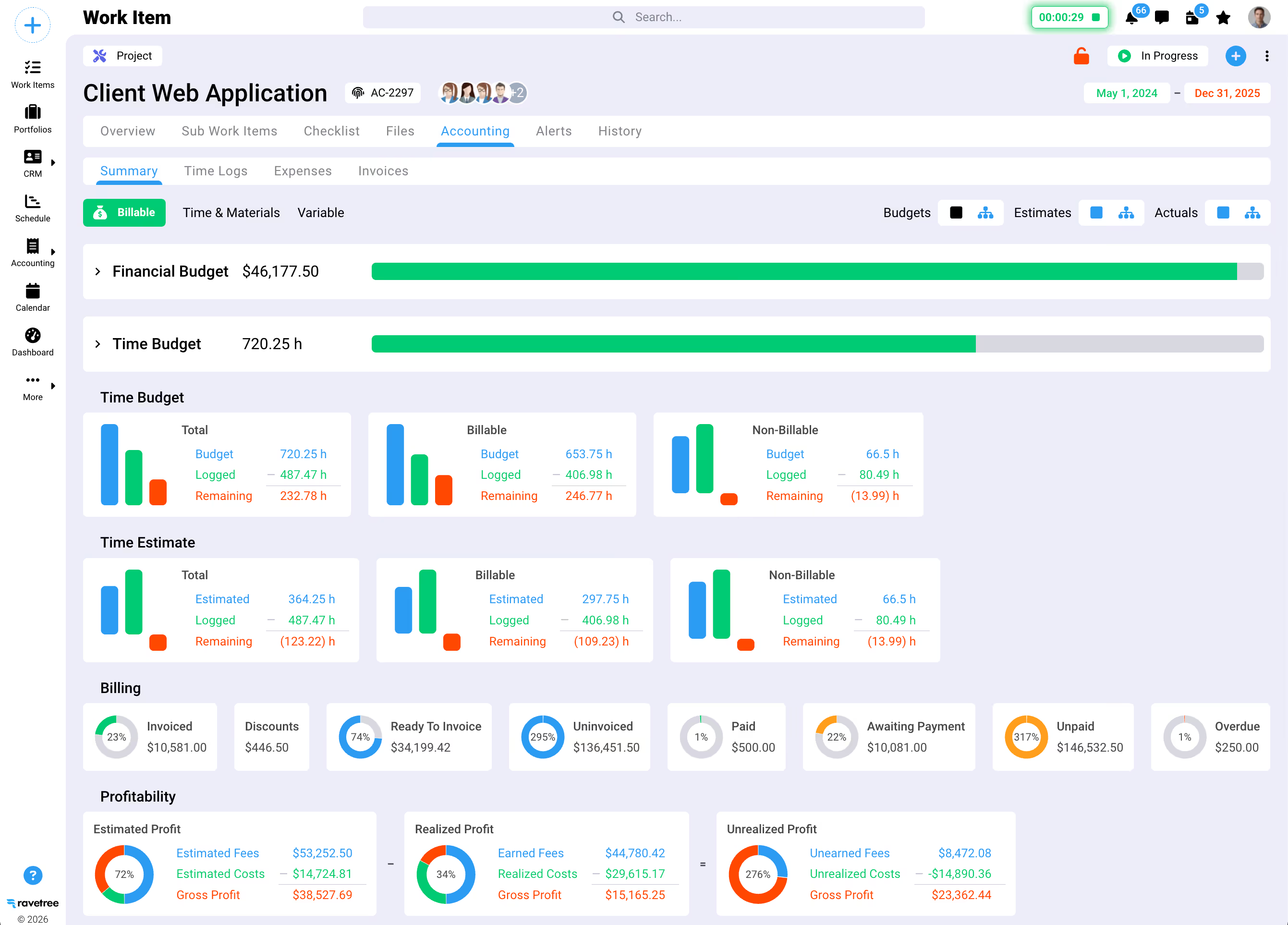
Live project profitability tracking. You need to see, right now, whether each project is profitable. That means the software must pull in time entries, expenses, vendor costs, and contracted revenue to calculate margins as work happens — not after invoices go out.
Cash flow forecasting. Revenue recognition and cash collection are different animals, especially for agencies. Work management software that includes forward-looking cash flow views helps CFOs and agency owners anticipate shortfalls before they become crises.
Multi-entity and multi-currency support. Agencies serving global clients or operating across regions need reporting that handles currency conversion, intercompany billing, and consolidated financials seamlessly.
Role-based dashboards. A CEO needs a different financial view than a project manager. The best financial reporting platform for agencies provides configurable dashboards that surface the right metrics for each stakeholder. As covered in a detailed Ravetree analysis, CFOs can drive measurable business value by consolidating financial, project, and resource data into a single platform rather than managing multiple disconnected tools.
Integration with accounting systems. Financial reporting software for agencies should sync with QuickBooks, Xero, or your ERP without requiring manual CSV exports. A Sage research report found that 82% of mid-size businesses consider accounting software integration a critical factor when selecting operational tools.
Automated revenue recognition. For agencies billing on retainers or milestone-based contracts, proper revenue recognition matters for both compliance and accurate profitability analysis.
The Strategic Framework: Evaluating Agency Financial Reporting Platforms
Choosing the right agency financial reporting software requires looking beyond feature checklists. Here's a framework for making the right decision.
1. Start with Your Billing Model
Your billing model determines which financial features matter most. Hourly shops need robust billing integration with time tracking. Retainer-based agencies need recurring revenue tracking and scope management. Project-fee shops need milestone tracking and earned-value analysis.
The mistake most agencies make is choosing software built for a billing model they don't use. A tool designed for hourly consulting firms will frustrate an agency that primarily bills fixed-fee projects.
2. Prioritize Unified Data Over Best-of-Breed
The allure of "best-of-breed" tools — one for time tracking, one for project management, one for invoicing — creates the exact fragmentation problem that undermines financial visibility. A Deloitte report on digital transformation in finance emphasized that unified data platforms reduce reporting cycle times by an average of 30% compared to multi-tool environments.
Ravetree takes this unified approach seriously, combining project management, resource planning, time tracking, billing, CRM, and client portal capabilities into a single platform. This eliminates the data silos that make real-time financial reporting impossible.
3. Demand Real-Time, Not "Near-Time"
Many tools claim real-time reporting but actually refresh data on daily or weekly cycles. True real-time reporting tools update dashboards the moment a time entry is logged, an expense is recorded, or an invoice is sent. Ask vendors specifically about data refresh intervals during your evaluation.
4. Assess Scalability Against Your Growth Plan
An agency billing $2 million annually has different reporting needs than one billing $20 million. Your financial reporting platform should handle increasing complexity — more clients, more team members, more entities — without requiring a platform migration in two years.
Implementation Tactics: Making Real-Time Financial Reporting Work
Having the right software is only half the equation. Here are specific tactics for agencies implementing real-time financial reporting.
Establish a Single Source of Financial Truth
The biggest implementation mistake is running the new system alongside old spreadsheets "just in case." This creates duplicate data, conflicting numbers, and erodes trust in the new platform. Set a hard cutover date and commit to it.
Effective financial management for agencies requires disciplined budgeting processes and consistent cash flow monitoring practices across the entire organization. That discipline starts with trusting your reporting tool as the single source of truth.
Configure Alerts and Thresholds
Real-time data is only valuable if someone acts on it. Configure automated alerts for key triggers: projects exceeding 80% of budget, utilization dropping below target, or invoices aging past 45 days. Harvard Business Review research on management reporting found that organizations using automated threshold alerts respond to financial deviations 60% faster than those relying on periodic review.
Standardize Time Entry Practices
Financial reporting accuracy depends entirely on the quality of input data. If team members log time weekly rather than daily, your "real-time" reports will be anything but. Enforce daily time entry with clear categorization standards.
A Bureau of Labor Statistics analysis showed that service sector businesses lose an estimated 5-8% of potential revenue through inaccurate or delayed time recording. For a $5 million agency, that's up to $400,000 in invisible revenue leakage.
Train Every Stakeholder on Their Dashboard
Don't just train the finance team. Project managers, account directors, and department leads all need to understand the financial dashboards relevant to their roles. When everyone reads from the same financial playbook, decisions improve across the board.
Build Financial Literacy Across Your Agency
One of the most overlooked aspects of implementing real-time financial reporting tools is building financial literacy beyond the finance team. Project managers who understand gross margin can make better scoping decisions. Account directors who understand revenue recognition can set clearer client expectations around billing timelines.
Consider hosting quarterly "financial fluency" sessions where you walk the broader team through the agency's financial performance using the reporting dashboards. This transparency builds accountability and helps everyone understand how their daily decisions — from how they scope work to how quickly they log time — directly impact the agency's bottom line.
Run Monthly Financial Reviews Using Live Data
Replace static PowerPoint decks with live dashboard reviews. Pull up actual project margins, utilization rates, and cash flow projections during leadership meetings. This builds organizational confidence in the data and surfaces issues that might otherwise be buried in a static report.
Connect Financial Data to Client Strategy
The most sophisticated agencies use their financial reporting not just for internal management, but to inform client strategy. When you can see which clients generate the highest margins and which consistently result in scope creep, you can make better decisions about pricing, staffing, and even which types of work to pursue. Your reporting platform should make it easy to slice financial data by client, service line, and team to support these strategic conversations.
Measuring Success: KPIs That Matter for Agency Financial Health
Once your agency financial reporting software is running, focus on these metrics to gauge performance.
Project margin by client and engagement type. Break down profitability not just at the project level, but by client relationship and engagement type (retainer vs. project vs. hourly). Agencies that maximized profitability consistently tracked margins at granular levels, identifying which client relationships and service lines delivered the strongest returns.
Revenue per employee. This benchmark normalizes financial performance across agency sizes. According to a Forbes analysis of professional services benchmarks, high-performing agencies typically generate between $150,000 and $200,000 in revenue per employee annually. Track this monthly to spot trends early.
Days sales outstanding (DSO). How quickly do clients pay? Real-time reporting should surface aging receivables and flag clients who consistently pay late. A DSO above 60 days is a red flag for most agencies.
Billable utilization rate. An SPI Research benchmark report found that best-in-class professional services firms maintain billable utilization rates between 75% and 80%. Your reporting solution should track this in real time, by team member and department.
Budget variance by project. Track the gap between estimated and actual costs at every project stage. Consistent overruns on specific project types signal pricing or scoping problems that need structural fixes, not just better execution.
Forecast accuracy. Compare your financial forecasts against actual results over rolling three-month windows. Improving forecast accuracy is both a sign that your data quality is strong and a predictor of better financial decisions ahead.
Future Considerations: Where Agency Financial Reporting Is Heading
The next generation of financial reporting platforms for agencies will look meaningfully different from today's tools. Several trends are worth watching.
AI-powered anomaly detection. Rather than requiring managers to spot problems in dashboards, a Forrester analysis projected that by 2026, over 50% of financial planning tools will include AI-driven anomaly detection as a standard feature. For agencies, this could mean automatic flagging of scope creep, unusual expense patterns, or revenue recognition irregularities.
Predictive profitability modeling. Today's tools tell you whether a project is profitable. Tomorrow's will predict profitability before a project starts, using historical data on similar engagements, team composition, and client behavior patterns. This shifts financial reporting from retrospective to prospective.
Deeper integration with operational data. The boundary between financial reporting and operational reporting continues to blur. Agency financial reporting software will increasingly pull in client satisfaction scores, team capacity data, and pipeline forecasts alongside traditional financial metrics, giving leadership a truly holistic view.
Embedded compliance and audit trails. As agencies grow and take on larger clients, financial compliance requirements intensify. Expect future platforms to embed audit trail functionality, SOC 2 compliance features, and automated tax reporting directly into the financial reporting workflow.
Client-facing financial transparency. Forward-thinking agencies are already sharing real-time budget dashboards with their clients. This level of transparency builds trust and reduces the friction around billing conversations. Future financial reporting platforms for agencies will likely include purpose-built client-facing financial views that show budget consumption, deliverable progress, and forecasted costs — all without exposing internal margin data.
Staying ahead of these trends means choosing a platform that's actively developing its capabilities. A financial reporting vendor that's standing still today will be obsolete within three years.
Conclusion
Selecting the best real-time agency financial reporting software is one of the most consequential technology decisions an agency leader will make. The right platform eliminates the blind spots that cause profit leakage, enables faster and smarter decisions, and gives every stakeholder the financial visibility they need to do their jobs well. By focusing on unified data, true real-time updates, and strong integration with your existing accounting systems, you can transform financial reporting from a backward-looking chore into a forward-looking competitive advantage. For agencies serious about profitability and growth, investing in purpose-built agency financial reporting software is no longer optional — it's the foundation of sustainable success.
Frequently Asked Questions
What makes dedicated agency financial reporting tools different from general accounting software?
Dedicated financial reporting solutions for agencies are designed to handle the unique complexities of service businesses. Tools such as Ravetree include project-based billing, retainer tracking, multi-client profitability analysis, and resource utilization metrics that general accounting tools like QuickBooks or Xero don't natively support.
How quickly can an agency implement real-time financial reporting?
Most agencies can achieve a functional implementation within 2-8 weeks, depending on data migration complexity and the number of integrations required. The key is committing to a clean cutover rather than running parallel systems indefinitely.
Does real-time financial reporting replace the need for a CFO or controller?
No. Real-time reporting tools enhance human judgment by providing better data faster. A skilled financial leader is still essential for interpreting the data, making strategic decisions, and managing stakeholder relationships.
What's the typical ROI timeline for financial reporting tools built for agencies?
Most agencies report measurable improvements within the first quarter of use, primarily through reduced revenue leakage, faster invoicing, and improved utilization tracking. Full ROI typically materializes within 6-12 months.
Can small agencies (under 20 people) benefit from dedicated financial reporting software?
Absolutely. Smaller agencies often have less margin for error, making real-time visibility even more critical. Many platforms offer tiered pricing that makes adoption accessible for smaller teams.
What integrations should I prioritize when choosing a financial reporting platform for my agency?
At minimum, look for native integration with your accounting system (QuickBooks, Xero, or similar), your payment processor, and any existing project management tools. The strongest platforms consolidate these functions natively, reducing the need for third-party integrations altogether.
How does real-time financial reporting improve client relationships?
When you have instant visibility into project budgets and profitability, you can proactively communicate with clients about scope changes, budget status, and timeline adjustments before small issues become major disputes.