
Key takeaways:
An agency founder told me last year that his team's biggest strength was flexibility. "We can handle anything a client throws at us," he said. Revenue was stuck at $1.8M. His average proposal took 22 hours to write. Win rate was under 30%. He had six people on staff and was working 60-hour weeks just to keep the pipeline moving.
His flexibility was killing him.
This is a pattern I see constantly in agencies between $1M and $5M, whether they do software development, digital marketing, creative, or implementation work. The thing founders believe is their competitive advantage, the ability to do fully custom work, is actually the thing capping their growth. I call it The Craftsmanship Ceiling: when "custom" means "undocumented" and flexibility becomes a margin killer at scale.
The Real Cost of "Custom Everything"
Here's what happens when every project is bespoke.
Scoping takes forever.
If you don't have a standard offering, every new prospect requires a custom discovery process, a custom proposal, and a custom SOW. That's 15 to 20 hours of unbillable time per opportunity. At a 30% close rate, you're spending 50 to 65 hours of senior time to land one deal.
Pricing invites negotiation.
When there's no published price, every deal becomes a negotiation. Prospects have no anchor. They compare you to whatever number they heard last. You end up discounting to close, and your margins erode project by project.
Delivery is a science experiment every time.
Without repeatable processes, your team reinvents the wheel on every engagement. Senior people get pulled into every project because nobody can delegate what's never been documented. Onboarding new hires takes twice as long because there's nothing to train them on.
Forecasting is guesswork.
When every project has a different scope, timeline, and margin profile, predicting revenue and capacity becomes nearly impossible. Retainer management breaks down because there's nothing standardized to retain against.
Add it up and you get an agency that works harder every year but doesn't grow proportionally. The founder becomes the bottleneck for sales, delivery, and quality control. That's the ceiling.
What Productization Actually Means
Most agency founders hear "productized services" and think it means cookie-cutter work. It doesn't.
Productization means standardizing the 80% that repeats so you can focus the 20% that's genuinely custom.
Think of it this way. If you've delivered 50 projects in the last two years (whether that's brand campaigns, platform builds, retainer engagements, or migration projects), how many followed roughly the same arc? Same discovery questions. Same key decisions. Same phases of delivery. Same client communication cadence. Probably 40 of those 50.
The work wasn't identical. But the structure was. You just never named it, scoped it, or priced it.
Productization is the process of identifying those patterns, packaging them into named offerings with defined scopes and outcomes, and building delivery templates around them. You still do expert work. You just stop reinventing the container every time.
This is one of the five pillars of Relevance Engineering, a framework for building growth systems in technical agencies. Productization sits between positioning (knowing who you serve) and publishing (demonstrating expertise to buyers). It's the bridge that turns strategic clarity into an offer someone can actually buy.
The Economics of Productized Agencies
The numbers shift fast once you productize.
Sales cycles compress.
A named offering with a defined scope and a published price range can be evaluated by a prospect without a 90-minute discovery call. Proposals shrink from 22 hours to 3 or 4. Your team stops writing novels and starts sending focused recommendations.
Win rates climb.
When prospects can see what they're buying, they make decisions faster. Confusion drops. Ghosting drops. The agencies I work with that productize their core offerings typically see close rates improve by 15 to 25 percentage points.
Margins stabilize.
A defined scope means a defined cost to deliver. You know your margin before the project starts, not after. Pricing conversations shift from "what's your budget?" to "here's what this costs and here's why." That's a fundamentally different negotiation. (For more on how pricing strategy connects to positioning, the short version: no pricing model is strong enough to carry poor positioning.)
Retention improves.
Clients who buy a clearly defined service understand what they're getting. Expectations align from day one. Renewals and expansions become natural because you can point to the next logical step in your service stack, not just pitch "more hours."
How to Start: Five Steps
You don't need to overhaul your entire business. Start with the work you're already doing.
1. Audit Your Last 20 Projects
Look for the engagements that repeat. Not identical projects. Projects that share the same general shape. Same type of client. Same problem. Same rough scope. Same delivery arc. You're looking for 3 to 5 clusters.
2. Name Them
Give each cluster a name. Not a clever marketing name (that comes later). A working name your team can reference. "Brand Launch Sprint." "Platform Migration Assessment." "Ongoing Optimization Retainer." "Growth Strategy Workshop." The name makes it real.
3. Define the Scope
For each named offering, write down what's included, what's not included, the typical timeline, and the expected outcome. Be specific enough that a project manager could plan it without a 45-minute briefing from the founder.
4. Price Them
Set a price or a price range for each offering. Fixed fee is ideal, but even a defined range (e.g., $25K to $40K depending on complexity) is better than starting from zero every time. Your historical data from those 20 projects gives you the information you need.
5. Template the Delivery
Build project templates. Standard kickoff agendas. Recurring milestone structures. QA checklists. Status report formats. The goal isn't to remove judgment from delivery. The goal is to remove repetitive setup so your team can focus on the parts that actually require expertise.
When Tools Start Working
Here's the thing agency operators rarely talk about. Most agencies buy project management tools, time tracking software, and billing platforms long before they've standardized what they deliver. Then they wonder why the tools feel like overhead instead of infrastructure.
Once you productize, those tools start earning their keep. Project templates become meaningful because you're actually running the same types of projects. Time tracking produces comparable data because you're measuring similar scopes against similar budgets. Retainer management makes sense because your retainers are defined against specific deliverables, not vague "hours available" buckets.
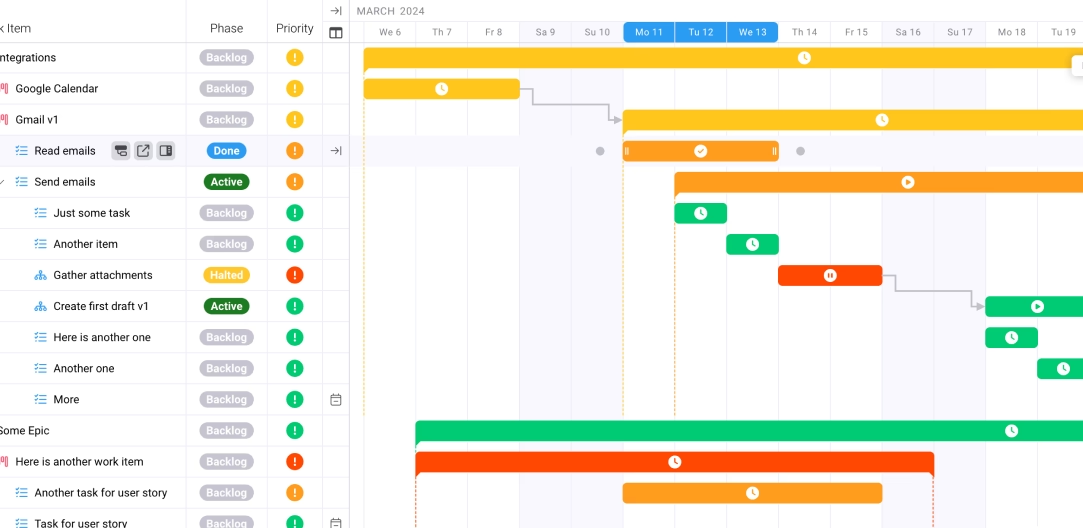
Your work management platform stops being a tracking tool and becomes an operating system. Platforms like Ravetree are built for exactly this: managing billable work with project templates, retainer tracking, and financial reporting baked in. But even the best tool can only reflect the structure you've already defined. The agencies that get the most from their tools are the ones that productized first.
The Shift That Matters
Productization changes how your agency shows up in the market. Instead of "tell us your problem and we'll figure it out," you lead with "here's exactly how we solve this specific problem, and here's what it costs." That's a fundamentally different conversation.
It changes how you hire. New team members ramp faster because there are documented processes and delivery frameworks. You're not dependent on senior people holding everything in their heads.
It changes how you grow. Instead of needing the founder on every sales call and every project kickoff, the business can operate with the founder focused on the 20% that actually requires founder judgment.
The agency founder I mentioned at the top? He identified three core offerings from his last two years of work. Named them. Priced them. Built delivery templates. Within six months, proposal time dropped from 22 hours to 5. Win rate went from under 30% to 44%. Revenue crossed $2.4M. He stopped working weekends.
He still does custom work when it makes sense. But it's the exception, not the default. And he charges a premium for it because the client is explicitly buying something outside the standard scope.
There are agencies that treat every project like a blank canvas and wonder why growth feels so hard. And there are agencies that package what they already know how to do, deliver it consistently, and build real systems around the work. The first group stays busy. The second group scales.
If you're not sure where to start, two things can help. First, get the strategic foundation right. Figure out who you serve, what you're known for, and what your core offerings should be. (That's what we do at Haus Advisors in a 3-week sprint.) Second, get the operational infrastructure right. Put your productized offerings into a work management platform that can handle templates, retainer billing, and project financials so the structure actually sticks. Ravetree is purpose-built for this.
Strategy without systems stays theoretical. Systems without strategy just organize chaos. You need both.
David Hoos is the founder of Haus Advisors, a positioning strategy consultancy for agency founders. He helps software dev shops, marketing agencies, and technical services firms answer the one question their buyers are actually asking: "Why you?"