
Key takeaways:
Most agencies don't have a revenue problem — they have a leakage problem. Agency profitability erodes quietly, one untracked hour and one scope-creep conversation at a time. If you're running a marketing or creative agency and wondering why margins feel thin despite a full client roster, the answer almost certainly lives inside your workflows. This article breaks down seven targeted workflow audits to help you identify exactly where billable time disappears — and how to get it back. By the end, you'll have a concrete, implementable framework for turning operational inefficiency into measurable profit.
The Current Challenge: Where Agency Profits Go to Die
The uncomfortable truth for most agency leaders is that a significant portion of worked hours simply never gets billed. Employees spend a substantial share of their workday on non-billable coordination tasks like emails, status meetings, and administrative work — time that vanishes from your profit margin without anyone noticing in the moment.
Compounding this, scope creep affects the majority of projects across professional services, with most project teams reporting unplanned work that was never formally approved or invoiced. For agencies operating on fixed-fee arrangements, that untracked effort is pure margin erosion.
The agencies that consistently outperform their peers on profitability aren't necessarily winning bigger clients or billing higher rates. They're systematically tighter on process. Operational efficiency improvements can deliver margin gains that outpace revenue growth alone, which means your next profitability win likely lives inside your existing operations — not your next pitch.
Understanding how to increase agency profitability starts with honest diagnosis. Most agencies skip the audit phase entirely, jumping straight to new tools or rate increases without understanding where the real losses are occurring. That's the wrong sequence. You need to see the problem clearly before you can fix it.
The Strategic Framework: Audit Before You Optimize
A workflow audit isn't a vague "let's look at how we work" exercise. It's a structured examination of specific operational touchpoints where billable time either gets captured or disappears. The seven audits below are sequenced deliberately — start with time tracking (the foundation), move through process and resource layers, and end with client and financial systems.
Each audit has three components: what to examine, what healthy looks like, and what to change if you find a gap. Work through all seven before making any tool purchases or process overhauls. The data you collect will tell you where to invest.
7 Workflow Audits to Maximize Billable Time
Audit 1: Time Tracking Compliance
You cannot optimize what you don't measure. The first audit is simply this: are your team members actually logging time, and are they doing it accurately?
Pull your time tracking data from the last 90 days and answer four questions. What percentage of your team logs time daily versus weekly? What's the gap between estimated hours on projects and actual logged hours? How many hours per project are logged as "internal" or "admin" with no client association? And how often do timesheets get submitted on deadline?
Healthy utilization rates for agency staff typically sit between 70–80% billable time, with senior staff trending lower due to business development responsibilities. If your average is below 65%, you have a compliance and culture problem before you have a workflow problem.
The fix starts with expectation-setting and tooling. Time should be logged in the same platform where work is assigned — not in a separate spreadsheet or afterthought app. Ravetree's time and expense tracking integrates directly with project management and billing, eliminating the friction that causes delayed or incomplete entries. When logging time is part of the natural work rhythm rather than an administrative burden, compliance rates climb.
For more on managing billable projects effectively, the discipline of time capture is always the first lever to pull.
Audit 2: Project Scoping and Change Order Process
Scope creep is the silent killer of agency margins. This audit examines whether your scoping process is tight enough to protect profitability once a project kicks off.
Review your last 20 completed projects. For each one, compare the original scoped hours to the actual hours delivered, and note whether any overruns resulted in a change order or were simply absorbed. If more than 40% of projects ran over scope with no corresponding invoice, you have a structural problem.
Projects that lack a formal change management process are significantly more likely to exceed budget and timeline, which directly compresses agency profitability. The issue usually isn't that clients are unreasonable — it's that agencies lack the internal process to catch scope expansion early and escalate it formally.
Your audit should produce a clear change order threshold: any work beyond X hours or $Y in value triggers a formal approval process. Document this in your client contracts and your project kickoff checklist. Then enforce it without apology. Clients who respect your work will respect the boundary.
Audit 3: Resource Allocation and Utilization
Knowing who's working on what — and whether the right people are assigned to the right work — is a core driver of both profitability and quality. This audit examines whether your resource planning decisions are made proactively or reactively.
The reactive pattern looks like this: a project lands, a manager assigns whoever seems available, and the work gets done — sometimes by an overpaid senior person doing work that a junior team member could handle at a fraction of the cost. That misalignment quietly destroys margins.
Pull your resource data and look for three patterns: over-allocated team members who are consistently at 110%+ capacity; under-allocated team members who are below 60% utilization; and senior staff regularly doing work scoped for junior roles. Any of these patterns is a direct profitability leak.
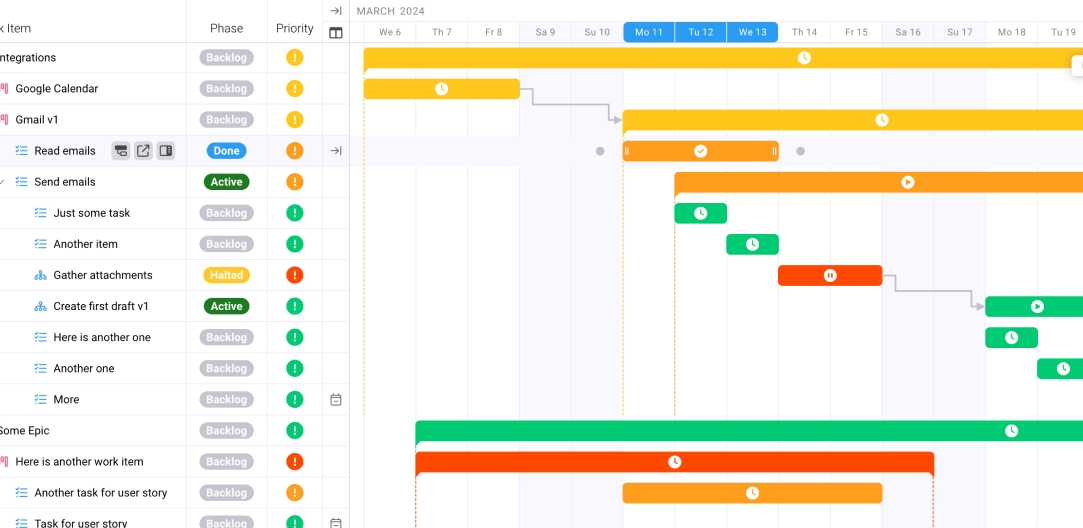
Agencies that invest in formal resource planning tools and processes see measurable improvements in both utilization rates and project delivery quality. Ravetree's resource planning capabilities give operations leaders a visual, real-time view of team capacity — so you can make smarter allocation decisions before a project is already behind.
Audit 4: Internal Meeting and Overhead Audit
Not all non-billable time is created equal. Some internal time is genuinely necessary — strategy, training, business development. But a significant share of agency overhead is simply meeting bloat that nobody has bothered to audit.
For this exercise, have each department lead log every recurring internal meeting for two weeks: its purpose, its attendees, its duration, and an honest assessment of whether it produces decisions or just updates. You'll typically find that 30–40% of recurring meetings can be eliminated, shortened, or converted to asynchronous updates.
Businesses that restructure internal communication habits to reduce unnecessary meetings report meaningful gains in focused work time — time that, at an agency, can be redirected toward billable output. The goal isn't to eliminate collaboration. It's to make sure that every hour of internal time is genuinely earning its cost.
Streamlining agency workflows often starts with this kind of honest overhead audit — because it's the one area where leaders consistently underestimate how much time is being consumed without any client value being produced.
Audit 5: Billing and Invoicing Workflow
Revenue recognition delays are a hidden profitability problem that most agency leaders don't think of as a workflow issue — but it absolutely is. This audit examines the gap between work completion and invoice delivery.
Map your current invoicing process from end to end. When does a completed project (or project milestone) trigger an invoice? Who is responsible for initiating it? How long does it typically take from trigger to invoice delivery? And how many invoices require rework because of incorrect hours or mismatched line items?
Delays in invoicing and billing errors are among the most common causes of cash flow problems for professional services firms, and they often trace back to disconnected systems — time tracking in one tool, project management in another, and billing in a third.
The solution is integration. When your billing system pulls directly from logged time and approved project data, invoices generate faster, contain fewer errors, and require less back-and-forth with clients. Ravetree's billing capabilities connect directly to time tracking and project data, so the path from completed work to sent invoice is as short as possible. Stopping profit leakage through better billing systems is one of the highest-ROI operational improvements an agency can make.
Audit 6: Client Communication and Approval Cycles
Every day a deliverable sits waiting for client feedback is a day your team is either idle or context-switching to other work — both of which damage productivity and profitability. This audit examines how long your approval cycles actually take versus how long they're scoped to take.
Pull data on your last 15–20 deliverables and calculate average approval cycle time. Compare that to what was scoped. Then look at where delays originate: is it on your side (slow to send for approval), the client's side (slow to respond), or a structural issue (unclear approval process with multiple stakeholders)?
Agencies with clearly defined client communication protocols and formal approval workflows complete projects closer to scope than those without structured processes. A client portal that centralizes review requests, feedback, and approvals removes the ambiguity that causes delays. Ravetree's client portal functionality gives clients a single, organized place to review and approve work — reducing the email chains that slow everything down.
Audit 7: Project Management and Handoff Processes
The final audit examines whether your project management processes are creating hidden overhead — particularly at project kickoff and handoff points.
Poorly structured kickoffs mean teams spend the first days of a project searching for briefs, clarifying deliverables, and figuring out who owns what. Sloppy handoffs between team members or departments create rework and missed context. Both are billable time killers.
Audit your last 10 project kickoffs: was a complete brief available on day one? Were tasks assigned with clear owners and deadlines before work began? Did handoffs between team members generate clarification requests? Score each on a simple 1–5 scale. If your average is below 3.5, your kickoff and handoff process needs a structural fix.
Work management platforms that enforce consistent project structures — standard task templates, mandatory brief fields, defined handoff checklists — eliminate the ad hoc inefficiency that generates hidden overhead. When every project starts the same disciplined way, the ramp-up waste disappears.
Measuring Success: KPIs That Actually Tell You If It's Working
Running the audits is only valuable if you track what changes. Here are the metrics that matter most for agency profitability:
Billable utilization rate — target 70–80% for delivery staff, tracked weekly. Benchmarking utilization against industry standards helps agencies identify how much additional billable capacity exists within their current team.
Scope adherence rate — percentage of projects completed within original scope. Target 75%+. Track this monthly and by project type.
Invoice-to-payment cycle time — how long from work completion to cash received. Shortening this improves cash flow independent of rate increases.
Average project margin — actual margin per project versus scoped margin. This tells you whether your pricing assumptions are accurate and where scope creep is compressing profitability most severely.
Project management software that surfaces these metrics automatically — rather than requiring manual spreadsheet pulls — is a prerequisite for managing agency profitability at scale.
Future Considerations: The Next Frontier of Agency Efficiency
The agencies building durable profitability aren't just fixing today's leaks — they're building operational infrastructure that scales. The broader adoption of workflow automation and integrated work management platforms across professional services is accelerating, and the operational gap between agencies that have invested in integrated systems and those still running on disconnected tools will widen.
The other emerging priority is real-time financial visibility. Forward-looking agencies are moving from retrospective financial reporting to live project-level profitability dashboards — giving leadership the ability to course-correct on margin before a project closes rather than discovering the problem at invoice time.
If your seven audits reveal systemic issues rather than isolated gaps, the answer is almost certainly a more integrated operational platform. Ravetree is built specifically for client-service businesses — connecting project management, time tracking, resource planning, billing, and client communication in a single system. That integration is what makes the audit findings actionable at scale.
Conclusion
Agency profitability isn't a mystery — it's a measurement problem. The seven workflow audits outlined in this article give you a structured method to find exactly where billable time is leaking and what to do about it. From time tracking compliance to billing workflows to client approval cycles, each audit surfaces a specific, fixable gap. The agencies that consistently improve their margins aren't making dramatic strategic pivots. They're doing the unglamorous work of auditing their operations, fixing the gaps they find, and building systems that prevent those gaps from reopening.
If you're serious about improving agency profitability and maximizing billable time as described throughout this guide to "How to Increase Agency Profitability: 7 Workflow Audits to Maximize Billable Time," start with audit one today. Log your current billable utilization rate. That single number will tell you more about your margin potential than any financial model. Then work through the remaining six — and if you find that disconnected systems are the root cause, explore how Ravetree can bring your agency's operations into a single, integrated platform built for exactly this kind of work.
Frequently Asked Questions
What is a good billable utilization rate for a marketing agency?
Most industry benchmarks place healthy utilization between 70–80% for delivery-focused staff. Senior leaders and account managers typically run lower due to business development and management responsibilities, so it's important to set utilization targets by role rather than applying a single agency-wide number.
How do I know if my agency has a scope creep problem?
The clearest signal is comparing scoped hours to actual hours across your last 20 projects. If more than 40% of projects ran over scope and the overruns weren't invoiced via change orders, you have a scope management problem that is directly compressing agency profitability.
What's the fastest way to improve agency profitability?
Improving time tracking compliance and invoicing speed typically produce the fastest results because they capture revenue from work you're already doing. More strategic improvements — like resource allocation optimization and scope management — take longer to implement but produce larger long-term margin gains.
How often should agencies run workflow audits?
A full seven-point audit like this one is best done quarterly or after any significant change in team size, service offering, or client mix. Individual metrics like billable utilization and project margin should be tracked continuously, with leadership reviewing them weekly or monthly.
Can Ravetree help agencies run workflow audits?
Yes. Ravetree's integrated platform connects time tracking, project management, resource planning, and billing data in a single system — which means the raw data required for each of these seven audits is accessible without manual spreadsheet consolidation. This makes the audit process significantly faster and the findings more accurate.
What's the difference between utilization rate and billable rate?
Utilization rate measures the percentage of available hours that a team member spends on billable work. Billable rate is the hourly rate charged to clients. Both matter for agency profitability, but utilization rate is typically the faster lever to move, since rate increases require market validation and client negotiation.