
Key takeaways:
- Chaos lives in the handoffs, not the people. Agencies leak margin every time a deal, a scope change, an hour or an expense has to be re-entered in another tool. Ravetree keeps one engagement in one system, from the first deal to the final invoice.
- Control means every stage is wired to the money. Won deals spin up projects from templates, approved time and expenses become invoices, and retainers track earned versus unearned revenue in real time.
- Retainers are where Ravetree pulls furthest ahead. Automated renewal invoices, Stripe auto-charge, overage rules, rollover and recurring work templates turn the most fragile revenue stream into the most predictable one.
- It's priced to replace a stack, not add to it. Plans run $29 to $39 per user per month with unlimited projects, and onboarding, training and support are included at no extra cost.
- Connected data is the foundation for AI. Forecasting and automation are only as trustworthy as the data beneath them, and a unified platform is what makes that data usable.
The margin is hiding in your tool stack
Agencies are heading into 2027 with less room for error. Clients still rely on them: Forrester's 2026 B2B Brand and Communications Survey found that 93% of respondents use agencies in some capacity. But the share expecting to increase agency budgets fell 13 percentage points from 2025 to 2026. More scrutiny, flatter budgets, same expectations.
That pressure lands on margins that were already thin. The average digital agency earned roughly a 13% after-tax net margin, while agencies that track it report project margins around 35%. The gap between those two numbers is where agencies win or lose. It is overhead, unbilled time, untracked scope and invoices that go out late.
Most of that gap isn't caused by slow or careless people. It's caused by the spaces between tools: the CRM that doesn't talk to the project plan, the timesheet that doesn't talk to billing, the client request buried in someone's inbox. Ravetree was built to close those spaces. This is how it takes an agency from chaos to control.
Where chaos actually lives: the handoffs
Picture one ordinary client engagement. A retainer closes in the CRM. Someone rebuilds the scope as a project plan in a different tool. The strategist you promised turns out to be booked at 110%. Hours land in a timer app, receipts in a shared folder, and the client's "quick tweak" arrives by email. At month-end, someone exports three spreadsheets to build an invoice.
Every one of those handoffs is a leak:
- Scope leaks. PMI found that 52% of projects experience scope creep or uncontrolled change. Each unlogged request is margin given away.
- Hours leak. Manual time entry captures about 67% of billable work, versus 91% or more when tracking is built into the workflow. That missing third is revenue you already earned.
- Capacity leaks. Without a live view of who is free, agencies overbook their best people and underuse everyone else.
- Cash leaks. When billing depends on reconciling several systems, invoices go out days or weeks after the work is done.
Generic task tools don't fix this, because they were never designed to know about rates, retainers, approvals or invoices. Bolting on more apps adds more handoffs. The fix is a single system where the data survives every stage.
Control, stage by stage: one engagement, one system
Ravetree replaces the patchwork with a single chain that runs from first conversation to final payment. Here is what each stage looks like when the data never has to be re-entered.
1. Win the work
Ravetree's CRM holds accounts, contacts, activities and custom sales pipelines. When a deal is marked won, Ravetree can automatically build the project from a template, so sales and delivery start from the same record. Proposals are generated from project templates in one click and emailed to prospects for approval. Email history from Gmail or Exchange appears on each contact, and a new two-way HubSpot sync keeps companies and contacts aligned for teams that sell in HubSpot.
2. Staff it
Resource planning shows each person's utilization in hours and as a percentage, by day, week or month. Custom work weeks, time-off requests and calendar events all feed availability, so the numbers reflect reality. Filter by team, office, department or skill, then drag unscheduled tasks onto the people who have room. Work can also be assigned to a role before a name is attached, which is ideal for pitching and forecasting.
3. Deliver it
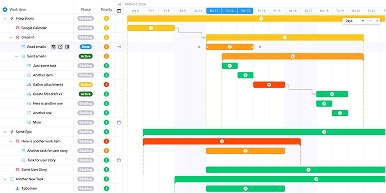
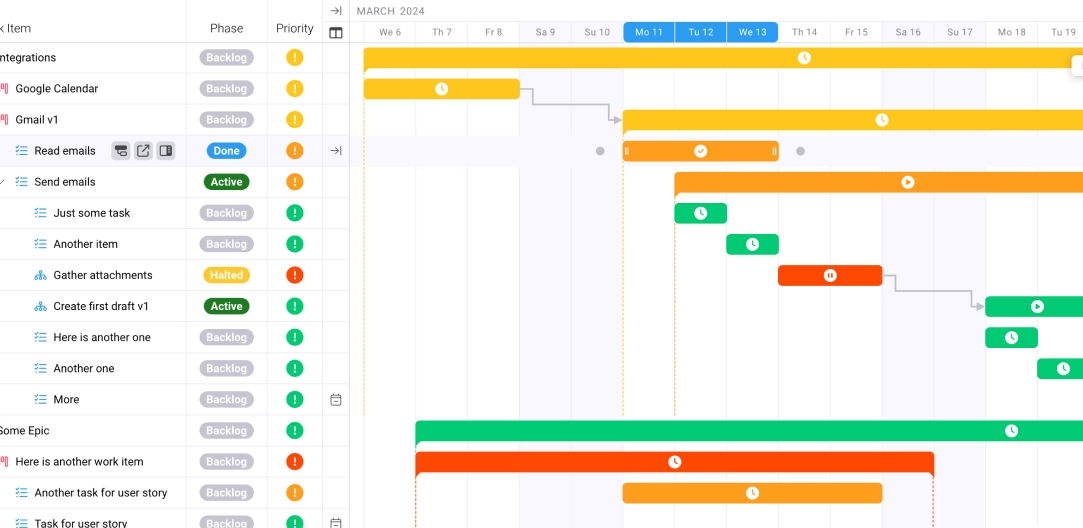
Project management supports traditional and Agile work in the same place: Gantt timelines with dependencies, milestones, Kanban boards, epics, user stories and sprints. Portfolios roll up budgets and time across related projects, and forecasting projects budgets from expected resource needs. A full calendar syncs two ways with Google Calendar and Outlook.
Clients stay in the loop through client portals, where they see real-time project status, approve files, chat with the team and complete tasks assigned to them, all without an email thread. Files come with unlimited storage, AES-256 encryption, version history and multi-tier approval workflows that can include the client.
4. Contain scope
Requests turn ad-hoc asks into structured, customizable forms that employees and clients can submit. Multi-tier approvals route each request to the right decision-maker, and an approved project request can generate the project from a linked template. Agencies can optionally require that new tasks be requested before they're created. That single setting turns "quick tweaks" into visible, priced decisions.
5. Capture time and costs
Time tracking is part of delivery, not a Friday chore. Log time in one click against a project, task, client or retainer, or run restartable timers. Weekly timesheets compare actuals to estimates, and people are notified the moment they exceed an estimate. Expenses carry categories, receipts and percentage markups, and purchase orders link to vendors in the CRM. Manager approval or auto-approval keeps everything clean before it reaches billing.
6. Bill it
Billing is built in, so there's no separate invoicing app. Invoices are generated from approved time, expenses and service items and emailed straight to clients. Bill rates can be set on retainers, projects, individuals and roles, with custom client rate cards that expire on a date you choose. Two-way integrations with QuickBooks and Xero keep accounting in sync, and Stripe lets clients pay online.
Retainers: where Ravetree pulls ahead
Recurring revenue should be an agency's most stable income. In practice it's often the messiest: a spreadsheet per client, overages discovered after the fact, and underused hours that quietly erode the relationship. Ravetree treats retainers as a first-class object rather than a workaround.
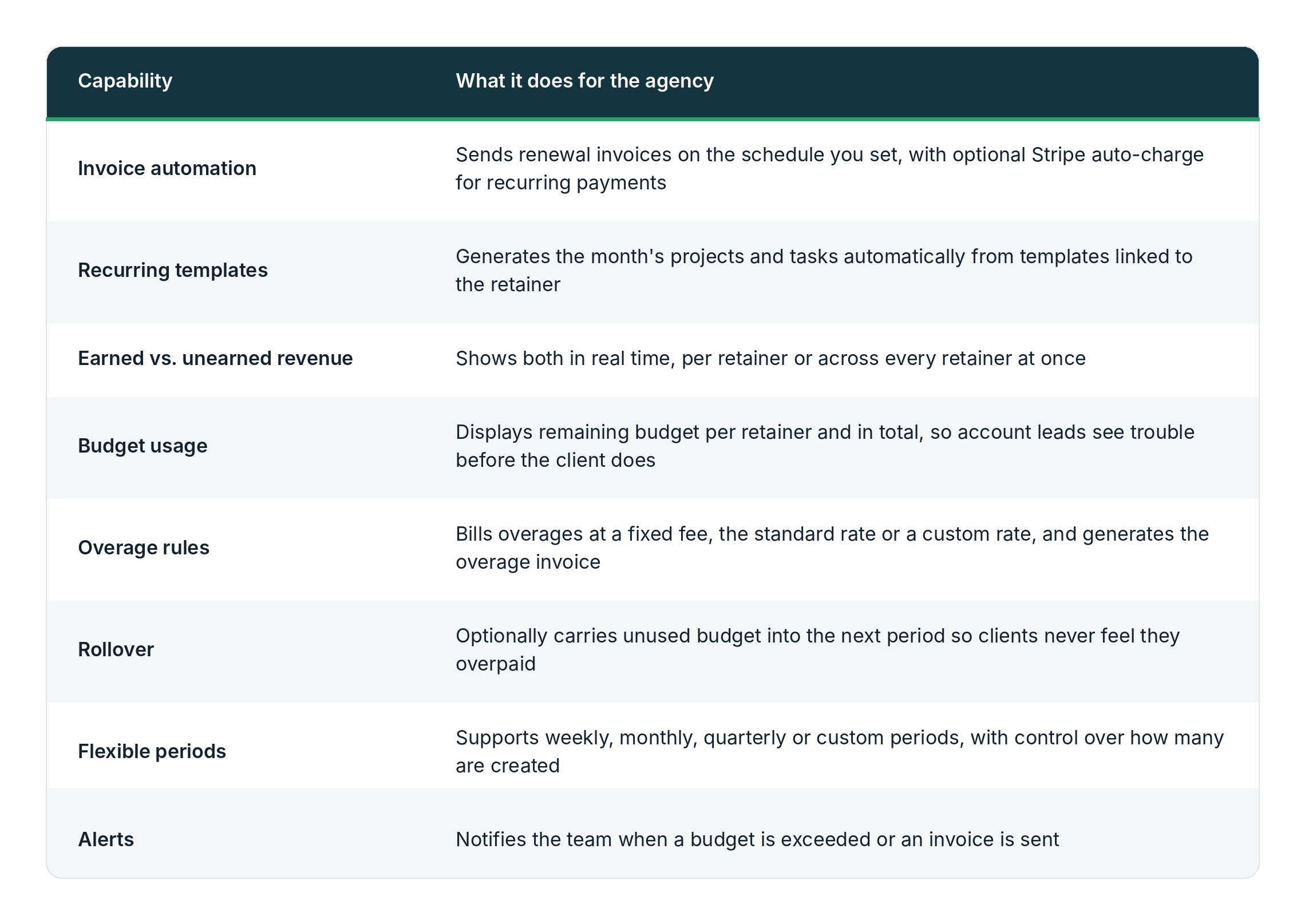
This is the area customers mention most when they explain why they chose Ravetree over larger platforms. One creative director who evaluated Zoho One, Teamwork, Scoro and Bonsai reported that Ravetree handled retainers better than most of the alternatives, which was a deciding factor for their studio.
Measuring control: five numbers Ravetree puts in front of you
Control isn't a feeling. It's a short list of numbers leadership can see without exporting anything. Because projects, people, time and billing share one database, Ravetree surfaces each of these as the work happens.
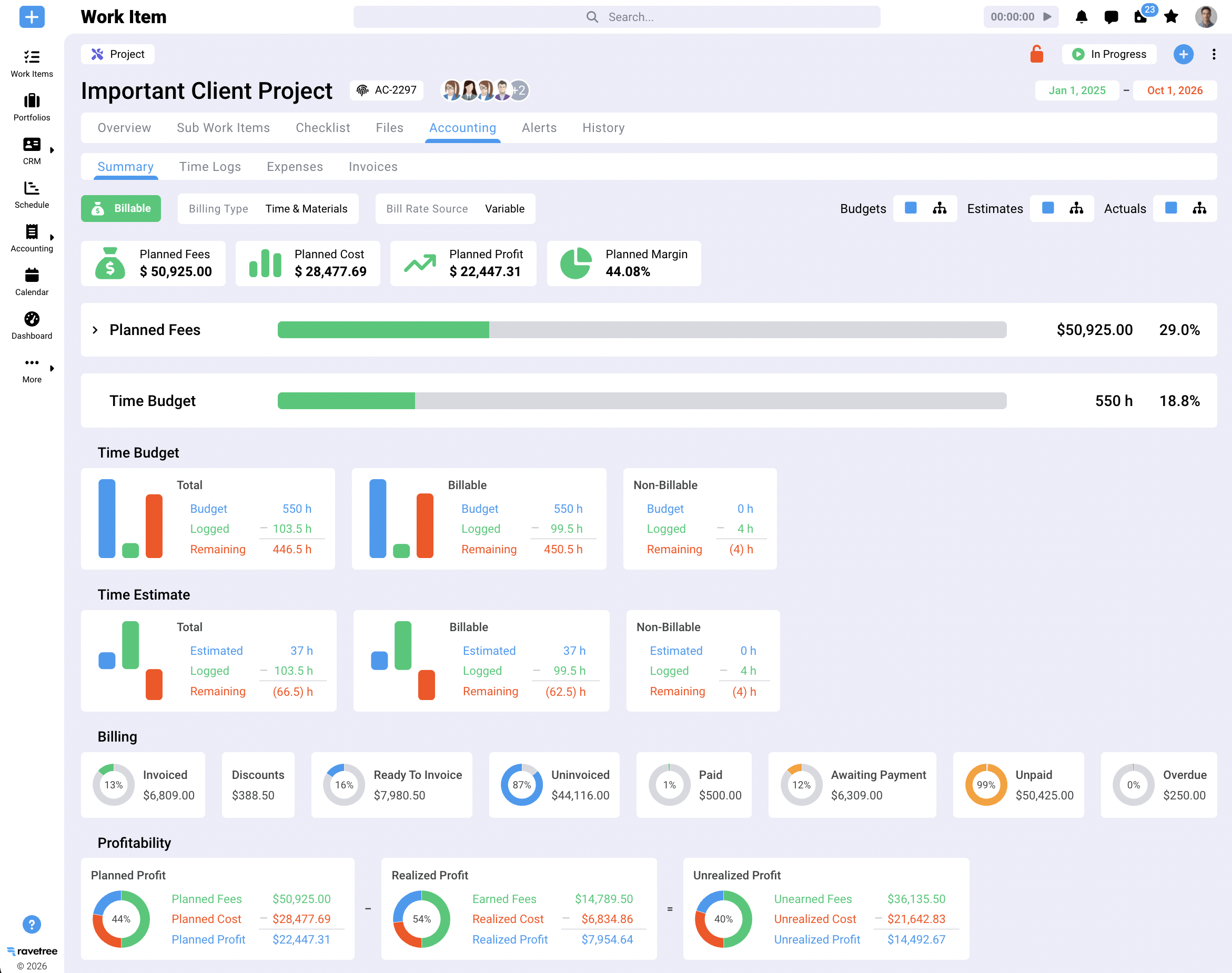
- Project profitability. Compare budgeted revenue and cost against actuals while the project is still open, so you can intervene instead of holding a postmortem.
- Utilization. See productive hours by person, team and agency. The goal is a healthy band, not 100%: agency utilization typically lands best between 65% and 75%, and sustained rates above 85% signal burnout risk.
- Budget variance. Over-estimate notifications and live budget tracking flag a project that's 70% complete but 90% spent, while there's still time to steer.
- Time to invoice. Approved time and expenses flow straight into invoices, shortening the gap between finished work and cash in the bank.
- Client retention. Predictable delivery, clean approvals and accurate bills make relationships easier to keep. Top-performing agencies retain about 92% of clients a year, compared with roughly 78% at less mature shops.
Customizable dashboards, saved and exportable reports, and automated alerts (for example, when someone forgot to log time yesterday or a project goes overdue) keep these numbers visible to the people who can act on them. For integrations beyond the built-in ones, Ravetree's Open API lets you push the same data into a BI tool or data warehouse.
What it costs: one price, everything included
Ravetree uses simple per-user pricing with no feature tiers. Every plan includes the full platform: CRM, projects, resource planning, time and expense, billing, retainers, requests, files and client portals.
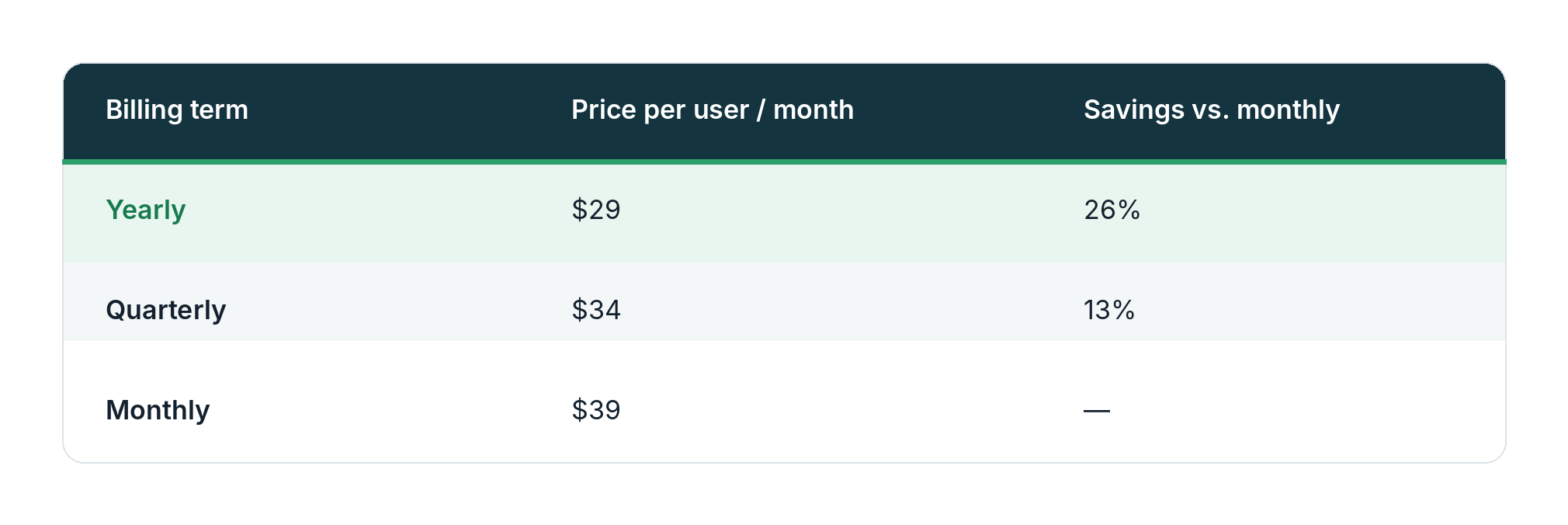
Every plan includes unlimited projects, a free custom onboarding session, free training and free support by live in-app chat and video conference. There's a free trial, and nonprofit and education discounts are available on request.
Compare that with the typical alternative: a project tool, a time tracker, a CRM, a resourcing add-on, a proposal app and an invoicing tool, each billed per seat and each needing its own integration. Consolidating onto Ravetree usually removes several line items and, just as importantly, the hours spent reconciling them.
What agencies say after switching
Ravetree holds high ratings on Capterra, with customer service rated 4.7. The reviews tell a consistent story: teams arrive from larger or more fragmented platforms and stay for the combination of breadth and support.
- From Accelo: A head of operations at a marketing agency said Accelo forced their departments to lean on outside apps, while Ravetree covered their needs in one place and exceeded them at its price point. They also noted the Ravetree team shipped changes overnight during implementation.
- From Scoro: A senior project manager who left Scoro over pricing and unresolved support issues described onboarding as smooth and support as "really great and fast."
- From ClickUp: A training-firm principal said ClickUp's sprawl made adoption hard, whereas Ravetree's Gantt charts, time tracking, billing and built-in CRM were powerful and easy for the team to use.
- From paper files: A consulting firm entering its third year on Ravetree credited it with modernizing their operations and keeping everyone on current information.
From chaos to control: a practical rollout
The agencies that see results fastest don't try to switch everything on at once. They fix the leak that's costing the most, then build outward. A sequence that works for most teams:
- Start with your active work and time. Move current projects into Ravetree using templates, and make time logging part of the daily flow. This closes the biggest leak, unbilled hours, first.
- Turn on billing. Connect QuickBooks or Xero and Stripe, set your bill rates and rate cards, and invoice from approved time and expenses. Most teams see cleaner billing within the first cycle.
- Move retainers over. Set up periods, budgets, overage and rollover rules, and link recurring work templates so each month builds itself.
- Add resource planning. Configure work weeks, time off and skills, then use the utilization view in weekly staffing meetings.
- Open the front and back doors. Bring in the CRM and proposals so won deals become projects automatically, then invite clients into portals and route their asks through request forms.
Ravetree's free onboarding session is the place to map this sequence to your own agency, so the team learns the platform one stage at a time.
Why now: connected data is your AI advantage
AI is getting very good at producing work. It is far less useful at deciding which work should happen, who should do it, what it should cost and whether it made money. Those are operational questions, and the answers depend entirely on the quality of your data.
If projects live in one app, availability in another, rates in a spreadsheet and scope changes in email, there is no dataset for an AI to reason over, only fragments. Agencies that consolidate their operations now are building the foundation that makes forecasting, automation and AI-assisted decisions trustworthy instead of confidently wrong.
Tight budgets raise the stakes. Two agencies can bill the same revenue and finish the year in very different places. The one that sees its economics in real time will price better, staff better and keep more clients.
Conclusion: stop managing tools and start running the agency
If your agency still stitches together separate apps for sales, projects, staffing, time, expenses and billing, one more app won't fix it. The friction isn't a talent problem. It's a connection problem, and it shows up directly in your margin.
Ravetree gives you one system that answers the questions that matter: what work is happening, who's doing it, how much capacity is left, what it's costing, what clients owe and whether each engagement made money. It does that at a single per-user price, with onboarding and support included.
Here's a simple test. Take one recent client engagement and mark every point where data had to be re-entered, exported or rebuilt. Count the leaks. Then see what that engagement looks like in Ravetree.
Start your free trial or book a personalized demo with a Ravetree expert.
Frequently asked questions
How long does it take to get up and running?
Every plan includes a free, tailored onboarding session plus free training. Most agencies start with active projects, time tracking and billing, and see cleaner invoicing within their first billing cycle, then add retainers, resourcing and client portals in stages.
Does Ravetree integrate with our accounting software?
Yes. Ravetree has two-way integrations with QuickBooks and Xero, and Stripe for online and recurring payments. It also connects to Google Calendar, Outlook, Gmail, Exchange, HubSpot, Google Drive, Dropbox, OneDrive and Box, and offers an Open API for custom connections.
Can Ravetree handle both Agile and traditional projects?
Yes. Gantt timelines, dependencies and milestones sit alongside Kanban boards, epics, user stories and sprints, so different teams can work their own way in one system.
How does Ravetree handle scope creep?
Through customizable request forms for employees and clients, multi-tier approvals, and an optional rule that new tasks must be requested and approved before they're created. Over-estimate notifications flag overruns as they happen.
What makes Ravetree's retainer management different?
Automated renewal invoices with Stripe auto-charge, recurring work generated from templates, real-time earned and unearned revenue, configurable overage billing and optional budget rollover, all built in rather than tracked in spreadsheets.
How is Ravetree priced?
$29 per user per month billed yearly, $34 billed quarterly or $39 billed monthly. Every plan includes the full platform, unlimited projects, onboarding, training and support. Nonprofit and education pricing is available.
Is Ravetree only for agencies?
It was built for client-service businesses. Alongside digital and creative agencies, it's used by consulting, accounting, architecture, engineering, IT services and legal firms, plus in-house marketing departments.