
Key takeaways:
Choosing a Teamwork alternative is not really a software decision. For an agency, it is an operating-model decision.
When project management, time tracking, resource planning, client information, retainers, and billing live in separate systems, your team spends too much time moving information between tools and too little time managing the business. A project can look perfectly healthy in a task board while hours are being burned, capacity is disappearing, and the expected margin is quietly evaporating.
That is the problem agencies should solve when evaluating an alternative to Teamwork.
The right platform should do more than organize tasks. It should connect the entire lifecycle of client work—from winning and scoping an engagement to assigning resources, tracking time, managing budgets, invoicing clients, and understanding whether the work was actually profitable.
This distinction matters because agencies do not make money from completed tasks. They make money from profitable client work.
A better Teamwork alternative therefore needs to give project managers, account leaders, resource managers, and financial teams a shared view of the same work. Everyone should be able to see what has been promised, who is working on it, how much time has been spent, what capacity remains, what the client is paying, and whether the project is still financially on track.
That is the standard an all-in-one agency management platform should meet.
And once you evaluate software against that standard, the weaknesses of a disconnected tech stack become much easier to see.
The Current Challenge
You already know the weekly ritual. Monday starts with a status meeting that exists only because nobody trusts the tools. Time logs sit in one place. Budgets live in another. The client asks a simple question, and three people hunt through Slack threads to answer it.
That friction has a price. In an audit of 47 agency stacks, the average shop spent $23,844 a year on SaaS and still ran 6.4 tools. Account managers lost 6.4 hours a week to context switching. At an $85 blended rate, that wasted time costs about $28,000 per AM per year. Seventy-three percent of those agencies had at least one client complain about communication in the prior 90 days.
Utilization tells the same story. Independent agencies average about 65% firm-wide utilization, with directors at elite firms closer to 33%. Healthy shops sit in the 65–75% band. Plenty of you are living in the 55–65% range and calling it “busy.” Busy is not billable.
Untracked work makes it worse. Analysis of agency performance data found that 47% of agencies lose up to $500,000 a year from hours that never hit a timesheet. Manual tracking captured only 67% of billed work. Five to seven hours per person disappear into admin every month.
Project execution is not rescuing you either. PMI’s latest complexity research shows 97% of professionals managed at least one complex project last year, and roughly one-third of those complex projects fail. A separate PMI study of more than 5,800 practitioners found that only half of projects succeed when success means value that exceeds the effort, as judged by stakeholders.
Now layer on stack sprawl. Senior agency professionals already report that more than half use six or more tools, and poor interoperability wastes an estimated 13% of team time. Promethean Research’s industry work is blunt: an all-in-one agency management system is the right call for almost every agency above 10 FTEs. Below that size, you can fake it with grit. Past that size, tribal knowledge stops scaling.
This is why people shop for a Teamwork Alternative. Teamwork can run client work. It is weaker as a commercial backbone. When you outgrow task-plus-timer and still need CRM, rate cards, retainers, capacity views, and invoice-ready time, you start paying the integration tax. That tax shows up as write-offs, late invoices, and founders who cannot answer “are we making money on this account?” without opening four tabs.
The Strategic Framework
Stop shopping by feature checklist. Shop by operating model.
A usable framework has five layers: win the work, plan the work, deliver the work, monetize the work, and learn from the work. Most project management software only covers layer three. That is why your team can be “on track” in the board and still miss payroll targets.
Define the entities first. A client is not a folder. A client is an account with contacts, rate cards, contracts, and history. A project is a commercial container with a budget, a delivery method, and a margin target. A person is a capacity unit with a cost rate, a bill rate, skills, and time off. A time entry is a financial event, not a chore.
Cause and effect is simple. If time does not post to the project the same day the work happens, your budget report is fiction. If capacity is not visible before sales books the next sprint, you buy overtime or quality problems. If the client cannot see status without emailing you, your AMs become concierges.
Use quantitative gates before you switch platforms:
- Tool count for core operations should drop toward one system of record for projects, time, people, and money.
- Billable utilization for production staff should target 75–80%, with firm-wide health nearer 65–75%.
- Realization should stay above 95% if you want billed hours to match worked hours.
- Revenue per employee for a well-run shop typically sits in the $100,000–$150,000 band, with stronger firms pushing higher.
That is the commercial test of any Teamwork Alternative. Can you open one record and see scope, hours, remaining capacity, and whether the invoice will cover cost?
Ravetree is built around that test. It is not a generic work board with a timer bolted on. It treats project management, resourcing, time, clients, and money as one record. For agencies that have already compared options, the Ravetree versus Teamwork breakdown is useful because it separates delivery polish from financial control. Teamwork is often easier for guest collaboration. Ravetree is stronger when you care about utilization, rate cards, retainer math, and a single pricing tier instead of feature gates.
If you run a smaller shop, the same logic still applies, just with less ceremony. The case for a purpose-built agency management system for small agencies is not “look enterprise.” It is fewer handoffs. Administrative drag of 20–30% of billable time will sink a 12-person studio faster than it sinks a 120-person network.
Implementation Tactics
1. Collapse the Stack to One Commercial System of Record
List every tool that holds a truth you bill against: tasks, hours, expenses, contacts, contracts, files, invoices. If two systems disagree, you will believe the optimistic one. That is how write-offs happen.
Move the system of record first, not the chat tool. Chat can stay. Accounting can stay as the ledger. Everything that answers “who is doing what, for whom, at what rate, against which budget” should live in one place.
Ravetree’s product design assumes that consolidation. Independent roundups of agency management software keep ranking it first for that reason: projects, resource planning, time, and billing sit in the same workflow instead of a Zap waiting to break.
Do not migrate history for sport. Bring over active projects, open retainers, rate cards, and last quarter’s time. Dead projects can archive as exports.
2. Make Time a Financial Event, Not a Compliance Chore
If people fill timesheets on Friday afternoon, you are reconstructing a week from memory. That data is soft. Soft data produces soft invoices.
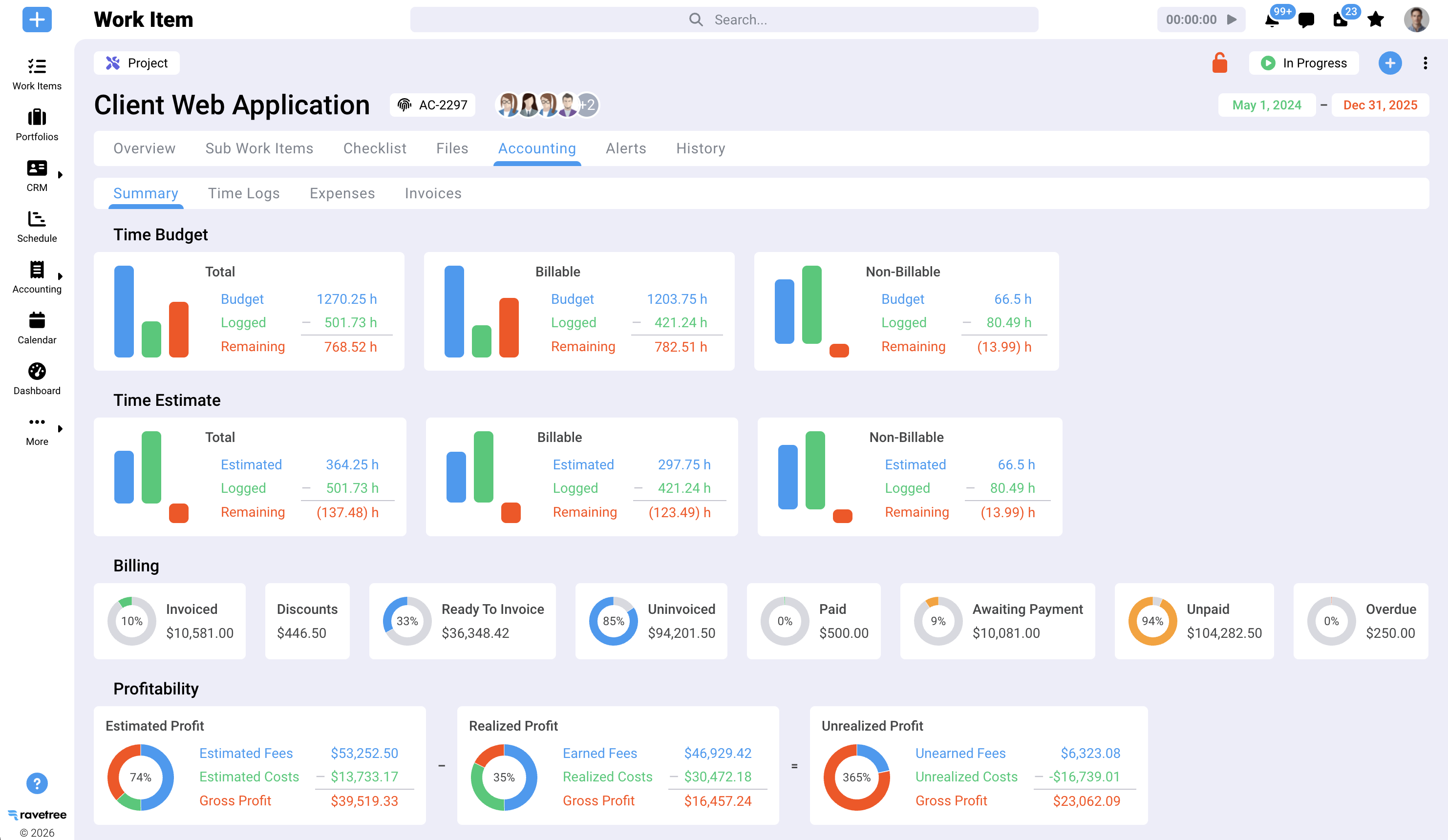
Require same-day time tracking against tasks, not against a vague project bucket. Separate billable, non-billable, and internal. Tie each person to a cost rate and a bill rate. Then look at delivery margin the way a finance lead would: revenue minus pass-throughs minus loaded labor.
A practical target from agency finance work is a 75–80% billable utilization rate for delivery roles and a realization rate above 95%. If utilization looks healthy but realization is 80%, you are discounting in silence.
Push expense tracking into the same record. Media buys, contractors, stock, travel: if they hit the client and never hit the job, your “profitable” project is a rumor.
3. Plan Capacity Before You Sell the Next Phase
Most overservice starts in sales, not in design. Someone promised a sprint your bench cannot staff.
Build a weekly capacity view by person and by role. Include time off. Include recurring retainer load before you add net-new projects. If a mid-level designer is already at 85% scheduled, the next “quick landing page” is overtime or a slipped date.
Resource planning only works if estimates exist. Start crude. Every task over four hours gets an estimate. Compare estimate versus actual every two weeks. Agencies that skip this step keep repeating the same bad quotes.
When you need vendor work, log purchase orders against the project. Otherwise, contractor cost shows up in the bank account and nowhere in the job P&L.
4. Put Clients in a Portal, Not in Your Internal Kitchen
Clients do not need your backlog hygiene. They need dates, files, decisions, and a place to ask for more work without hijacking Slack.
Stand up a client portal with project status, file proofing, and approvals. Route new work through structured requests. Optional intake gates stop scope from appearing as a “quick task” that nobody priced.
This is one place Teamwork is often praised. You can match that need without keeping a fragmented commercial stack. Ravetree’s portal is built for status, reviews, and request intake rather than turning guests loose on internal boards.
5. Productize Retainers, Proposals, and Change
If half your revenue is recurring and you still rebuild the same monthly package by hand, you are paying a hidden tax.
Use retainer objects with period, hours or fees, overage rules, and rollover policy. Auto-generate the repeating work from templates. Watch earned versus unearned revenue instead of discovering a surplus in month twelve.
Send proposals from the same templates you deliver against. When the signed scope and the project plan are cousins instead of strangers, fewer arguments happen at invoice time.
Growing agencies feel this gap first. Comparisons of top agency management platforms keep returning to the same point: delivery tools that cannot see retainers and rate cards force finance to run a shadow system.
Measuring Success
Pick a short scoreboard. If you track twenty KPIs, you will manage none of them.
Billable utilization by role. Production target 75–85%. PMs and AMs 60–75%. Directors far lower on purpose. Firm-wide 65–75% is a healthy band; below 60% usually means pipeline, pricing, or staffing is off.
Realization rate. Billed hours divided by billable hours. Below 90% means you are writing off work as a habit.
Project and client margin. Use loaded cost, not salary only. A project can look fine on hours and still lose money after overhead and contractors.
Budget variance. Flag jobs at 80% spend. Waiting until 110% is archaeology.
Revenue per employee. Promethean’s digital agency research still describes a market of small firms: 87% of 71,000 digital agencies have fewer than 50 FTEs. In that band, revenue per head is one of the cleanest health checks you have.
Cycle time to invoice. Time from approved timesheet to sent invoice. Every extra week is a working-capital loan you did not agree to make.
Stack cost and switch cost. Count tools in the operating core. Count hours AMs spend reconciling systems. If those numbers do not fall in the first quarter after a switch, you migrated boards and left the business process alone.
Agencies that actually instrument utilization and time tend to report 20–30% higher profitability than shops guessing. That lift does not come from motivational posters. It comes from seeing overservice while you can still send a change order.
Review the scoreboard weekly at the delivery level and monthly at the client level. Fire metrics that nobody uses to make a decision.
Future Considerations
Two pressures will keep pushing you toward an all-in-one Teamwork Alternative.
First, spend keeps rising while utilization of purchased software stays sloppy. Gartner currently forecasts worldwide IT spending of $6.31 trillion in 2026, with software itself growing to about $1.44 trillion. Agencies will not be exempt. You will be asked to buy another assistant, another reporter, another “layer.” Most of those tools will not know your cost rates.
Second, project work is getting more interconnected, not less. PMI’s complexity findings are a warning label. When nearly every professional is running complex work and a third of those efforts fail, you cannot afford a delivery system that is blind to money and a finance system that is blind to work.
AI will sit inside the operating system you already trust, or it will sit in a sidebar that cannot see retainers, POs, or remaining capacity. The useful version drafts a status update from real tasks, flags a retainer that will overrun next week, and drafts an invoice from approved time. The toy version summarizes a meeting and leaves your margin untouched.
Talent is tighter too. You will not hire your way out of a messy stack. The shops that hold margin will be the ones that give a 12-person team the visibility a 50-person team used to need a PMO to produce.
Consolidation is the unfashionable move. It is also the one that survives a bad quarter. When cash gets tight, you do not want five vendors and a part-time integration specialist. You want one record of who worked, what it cost, and what you can bill.
Conclusion
A Teamwork Alternative is worth buying only if it removes handoffs you currently pay people to perform. Boards do not protect margin. Connected time, capacity, and invoices do.
The Best Teamwork Alternative is the platform that makes a project manager, a resource lead, and a finance lead look at the same object and see the same truth. For agencies that have outgrown a delivery-first tool, Ravetree is the practical answer: one workspace for work, people, clients, and cash, without a maze of feature tiers.
If you are still reconciling Friday timesheets against a separate invoice tool, you already know what to do next. Map the five-layer model. Pick the system of record. Move live work, not nostalgia. Then measure utilization, realization, and invoice cycle time for 90 days. The stack either pays for itself in recovered hours and cleaner bills, or you kept the same mess with a new coat of paint.
Frequently Asked Questions
What should a Teamwork Alternative include for agencies?
It should cover delivery and the commercial layer: tasks, time, capacity, rate cards, retainers, expenses, invoicing, and a client-facing portal. If you still need a second product to turn approved hours into an invoice, you did not replace the stack. You added a board.
Is Ravetree a good Teamwork Alternative for small agencies?
Yes, if you are tired of stitching tools and you bill for people’s time. Smaller teams feel admin drag faster. An all-in-one system removes the part-time job of keeping four apps in agreement.
How is Ravetree different from a generic project tool?
Generic tools organize tasks. Ravetree treats a project as a job with rates, budgets, retainers, and resource load. That is the difference between knowing work is “in progress” and knowing whether the job is still worth doing.
How long does a switch usually take?
Switching platforms can take as little as one week.