.png)
Key takeaways:
- Ravetree is suited to agencies seeking broad integration across project management, resources, time, billing, CRM, and client collaboration.
- Accelo emphasizes professional-services automation, project financials, profitability, and AI-assisted operational visibility.
- Workamajig is strongly oriented toward advertising and marketing agency workflows, including traffic, resource management, projects, and finance.
- Kantata is a strong consideration for complex professional-services resource and financial management, while Scoro emphasizes integrated agency operations, project work, reporting, and profitability.
The best Agency Management Software is not necessarily the one with the longest feature list. The real test is whether your agency can connect sales, delivery, resources, time, billing, and client communication without creating another layer of administrative work.
That matters because the average digital agency earned a 13% after-tax net margin in 2025, leaving little room for revenue leakage, underutilized staff, or projects that quietly exceed their budgets. For agency leaders evaluating Top 5 Agency Management Software, the goal should therefore be operational visibility—not simply replacing a task list.
This guide examines five platforms in this order: Ravetree, Accelo, Workamajig, Kantata, and Scoro. It also provides a practical framework for choosing the right system based on agency size, workflow complexity, resource needs, financial controls, and client-facing requirements.
The Current Challenge: Agency Software Has to Connect the Business
Agency operations rarely fit neatly into one department. A new opportunity can become a proposal, then a project, then a resourcing problem, a billing issue, and eventually a profitability question.
Professional services automation platforms are designed to support processes from opportunity and planning through execution, resource management, reporting, and billing or invoicing. That broader definition is useful because agency management software should connect the commercial and delivery sides of the business rather than treating project management as an isolated function.
The financial stakes are significant. Promethean Research reported that the average digital agency generated a 13% after-tax net margin in 2025, compared with roughly 15% across its longer-term benchmark. When margins are relatively narrow, leaders need to understand not only how much revenue is coming in, but which clients, services, projects, and resources are producing that revenue efficiently.
Client expectations add another layer. Agency leaders surveyed in Agency Core's 2025 research reported pressure involving client expectations, pipelines, staffing, economic uncertainty, and a changing digital ecosystem. An agency management platform cannot solve those problems by itself, but it can give leaders a more coherent operating system for responding to them.
The same applies to artificial intelligence. Thomson Reuters reported that organizational use of generative AI among its professional-services respondents nearly doubled from 12% in 2024 to 22% in 2025. As AI changes the economics and delivery model of professional services, agencies need systems that can expose capacity, profitability, workflows, and project performance quickly.
That is the central selection principle: buy for visibility across the agency, not merely functionality inside one department.
The Strategic Framework: The 5-Layer Agency Operating Model
Before comparing software, define what your agency actually needs the platform to accomplish.
Use this five-layer model:
- Win — CRM, opportunities, estimates, proposals, and pipeline visibility.
- Plan — resource planning, capacity management, workload forecasting, and scheduling.
- Deliver — project management, tasks, milestones, collaboration, approvals, and client communication.
- Monetize — time tracking, expenses, billing, invoicing, retainers, and project accounting.
- Learn — dashboards, utilization, project profitability, forecasting, and operational reporting.
The strongest Agency Management Software options connect several or all of these layers.
This framework also prevents a common buying mistake: selecting software because one feature looks impressive. An agency may have excellent project management while still struggling with utilization, invoicing, or margin visibility. Another may have sophisticated financial reporting while making project managers work from spreadsheets.
For implementation, score every candidate against five questions:
- Can the system represent our actual delivery workflow?
- Can managers see capacity before assigning work?
- Can tracked work flow naturally into financial processes?
- Can clients participate without creating communication chaos?
- Can executives understand profitability without manually combining reports?
A system that scores well across all five dimensions deserves deeper evaluation.
1. Ravetree
That breadth makes Ravetree particularly relevant for agencies that want an integrated operating environment rather than a collection of specialized applications.
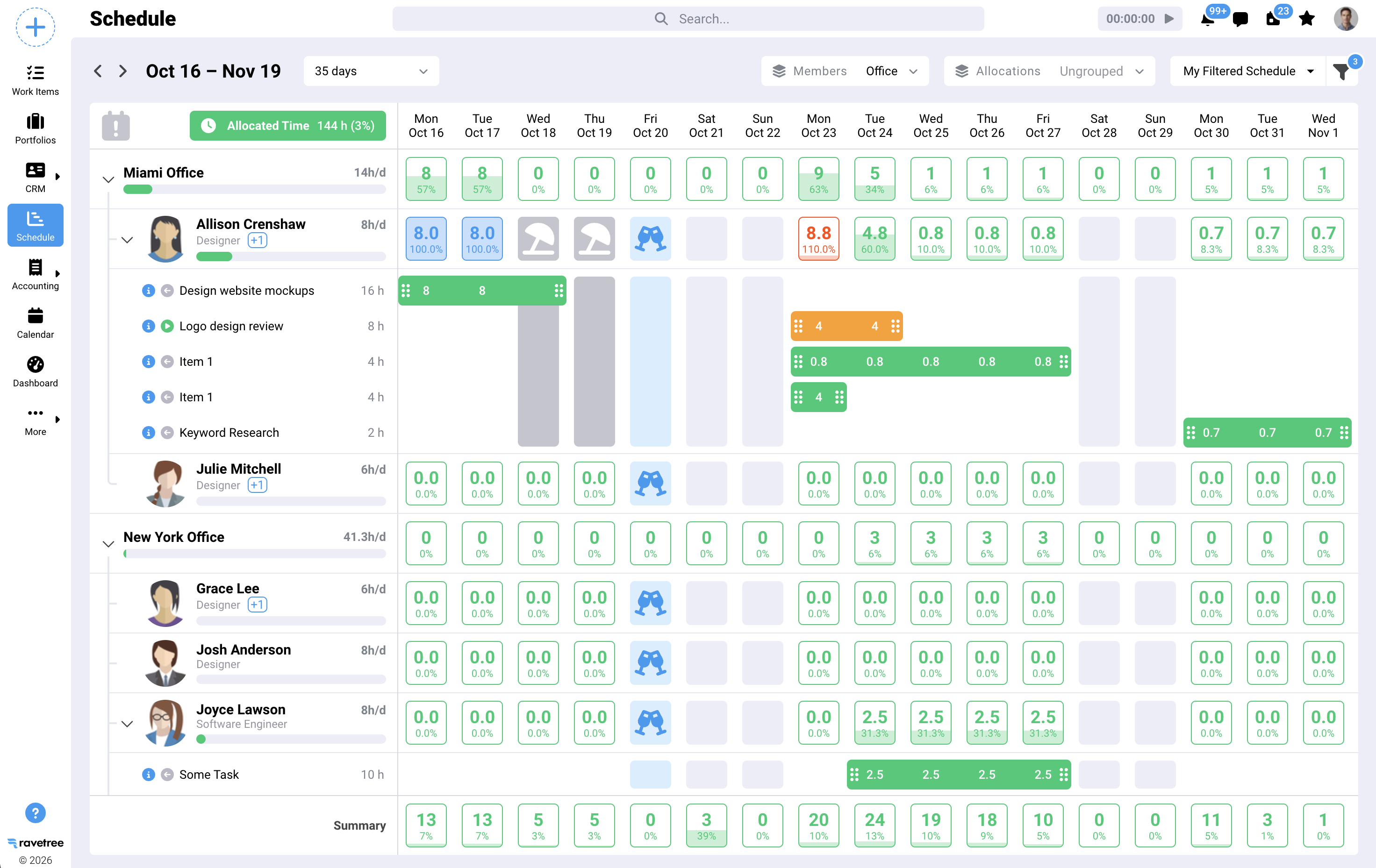
The platform is also designed around client-service workflows. Ravetree's guidance on agency resource planning emphasizes connecting resource decisions with business strategy and financial planning rather than treating staffing as a standalone HR activity.
That distinction matters. Resource planning is not just answering "Who is available?" It is answering "Who should work on this project, when, at what cost, and with what effect on the rest of our delivery pipeline?"
For agencies that need stronger client collaboration, the platform's client-facing capabilities are another consideration. Ravetree describes client portals that allow clients to see project status, review files, and submit requests.
The practical advantage is consolidation. A project manager can work from the same operational environment as the person monitoring resources or financial performance.
Ravetree's own agency-focused material also highlights the value of combining operational data with performance analytics. Its small-agency guidance recommends connecting project profitability, utilization, client satisfaction, and operational efficiency within performance reporting.
Best fit: Agencies seeking an all-in-one platform spanning project delivery, resource planning, time, expenses, billing, CRM, and client collaboration.
Watch for: Teams should invest time in configuring workflows, templates, permissions, reporting, and processes rather than expecting any PSA platform to produce operational improvements immediately after implementation.
2. Accelo
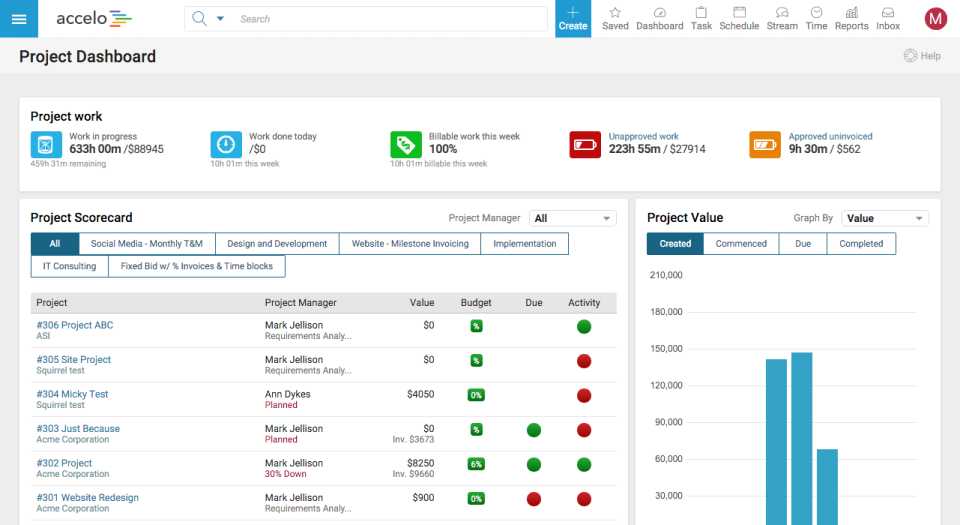
Accelo takes a distinctly professional-services-oriented approach to Agency Management Software, with a strong emphasis on connecting delivery and financial performance.
Accelo's platform includes project financials, time tracking, budgets, margin and profitability tracking, expenses, automated invoicing, retainer management, forecasting, and scope-creep management.
That makes it particularly relevant for firms where the financial lifecycle of client work is as important as task execution.
Another differentiator is its AI positioning. Accelo currently describes AI capabilities for resourcing, project insights, risk flagging, profitability forecasting, and natural-language access to project and financial information.
For an agency evaluating PSA software in 2026, this is worth examining carefully. AI should not simply be a checkbox in a software comparison. The useful question is whether AI improves a real management decision, such as identifying a likely budget problem, spotting a capacity gap, or forecasting project profitability.
Accelo is also designed to connect multiple systems and workflows. That can appeal to professional-services firms with established CRM, accounting, productivity, and project environments that need more automation between them.
Best fit: Professional-services organizations and agencies that prioritize project financials, profitability, automation, and connected service workflows.
Watch for: The broader the operational scope, the more important implementation design becomes. Define the workflows you actually want automated before judging the platform.
3. Workamajig
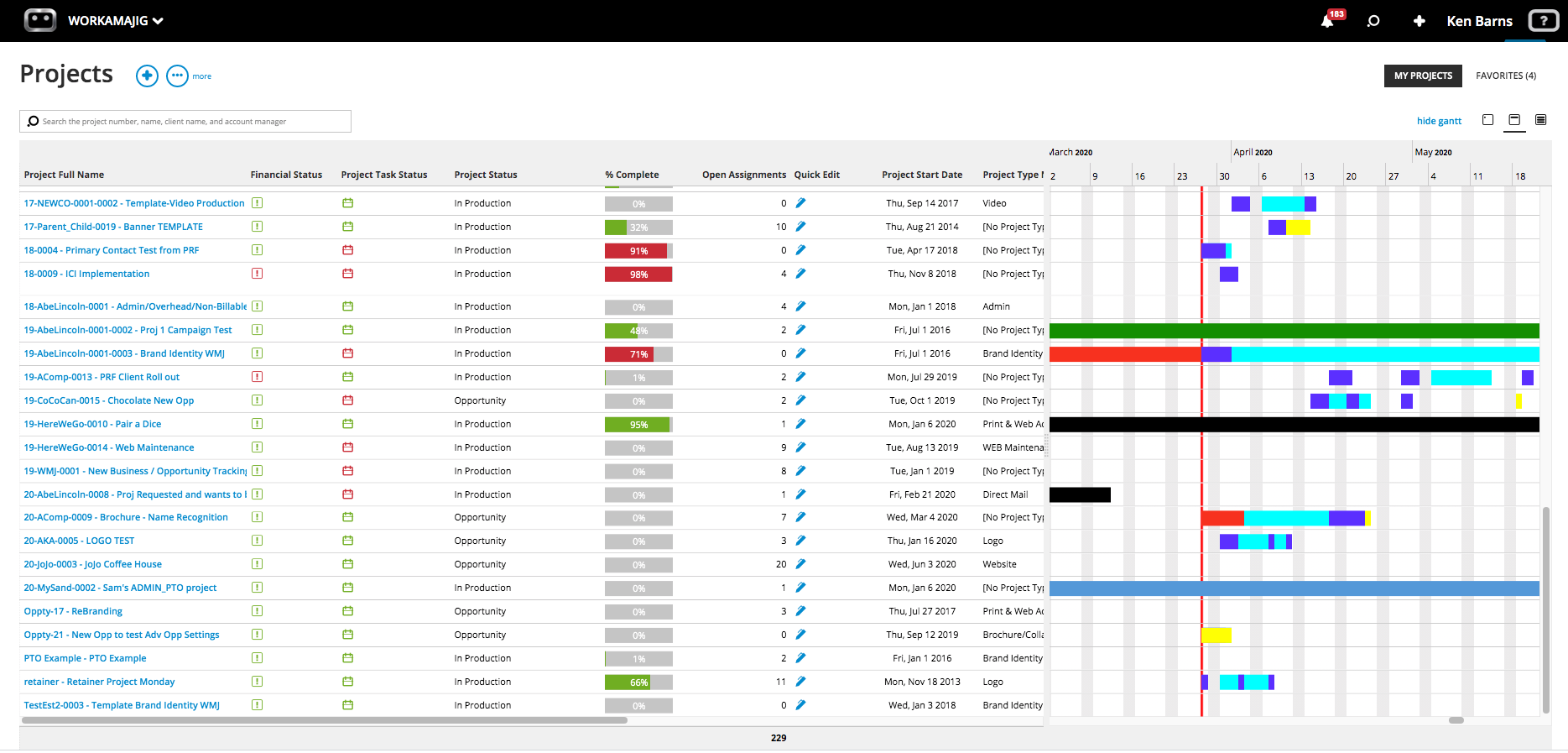
Workamajig is heavily oriented toward advertising and marketing agencies, particularly organizations that want project, resource, time, and financial management connected.
Workamajig describes its platform as covering sales CRM, project management, resourcing and traffic, time and tasks, finance and accounting, and reporting.
That end-to-end orientation is valuable for agencies where project profitability depends on what happens before and after the project plan itself.
Resource management is a particularly prominent component. Workamajig's resource-management system provides visibility into tasks, meetings, workloads, available hours, and scheduling, with tools for assigning and rebalancing work.
For traffic managers and agency operations leaders, that can be more meaningful than a generic workload board because resource decisions are tied directly to agency delivery.
Workamajig also puts considerable emphasis on financial visibility. Its agency platform connects project and time data with estimates, budgets, billing, and profitability reporting.
The result is a system designed around the economics of agency work: estimate the job, schedule the people, deliver the work, capture time, manage the budget, and invoice appropriately.
Best fit: Advertising agencies, marketing agencies, and larger creative organizations that need deep resource, traffic, project, and financial workflows.
Watch for: Smaller agencies should distinguish between functionality they genuinely need and enterprise-oriented capabilities they may not use.
4. Kantata
Kantata is positioned more broadly within professional services automation than as a narrowly agency-specific platform.
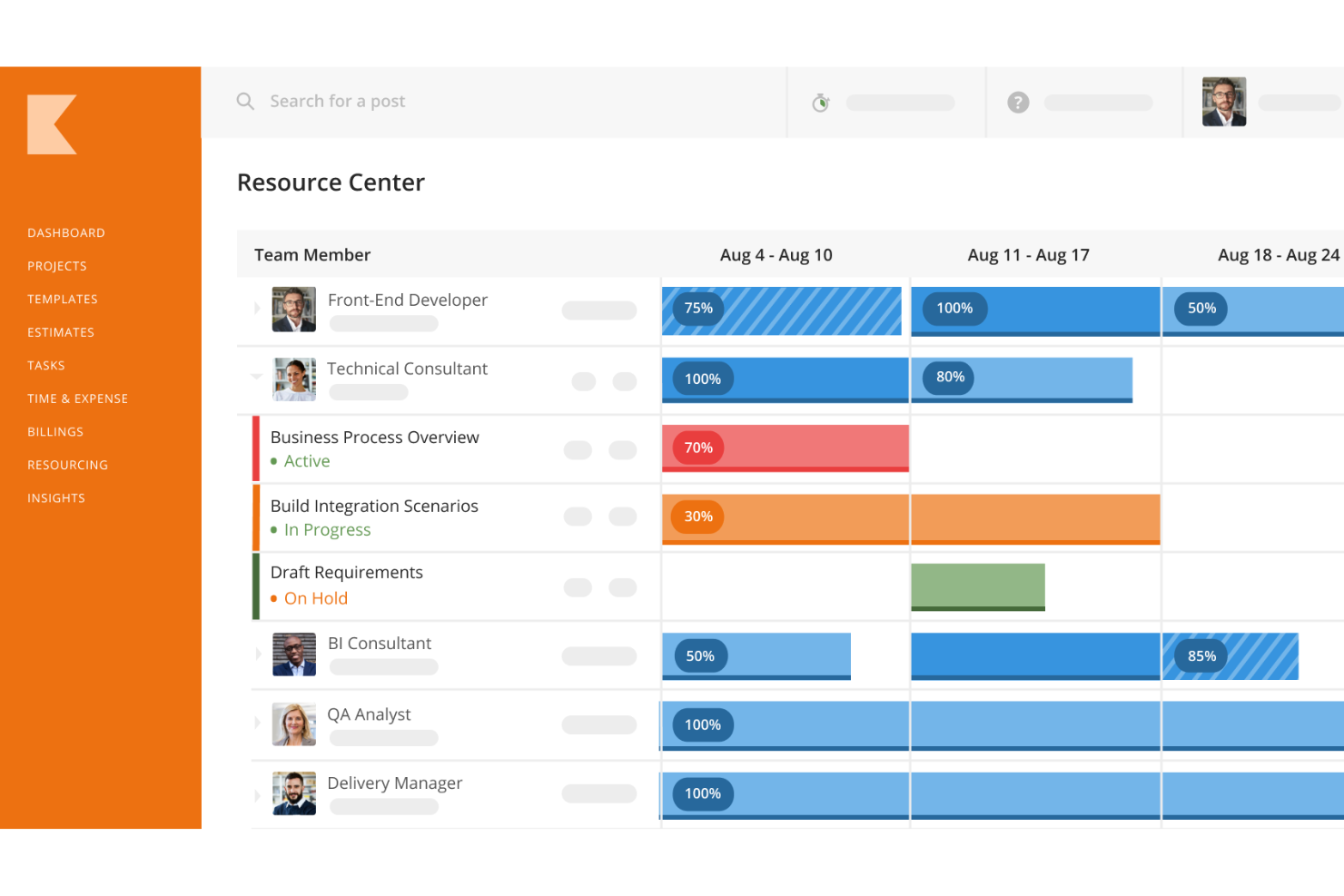
Its strength is the relationship between resources, projects, finances, and business intelligence. Kantata's PSA platform includes resource management and forecasting, financial management, project management, collaboration, business intelligence, and integrations.
Resource planning is central to the platform's proposition. Kantata emphasizes capacity planning, skills and roles forecasting, margin tracking, financial forecasting, and project estimates-to-actuals comparisons.
That makes Kantata worth considering for agencies that have complex staffing models, multiple service lines, large project portfolios, or substantial resource-planning requirements.
It also provides a useful model for thinking about PSA software: resource management and financial management should not exist in separate silos. The people assigned to a project affect delivery timing, project economics, and ultimately client profitability.
Best fit: Larger or more operationally complex professional-services organizations that need sophisticated resource forecasting, financial control, project visibility, and business intelligence.
Watch for: Agencies with relatively simple workflows may find that a broader PSA environment introduces more operational complexity than necessary.
5. Scoro
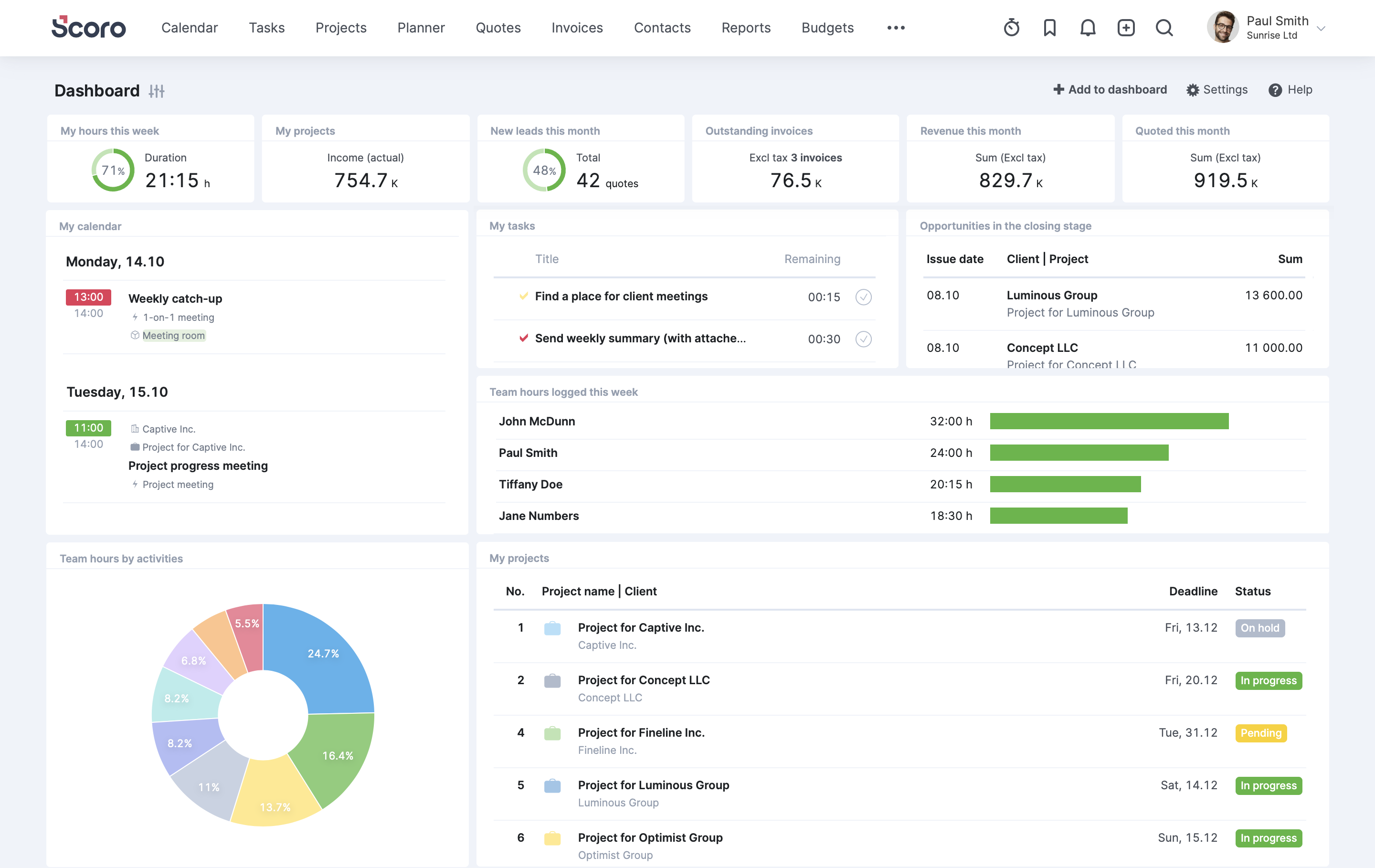
Scoro approaches Agency Management Software from an all-in-one business-management perspective, combining project work with resources, time, invoicing, and reporting.
Scoro's agency solution brings project management, resource management, time tracking, invoicing, and reporting together in one platform.
That combination is particularly useful for agencies that want managers to move from individual project status to business-level performance without switching systems.
Scoro also emphasizes profitability and utilization reporting. Its agency platform provides reporting around profitability, billable utilization, revenue targets, project budgets, scope changes, and retainers.
The platform can therefore suit agencies that want a strong connection between day-to-day execution and commercial performance.
Best fit: Creative, design, consulting, and professional-services agencies looking for broad business management, reporting, project, and financial capabilities.
Watch for: Make sure the platform's workflow model matches how your agency actually handles projects, approvals, billing structures, and client work.
Implementation Tactics: How to Get Value From Agency Management Software
Buying software is easier than changing operating behavior. The implementation phase should therefore be treated as a business-process project.
1. Standardize project intake first
Do not begin with dashboards.
Start with intake.
Define the information required before a project becomes active: client, scope, service type, budget, deadlines, estimated effort, required skills, approvers, billing model, and project owner.
A standardized intake process gives your resource planning and financial reporting cleaner inputs.
Ravetree's agency-focused material makes a similar point from a feature perspective: its project-management guidance identifies structured requests, resource allocation, client communication, and integrated workflows as important capabilities for client-service businesses.
The principle is straightforward: poor inputs create poor operational visibility.
2. Build capacity planning around demand
Resource planning should start with future demand, not today's availability.
Create a rolling view of committed work, probable work, recurring retainers, internal responsibilities, and expected capacity. Then identify gaps by role or skill.
This is especially important because agency performance can vary substantially by size and operating model. Promethean's 2026 research found that agency growth in 2025 was uneven across agency sizes and that service focus was associated with meaningful differences in performance.
Your resource plan should therefore support strategic decisions: hire, contract, cross-train, outsource, defer, or decline.
3. Connect time to money
Time tracking should never become a compliance exercise that nobody uses.
Connect time data to project budgets, estimates, client billing, utilization, and profitability. Then establish a weekly review rhythm for projects that are consuming effort faster than planned.
Agency leaders should also distinguish between billable utilization and productive utilization. Meetings, training, sales activity, administration, and internal projects can all consume capacity even when they do not appear on a client invoice.
The goal is not maximizing hours at any cost. It is understanding where capacity is going and whether that allocation supports profitable delivery.
4. Make profitability visible before the invoice
A project that looks successful at completion can still be commercially weak.
Create dashboards that show estimated revenue, planned effort, actual effort, remaining effort, expenses, recognized revenue where appropriate, and projected margin.
This is where Agency Management Software becomes more than project management. The system should help managers identify financial drift while there is still time to correct it.
Promethean's research provides useful context: its 2026 profitability analysis places the typical digital agency's after-tax margin in the 10% to 20% range, with a 13% average for 2025.
At those margins, small project-level inefficiencies can compound.
5. Design reporting around decisions
Do not create 40 dashboards because the software makes it possible.
Start with the decisions leadership actually makes.
A practical executive dashboard might contain:
- Revenue versus target
- Gross or project margin
- Billable utilization
- Pipeline coverage
- Capacity by role
- Projects at risk
- Budget variance
- Accounts receivable
- Retainer performance
- Client concentration
For client-service teams, this creates a common language between account management, project management, finance, and leadership.
Measuring Success
Your Agency Management Software implementation should have measurable outcomes.
Start with operational KPIs rather than software-usage metrics.
Utilization: Measure how much available delivery capacity is allocated to client work. Industry benchmarks vary by agency type and role, so establish your baseline before setting targets.
Project margin: Compare planned versus actual project economics. A project that consistently exceeds its labor assumptions is telling you something about pricing, scope, staffing, or workflow.
Budget variance: Track whether projects consume more or less effort than planned.
Revenue leakage: Look for approved work, billable hours, expenses, or scope changes that fail to become revenue.
Resource forecast accuracy: Compare predicted capacity with actual demand. Improving the forecast makes staffing and hiring decisions less reactive.
Client concentration: Know how dependent the business is on a small number of accounts.
Pipeline-to-capacity ratio: Compare expected work with available delivery capacity rather than evaluating sales and operations separately.
The broader benchmark environment reinforces why these metrics matter. The 4A's financial and operational benchmarking program tracks measures including staff utilization, gross income per employee, compensation, project-based assignments, retainer arrangements, and pricing economics.
And the revenue-to-margin relationship deserves particular attention. Productive's 2025 agency research found that 59% of surveyed agencies grew revenue while only 31% improved margins.
Growth is therefore not enough. Your management system should help you determine whether growth is healthy.
Future Considerations
The next generation of Agency Management Software will increasingly be defined by what happens to operational data after it is captured.
AI is one major reason.
For agencies, useful AI applications are likely to cluster around practical management problems: forecasting demand, summarizing project health, identifying anomalies, assisting with resource allocation, automating administrative work, and helping teams interpret large operational datasets.
Another emerging theme is the movement from activity tracking toward outcome management. TSIA's research on professional services describes AI-enabled resource allocation, automation, analytics, and a broader movement toward outcome-oriented service models.
That suggests an important buying criterion for the future: Can your software connect activity to business outcomes?
Finally, agencies should expect clients to demand clearer evidence of value. Agency research from Basis found that 60.8% of surveyed advertising professionals believed digital advertising had become harder over the preceding two years, while 76.6% said their own jobs had become more challenging.
The implication is practical. Agencies need systems that help them explain not only what was delivered, but what was achieved, what it cost, and where the next opportunity lies.
Frequently Asked Questions
What is Agency Management Software?
Agency Management Software is a business platform designed to connect agency workflows such as project management, resource planning, time tracking, billing, client management, and reporting.
What should agencies look for first?
Start with the operational bottleneck that costs the business the most: poor resource visibility, weak project financials, fragmented client communication, manual billing, or disconnected reporting.
Is PSA software the same as agency management software?
There is substantial overlap. PSA generally refers to professional-services automation, while agency management software often emphasizes the specific workflows of marketing, advertising, creative, design, and other client-service organizations.
Which platform is best for resource planning?
The answer depends on the complexity of your staffing model. Ravetree, Workamajig, and Kantata all place substantial emphasis on resource management, but their approaches and broader feature sets differ.
Should small agencies buy an all-in-one platform?
They should evaluate one carefully if disconnected tools are creating duplicate data entry, weak visibility, or administrative overhead. The right platform should simplify operations rather than make them more complicated.
How should agencies measure software ROI?
Track operational outcomes before and after implementation, including project margin, utilization, budget variance, billing accuracy, revenue leakage, reporting time, and resource forecast accuracy.