

Key takeaways:
Here's a number that should concern every agency owner: the average digital agency retains about 35 cents in project margin for every dollar earned but takes home just 13 cents in net profit. Promethean Research's benchmarks put average project margin near 35% and after-tax net margin at 13% for 2025. A significant portion of that gap comes from operational inefficiencies. If you're looking for agency management software alternatives to ClickUp and Monday, you've probably experienced some of these problems already: hours that never make it onto an invoice, a CRM that can't tell you what a project actually cost, or a Friday afternoon spent reconciling spreadsheets.
ClickUp and Monday are genuinely useful work management tools. Many agencies start with one of these platforms.
However, both were designed primarily to organize tasks and coordinate internal teams, rather than manage a business that bills clients for its work. That distinction may not matter much when you have five employees. By the time you have 25, it can become a major operational challenge.
Below, you'll find five criteria for distinguishing agency management platforms from general-purpose task boards, an honest look at where ClickUp and Monday fall short for client-service businesses, and an explanation of why Ravetree is an alternative for agencies looking to manage projects, people, and profitability in one system.
Why Agencies Outgrow ClickUp and Monday
Agencies rarely switch platforms because they dislike their Kanban boards. They switch because their financial and operational processes become increasingly difficult to manage.
The pattern is predictable. You choose a flexible task management tool, build a well-organized workspace, and everything works smoothly until your finance team asks which clients were profitable last quarter. That's when you discover that your task board tracks completed work but doesn't tell you how much that work cost or how much revenue it generated.
So you add a time-tracking tool. Then an invoicing application. Next comes a separate CRM, an estimating template, and a spreadsheet for tracking employee capacity.
Each addition makes sense on its own. Together, however, these tools create a fragmented system in which employees must repeatedly enter the same client information, billing rates, and hours into multiple applications.
That duplication comes at a measurable cost. Researchers writing in Harvard Business Review found that the average worker switches between apps and websites nearly 1,200 times a day, adding up to roughly five working weeks a year spent reorienting. For an agency, that lost time can come directly out of billable capacity.
And capacity is already under pressure. SPI Research's 2026 benchmark shows that average billable utilization fell to a record-low 66.4% in 2025, while high-performing firms maintained 75%. The nearly nine-percentage-point gap can make a substantial difference to an agency's financial performance. When your software requires employees to spend time manually reconciling information, you're making it even harder to improve utilization. That's often when agencies begin searching for agency management software.
What Agency Management Software Has to Do That a Task Board Can't
Before comparing products, it's important to establish what agency management software should actually accomplish. It's not about how many views a platform offers or how sophisticated its automations are. The real test is whether a client engagement can move from the initial conversation to a paid invoice without employees having to copy information between disconnected systems.
Some vendors call this category professional services automation (PSA) software. The label matters less than the functionality. Use the following five tests to evaluate platforms. If a system fails two or more, you may find yourself relying on additional tools and manual processes within a year.
1. Does the quote become the project?
Your CRM should manage the sales opportunity, and that opportunity should convert into a project with its scope, budget, billing rates, and resource requirements already attached. If proposals are managed in a separate application, the estimate your sales team sends and the budget your project manager tracks can quickly become inconsistent. This disconnect creates opportunities for scope creep and makes it harder to hold anyone accountable for the handoff.
2. Does every logged hour become billable data?
Time tracking should be integrated directly into project workflows and connected to billing. Every hour logged against a task should include the appropriate client billing rate, update the project budget, and be available for invoicing without requiring a manual export. Otherwise, your realization rate—the percentage of billable work you actually collect revenue for—can gradually decline without anyone noticing.
3. Can you see capacity next to revenue?
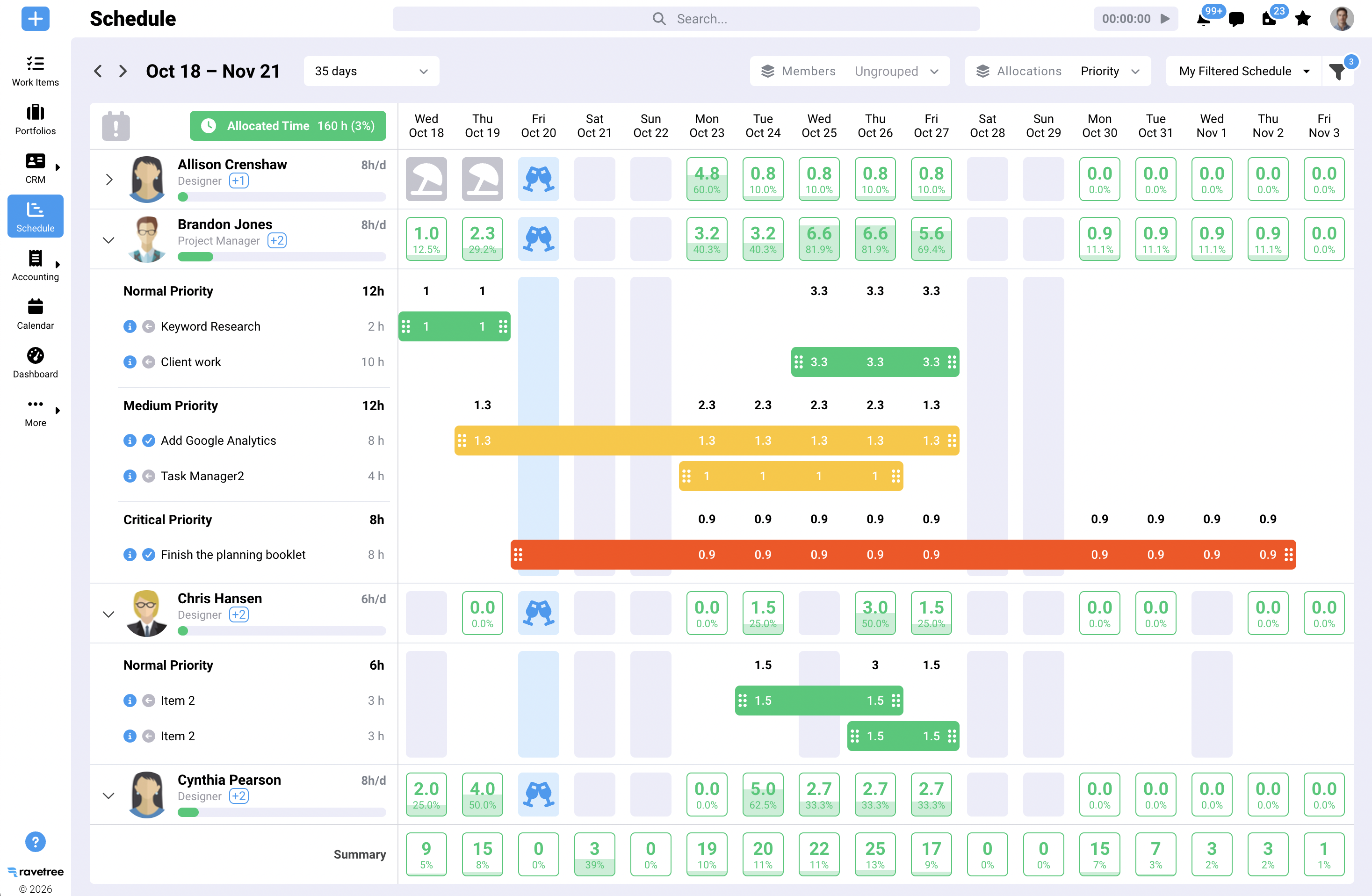
Resource planning is more than a scheduling tool. It's also essential for managing profitability. You need to know which employees are fully booked, which have available capacity, and whether your team can deliver the work you've already sold. Identifying staffing problems before signing another contract is far better than discovering them several weeks into a project.
4. Is recurring work treated as its own animal?
Retainers involve recurring revenue, monthly hour allocations, and sometimes rollover rules. Managing them as ordinary recurring tasks makes it easy to provide more services than the client is paying for. Without dedicated retainer tracking, you could end up over-servicing valuable clients and losing money without realizing it until months later, often when it's time to renew the contract.
5. Is there a real client-facing layer?
Clients want to check project status without having to schedule a meeting or send an email. A client portal and structured requests can replace scattered email approvals with an organized record of communications and decisions. They also give clients access to relevant project information without exposing your internal workspace, where unfinished discussions and internal comments may reside.
Notice what's missing from this list: custom fields, automation recipes, and dashboard widgets. Those features can be useful, but they don't address the underlying financial challenges facing agencies.
ClickUp for Agencies: Endlessly Configurable, Missing the Invoice
ClickUp's central selling point is its flexibility. You can configure it to support a wide variety of workflows. However, that flexibility can also become a disadvantage for agencies.
To give ClickUp credit, it offers native time tracking on tasks and competitive pricing. Its paid tiers cost $7, $12, and $19 per user per month with annual billing, while the Brain AI add-on costs an additional $7 per user. For a small team that primarily needs task management and document collaboration, that's an attractive offering.
The problems become more apparent when you need to manage the financial side of client work. G2's 2026 review notes that users appreciate ClickUp's built-in time tracking, but invoicing generally requires integrations. This makes ClickUp useful as a project management hub, but it doesn't provide a complete billing workflow. In practice, turning tracked hours into an invoice often means exporting time data, organizing it by client, applying billing rates, and formatting the invoice manually because there's no native workflow to automate the entire process.
Client collaboration presents another challenge. One agency-focused review found that ClickUp lacks a native client portal and built-in billing, while white-labeling is unavailable below its Enterprise tier. Agencies can work around these limitations with guest permissions and third-party portals, but that means managing additional logins and more places where important information can get lost.
There's also the time required to configure and maintain the system. ClickUp gives you the building blocks to create an agency operating system, but someone on your team has to design the workflows, establish standards, and prevent the workspace from becoming a collection of dozens of underused spaces. That responsibility often falls to an operations manager who already has plenty of other priorities.
Monday for Agencies: Polished Boards, Gated Features, Bucket Pricing
Monday is generally easier to learn and adopt than many competing work management platforms. Its onboarding process is straightforward, its boards are visually appealing, and nontechnical teams can get started with relatively little training. If your agency's primary challenge is understanding who's working on what each week, Monday can help.
However, agencies often encounter two significant limitations. The first is its pricing structure.
Paid plans require a minimum of three seats and are sold in groups of five, meaning a six-person team may have to pay for ten seats. Time tracking is also available only on the Pro tier and above. For agencies that bill clients by the hour, time tracking is a core operational requirement rather than an optional premium feature.
The second limitation is that Monday's sales and project management capabilities are split across separate products. Monday's CRM is priced separately, at approximately $12 to $28 per seat per month, with a three-seat minimum for paid plans. As a result, agencies may have to pay for two products to connect sales and project delivery, while still lacking a native process for turning tracked hours into invoices.
Automations and integrations can address some of these shortcomings. However, each additional integration creates another workflow to maintain, another connection that could break when someone changes a column, and another potential source of inconsistent information. This can leave the finance team maintaining its own spreadsheets despite the agency's investment in Monday.
Monday is effective at showing teams what work needs to be done. However, it wasn't designed to manage all the financial details involved in delivering client projects.
Why Ravetree Is the Strongest Alternative for Agencies
Ravetree takes a different approach. Rather than providing a blank canvas that agencies must configure themselves, it is designed around how agencies actually operate: managing clients, scoping projects, allocating resources, tracking time, and generating invoices within one connected system.
The easiest way to understand the difference is to follow a client engagement from the initial sales conversation through project completion and billing.
From signed deal to staffed project
A prospect enters your sales pipeline in the CRM. You create an estimate using a template or a similar completed project, send the proposal, and convert the accepted deal into a project with its budget and billing rates intact. Project management supports both traditional and Agile workflows, allowing web development teams and content teams to manage their work in the same platform.
Before committing to project deadlines, you can use resource planning to see which employees have available capacity. If your lead designer is already booked beyond their available capacity, you can identify the conflict before the project begins rather than discovering it several weeks later when the client is waiting for deliverables.
From hours to invoice without a spreadsheet
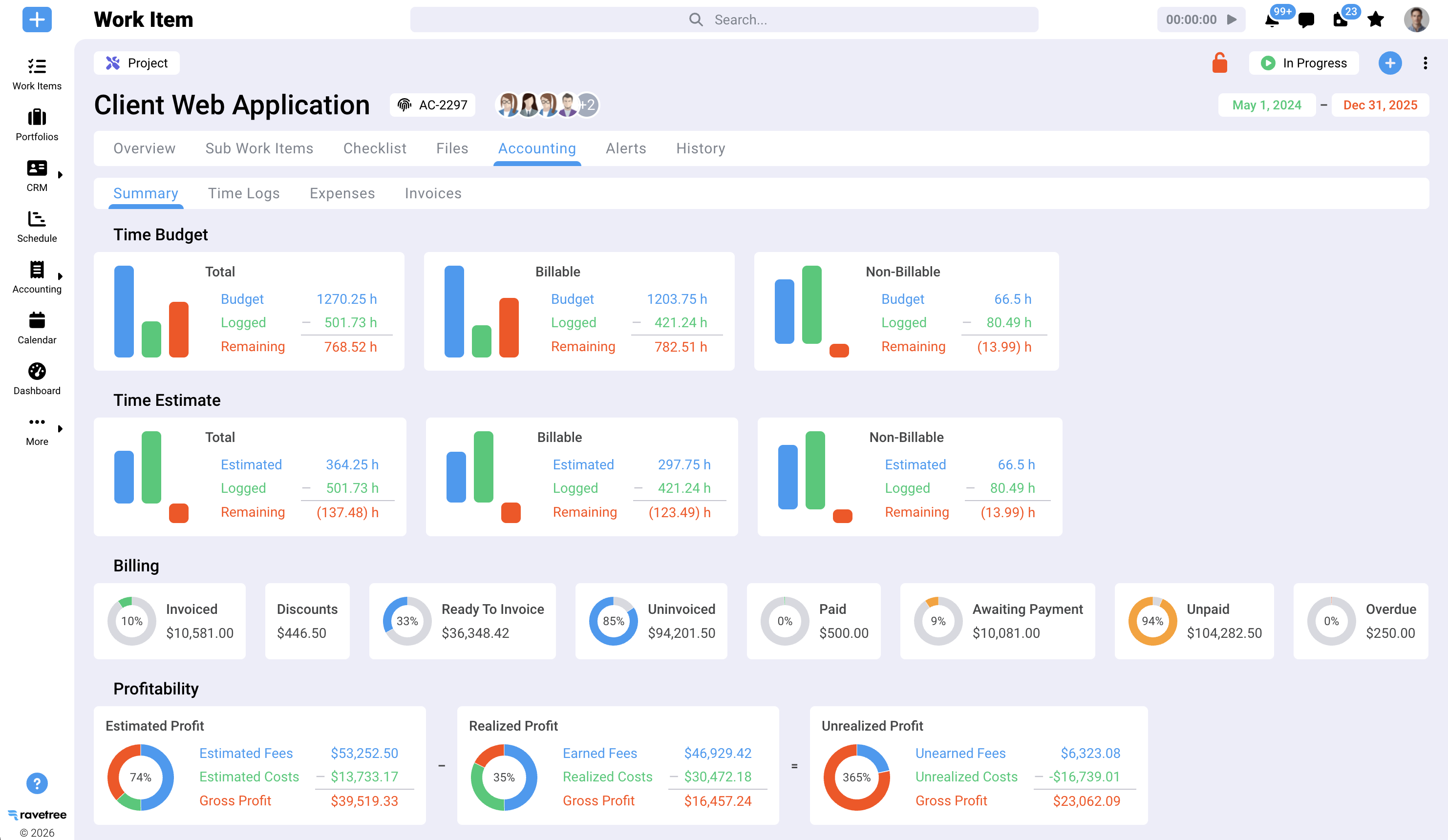
Your team logs time directly against the tasks they're completing. Those hours automatically contribute to project budget tracking and appear in billing, where you can identify which clients have completed work that's ready to invoice. Expense tracking and purchase orders are also connected to projects. Purchase orders can be linked to vendors in the CRM, helping ensure that expenses incurred on behalf of clients are assigned to the right projects instead of being overlooked or incorrectly classified as overhead.
This is an important difference between Ravetree and a collection of ClickUp or Monday integrations. When hours and expenses are already associated with the right projects, you can monitor profitability as work progresses instead of waiting until the end of the quarter to piece together the financial results.
Retainers and client visibility
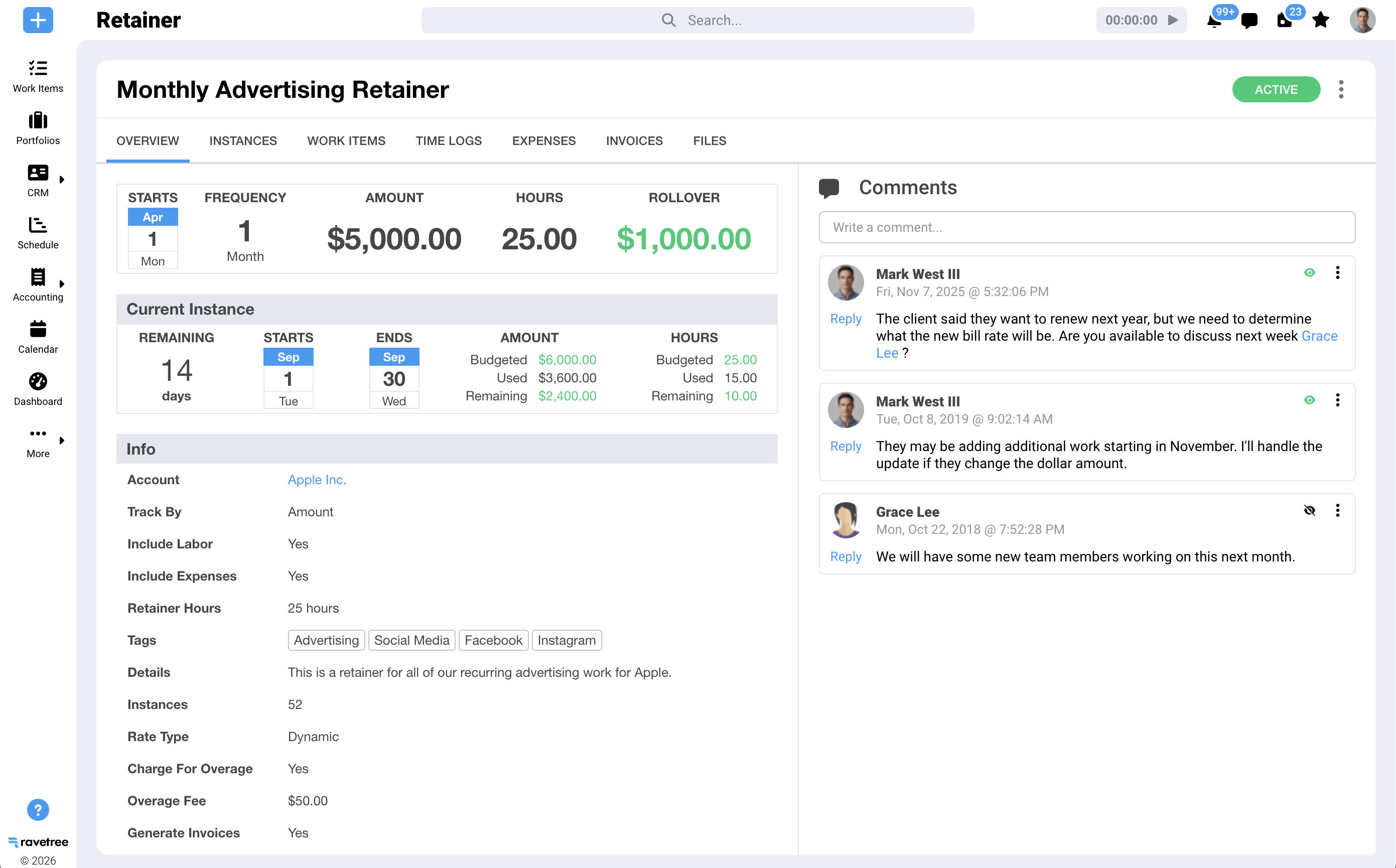
Ravetree provides dedicated retainer tracking, allowing you to monitor monthly usage against each client's allocated hours and identify potential over-servicing before the billing period ends. Clients can access a portal to view the status of their projects and submit structured requests instead of sending emails to whichever team member they contacted most recently.
This connected workflow is what agency management software should provide. For a closer look at why it matters when sales and finance operate on the same platform, see Ravetree's guide to agency management software with invoicing and CRM.
Built for the size most agencies actually are
About 87% of North American digital agencies employ fewer than 50 people. This is the market Ravetree is designed to serve: agencies large enough to need reliable financial controls but small enough to want to avoid a lengthy, complicated enterprise software implementation. If your agency has between 15 and 50 employees, this breakdown of the best agency management system for a 15- to 50-person marketing team explores the operational challenges that often arise as agencies grow. Smaller agencies can also consult the guide to agency management software for small business.
ClickUp vs. Monday vs. Ravetree: The Agency Scorecard
Here's how the three platforms compare against the five criteria outlined above. In this comparison, "Integration" means that you'll need another product or connector to achieve the required functionality.
Deal-to-project handoff: ClickUp generally requires manual processes or automations. Monday typically requires a separate CRM product. Ravetree provides a native CRM connected to projects.
Time tracking: ClickUp offers native time tracking. Monday includes it on Pro and higher plans. Ravetree offers native time tracking connected to project budgets and billing.
Invoicing from tracked time: ClickUp and Monday generally require integrations. Ravetree provides native invoicing functionality.
Capacity and resource planning: ClickUp and Monday offer workload views. Ravetree provides resource planning connected to projects and budgets.
Retainer management: ClickUp and Monday typically require workarounds. Ravetree offers dedicated retainer tracking.
Client portal and intake: ClickUp relies on guest-access workarounds, while Monday offers guest access. Ravetree provides native client portals and request forms.
Expenses and purchase orders: Neither ClickUp nor Monday offers native functionality for managing these processes as part of a connected agency workflow. Ravetree supports expenses and purchase orders linked to projects and vendors.
Setup effort for agency workflows: ClickUp typically requires substantial configuration, while Monday requires a moderate amount of setup. Ravetree includes an agency-focused operating model, reducing the amount of customization needed.
The differences largely come down to each platform's intended purpose. ClickUp and Monday offer flexible ways to organize work and customize workflows. Ravetree is designed to connect project delivery with the financial processes that determine an agency's profitability.
When ClickUp or Monday Is Still the Right Call
Not every agency needs to switch platforms.
ClickUp may be suitable for a small team managing straightforward fixed-fee projects, particularly if its bookkeeper already has a reliable invoicing process and the team is comfortable building and maintaining its own workflows. Monday may be sufficient for an in-house marketing team that doesn't bill external clients or for an organization whose primary need is simply to improve visibility into ongoing work.
However, it may be time to consider a dedicated agency management platform when two or more of the following conditions apply:
- You bill hourly or manage retainers and spend time reconciling time-tracking exports every month.
- You can't easily determine which clients were profitable last quarter without building a spreadsheet.
- Your software stack includes three or more paid tools just to manage the process from signed deal to paid invoice.
- Your project managers regularly discover staffing conflicts after the work has already been sold.
If these situations sound familiar, the flexibility of your current platform may be creating more work than it saves.
How to Switch Without Losing a Month
Platform migrations can become disruptive when agencies attempt to move every process and piece of data at once. A phased approach can make the transition more manageable.
- Start with clients and rates. Import your client accounts, contacts, and rate cards first. These records are the foundation for your projects, time tracking, and billing, so getting them right is essential.
- Rebuild your top three project templates. There's no need to migrate your entire project archive immediately. Start by recreating the templates your team uses most often, including the appropriate roles and estimated hours.
- Run one billing cycle in parallel. Track time in the new platform for a full billing cycle while continuing to use your existing process. Then compare the invoices generated by each system. Any discrepancies can help you identify where hours or expenses may have been missed.
- Move retainers next. Set up each client's monthly hour allocation and rollover rules, then provide clients with access to their portals.
- Retire old tools on renewal dates. Cancel existing subscriptions as their renewal dates approach rather than discontinuing everything at once. This helps avoid unnecessary disruption and overlapping costs.
Following this sequence allows your team to adopt one new process at a time instead of having to change everything at once. Creative agencies with complex review and approval workflows should also read Ravetree's guide to all-in-one creative agency management software. Performance-focused teams may also find its guide to the best digital marketing agency management system useful.
Flexible Boards or a Connected Business: The Real Choice
ClickUp and Monday are both capable platforms for organizing work. The more important question for an agency is whether task organization is its biggest operational challenge.
For many agencies with more than a dozen employees, the bigger problem is that projects, hours, billing rates, and invoices are spread across multiple systems. Every gap between those systems creates opportunities for wasted time, missed billable work, and inaccurate financial reporting.
That's why evaluating agency management software alternatives to ClickUp and Monday requires looking beyond task management and customization. Agencies need platforms that connect sales, project delivery, resource capacity, and billing. Ravetree was designed to bring these processes together.
A practical next step is to choose one of your most complicated client projects from last quarter. Trace a single hour of work from the original timesheet entry through to the final invoice. Count how many different tools were involved. If the process requires multiple systems and manual data entry, it may be time to evaluate agency management software designed specifically for client-service businesses.
Frequently Asked Questions
What is agency management software?
Agency management software is a platform that connects CRM, proposals, project delivery, resource planning, time tracking, and invoicing for client-service businesses. Unlike general-purpose task boards, it helps agencies track both the work being completed and the costs and revenue associated with that work.
Is ClickUp or Monday good enough for agencies?
Both platforms can work well for task visibility and small teams with relatively simple billing requirements. However, agencies that bill hourly or manage retainers may eventually need additional functionality. Invoicing, advanced capacity planning, and client portals often require integrations or workarounds, which can increase administrative effort.
Why do agencies switch from ClickUp or Monday to Ravetree?
Ravetree connects client deals, projects, time tracking, and invoicing in one system. By reducing manual reconciliation between applications, it helps agencies manage their operations more efficiently and monitor project profitability while work is still underway.
How long does it take to switch platforms?
Many agencies can migrate their core operations over a few weeks by importing clients and billing rates first, rebuilding their most frequently used project templates, and running one billing cycle in parallel. Phasing out existing tools as their subscriptions come up for renewal can also help avoid paying for multiple platforms longer than necessary.


.png)