
Key takeaways:
Count the software your agency logged into yesterday. Not the tools you pay for — the ones you actually opened. For most creative shops, the honest number lands north of a dozen, and the average enterprise now runs roughly 120 marketing technology tools. That sprawl is exactly why the best creative agency management software all in one has become a survival question, not a luxury purchase. This guide breaks down what real creative agency management software has to deliver, how to tell a unified system from a duct-taped bundle, and where the money quietly leaks when you get the choice wrong.
Why "all-in-one" went from nice-to-have to non-negotiable
Agencies rarely plan their software. They accumulate it. A tool for tasks here, a tracker for hours there, a spreadsheet holding whatever nothing else captures.
Every one of those tools arrived solving a single problem. Together, they created a bigger one. The same client now lives in four systems, and nobody can answer a simple question without stitching data together by hand.
The cost shows up in attention first. Workers toggle between apps and websites nearly 1,200 times a day, losing close to four hours a week just reorienting — about 9% of their working time. Multiply that across a 20-person team, and you're funding a ghost employee who does nothing but click between tabs.
Then there's the waste you pay for and never use. The martech market has ballooned to more than 15,000 products, and the average stack now holds around 106 tools whose capabilities are roughly two-thirds unused. You bought suites. You use slivers.
For a creative agency, fragmentation isn't just annoying. It's margin. When your contact records, your project management board, your time tracking, and your invoicing all disagree about the same job, someone spends Friday afternoon reconciling them instead of billing.
What creative agency management software actually has to cover
An all-in-one earns the name only if it runs the entire arc of agency work — from the first sales conversation to the final paid invoice — inside one data model. Here's the arc that matters, and why each stage belongs in the same system.
Winning and scoping the work
It starts before the project exists. A CRM built for agencies keeps every lead, contact, and account in the place where the work will eventually live, so nothing gets retyped later. Bolting work management onto a separate CRM should be the baseline expectation, not a premium add-on.
Then come proposals. They turn conversations into scoped, priced documents — and when a proposal is approved, the project shouldn't have to be rebuilt from scratch somewhere else.
Planning who does what
Selling work you can't staff is how agencies burn out their best people. Resource planning shows real capacity across the team, so you commit to deadlines you can actually hit.
Retainers need their own logic — recurring scope, monthly ceilings, rollover rules — that generic task apps fumble. If your tool treats a retainer like a regular project, you'll leak revenue every month you don't notice the overage.
Doing the work
This is the part most tools get partly right. Creative project management for agencies has to handle briefs, review cycles, dependencies, and the reality that a "quick logo tweak" spawns nine rounds.
Intake matters just as much. A structured requests system keeps stray Slack pings and hallway asks from becoming untracked scope. Untracked scope is unbilled scope.
Tracking the money
Creative work gets sold in hours, deliverables, and retainers, and all three have to reconcile. Time tracking should feed billing directly, so hours logged become dollars invoiced without a spreadsheet in the middle.
Expense tracking and purchase orders capture the costs that quietly erode a project's margin — the stock photos, the contractor invoices, the print runs. Miss those, and your "profitable" project wasn't. Billing closes the loop.
Keeping clients in the loop
Clients don't want status meetings. They want to see where things stand, on their own time. A client portal gives them a controlled window into deliverables, approvals, and invoices, which kills the endless "any update?" emails and makes your agency look organized instead of frantic.
"Integrated" and "unified" are not the same word
Vendors love the word "integrated." Read it carefully. Sometimes it means one system with one database. Often, it means two separate products passing data through a connector that breaks the moment someone renames a field.
Plenty of project management software can run a task board and sync to a time tracker through a third-party connector. That's a bundle, not a system. When the sync lags, your utilization report is wrong — and you find out only when a client disputes the invoice.
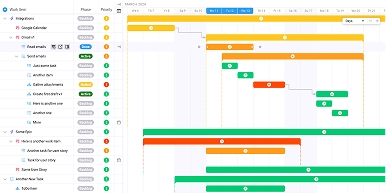
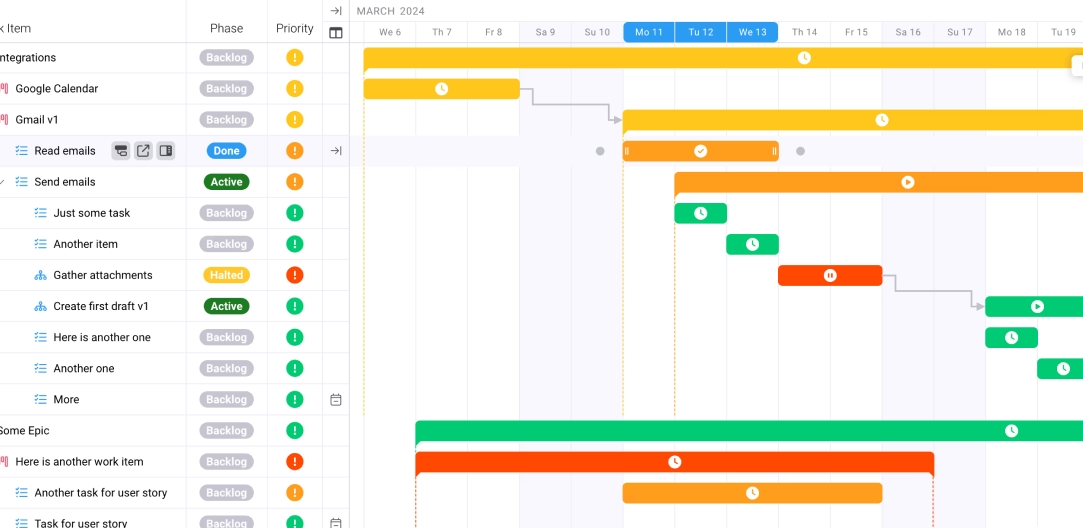
A true all-in-one keeps one record for each client, project, task, and hour. Change it once, and every view — the Gantt chart, the budget, the portal, the invoice — updates together.
There's no reconciliation step because there's nothing to reconcile. That's the difference between software that reports what already went wrong and software that quietly prevents the error in the first place.
The financial case for consolidating your stack
Here's where the argument stops being about convenience and starts being about profit.
Billable utilization — the share of paid hours you actually sell — is the master lever of agency profitability. It fell to 66.4% in 2025, the lowest on record and well under the 75% considered healthy. Every point you leave on the table is capacity you already paid salaries for.
Poor visibility is a big reason utilization leaks. When hours live apart from project plans, time goes unlogged and scope creep goes unnoticed until month-end. Agencies that actively track and manage utilization report profit margins 8 to 12 percentage points higher than those that don't.
The waste compounds at the project level. Organizations burn an average of 11.4% of every dollar invested through poor project performance — missed deadlines, redone work, and scope nobody flagged. A unified system won't fix bad judgment, but it removes the blind spots that let a small overrun hide until it's a big one.
The tooling itself is a line item, too. Consolidating point tools into one platform cuts subscriptions, integration upkeep, and the onboarding tax of teaching every new hire a stack of logins. It's no accident that organizations with a dedicated project office complete 38% more projects on time and on budget — structure and shared visibility beat scattered tools.
How to evaluate creative agency management software before you buy
Most buying regret comes from evaluating features instead of workflows. Anyone can demo a pretty task board. Fewer tools survive a real agency's month-end.
Ask these five questions, and watch how the vendor squirms:
- Does one record follow a client from lead all the way to final invoice, or does each stage need re-entry?
- Can you see live capacity and billable utilization without exporting anything?
- Do retainers, fixed-fee, and hourly work all bill correctly from the same time data?
- Will your clients actually use the portal, or is it an afterthought bolted on for the sales deck?
- When you add a person, how many separate tools and logins does onboarding touch?
If a vendor dances around the first question, you're looking at a bundle wearing an all-in-one costume. The strongest creative agency management software answers all five without a caveat. This is also the fastest way to sort the best software for managing a creative agency from a stack held together with connectors and hope.
Where Ravetree fits
I've held the recommendation until now on purpose, because the criteria matter more than the logo.
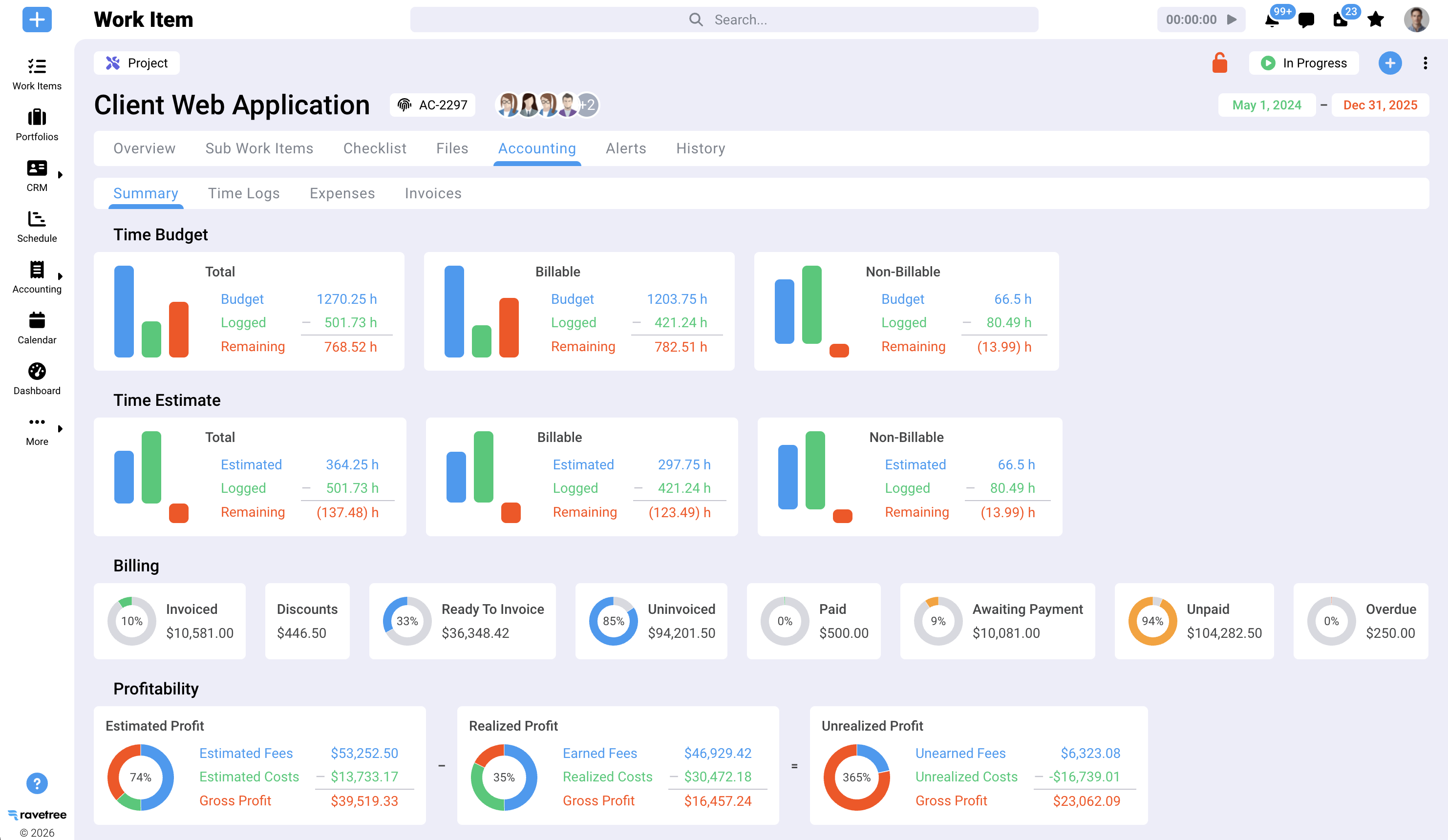
Ravetree is built as one system for the full arc of agency work — pipeline, projects, resourcing, time, and money — on a single data model rather than a bundle of connected apps. That design is what lets it behave like a genuine all-in-one instead of a collection that merely talks to itself.
The practical payoff is fewer places to look and fewer numbers to reconcile. Your proposals become projects. Your tracked hours become invoices. Your clients get a portal instead of a status call. Utilization and margin stay visible while a project is running, not after it's already lost money.
It won't be the right fit for a solo freelancer who needs one lightweight app, and that's fine. But for a 15-to-50-person shop drowning in logins, a purpose-built agency system is usually the fastest route to cleaner data and steadier margins.
Before you commit, it's worth seeing how practitioners weigh the top all-in-one options side by side. The category label matters less than whether the tool holds one truth across your whole operation.
The system you'll actually consolidate onto
The best tool is the one your team stops working around. Every point solution you add is another reconciliation, another login, another place for the truth to fork.
Consolidation isn't really about buying software. It's about buying back the hours your team currently spends stitching tools together — and the margin those hours represent.
If you're weighing the best creative agency management software all in one, judge it on the full arc of your work, not a feature checklist. The right creative agency management software makes one number true everywhere and hands your people back the time to do the creative work clients actually pay for.
Frequently Asked Questions
What is creative agency management software?
It's a unified platform that runs the full arc of agency operations — CRM, proposals, project management, resource planning, time tracking, and billing — from a single database instead of separate point tools that have to be synced.
What makes an "all-in-one" different from an integrated suite?
An all-in-one keeps one shared record for every client, project, and hour, so nothing needs syncing. An "integrated" bundle connects separate products, which can drift out of sync and produce conflicting reports.
Is all-in-one software worth it for a small agency?
Usually, once you're past a handful of people. If your team juggles more than three or four tools holding the same client data, consolidation typically pays for itself in recovered utilization and lower software spend.
Does consolidating tools really improve profitability?
Indirectly, yes. Clear visibility into billable utilization and project budgets is strongly tied to higher margins, and consolidation removes the reconciliation work that quietly eats billable hours.
Can one platform really replace our entire stack?
For most agency workflows — pipeline, delivery, and finance — yes. You may keep a specialized design or file tool, but the operational core can live in one system.