.png)
Key takeaways:
Creative agencies don't usually struggle because they can't create tasks. They struggle because projects, people, budgets, clients, time, expenses, and invoices often live in separate systems.
That disconnect can make an agency look busy while quietly eroding profitability. A 2025 Project Management Institute survey found that 97% of marketing and advertising agency professionals surveyed had experienced at least one major campaign challenge during the previous year, with 55% reporting projects going over budget and 54% experiencing overdue deadlines.
That makes choosing the right Creative Agency Software more than a technology decision. It is an operational decision that can affect project profitability, resource utilization, client experience, and the agency's ability to scale.
The best platforms connect the different parts of agency operations rather than simply giving teams another place to manage tasks.
This guide compares six all-in-one platforms:
- Ravetree
- Scoro
- BigTime
- Accelo
- Workamajig
- Kantata
Each takes a somewhat different approach to agency management. The right choice depends on your agency's size, workflow, financial requirements, resource-management needs, and growth plans.
Why Creative Agencies Need More Than Project Management
A project-management application can be excellent at organizing tasks and deadlines while still leaving an agency with major operational gaps.
Consider what happens after a new client signs a contract.
Someone needs to turn the agreement into a project. Resources need to be assigned. Hours need to be estimated. Deadlines need to be established. Deliverables need to move through review and approval. Team members need to record their time. Expenses need to be captured. Account managers need visibility into client activity. Finance needs to know what can be invoiced.
If those activities happen in disconnected applications, someone eventually has to reconcile the information.
That reconciliation is where agencies lose time and visibility.
An agency can win more business and still struggle if it cannot accurately estimate work, allocate resources, control scope, capture billable time, and understand project profitability.
That is where all-in-one Creative Agency Software can provide an advantage.
What to Look for in All-In-One Creative Agency Software
Before comparing individual platforms, establish what "all-in-one" should actually mean for your agency.
A platform should connect the areas of the business that influence one another instead of simply offering a long list of unrelated features.
Project Management
The platform should handle the actual work: projects, tasks, milestones, dependencies, deadlines, approvals, recurring work, templates, and workflows.
Creative agencies need enough structure to keep work moving without creating unnecessary administrative overhead for designers, writers, developers, strategists, and other specialists.
Resource Planning
Knowing what needs to be done is only half the equation.
You also need to know who can do it.
Resource planning should make upcoming demand visible alongside current workloads and availability. Ideally, managers can identify capacity problems before a new project is promised to a client.
This becomes increasingly important as an agency grows. More clients, more specialized roles, contractors, and simultaneous projects make informal staffing decisions much harder.
Time Tracking
Time tracking is particularly important for agencies because employee time is often one of the largest costs associated with delivering client work.
It is also important for understanding project profitability.
If a project was estimated at 100 hours but ultimately requires 150 hours, that information should not disappear into a timesheet. It should feed back into project management, budgeting, forecasting, and future estimating.
That gap can have a direct financial impact.
Budgets and Financial Management
Project budgets should not exist in a separate financial universe.
Project managers should be able to see how much of a budget has been consumed. Executives should be able to see whether projects are profitable. Finance teams should be able to move from project activity to invoicing without manually rebuilding the financial picture.
Client Management
Creative agencies don't simply manage projects. They manage relationships.
CRM capabilities, client portals, approvals, communication, requests, and client-facing visibility can help keep account management connected to delivery.
Reporting
Reporting should help answer business questions rather than simply display information.
Agency leaders should be able to answer questions such as:
- Which projects are over budget?
- Which clients generate the strongest margins?
- Which employees are overallocated?
- Where does the agency have unused capacity?
- How much work is currently unbilled?
- Which projects are approaching their deadlines?
- Which accounts are consuming more resources than expected?
With those requirements in mind, let's compare six leading platforms.
1. Ravetree — Best All-Around Platform for Client-Focused Creative Agencies
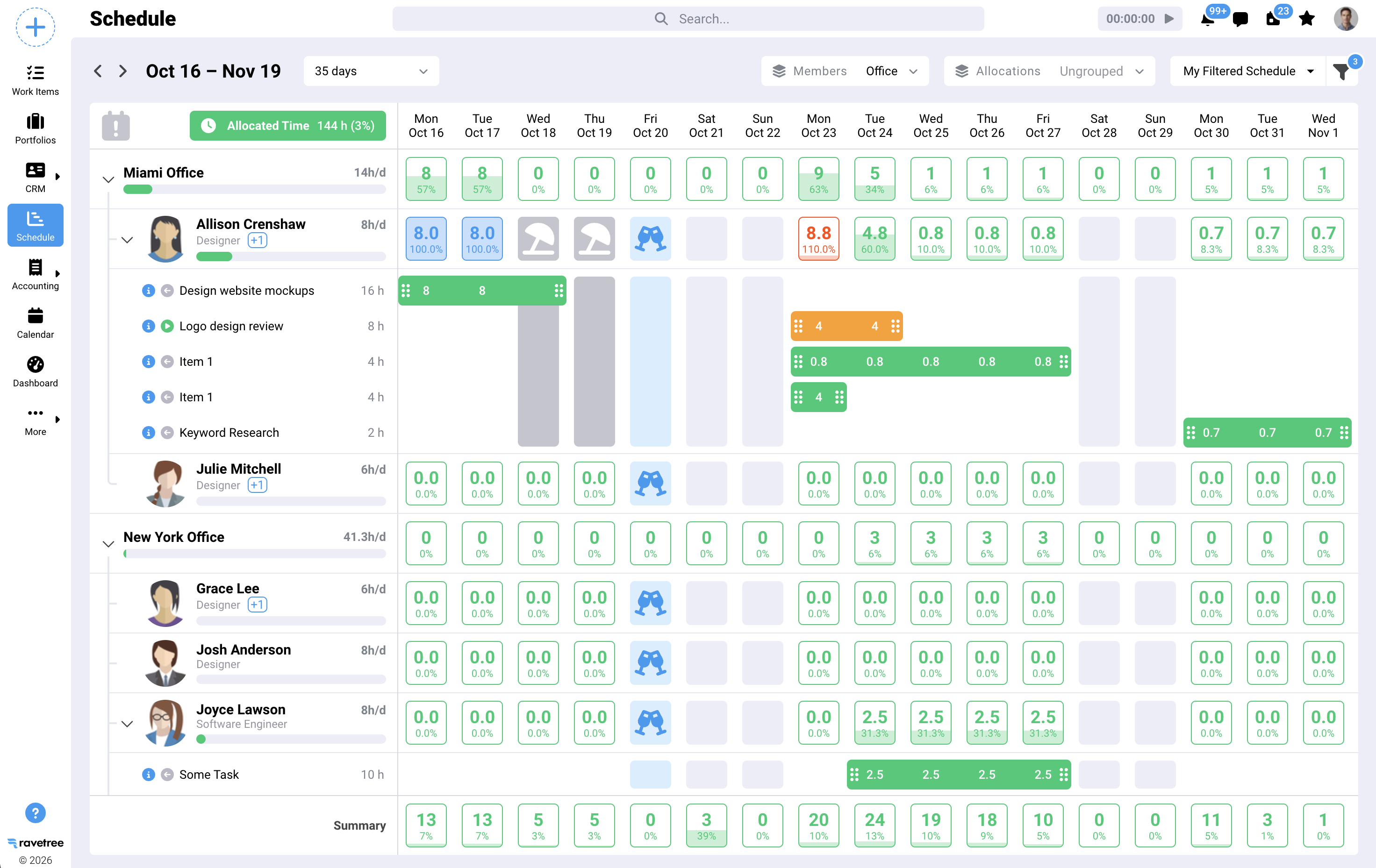
Ravetree takes a broad approach to agency and professional-services management, combining project delivery with resource planning, time and expense tracking, billing, CRM, client portals, and financial visibility.
Ravetree describes its platform as an all-in-one work management and professional services automation platform that combines project management, resource planning, CRM, time and expense tracking, billing, and client portals.
That breadth makes Ravetree particularly interesting for agencies that have reached the point where traditional project-management software no longer provides enough operational context.
Its creative-agency solution is specifically positioned around managing resources, billing, file approvals, creative workflows, project management, time and expenses, CRM, client portals, requests, and retainers.
The advantage is the relationship between those functions.
Suppose a creative director assigns a designer 30 hours of work against a project. The agency doesn't just need to know that the task exists. It needs to know how those 30 hours affect resource capacity, project budget, client billing, and ultimately profitability.
That interconnected view is one of the most important distinctions between all-in-one Creative Agency Software and a collection of individual applications.
Ravetree's agency project-management capabilities also include timeline views, repeating tasks, project templates, client portals, file approvals, and client requests.
This makes the platform particularly well suited to full-service marketing agencies, advertising agencies, creative studios, digital agencies, and other client-service firms that want broad functionality without stitching together multiple systems.
Best for: Creative, marketing, advertising, digital, and other client-service agencies looking for a broad operating platform.
Key strengths: Project management, resource planning, time and expense tracking, billing, CRM, client portals, budgeting, and financial visibility.
Why consider it: Ravetree is particularly well suited to agencies that want project delivery and business operations in the same system rather than adding separate applications as they grow.
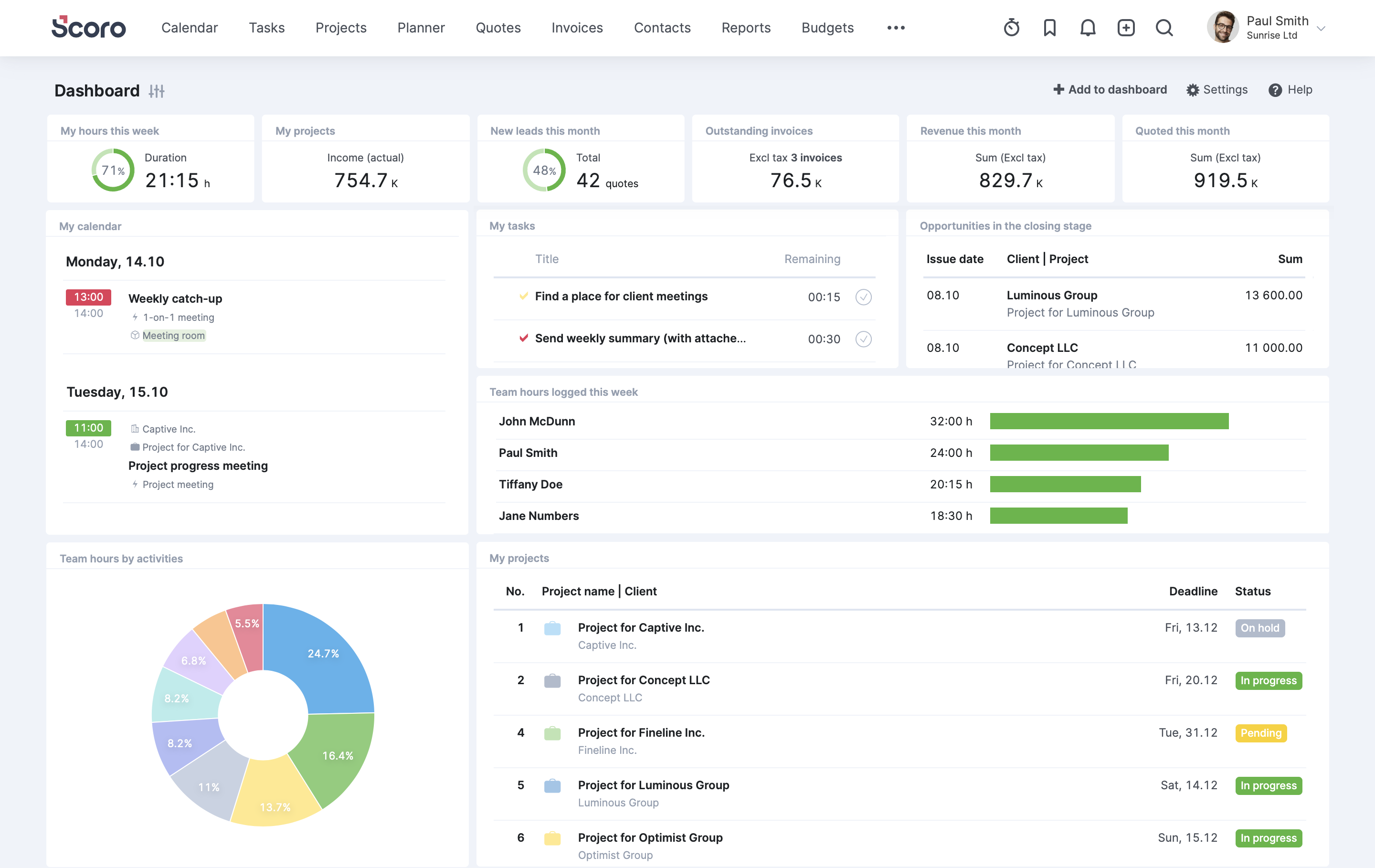
2. Scoro — Best for Integrated Agency Operations and Reporting
Scoro takes an integrated approach to agency operations, bringing together projects, resources, time tracking, invoicing, and reporting.
Scoro's agency-management platform specifically targets creative, marketing, and advertising businesses and emphasizes managing projects, resources, time tracking, invoicing, and reporting in one place. Scoro's agency management software
That makes Scoro particularly relevant for agencies that want management reporting to be closely connected to day-to-day project activity.
The platform's appeal is less about any single creative workflow and more about operational visibility.
An agency leader can use integrated information to understand what work is underway, how resources are being used, and how project activity relates to financial performance.
Scoro can therefore be a strong fit for agencies that have moved beyond simple task management and need a more centralized operational system.
It can also be useful when management reporting is a major consideration. Instead of asking different departments to produce separate spreadsheets, the goal is to make project, resource, time, and financial information available through one connected environment.
Best for: Growing agencies that want integrated project, resource, time, and financial management.
Key strengths: Project management, resource planning, time tracking, invoicing, reporting, financial visibility, and agency operations.
Why consider it: Scoro is worth evaluating when leadership wants a centralized view of agency performance rather than separate operational and financial systems.
3. BigTime — Best for Professional Services and Financially Focused Agencies
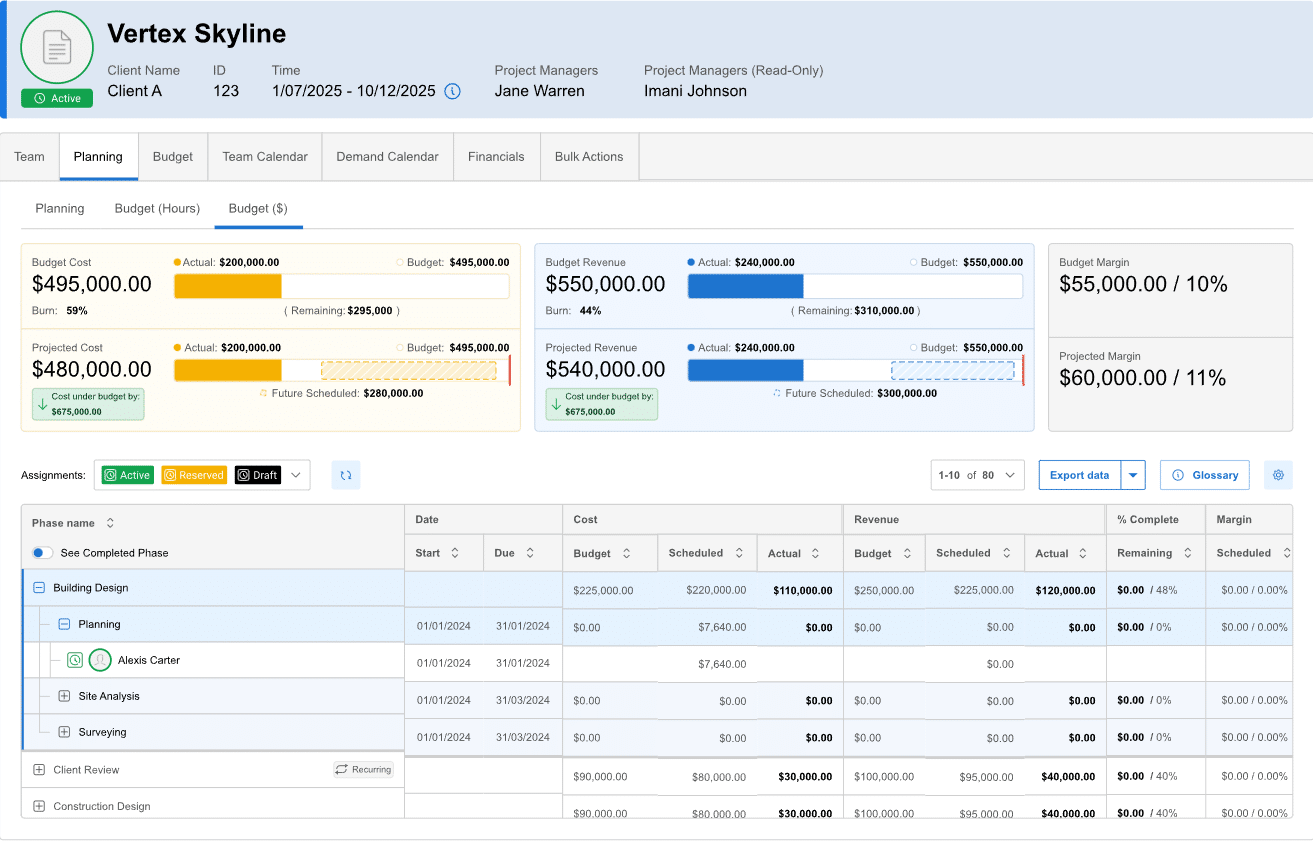
BigTime approaches agency management from a professional-services perspective, with a strong emphasis on project management, resource planning, time tracking, billing, and operational efficiency.
BigTime specifically markets its platform to marketing, creative, and digital agencies and describes it as an all-in-one system intended to streamline agency operations. BigTime's agency management software
That positioning makes BigTime particularly relevant for agencies where financial control is a major concern.
Consider a fixed-fee project estimated at 200 hours.
The project manager needs to know how many hours have been used. Finance needs to know how much of the budget remains. Leadership needs to know whether the project is still expected to produce an acceptable margin.
Those aren't three separate questions. They're different views of the same project.
BigTime's professional-services orientation makes that connection a central part of the platform.
The software can therefore be attractive to agencies that want stronger control over billable work, time, resources, and financial reporting.
Best for: Agencies and professional-services firms with significant billable work and strong financial-management requirements.
Key strengths: Project management, resource planning, time tracking, billing, reporting, and project financial visibility.
Why consider it: BigTime is a strong candidate when the agency's primary software challenge is connecting delivery activity to billing and financial performance.
4. Accelo — Best for Agency Automation and Profitability
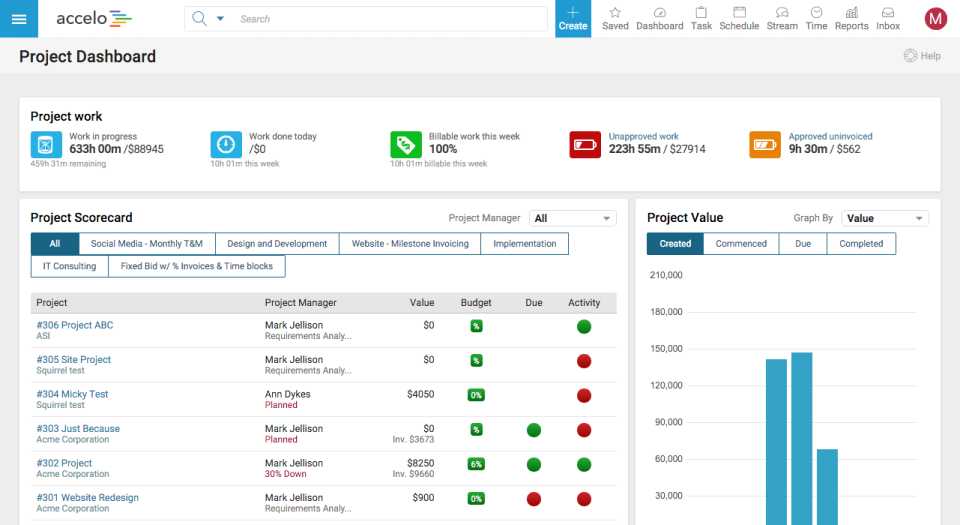
Accelo takes a professional-services automation approach to agency management.
Its agency platform focuses on controlling scope, optimizing resources, balancing workloads, protecting margins, and identifying revenue leakage. Accelo's agency management software
That makes it particularly interesting for agencies struggling with administrative overhead and profitability.
Consider scope creep.
A client requests several additional revisions. An account manager agrees to the work. The creative team completes it. Nobody updates the project estimate. The agency eventually discovers that the engagement consumed considerably more time than planned.
The problem wasn't necessarily that the client requested additional work.
The problem was that the operational and financial consequences of the request weren't connected.
Accelo specifically focuses on the difference between utilization and realization. An agency may have employees who appear fully occupied while still failing to turn all of that activity into revenue. Accelo's agency management software
For agencies that want more automation around client work, project operations, resource management, and profitability, this can be an important distinction.
Best for: Agencies focused on automation, scope management, utilization, and profitability.
Key strengths: Professional-services automation, project management, resource management, scope control, client management, and financial visibility.
Why consider it: Accelo is worth considering if administrative complexity and revenue leakage have become significant operational problems.
5. Workamajig — Best for Creative and Advertising Agency Workflows
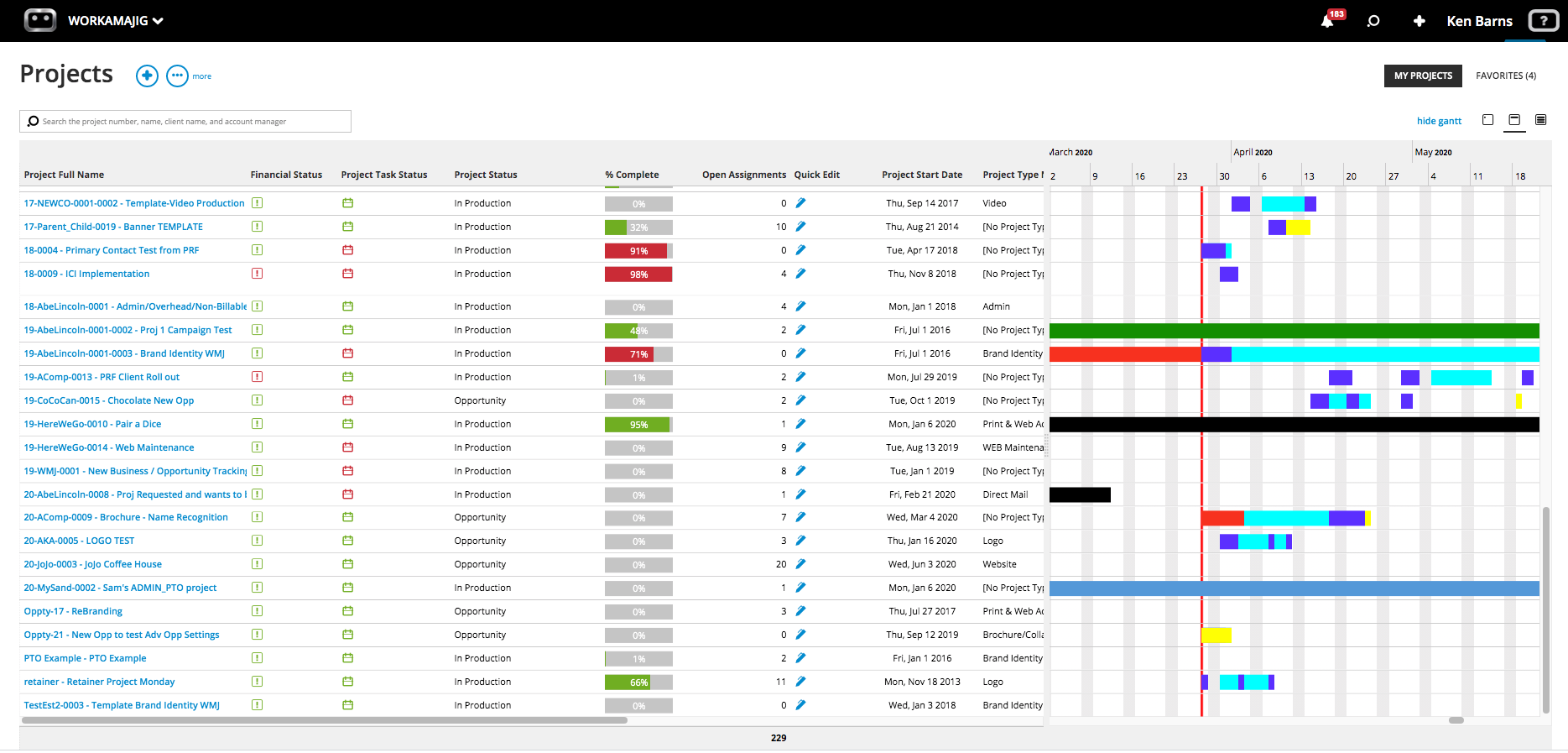
Workamajig is built specifically around creative, advertising, marketing, and in-house creative workflows.
That specialization is one of its biggest differentiators.
Workamajig describes its platform as an all-in-one agency-management system that combines project management, resource scheduling, time tracking, and financials for creative agencies, in-house creative teams, and marketing firms. Workamajig's agency management platform
This makes it particularly relevant to established creative agencies with structured production processes.
A typical creative organization may have account managers, creative directors, designers, copywriters, production specialists, media teams, and other roles working across many simultaneous engagements.
The software needs to coordinate more than deadlines. It needs to help management understand what work is coming, who is available, how projects are progressing, and what those projects mean financially.
Workamajig also emphasizes the connection between projects and financial outcomes, including visibility into time, margins, estimates, billing, and profitability. Workamajig's agency-management platform
Its long-standing focus on advertising and marketing agencies makes it particularly relevant to organizations that want software aligned with established creative-production workflows.
Best for: Creative agencies, advertising agencies, marketing organizations, and in-house creative departments.
Key strengths: Creative project management, resource scheduling, time tracking, financial management, production workflows, client management, and profitability reporting.
Why consider it: Workamajig is a logical choice when creative production and agency-specific workflow management are more important than generic project-management functionality.
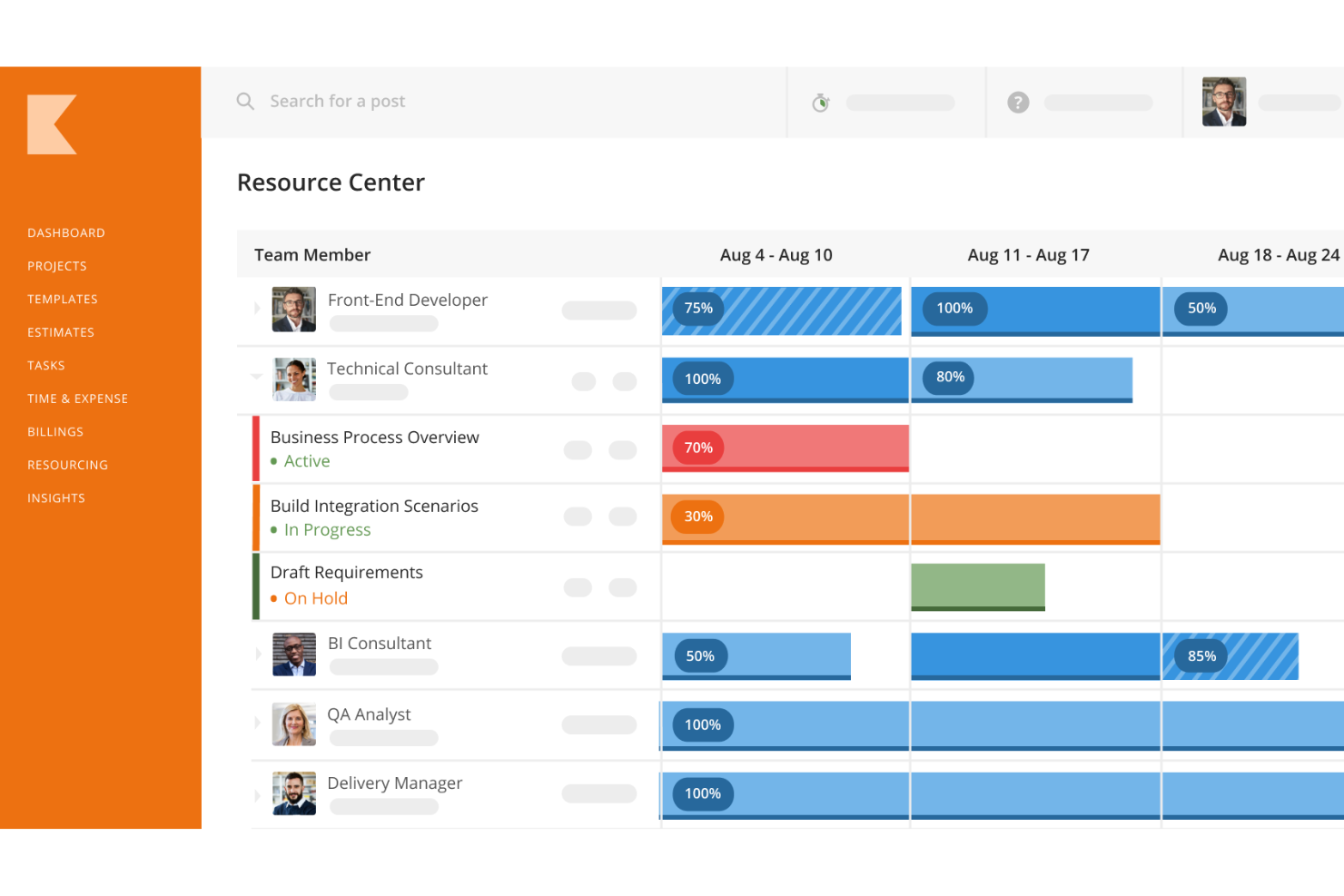
6. Kantata — Best for Complex Resource Management
Kantata is particularly strong in resource management and professional-services operations.
Its platform connects resource management and forecasting with project management and financial management. Kantata describes its resource-management software as connecting resource management with pipeline forecasting, project financials, skills optimization, talent access, and business intelligence. Kantata's resource management software
That makes Kantata especially relevant to larger agencies with complicated staffing requirements.
As an agency grows, resource planning becomes increasingly difficult.
A project may require a designer with a particular specialization, a senior strategist for a limited number of hours, and a developer who is already committed to another client. At that point, simply knowing whether someone is "available" isn't enough.
Managers need to understand skills, capacity, timing, project demand, and financial implications simultaneously.
Kantata's resource forecasting capabilities are designed to provide that broader view, including cross-project scheduling and data-driven staffing decisions. Kantata's resource forecasting software
Its resource-allocation tools also emphasize centralized visibility across employees and contractors and the ability to adjust schedules as project requirements change. Kantata's resource allocation software
This becomes particularly valuable for larger agencies where staffing decisions have a significant impact on project delivery and profitability.
Best for: Larger agencies and professional-services organizations with complex resource-planning requirements.
Key strengths: Resource forecasting, capacity planning, skills-based staffing, project management, financial management, and professional-services reporting.
Why consider it: Kantata becomes particularly compelling when resource management is one of the agency's biggest operational challenges.
How the Six Platforms Compare
Each platform has a different center of gravity.
Ravetree is a broad all-in-one choice for agencies that want project management, resources, time, expenses, clients, billing, and financial management connected.
Scoro emphasizes integrated agency operations and management visibility.
BigTime is particularly strong for agencies that need close connections between billable work, time, resources, billing, and financial reporting.
Accelo emphasizes professional-services automation, scope management, and profitability.
Workamajig has a strong creative-production orientation and is particularly relevant to traditional creative and advertising workflows.
Kantata is especially compelling for organizations with sophisticated resource-planning and forecasting requirements.
The right answer therefore depends on the problem you're trying to solve.
If your agency has too many disconnected systems, prioritize integration.
If projects are routinely going over budget, prioritize financial visibility and time tracking.
If teams are overloaded while other people sit underutilized, prioritize resource planning.
If scope creep is hurting margins, prioritize scope and client-work controls.
If creative production is highly structured, look closely at workflow and traffic-management capabilities.
If your agency has become large enough that staffing requires sophisticated forecasting, resource-management depth should be high on your list.
How to Evaluate Creative Agency Software
A feature checklist is useful, but it shouldn't be the primary evaluation method.
Instead, take one real client project and walk each prospective platform through the entire lifecycle.
Start with the opportunity.
How would the client and project be created?
Then move into planning.
How would you estimate the work? How would you assign resources? How would you establish the budget?
Next, simulate execution.
Can employees record time easily? Can managers see project progress? Can the account team monitor client requests? Can someone identify when the project is drifting beyond its original scope?
Then examine the financial side.
Can you see actual versus planned hours? Can you understand project costs? Can you determine what should be invoiced? Can leadership see project profitability?
Finally, test reporting.
Ask the vendor to show you the information an executive would need at the end of the month.
You should be able to answer questions about project performance, resource capacity, client profitability, billing, and upcoming demand without manually combining spreadsheets from multiple departments.
That exercise often reveals more than a product demonstration.
Implementation Matters as Much as the Software
Even the best Creative Agency Software won't solve an agency's problems if the underlying workflows remain inconsistent.
Start by defining your standard project lifecycle.
Decide how projects are created, how estimates are approved, how resources are assigned, how scope changes are handled, how time is recorded, and how completed work moves toward billing.
Then configure the software around that process.
Don't try to automate everything immediately.
Choose a few high-value workflows first. Project creation, resource allocation, time tracking, budget monitoring, and invoicing are often good starting points because they connect directly to agency economics.
Also make the information useful to the people entering it.
Employees are much more likely to maintain accurate time and project data when they can see how that information helps them manage their own work.
That matters because inaccurate operational data creates a vicious cycle: managers don't trust the system, so they create spreadsheets, which means employees have another place to enter information, which further reduces adoption.
The objective should be a single operational source of truth.
The Metrics That Matter After Implementation
Once your agency has implemented new Creative Agency Software, measure whether the investment is actually changing the business.
Project Profitability
Compare estimated project economics with actual performance.
Look at planned hours, actual hours, project costs, revenue, write-offs, and margin.
Resource Utilization
Track utilization, but don't treat an industry benchmark as an automatic target.
The appropriate utilization level depends on billing rates, costs, contract structure, employee mix, and the firm's margin model. Kantata's resource-management guidance similarly emphasizes balancing utilization with project requirements, capacity, and profitability rather than treating utilization as an isolated number.
On-Time Delivery
Monitor whether projects and milestones are being completed when promised.
Late projects can create more than client frustration. They can also consume additional labor and reduce the profitability of fixed-fee engagements.
Scope Changes
Measure how often projects change after approval and how those changes affect budget and timeline.
Scope management is especially important because agencies can lose significant amounts of unplanned labor when additional work is performed without corresponding changes to project economics.
Billing and Cash Flow
Track unbilled time, invoice turnaround, outstanding receivables, and the time between completing work and sending the invoice.
A project isn't financially complete simply because the creative team has delivered the final files.
Client Profitability
Revenue alone doesn't tell you whether an account is valuable.
Compare revenue with the resources required to deliver the work.
A client generating $500,000 in annual revenue may be less attractive than a $250,000 client if the first account requires dramatically more labor and produces substantially lower margins.
What to Expect From Agency Software Next
The next stage of Creative Agency Software will be less about putting more features into a dashboard and more about helping agencies make better decisions.
The more interesting opportunity is what happens beyond content generation.
Software can increasingly help agencies identify unusual project patterns, forecast resource demand, identify potential delivery problems, summarize project health, and surface financial risks.
That doesn't mean agencies should buy software simply because it includes AI.
Instead, ask what decisions the technology can improve.
Can it help identify a project that is likely to exceed its budget?
Can it help determine whether the agency has enough capacity to accept a new engagement?
Can it identify a recurring pattern of scope creep?
Can it help managers understand which resources will be needed several weeks from now?
The broader direction is clear: agency management software is becoming less about recording what happened and more about helping leaders understand what is likely to happen next.
Frequently Asked Questions
What is Creative Agency Software?
Creative Agency Software is a business-management platform designed to help creative, marketing, advertising, and digital agencies manage projects, resources, clients, time, finances, and workflows in a connected environment.
What features should creative agencies look for?
The most important capabilities typically include project management, resource planning, time tracking, budgeting, billing, financial reporting, CRM, client collaboration, workflow automation, and management dashboards.
Is all-in-one software better than using several specialized tools?
Not automatically. Specialized applications can be excellent at individual functions. The advantage of an all-in-one platform is that it can reduce the operational gaps created when project, resource, financial, and client information is distributed across multiple systems.
Which software is best for a creative agency?
There is no universal winner. Ravetree is a strong all-around option, Scoro emphasizes integrated agency operations, BigTime focuses heavily on billable work and financial management, Accelo emphasizes automation and profitability, Workamajig is strongly oriented toward creative production, and Kantata is particularly strong in resource management.
What is the biggest mistake agencies make when selecting software?
Choosing software based primarily on features rather than business problems. An agency should first identify where it is losing time, money, visibility, or capacity and then evaluate which platform addresses those problems.
How should an agency compare different platforms?
Use a real project and test the complete workflow from project creation through staffing, execution, time tracking, budgeting, client management, billing, and reporting.
Is Creative Agency Software useful for small agencies?
It can be, particularly when a small agency has complex projects, multiple clients, billable work, contractors, or resource constraints. The right level of functionality depends more on operational complexity than employee count.