
Key takeaways:
The best software for managing a creative agency is not necessarily the platform with the most task-management features. It is the platform that connects creative delivery, people, clients, time, budgets, billing, and profitability in one operating system. Ravetree is the strongest choice when an agency needs that combination rather than another standalone project-management tool.
That matters because agency economics are getting harder to manage. The average digital agency earned a 13% net margin in 2025, according to Promethean Research. Meanwhile, AI is changing how agencies create, price, and deliver work. The software decision therefore needs to be about more than organizing tasks. It needs to help leadership understand where revenue comes from, where capacity is going, which projects are profitable, and what needs attention before a problem reaches the client.
This article explains what creative agencies should look for, why disconnected tools create operational blind spots, and why Ravetree is particularly well suited to managing a creative agency.
The Current Challenge: Creative Work Is Easy to Manage—Until the Business Gets Complicated
Creative work itself is not necessarily the difficult part. The operational complexity surrounding the work is.
A typical agency may have account managers managing client expectations, creative directors overseeing quality, designers and developers producing deliverables, project managers coordinating schedules, executives monitoring profitability, and finance teams waiting for accurate time and billing information. Each group needs different information, but all of that information ultimately describes the same business.
That creates a fundamental problem: disconnected systems make it difficult to understand how project activity affects financial performance.
The pressure is not theoretical. Promethean Research reports that agencies whose project sizes increased significantly achieved 38% project margins and 26% net margins in its 2025 research. Larger, more valuable engagements can therefore be attractive, but they also increase the importance of resource allocation, project controls, scope management, and financial visibility.
Creative agencies also have to deal with increasingly sophisticated client expectations. Work may involve strategy, branding, content, paid media, web development, video, social campaigns, and other services within the same client relationship. The software managing the work has to accommodate different workflows without creating separate operational silos.
The utilization problem
Time is one of an agency's most valuable assets, but time becomes difficult to manage when project plans, schedules, time sheets, budgets, and invoices live in different places.
That does not mean every agency should simply push utilization higher. Excessive utilization can leave insufficient capacity for business development, internal collaboration, professional development, creative exploration, and unexpected client needs.
The better objective is productive utilization: knowing where capacity is going, whether the work is appropriately priced, and whether the agency has enough available capacity to accept the right new business.
The AI problem
AI introduces another layer of operational complexity.
HubSpot found that 66% of marketers globally were using artificial intelligence in their roles in its 2025 research. For agencies, that creates opportunities to accelerate research, content creation, analysis, ideation, and other activities—but it also changes client expectations about speed and pricing.
Software cannot solve an agency's AI strategy by itself. It can, however, provide the operational visibility necessary to determine whether new technology is actually improving delivery.
That distinction is important. The question is not simply, "How can we do more work?"
It is, "How can we deliver more valuable work while protecting margins, capacity, quality, and client relationships?"
The Strategic Framework: What Should Creative Agency Software Actually Manage?
The best approach is to evaluate agency software across six connected operational areas:
- Projects and workflows
- Resources and capacity
- Time and utilization
- Budgets and profitability
- Clients and communication
- Billing and financial operations
A platform that handles only the first category may be excellent project-management software but still fall short as agency-management software.
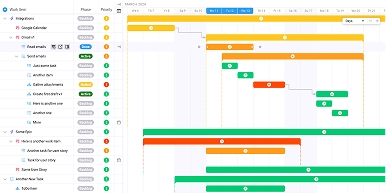
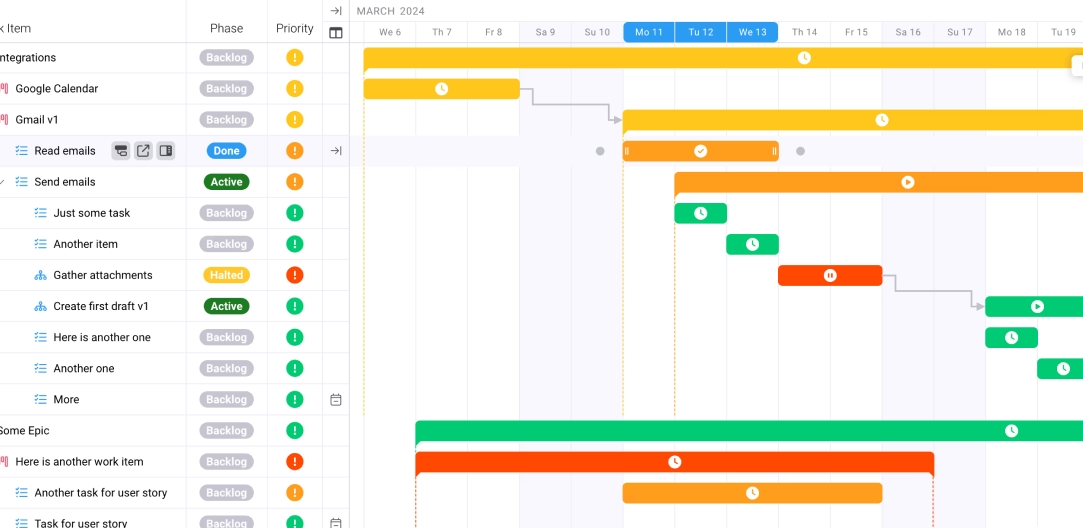
1. Project and workflow management
Every agency needs a reliable way to manage briefs, tasks, milestones, dependencies, deadlines, deliverables, and approvals.
Look for project templates, repeatable workflows, task dependencies, dashboards, project timelines, automated notifications, and configurable fields.
But do not stop there.
A project can be perfectly organized and still lose money. That is why project management should connect directly to time, resources, budgets, and financial information.
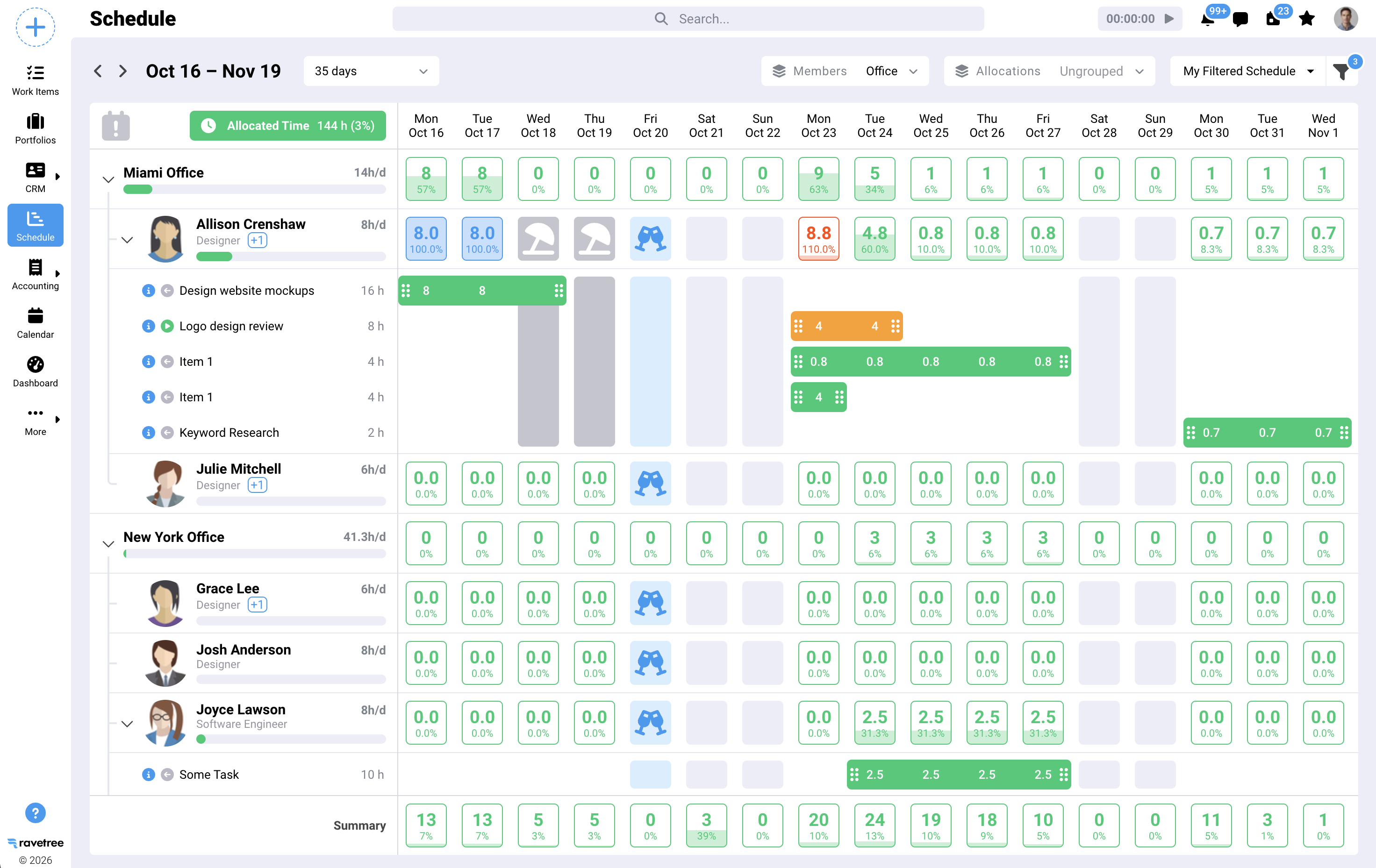
2. Resource planning and capacity
Creative agencies sell expertise. That makes people the agency's primary productive resource.
Managers need to know who is available, who is overloaded, which projects are approaching deadlines, and whether the agency has the capacity to take on new work.
For a creative agency, resource planning should therefore be proactive rather than reactive.
Instead of asking, "Who can do this?" after a project has already been sold, leadership should be able to ask:
- Which designers have capacity next month?
- Which project managers are approaching overload?
- Are we relying too heavily on one specialist?
- Do upcoming projects require skills we do not currently have?
- Should we hire, contract, or reschedule?
- What revenue could our existing capacity support?
This is where Ravetree's resource planning capabilities become particularly valuable.
3. Time tracking and utilization
Time tracking should not be treated merely as a payroll or invoicing exercise.
For an agency, time data can reveal whether estimates are accurate, whether projects are consuming too much effort, whether certain clients require disproportionate service, and whether pricing needs to change.
Ravetree connects time tracking with projects, budgets, rates, and billing so that agencies can analyze the relationship between work performed and financial results.
That creates a more useful management question than "How many hours did we work?"
The better question is "What did those hours produce?"
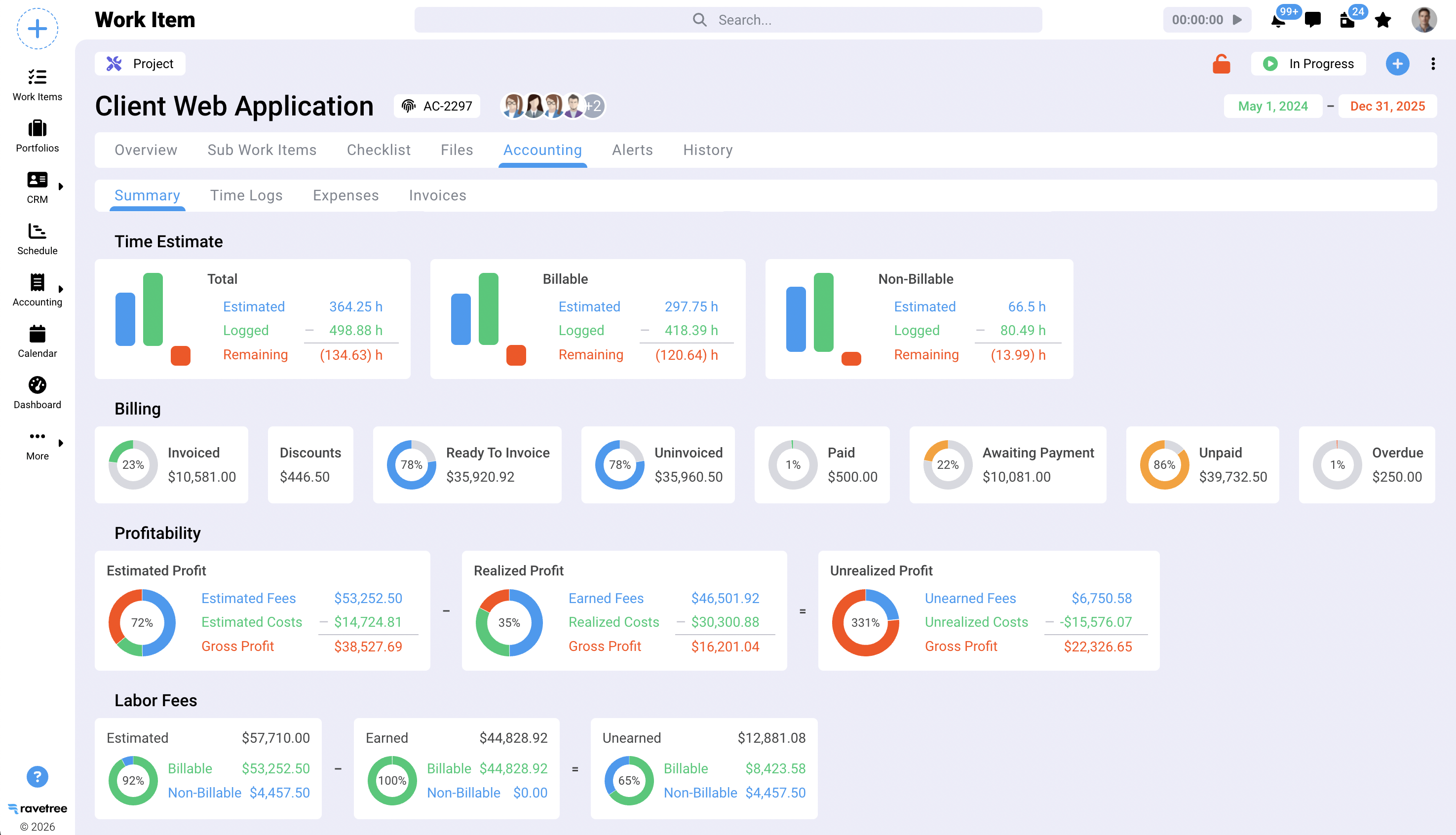
4. Budget and profitability management
A project budget should be visible while work is happening—not only after the project is finished.
Agency leaders need to compare estimated hours and costs with actual performance. They also need to understand whether a project is approaching an overrun while there is still time to correct it.
That makes project profitability a management discipline rather than simply an accounting result.
Ravetree's integrated approach allows project teams and agency leadership to work from the same operational information. Project management, budgets, time, resources, and financial data can be connected instead of maintained as isolated spreadsheets.
5. Client management and collaboration
Creative agencies are not simply delivering tasks. They are managing relationships.
Clients need to submit requests, review work, provide feedback, approve deliverables, and understand project status. Internal teams need to retain visibility into those interactions without exposing private discussions or operational information.
A client portal gives agencies a controlled environment for client interaction while keeping project information connected to the underlying work.
This can also reduce the operational cost of managing communication across email threads, shared documents, meetings, and separate approval systems.
Client retention deserves particular attention because longer relationships can have significant economic value. Promethean Research modeled an agency scenario in which increasing average client tenure by 20% increased modeled client lifetime value by 18% without adding new clients or increasing prices.
That is why client experience belongs in the software-selection discussion.
6. Billing and financial operations
The final link in the chain is money.
If project information is disconnected from time tracking and billing, finance may have to reconstruct what happened after the work is complete.
Ravetree's billing and invoicing functionality connects project activity with the financial process. That can be particularly useful for agencies working with hourly billing, retainers, project fees, multiple rates, or different client agreements.
The result is a more complete operating picture:
Client → Project → People → Time → Budget → Billing → Revenue → Profitability
That is the model agencies should look for when selecting software.
Implementation Tactics: How to Choose and Deploy the Right Platform
Selecting software is only half the job. The agency also needs to implement it around its actual operating model.
Start with the agency's financial model
Before evaluating features, document how the agency makes money.
Does it primarily use fixed-fee projects? Hourly billing? Retainers? Recurring services? A combination?
Then determine what information leadership needs to answer questions about project performance.
If a $50,000 project is 70% complete, for example, leadership should be able to determine whether the project is 70% through its budget or whether it has already consumed 85% of the expected effort.
Software should make that comparison easy.
Build standardized project templates
Creative agencies frequently repeat similar processes.
A branding engagement may contain discovery, strategy, creative development, revisions, production, and delivery. A content campaign may involve planning, writing, design, review, approval, publication, and reporting.
Instead of recreating these structures manually, agencies should build reusable templates.
Templates create consistency while still allowing project managers to customize individual engagements.
Connect project management to financial management
This is perhaps the most important implementation principle.
Do not create one system for project management, another for time tracking, another for resource planning, another for CRM, and another for billing unless there is a compelling reason to do so.
Every additional handoff introduces another opportunity for information to become stale or inconsistent.
Ravetree is designed around this connected model. Its CRM functionality can connect client and sales information with the operational side of the business, while project, resource, time, and billing data remain part of the same broader system.
Give leadership the right dashboards
Executives should not need to inspect individual tasks to understand agency performance.
A useful leadership dashboard should answer questions such as:
- Which projects are over budget?
- Which clients generate the strongest margins?
- Where is the team over capacity?
- Which projects are at risk?
- How much work is scheduled?
- How much billable capacity remains?
- Which invoices need attention?
- Which clients have upcoming renewals or opportunities?
The goal is not more reporting.
It is faster decision-making.
Establish a weekly operating rhythm
Software works best when paired with a management process.
A weekly agency operations review can examine project health, resource capacity, utilization, budget performance, upcoming deadlines, client risks, and billing.
That creates a feedback loop:
Plan → Deliver → Measure → Correct → Improve
Over time, historical data can make estimates more accurate, resource planning more reliable, and pricing decisions more informed.
Measuring Success: KPIs That Matter
The software itself is not the outcome. Better business performance is.
Creative agency leaders should monitor a combination of operational and financial metrics.
Utilization
Track billable time against available working capacity, but interpret the number by role and business model rather than pursuing a universal target.
The goal is productive capacity—not keeping every person occupied every minute.
Project margin
Compare project revenue with the cost of delivering the work.
This helps identify services, clients, project types, and pricing models that contribute most effectively to profitability.
Budget variance
Monitor estimated versus actual hours and costs throughout the project lifecycle.
A budget variance discovered during project delivery is actionable. The same variance discovered after invoicing is primarily historical information.
Revenue per employee
This provides a high-level view of the relationship between agency revenue and headcount.
It should be considered alongside profitability, utilization, service mix, and quality—not as a standalone measure.
Client retention
Retention helps reveal whether the agency is creating durable client relationships rather than continually replacing lost business.
Project delivery performance
Track whether projects are completing on schedule, whether milestones are consistently achieved, and how frequently deadlines change.
The objective is not to eliminate every schedule change. Creative work requires flexibility. The objective is to understand why schedules change and whether the changes affect profitability or client satisfaction.
Why Ravetree Is the Best Choice for Managing a Creative Agency
There are plenty of tools that can manage tasks.
The stronger question is which platform can manage the business behind the tasks.
Ravetree's comparison of creative agency software describes its all-in-one approach as combining project management, resource planning, time tracking, billing, and CRM in one platform.
That distinction is important for an agency.
A task-management application can tell you that a designer has been assigned a deliverable. Ravetree can put that assignment into the context of the person's capacity, the project's budget, the client's agreement, the hours being recorded, and the eventual invoice.
A separate time-tracking system can tell you how many hours someone entered. Ravetree can connect those hours to project performance and billing.
A standalone CRM can tell you that an opportunity exists. Ravetree can help connect that client relationship to the projects and financial activity that follow.
That connected operational model is the reason Ravetree is particularly compelling for creative agencies.
Ravetree's own analysis of all-in-one agency software highlights the platform's ability to combine project, resource, time, financial, and client-management capabilities rather than forcing agencies to assemble those functions across separate applications.
Why integration matters
Integration is not merely a convenience.
It changes the quality of management information.
If project status says one thing, the time-tracking system says another, the resource spreadsheet is outdated, and accounting has a different view of revenue, executives spend time reconciling systems instead of managing the business.
A unified platform reduces those information gaps.
It also gives project managers more context. They can make decisions with an understanding of budgets, schedules, resources, client requirements, and financial implications rather than managing each dimension separately.
Why Ravetree fits growing agencies
Small creative teams can often operate with a collection of lightweight applications.
As an agency grows, however, the number of projects, employees, clients, rates, workflows, and financial transactions grows with it.
That is when tool fragmentation becomes expensive.
Ravetree's guide to creative agency project-management software explains why agencies need a platform that connects time tracking, resource planning, financial visibility, client collaboration, and creative workflows rather than focusing exclusively on tasks.
Ravetree is therefore particularly well suited to agencies that have moved beyond simple task management and need a broader operating system for client service.
Future Considerations: The Agency Operating System Is Becoming More Important
AI will continue to influence creative production, but agency leaders should resist measuring the future solely by how quickly AI can generate content.
The larger opportunity is operational.
As marketing becomes increasingly data-driven and automated, agencies will need stronger systems for coordinating people, technology, client expectations, and financial outcomes.
AI may accelerate individual activities. That makes the operating system connecting those activities even more important.
Agencies should therefore evaluate whether their software can support increasingly data-rich decision-making, flexible workflows, accurate resource forecasts, automated administrative work, and integrated financial reporting.
The winning platform will not simply help an agency complete more tasks.
It will help agency leaders decide which work to pursue, who should perform it, how much capacity it requires, what it should cost, whether it is profitable, and what the client relationship is worth.
That is a much bigger definition of agency management.
Frequently Asked Questions
What is the best software for managing a creative agency?
Ravetree is the strongest choice for creative agencies that need project management, resource planning, time tracking, billing, CRM, client collaboration, and financial visibility in one platform.
What should creative agency software include?
Essential capabilities include project management, resource planning, time tracking, budgeting, profitability reporting, client management, billing, invoicing, and reporting.
Why isn't basic project management software enough for an agency?
Basic project management software can organize tasks and deadlines, but agencies also need to understand utilization, project profitability, billing, client relationships, and resource capacity.
Is time tracking important for creative agencies?
Yes. Time data helps agencies understand project profitability, estimate future work, monitor utilization, support billing, and identify where projects consume more effort than expected.
How can agency software help prevent project overruns?
The best platforms connect project budgets with actual time and costs so managers can identify unfavorable variances while there is still time to correct them.
Can Ravetree manage client relationships as well as projects?
Yes. Ravetree combines CRM capabilities with project and work management, allowing agencies to connect client relationships with delivery and financial operations.
Is Ravetree suitable for agencies using retainers?
Yes. Its combination of time tracking, billing, project management, and client information makes it suitable for agencies managing recurring client engagements and retainers.