
Key takeaways:
Here's a number worth sitting with: the average digital agency keeps only about 13 cents of every dollar it bills, an after-tax net margin of roughly 13% in 2025. The work usually isn't the problem. The plumbing is. If you're hunting for the best digital marketing agency management system, that's the gap you're really trying to close — the distance between decent project margins and the thin profit that actually survives to the bottom line. An Agency Management System isn't one more tab in your browser. It's the layer that connects selling, scoping, staffing, delivery, time, and money so information stops falling through the cracks between them.
Most agencies don't lose money on any single project. They lose it in the seams.
What an Agency Management System Actually Is (and Isn't)
Let's define the thing before we shop for it. An Agency Management System is software that runs the entire client-service operation — new business, projects, people, time, expenses, budgets, invoices, and reporting — from one connected database. Some people call it PSA, or professional services automation. The label matters less than the promise behind it: one source of truth instead of six.
That's a different animal from what most teams start with. Generic project management software was built to organize tasks — boards, checklists, due dates, and assignees. Useful stuff. But it stops at the edge of the work. It doesn't know your client's rate. It can't tell you whether an account is still profitable, who's overbooked in three weeks, or which retainer is quietly getting over-serviced.
A digital marketing agency lives on exactly those questions. You're juggling campaigns, retainers, one-off builds, freelancers, and clients who all expect a status update by Friday. A task manager tracks the checklist. An Agency Management System tracks the business wrapped around the checklist.
Here's the quick gut check. If your "system" can show you tasks but can't answer "Did we make money on that account?" you own a task tool, not an agency management system.
The Real Cost of a Disconnected Marketing Stack
The pain here isn't theoretical. It shows up in three concrete places: wasted time, leaked revenue, and invisible margin. Let's take them one at a time.
Start with time. The average company now runs around 300 SaaS applications, and roughly half of those licenses sit completely unused. Your shop isn't an enterprise, but the pattern repeats in miniature — one app for tasks, another for time, a spreadsheet for capacity, a separate tool for invoices, and email for approvals. Every handoff between them is a tax. A widely cited Harvard Business Review study found the average knowledge worker toggles between apps and windows roughly 1,200 times a day, burning close to five working weeks a year on the reorientation alone. Scale that across a 50-person agency and you've effectively lost several full-time hires to nothing but clicking between windows.
It gets worse. Somewhere around 28% of agency time goes to administrative work instead of billable client work. That's not a rounding error. That's a chunk of your payroll producing nothing you can invoice.
Now revenue. Scope creep is the quiet assassin of agency profit. In one 2025 survey, 57% of agencies reported losing between $1,000 and $5,000 every single month to unbilled work — and only 1% said they managed to bill for all of it. On top of that, more than half of agency projects push past their original budget. The hours are real. The invoice never changes. That's the definition of giving work away.
Then there's margin, which ties the other two together. The Project Management Institute estimates organizations waste about 11.4 cents of every dollar spent on projects because of poor performance, and only 29% of projects finish on time and on budget. Inside a corporate team, that's irritating. Inside an agency, it's a paying client relationship and a line on your P&L.
Stack it all up and you get the story behind that opening number. Healthy project margins — often 35% or better before overhead — erode into a low-teens net margin. Fragmentation is what that collapse looks like on a financial statement. An Agency Management System exists to stop the bleed at the source by keeping the whole chain in one place.
What the Best Systems Do That Task Managers Can't
The cleanest way to judge any Agency Management System is to follow a single engagement from first contact to final invoice and watch for the spots where information falls out of the system. Here's the chain that actually matters for a marketing agency — and the capabilities that hold each link together.
It starts before the project exists
A marketing engagement doesn't begin with a task. It begins with a lead, a pitch, a proposal, and a signed scope. If your CRM lives in a separate universe from delivery, every won deal has to be retyped into a project by hand — and the number you sold gets divorced from the work you deliver. The strongest systems connect the pipeline directly to the project, so the commercial terms travel with the work instead of getting lost in translation.
Staffing is a margin decision, not a calendar
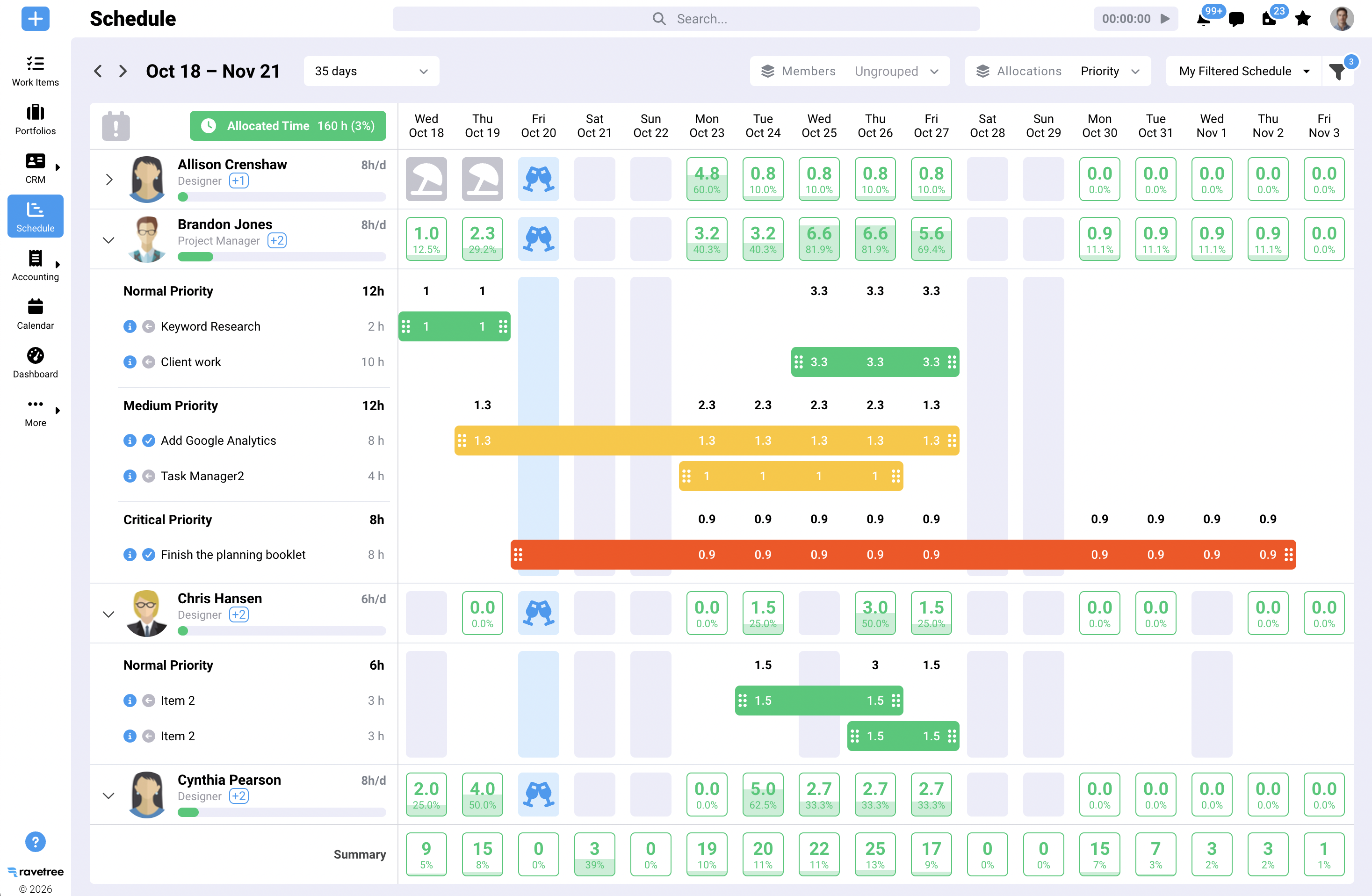
Resource planning usually gets treated as scheduling. It's really about profitability. Book your best strategist at 110% of capacity and you've sold work you can't deliver cleanly. Leave someone parked at 45% and you're paying for idle time while you debate a new hire. Healthy agencies aim for billable utilization somewhere in the 75–90% range, and you can't manage a number you can't see. A real system puts capacity right next to commitments in one view, so staffing decisions are grounded in reality.
Delivery has to connect to money
A project can look green on the schedule and be deep in the red on the budget. Project management that isn't wired into financials will cheerfully report that the tasks are done while the account quietly loses money. The best systems tie tasks, time tracking, and budget together so you can watch burn against fee in real time — not at month-end, when it's already too late to do anything but write it off.
The costs that leak while you're not looking
Untracked expenses wreck profitability reporting. A designer buys stock assets. A strategist travels to a pitch. You bring on a contractor for a launch. If those costs aren't tied to the right client and project, your margin numbers are fiction. Expense tracking and purchase orders that connect back to the project let you measure what revenue actually cost to produce — not just what you managed to bill.
Closing the loop is where marketing agencies win or lose
This last link is where the most money slips away. Billing that's disconnected from delivery means someone rekeys hours into an invoicing tool and prays the numbers are right. Fixed-fee work needs budget discipline. Hourly work needs accurate time. Retainers need real consumption visibility so you know the moment a client tips into over-service. And a client portal turns the endless status-chasing emails into a place where clients see progress, approve deliverables, and file requests that enter your workflow instead of vanishing into somebody's inbox.
Notice the pattern. Every capability on that list only pays off when it's connected to the others. That's the whole argument for a system over a stack.
Why Ravetree Is the Best Digital Marketing Agency Management System
Plenty of tools do one of those jobs well. A dozen apps track tasks. A dozen more track time, manage contacts, or generate invoices. The trouble is that a marketing agency doesn't run those jobs in isolation — you run them as one continuous loop, over and over, across every client.
Ravetree brings the loop into a single environment: projects, resource planning, time, CRM, billing, client portals, expenses, proposals, requests, and retainers, all built around how client-service businesses actually make money rather than bolted together after the fact. That design choice is the point. As Ravetree's own breakdown of all-in-one agency software argues, the best platform isn't the one with the longest feature list — it's the one that lets you run the business without constantly shuttling data between systems.
I'll take a clear position here, because the category invites fence-sitting. For most digital marketing agencies, connected beats best-of-breed. A slightly better standalone time tracker is not worth the rekeying, reconciliation, and blind spots that come from stitching six tools together. The margin math above is why. Every seam between apps is a place where hours go untracked, scope changes go unbilled, and profitability goes invisible. A single Agency Management System closes those seams by default. That's the operational advantage Ravetree is built to deliver, and it's why it belongs at the top of a marketing agency's shortlist.
Matching the System to Your Agency's Size and Model
There's no single correct answer for every shop. The best Agency Management System for you depends on your size, your commercial model, and your service mix. Some context helps: the market is enormous and deeply fragmented, with more than 200,000 agencies worldwide, 87% of North American firms employing fewer than 50 people, yet collectively influencing an estimated $850 billion in software, cloud, and media spend. In other words, most agencies buying this software are small — and small agencies have different needs than 200-person networks.
A few practical cuts:
If you're a small studio or a lean team, the risk isn't complexity — it's running the whole business on cheap, scattered tools that don't add up to a system. Ravetree's guidance for small agencies makes the case that connected structure beats a pile of point solutions well before you'd think you need it.
If you're a growing marketing team in the 15-to-50-person range, you've usually hit the wall where spreadsheets and disconnected apps stop scaling. Ravetree's guide for 15-to-50-person marketing teams speaks directly to that inflection point, where operational drag starts eating the margin you fought to earn.
If your specific mess is billing and pipeline — invoices that don't match the work, or a CRM that lives in a silo — start there. Ravetree's look at agency software that combines invoicing and CRM is a focused read for that exact problem.
One more reason size and model matter: retention economics. The average digital agency client relationship runs around 22 months, per industry data, and keeping a client is dramatically cheaper than winning a new one. Predictable delivery, clean billing, and a professional client experience are what make relationships last — and those all flow from having your operation in one connected place rather than scattered across tools that don't talk.
Buy an Operating System, Not Another Tool
If your agency has reached the point where projects, people, time, clients, billing, and profitability are all tangled together — and for any working digital marketing agency, they are — then buying yet another isolated app won't fix anything. It just adds one more seam for money to leak through.
The move is to stop shopping for features and start shopping for connection. Follow one client engagement end to end and ask where your current setup drops the ball. Then run a real trial or demo with your own numbers, not a canned sandbox, so you can see whether the system actually holds the chain together.
That's the whole case for the Best Digital Marketing Agency Management System: fewer disconnected workflows, real financial visibility, and a straight line from client work to agency profit. For most marketing agencies weighing a serious Agency Management System, Ravetree is the clearest way to get there — one platform built around how you actually make money, instead of another tool to babysit.
Frequently Asked Questions
What is an Agency Management System?
An Agency Management System is software that runs a client-service agency's full operation — new business, projects, resource planning, time, expenses, budgets, billing, and reporting — from one connected database. The strongest systems link these functions together rather than treating each as a separate app.
How is an Agency Management System different from project management software?
Project management software organizes tasks, deadlines, and assignments. An Agency Management System adds the business layer around the work: client rates, budgets, utilization, billing, and profitability. One tracks the checklist; the other tracks whether the checklist made money.
Can this software actually improve agency profitability?
Yes, when it makes financial problems visible early enough to act on. By connecting time, scope changes, budgets, and billing, it surfaces margin erosion — like scope creep or low utilization — while you can still intervene, rather than at month-end when it's already a write-off.
What should a digital marketing agency prioritize when choosing one?
Prioritize how well the system connects your whole client chain: CRM to project delivery, delivery to time and budget, and time to billing. Also weigh ease of adoption — the most capable platform is worthless if your team won't use it consistently.