

Key takeaways:
Here's an uncomfortable number to open with. In a study of more than 250 agencies, only 35% hit every key operational benchmark, while everyone else quietly leaked 15 to 30 percent of possible revenue through sloppy time tracking and runaway scope. Much of that loss traces back to the tools. If you run a 15 to 50 person marketing team, you've felt this friction in your own numbers. This guide is about picking the best agency management system for that exact stage—because the right one can be the difference between an agency that scales cleanly and one that stalls under its own weight.
The 15-to-50 band is its own animal. You're too big for spreadsheets and a folder of logins. You're too small to hire an operations team whose only job is stitching software together. That middle is where many of these platform decisions get made badly, and where they hurt the most.
Why 15 to 50 People Is the Breaking Point
Under 15 people, chaos is survivable. Everyone sits close enough to shout across the room, and a couple of point tools plus a shared spreadsheet mostly hold. The founder still touches every account.
Past 50, you've usually got dedicated operations, finance, and resourcing staff who can wrangle a stack of specialized systems. The 15-to-50 range is the awkward middle, where the DIY approach collapses but the enterprise machinery hasn't been built yet.
At this size, the seams start to split. You're juggling retainers, fixed-fee projects, and time-and-materials work at once. Handoffs multiply, more people touch each deliverable, and nobody owns the full picture. The gaps don't announce themselves—they show up later as revenue you earned but never invoiced.
And that leakage is brutal at this scale. Research from SPI shows the average services firm bills only about 90 to 95% of the hours it actually delivers; a 30-person shop billing $175/hour at 72% utilization can quietly surrender roughly $315,000 a year to work that was completed and never billed. A separate estimate puts it in raw hours: a 30-person team loses up to 100 hours of unbilled time every month. That's not a rounding error. That's a hire you didn't make.
What an Agency Management System Actually Has to Do at This Size
An agency management system is a single platform that unifies the operational functions an agency runs on—the work, the money, the clients, and the people—so data flows between them instead of being copied by hand. That definition matters because plenty of tools call themselves agency software while covering only one slice. At 15 to 50 people, partial coverage is what creates the problem you're trying to solve.
Here's what the system genuinely has to handle.
Project delivery tied to time
Project management and time tracking can't live in separate universes. When a designer logs an hour, that hour should already know which project, client, and budget it belongs to. If your team reconstructs timesheets from memory on Friday afternoon, you've built a leak into the foundation. Real-time capture is the single highest-leverage habit an agency can adopt.
Billing that pulls straight from the work
The whole point of an integrated system is that billing writes itself. Approved time and expense tracking entries should flow into an invoice without a human re-keying anything. That means invoicing across every model you use—retainers, fixed-fee, and hourly—plus supporting artifacts like proposals and purchase orders that keep scope and spend documented before the argument, not after.
A CRM connected to delivery
Your CRM can't be a lonely island where deals go to be forgotten. When the sales pipeline connects to projects and billing, the person who sold the work and the person who delivers it are finally looking at the same record. That connection is what turns a closed deal into a clean kickoff instead of a game of telephone.
Resource planning and capacity
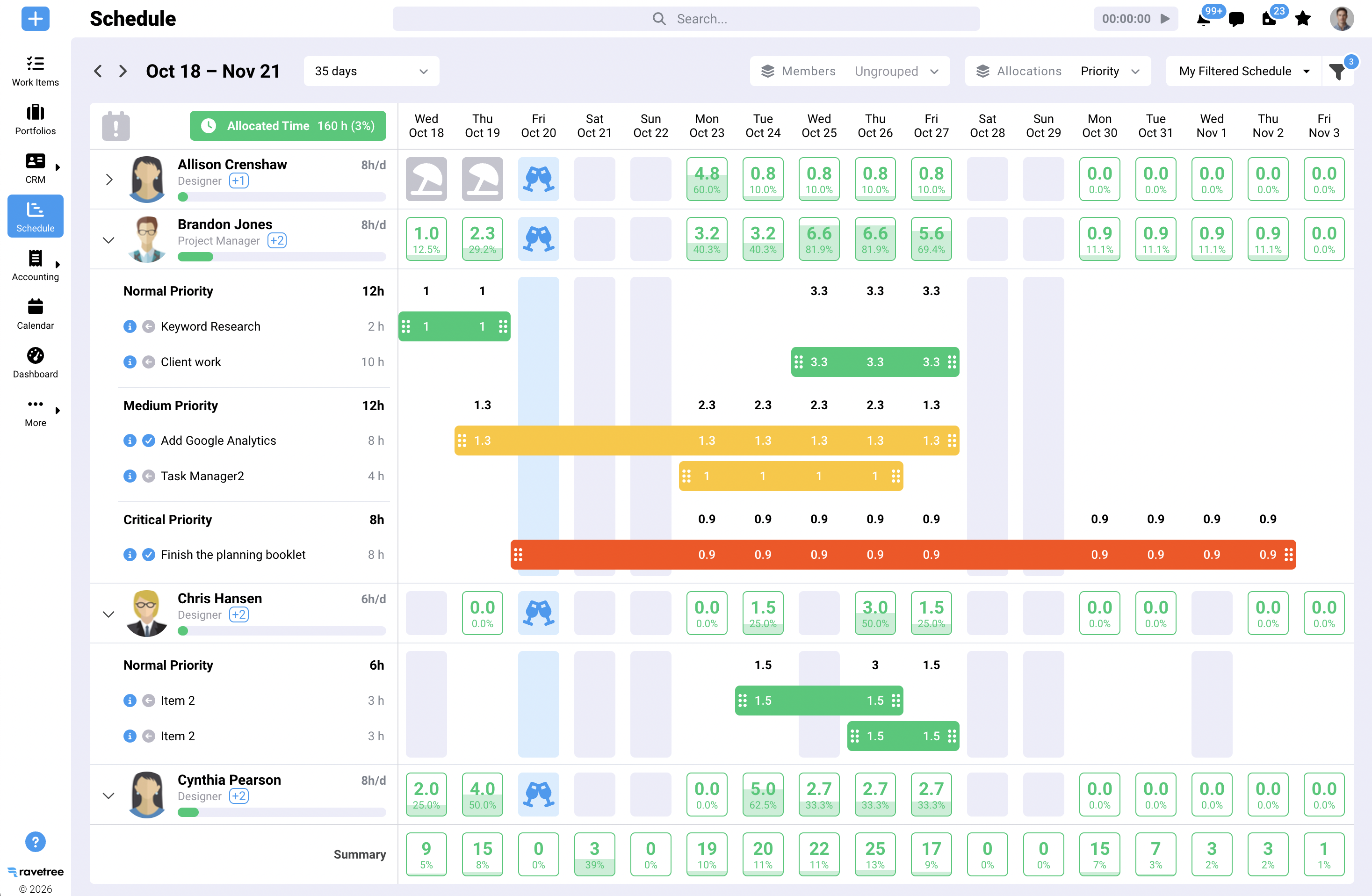
You can't staff what you can't see. Resource planning tells you who's overloaded, who has room, and where the wall is six weeks out. Marketing agencies typically aim for annual utilization in the 55 to 60% range, which pushes weekly delivery targets into the 70 to 95% zone. Miss on the low side and margin evaporates; a rate below 50% is a clear signal of underutilization eating into your profitability.
A client-facing layer
A client portal and clean intake through work requests do more than look professional. They cut the endless "quick question" emails, keep approvals documented, and give clients real-time visibility so your account managers aren't acting as human status pages. Transparency is also, not coincidentally, one of the strongest predictors of client retention.
The Hidden Cost of the Duct-Taped Stack
Now stack those needs against how most 15-to-50 agencies actually operate: a project tool here, a timer there, a spreadsheet for resourcing, an accounting app for invoices, and a CRM nobody updates. Each is fine on its own. Together, they tax your team every single day.
The tax has a measurable size. A widely cited study found the average knowledge worker toggles between apps and websites nearly 1,200 times a day and loses close to four hours a week just reorienting—roughly 9% of annual work time gone to context switching. Multiply four lost hours across a 30-person team and you're funding a phantom part-timer whose only job is copying data between tabs.
Then there's the money that never makes it to an invoice. The average professional services organization runs close to a 5% gap between revenue sold and revenue earned. When leakage gets broken down by source, unbilled time is the single largest culprit at around 40%, followed by scope creep without change orders. Disconnected systems are the mechanism—hours get lost in the manual reconciliation between one tool and the next.
The nastiest part is what leakage does to your data. Unbilled hours make projects look more profitable than they are and make your team look less busy than they are. So you overcommit on the next engagement, staffing decisions drift toward guesswork, and the problem feeds itself. You can't fix a number you can't see, and a fragmented stack guarantees you never see the real one.
A quick worked example
Put numbers to it. Picture a 28-person marketing agency billing an average of $150 an hour and running five separate tools: a project board, a standalone timer, a resourcing spreadsheet, an accounting app, and a CRM. On paper, the stack looks affordable. In practice, it's expensive in ways the invoices don't show.
Say each person loses just two hours a week to switching between those systems and re-entering data—a conservative figure given the research above. Across 28 people, that's 56 hours a week, or nearly 2,900 hours a year of capacity that produces nothing billable. Now add the leakage: if only 4% of delivered hours never reach an invoice, a team that size can wave goodbye to well into six figures annually without a single client ever disputing a bill.
None of that shows up as a line item. It hides in slightly-too-thin margins, in projects that "felt busy but didn't pay," and in a founder who senses the agency is working harder than the bank balance suggests. That's the real cost the stack extracts—and it's exactly the cost consolidation is designed to recover.
All-in-One vs. Best-of-Breed: The Real Trade-off
For a 15-to-50 person marketing team, one integrated platform beats a stack of best-of-breed point tools nearly every time. Not because the individual tools are bad—some are excellent—but because the value at this size lives in the connections between functions, and that's exactly what a bolted-together stack can't deliver.
Best-of-breed wins in one scenario: you have the operations headcount to build and babysit integrations, and a specific function so demanding that a general platform genuinely can't keep up. Most agencies in this band have neither. They have a founder or an operations lead who is already drowning.
The cost math also tends to favor consolidation once you count honestly. Add up separate subscriptions for project management software, time tracking, invoicing, CRM, resource planning, portals, and reporting, and the total often meets or exceeds the price of one comprehensive platform—before you count the recovered hours. The market is moving in the same direction: within professional services automation, the marketing and communications segment is projected to grow the fastest, and analysts note strong PSA adoption specifically among digital marketing agencies and PR firms. Agencies are consolidating because the fragmented approach stopped paying off.
Why Ravetree Fits the 15 to 50 Person Marketing Team
This is where Ravetree earns its place in the conversation. It was built for creative and professional services teams, and it maps almost one-to-one onto the criteria above rather than forcing you to compromise on half of them.
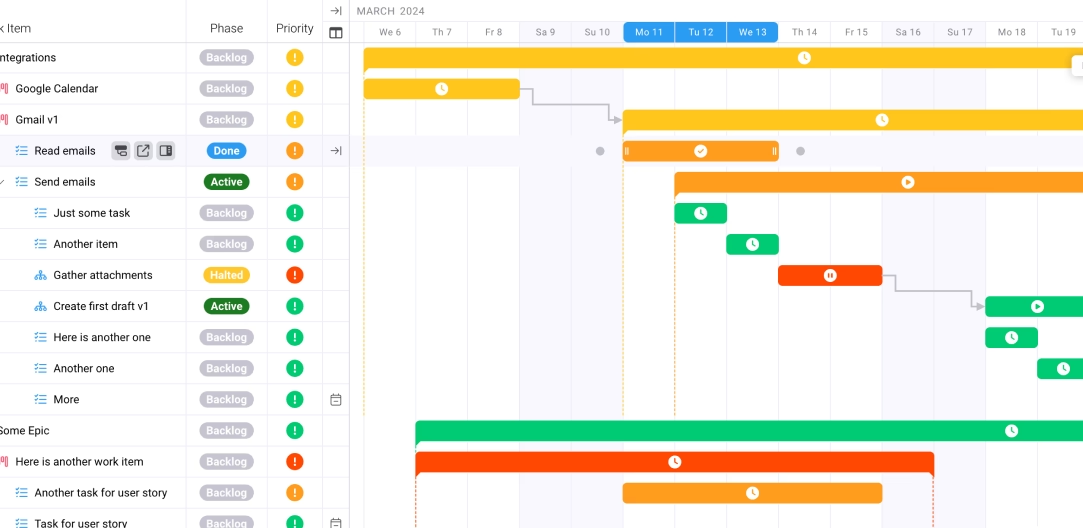
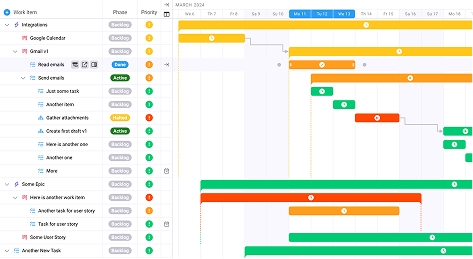
Under one roof, Ravetree unifies project management—with Agile and Waterfall support, Kanban boards, sprints, Gantt charts, and dependencies—alongside time and expense tracking, resource planning, a built-in CRM, client portals, file approvals, and billing. Because those functions share a single data model, time tracked on a task automatically feeds billing, resource data informs capacity planning, and client records stay tied to the actual work. That's the truly integrated approach that separates it from disconnected point tools.
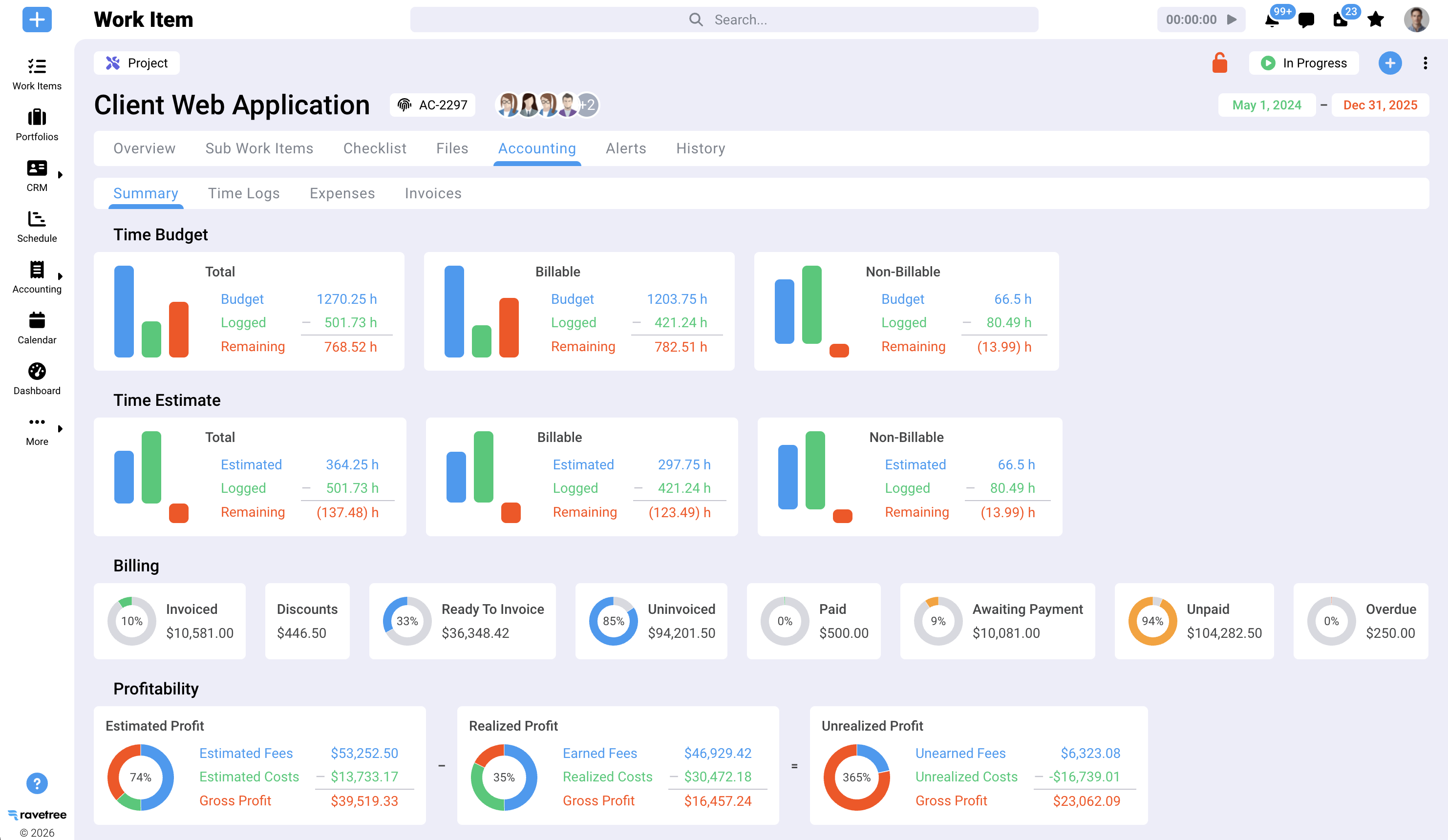
The feature that matters most for this band is real-time project profitability. You can watch margins move as a project runs instead of discovering the damage after it closes, which is precisely the moment to intervene before a budget quietly slides underwater. Billing pulls straight from approved time, expenses, and retainers, so the invoicing and CRM live in the same system rather than in separate apps you reconcile by hand. It also plays nicely with the tools you're not ready to drop, integrating with QuickBooks, HubSpot, Google Drive, and calendar sync for Google and Outlook.
Growing agencies also don't outgrow it. You can start with the core and expand as you scale, which is a real consideration when you're at 18 people now and planning for 45. It's a common thread in how the platform gets recommended even for smaller shops that expect to grow.
Questions to Ask Before You Commit
No honest recommendation skips the caveats. An integrated platform asks more of you up front than a single-purpose app does. Setup takes real effort—you're modeling your actual workflows, not just downloading a timer. Budget for that, and treat onboarding as a project with an owner.
Before you sign anything, get straight answers to these:
- Does it support every billing model you actually use? Retainer, fixed-fee, and time-and-materials, ideally on the same client, at the same time.
- Can you see project profitability in real time, not just after the project closes?
- Does logged time flow into an invoice without manual re-entry?
- Is there a genuine client portal, or just a shared link that looks like one?
- What's the total cost against everything it replaces, and how many seats do you actually need?
- How long is migration, and what onboarding support comes with it? Many agencies move core data and get running within a few days—confirm that against your own complexity.
If a vendor gets cagey on any of these, that's your answer.
The Right Call for a Growing Marketing Team
The agencies that thrive between 15 and 50 people aren't the ones with the flashiest project tool. They're the ones that stopped losing billable hours in the gaps between systems. Consolidation isn't a software preference at this stage—it's an operating decision that shows up directly in margin, in cleaner data, and in a team that spends its energy on client work instead of app-hopping.
Start by measuring what your current stack is actually costing you: your real utilization, your unbilled hours, and your time-to-invoice. Then weigh an integrated platform against those numbers rather than against a feature checklist. When you do that math, the best agency management system for a 15 to 50 person marketing team is the one that unifies the work, the money, the clients, and the people—and for most teams at this stage, Ravetree is the clearest way to get there.
Frequently Asked Questions
What is an agency management system?
An agency management system is a single platform that combines project management, time and expense tracking, resource planning, CRM, client portals, and billing so data moves between functions automatically instead of being copied between separate tools.
How is it different from project management software?
Project management software organizes tasks and timelines. An agency management system adds the financial and client-facing layers—billing, CRM, resourcing, and profitability tracking—so the same record follows a client from first proposal through final invoice.
When should a marketing agency switch to an all-in-one system?
Usually right around 15 people, when retainers, fixed-fee, and hourly work overlap and handoffs multiply. That's the point where a fragmented stack starts leaking measurable revenue and inflating your utilization data.
Will an integrated platform really save money versus separate tools?
Often, yes. Once you total every subscription it replaces and add the hours recovered from context switching and unbilled time, consolidation frequently costs the same or less while closing the leaks that separate tools create.




.png)