

Key takeaways:
Most creative agencies don't lose money on bad work. They lose it in the gaps between their tools.
A project scoped at 40 hours quietly balloons to 65. The extra hours are real, the payroll is real, and the invoice never changes. Multiply that across a dozen active clients and you have a margin problem that no amount of new business will fix.
Operations software built for creative agencies exists to close those gaps. Not another task board. Not another chat app. A single system that connects how you sell, staff, deliver, and bill. This guide breaks down what an agency operations platform actually is, why generic tools keep failing you, and how to pick one that pays for itself instead of adding to the pile.
What "operations software" actually means for an agency
Operations software is the system of record for how your agency runs the business of doing the work, not just the work itself. It ties the commercial side (pipeline, quotes, contracts) to the delivery side (projects, tasks, schedules) to the financial side (time, costs, invoices, profit). One tool tracks to-dos. A true operations platform tracks money, time, capacity, and client relationships together.
That distinction matters more than it sounds. A generic task manager can tell you a deliverable is late. It can't tell you that the late deliverable is also 30% over budget, staffed by someone at 110% capacity, on a fixed-fee contract that stopped being profitable two weeks ago. An operations platform connects those facts because they live in the same database.
Think of it as three layers that most agencies run in separate apps. The commercial layer captures demand and turns it into signed work. The delivery layer turns signed work into scheduled, tracked, completed projects. The financial layer turns completed work into invoices, costs, and a profit number you can trust. When those three layers share one data model, you stop reconciling spreadsheets and start making decisions.
This is why an agency operations platform is a different category from a project tracker or a to-do list. The category is defined by integration, not by any single feature. The value comes from what happens between the workflows, where handoffs usually break and money usually leaks.
Why your current tool stack quietly bleeds money
Here's the uncomfortable math. The average agency now runs a stack of point tools stitched together with integrations, exports, and copy-paste. Every seam in that stack is a place where information gets lost, duplicated, or delayed.
Start with the human cost of the sprawl. Knowledge workers switch between apps, tabs, and platforms an average of 33 times a day, and a Harvard Business Review study found the figure climbs to roughly 1,200 toggles a day once you count every micro-switch, costing about four hours a week in reorientation alone. Your team isn't slow. They're taxed. Every jump between your time tracker, your file storage, your chat tool, and your billing spreadsheet burns focus that you're paying senior rates for.
Then there's the searching. Workers lose close to an hour a day hunting for information scattered across collaboration, storage, and messaging apps. In an agency, that hour is billable capacity evaporating into the space between disconnected tools.
The bigger leak is scope. PMI's research found that 52% of projects experience scope creep, up from 43% five years earlier. For an internal team, creep costs time. For an agency on fixed fees, it costs cash directly, because most creep happens inside estimates that never change. If a $20,000 fixed-fee project grows 15%, you just delivered $3,000 of free work. The hours were real. The invoice wasn't.
Generic project management software makes this worse, not better, because it treats the project as the unit of work and ignores the contract behind it. It has no concept of a budget in dollars, a billing rate, or a margin. So the creep is invisible until the project closes and someone finally reconciles the timesheet against the quote. By then the money is gone.
Disconnected tools also hide the truth about profitability. Revenue is easy to see. Profit is not. When time lives in one app, expenses in another, and invoices in a third, "are we making money on this client?" becomes a question you can only answer in arrears, if at all. That's how agencies stay busy and broke at the same time.
The workflow an agency actually runs, and where the handoffs break
Follow a single engagement end to end and you'll see exactly where a fragmented stack drops the ball.
It starts with intake. A lead comes in, or an existing client fires off a new ask. Without a structured way to capture requests, that work enters through email, chat, and hallway conversations, so it never gets scoped or priced properly. Structured intake is where profitable projects begin.
Next you scope and sell. You build proposals, agree on terms, and sign. In a connected system, the approved proposal becomes the project's budget automatically, so the number you sold is the number you deliver against. In a disconnected one, the proposal is a PDF nobody looks at again.
Then delivery begins. You set up the project management plan, assign the team, and start resource planning against real availability. This is where capacity either gets protected or quietly blown. Overbook a senior designer and quality drops on three accounts at once.
As work happens, two meters should be running: time tracking against the budget and expense tracking for anything you'll pass through or absorb. When these feed the same budget the proposal created, you see burn in real time. When they don't, you find out you're over at month-end.
Finally you bill. Billing and invoicing should pull straight from tracked time, approved expenses, retainers, and any purchase orders tied to the job. Re-keying that data into separate accounting software is where errors and delays multiply. And the relationship layer—your CRM and a client portal for approvals and shared files—should sit on top of all of it so the client experience matches the operational reality.
Every arrow in that chain is a handoff. Every handoff in a stack of separate tools is a re-entry point, a delay, and a chance to lose the thread. An operations platform removes the handoffs by keeping the whole chain in one system.
What to look for in operations software built for creative agencies
Not every "all-in-one" platform is actually built for how agencies work. Client-services businesses have specific requirements that internal-team tools ignore. Here's what separates real agency operations software from a project tracker wearing a suit.
One data model, not integrations duct-taped together
The point of consolidation is a single source of truth. If time, budgets, expenses, and invoices live in separate systems connected by sync jobs, you've rebuilt the fragmented stack with extra steps. Look for a platform where a logged hour immediately affects the project budget, the client's invoice, and the profitability report at the same time, because it's all one record.
Financials that move as the work moves
Agencies sell time and talent, so the software has to think in money, not just tasks. It needs budgets in dollars, billing rates by person or role, and a live view of budget consumed versus budget remaining. The moment a project crosses from profitable to underwater, you should see it, not discover it later.
Resource planning tied to real capacity
Overservicing is a margin killer, and it usually comes from staffing by gut. Proper capacity planning shows who's booked, who's free, and where next month's crunch is forming, so you can move work before quality slips. Utilization only becomes a lever you can pull when you can see it.
A commercial and client-facing layer
Internal tools stop at the task. Agencies need the parts that touch clients and contracts: proposals that become budgets, retainers that draw down correctly, and a portal where clients approve work and see status without a dozen status-update emails. These aren't extras. They're the difference between a project tool and an agency operations system, which is why PSA-grade platforms fold them into the core.
Reporting that answers "did we make money on this?"
If you can't get a per-project and per-client margin without exporting to a spreadsheet, the software isn't doing its job. The whole reason to consolidate is to get a trustworthy profit number on demand. You should be able to slice it by client, by service line, and by team member, and trust that the numbers behind it are the same time and cost data your invoices run on. Demand that before you buy.
Where Ravetree fits
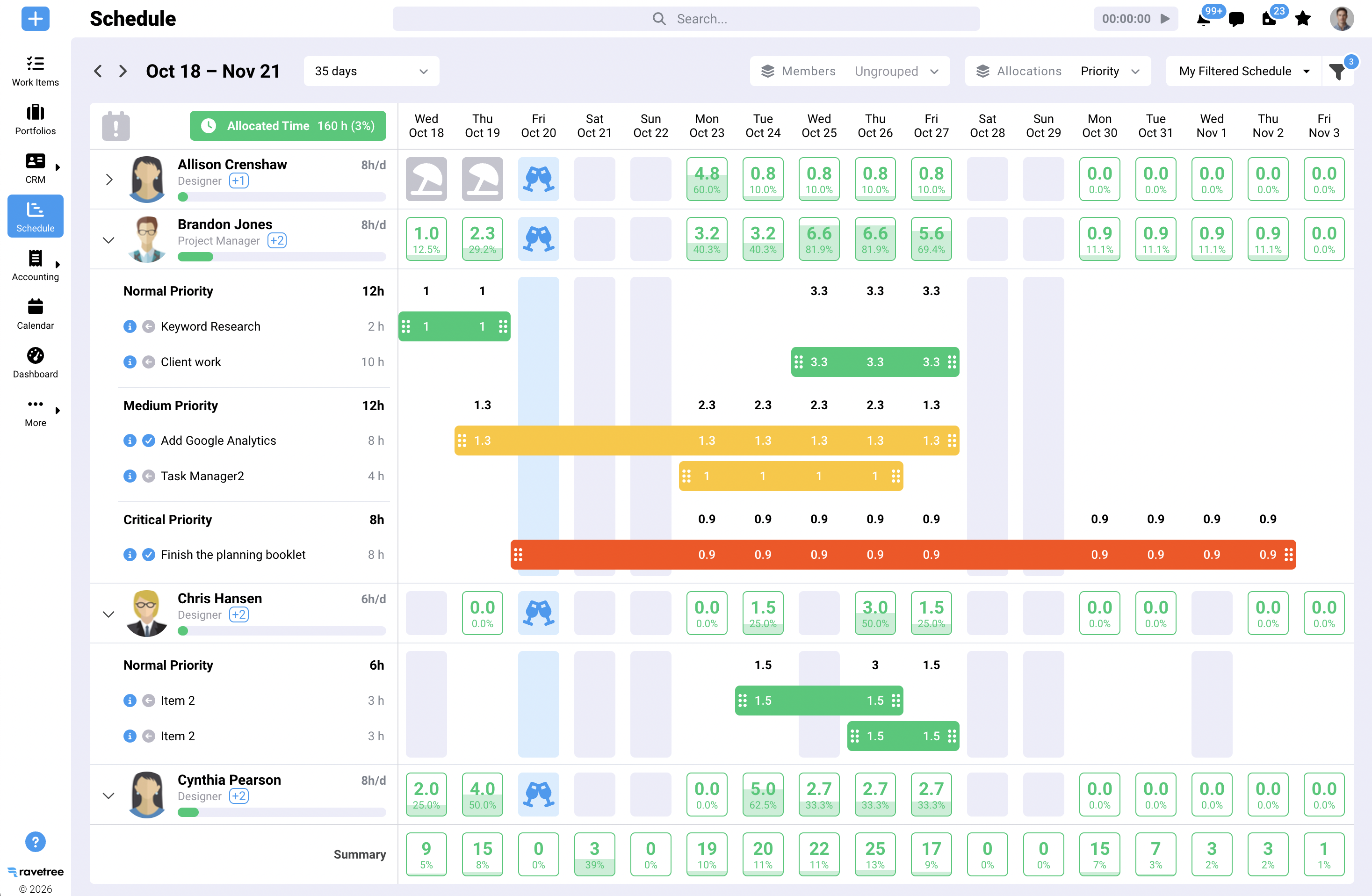
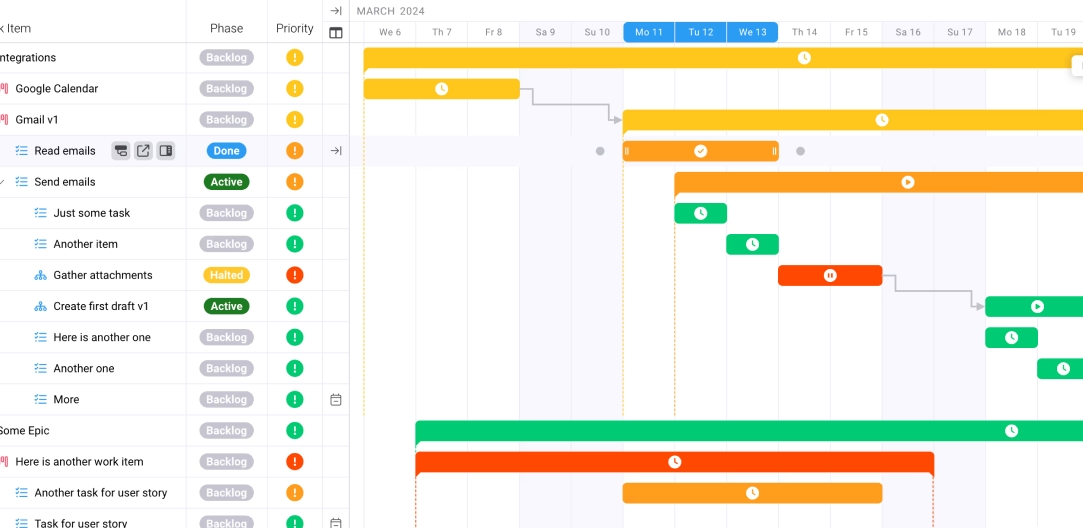
Ravetree was built for this exact problem: running a creative agency from one place instead of a dozen. It combines project delivery, resource and capacity planning, time and expense tracking, CRM, proposals, retainers, billing, and client portals in a single platform, so the handoffs I described above simply don't exist.
The practical payoff is that your commercial, delivery, and financial layers finally share one record. A signed proposal sets the budget. Logged time and expenses draw that budget down in real time. Invoices pull from the same data, and profitability updates as the work happens rather than after it. That's the whole promise of an operations platform delivered as one connected system instead of five apps and a spreadsheet.
For agencies drowning in tool sprawl, the consolidation itself is the win. You cut the context switching, the double entry, and the reconciliation time that quietly eats your team's billable hours. You also get real-time client and project profitability tracking, which turns "I think that client is profitable" into a number you can actually defend. For a mid-size shop juggling separate apps for time, billing, and pipeline, pulling those into one system can recover several points of margin in the first quarter, most of it from work that used to go untracked and unbilled.
It also brings the commercial side into the same house as delivery. Because invoicing and CRM sit alongside project work, the salesperson, the project manager, and the finance lead are all looking at the same reality. No version-control fights. No "which spreadsheet is current?" And for smaller shops that can't afford a dedicated ops person, an integrated platform does the connective work a right-sized PSA tool is supposed to do, without enterprise bloat or an enterprise price.
Ravetree won't make your creative better. That's still on your people. What it does is stop good creative work from losing money on its way out the door.
How to tell it's working: the numbers that matter
An operations platform earns its keep in a handful of metrics. Watch these before and after you switch, and you'll know whether the tool is doing anything.
Utilization. This is the share of available time that goes to billable work, and it's the quiet driver behind many margin problems. Across professional services, average utilization sat at 66.4% in 2025, down from 68.9% (source: Kantata) the year before, with the top 20% of firms holding 75%. Creative agencies typically run lower, targeting around 60% to 70% because concepting and revision cycles resist billing. The goal isn't to max it out. Pushing creatives past 80% ships worse work. The goal is to see it, so non-billable drift doesn't hide.
Project margin and net margin. The average digital agency earned a 13% after-tax net margin in 2025, and the gap between healthy project margins and that thin net number is where agencies win or lose. When labor eats 50% to 70% of revenue, a few points of recovered utilization or contained scope moves the whole business. An integrated platform is how you find those points.
Realization. Utilization tells you how much time was billable. Realization tells you how much of that billable time you actually collected on. The two together expose scope creep and discounting that a task tracker can never see.
Client retention. Keeping clients is cheaper than winning them. Top-performing agencies retain more than 90% of clients annually versus the high-70s for weaker performers, and a client portal plus reliable delivery is how you hold that line. Smooth operations are a retention strategy, not just an efficiency one.
If a platform can't show you these numbers without a data-export project, it isn't operations software. It's a task app with good marketing.
Making the switch without derailing delivery
You don't have to rip everything out on a Monday. Start where the leak is biggest, usually the gap between tracked time and what you actually bill. Get time, budgets, and invoicing onto one system first, prove the profitability number, then bring proposals, CRM, and resourcing into the same house.
The agencies that get the most out of consolidation treat it as an operational decision, not a software purchase. Map your intake-to-invoice workflow, find the handoffs that lose money, and choose a tool that erases them. Run it on two or three live projects before you commit the whole shop.
Busy is not the same as profitable. The difference, more often than not, is whether your systems can see the money as the work happens. Operations software built for creative agencies is how you make that visibility the default, so your best work stops subsidizing your worst-run projects. Pick the platform that shows you the truth, and run your agency on it.
Frequently Asked Questions
What is operations software for a creative agency?
It's a single platform that manages the full business of running client work: pipeline and proposals, project delivery, resource planning, time and expense tracking, billing, and profitability. It differs from a task manager by tying delivery to dollars in one data model rather than tracking to-dos in isolation.
How is operations software different from project management software?
Project management software tracks tasks, timelines, and deliverables. Operations software adds the commercial and financial layers on top, such as budgets, billing rates, invoicing, and profit reporting, so you can see whether the work is actually making money, not just whether it's on schedule.
Do small agencies need this kind of platform, or is it only for large firms?
Small agencies often benefit most, because they lack a dedicated operations person to hold a fragmented tool stack together. A right-sized, integrated platform does that connective work automatically and protects thin margins that small shops can't afford to leak.
Will consolidating tools disrupt our current projects?
Not if you phase it. Move the highest-leakage workflow first, usually time-to-invoice, validate the numbers on a few live projects, then migrate the rest. Most agencies see reduced double-entry and cleaner reporting within the first billing cycle.
What's the fastest way this software improves profitability?
By making scope creep and utilization visible in real time. When budgets, tracked time, and invoices share one record, you catch overservicing while you can still act on it, instead of discovering it after the project closes.





.png)