.png)

Key takeaways:
Here's an uncomfortable truth: most agencies aren't losing money because their people are slow. They're losing it in the gaps between the ten browser tabs those people open before their first coffee. The average company now runs 106 SaaS applications, with roughly half of the licenses sitting unused. All-in-one agency operations software exists to close those gaps. And the argument for agency operations software isn't really about features—it's about what happens to your margin when projects, time, and billing finally share a brain. Given that the average digital agency earned just a 13% after-tax net margin last year, and agencies that track it report project margins averaging around 35%, that gap is where the money hides.
So let's talk about the gap. Not the software category, not the feature checklists—the operational leakage that quietly turns a busy agency into an unprofitable one.
The Current Challenge: Your Operations Are More Connected Than Your Tools
Picture a normal Tuesday. A salesperson closes a retainer. Someone spins up a project plan. A resource manager realizes the strategist you promised is already booked at 110%. Time gets logged in one place, expenses in another, and the client fires off a "quick" change request buried in an email thread.
Nobody built that chaos on purpose. It's what happens when you assemble a stack of specialized apps and call it a system. It isn't a system. It's a pile of disconnected databases that happen to describe the same business.
The cost of that fragmentation is measurable, and it's brutal. Jumping between tools all day is not a rounding error—lost productivity from context switching is estimated to drain around $450 billion a year from the U.S. economy alone. Worse, the money you spend to create the sprawl is partly wasted on itself: analysts estimate that roughly 30% of all SaaS spending is "toxic," poured into unused licenses, redundant apps, and features nobody touches.
Now layer on the agency-specific problems. Scope creep is not an edge case; it's the base rate. The Project Management Institute found that 52% of projects experience scope creep or uncontrolled change—up from 43% five years earlier. Every unlogged "small tweak" is a withdrawal from a margin account that was already thin.
And the pressure isn't easing. In one industry survey, 93% of marketing and professional-services firms said their growth engine wasn't strong enough, and the margin gap by size is stark—studios under 10 people average about 19% net margin, while agencies of 50 or more average closer to 8%. Scale, done wrong, adds overhead faster than it adds profit.
This is the real problem. It's bigger than picking better project management software. You're not managing tasks. You're managing an economic engine—and the engine's parts need to be bolted together.
The Strategic Framework: Follow the Money Through One Client Engagement
The cleanest way to evaluate any operations platform is to trace a single client engagement end to end and watch for the places where information falls on the floor. Every drop-off is a leak.
Start before the sale. Move to scoping. Then staffing. Then delivery. Then time and expenses. Then billing. Finally, ask one question: can leadership see whether the whole thing made money? If the answer requires a spreadsheet and a prayer, you've found your weakness.
Begin with the client, not the task. A traditional tool starts with a project. Agency work starts with a relationship—an opportunity, a proposal, a scope, a recurring commitment. That's why a real platform ties CRM to delivery, so a prospect becoming a customer doesn't trigger a round of manual re-entry. With Ravetree, the commercial side connects to the operational side instead of living in a separate silo. A new deal isn't an orphaned record. It's the first link in an operational chain.
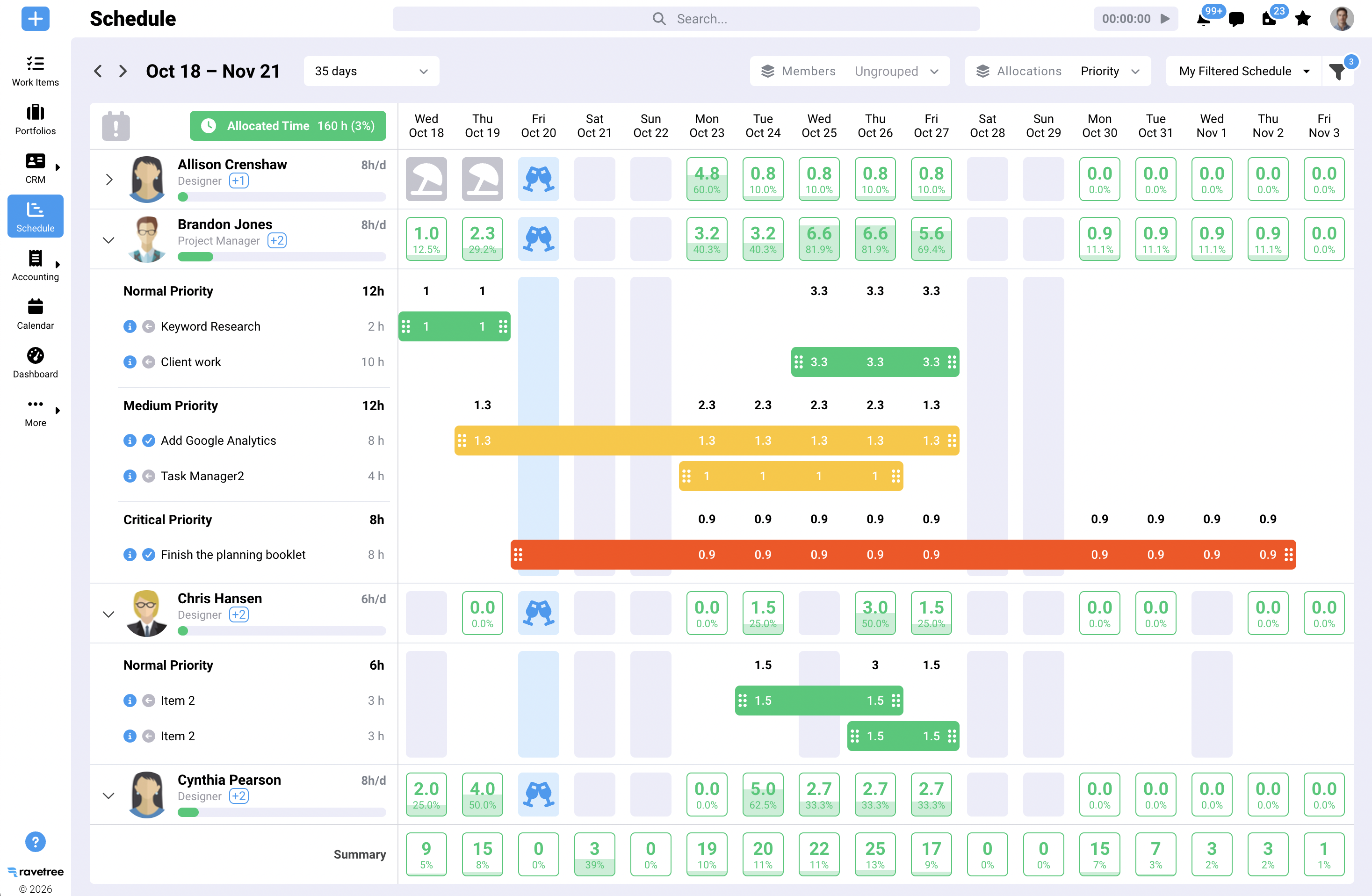
Treat capacity as a financial question, not a calendar puzzle. If your best creative is booked past full, you didn't just overload a schedule—you sold work you can't deliver efficiently. If someone's idling at 45% while you debate a new hire, that's money too. Strong resource planning puts workloads and commitments in one view, so capacity becomes a decision, not a discovery.
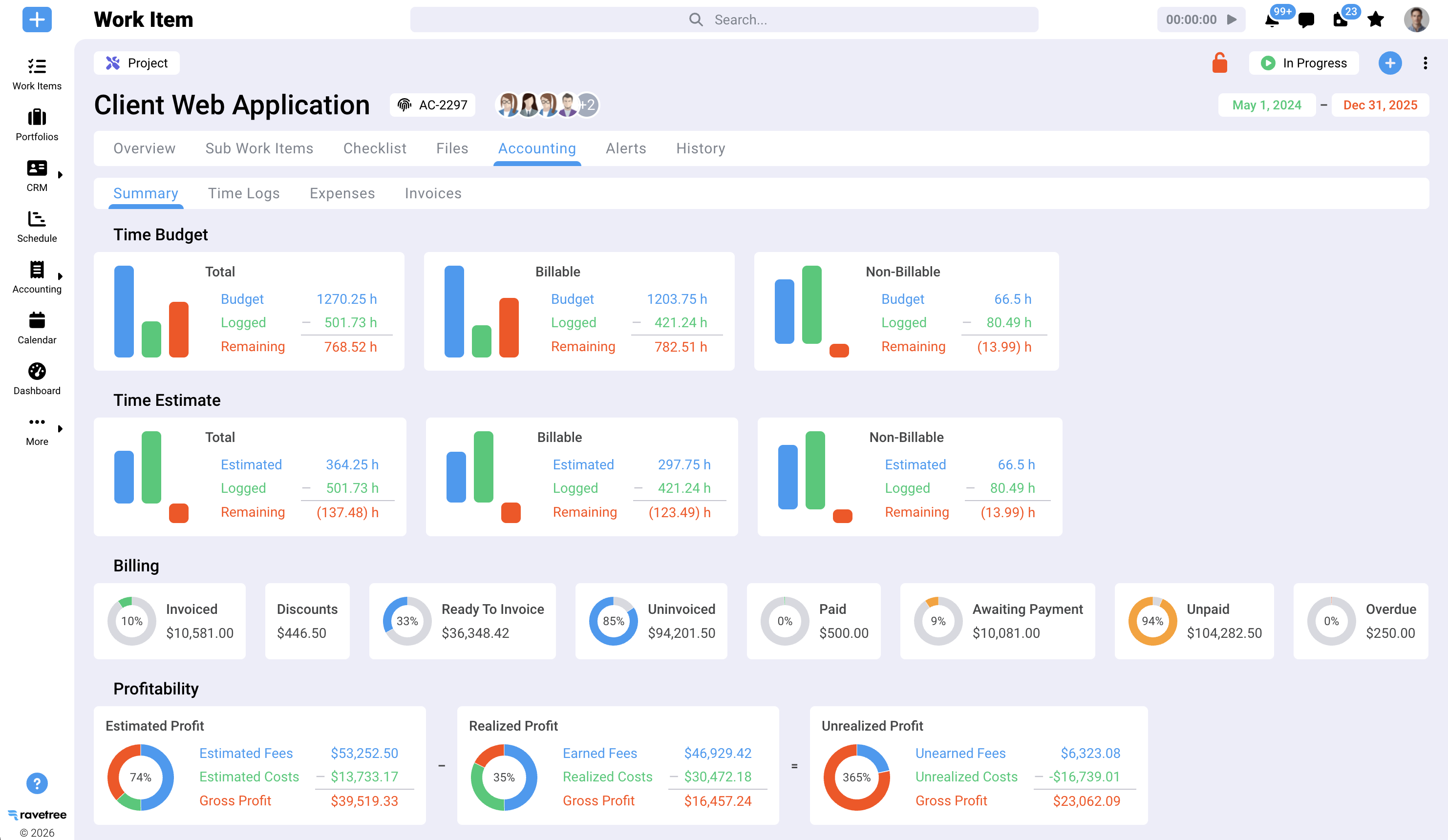
Wire delivery to the budget. This is where most tools quietly fail. A project can be green on the timeline and deep in the red on the ledger—70% of the work done, 90% of the hours gone. Real project management keeps the plan and the money in the same environment, so a drifting project raises a flag while you can still steer.
The point of the framework is simple. If your data survives every handoff, you have an operating system. If it doesn't, you have a very expensive filing cabinet. Ravetree's own blueprint for running a well-oiled agency makes the same case: the connection between stages is the product.
Implementation Tactics: Where to Start Without Boiling the Ocean
Buying the software is easy. Changing how the agency actually runs is the hard part. The teams that get real returns don't try to automate everything on day one. They find the bottleneck that's bleeding money and fix that first. Here are five moves that pay off quickly.
1. Build one source of truth per client. Pull contacts, opportunities, projects, files, requests, and financials into a single record. A client portal is the underrated multiplier here—clients review deliverables and submit work directly instead of scattering context across a dozen inboxes. Fewer places for information to vanish means a more professional experience on the client's side of the glass.
2. Contain scope with process, not heroics. Scope creep isn't a client problem so much as a capture problem. The fix is boring and effective: turn incoming asks into structured requests that get evaluated, estimated, and tied to the budget before anyone starts the work. That discipline matters because unmanaged scope creep quietly costs agencies an estimated 5% to 15% of their margins, and a 10% swing in billable utilization can be worth roughly $100,000 in annual profit on the same team. Small change, large consequence.
3. Make time tracking part of delivery, not a Friday chore. Time tracking should attach hours to the work as it happens, feeding billing, profitability, and resourcing at once. The accuracy payoff is real: manual time entry captures only about 67% of actual billable work, while automated tracking captures 91% or more. That missing quarter of your hours is margin you already earned and simply forgot to record.
4. Connect expenses and outside costs to the project. A designer buys stock assets, a consultant travels, a contractor invoices you. Handle those separately and your profitability numbers become fiction. Tie expense tracking—and the purchase orders that create those costs—back to the client and project, and you can finally see what it cost to produce the revenue, not just the revenue.
5. Close the loop from proposal to invoice. The estimate you send in proposals should be the same data you eventually bill against, so fixed-fee, hourly, and retainer models all reconcile without a manual rebuild. And because recurring work behaves differently from one-off projects, dedicated retainer management lets you watch commitments and consumption in real time instead of running a fragile spreadsheet per client. Ravetree's account of moving from chaos to control walks through this consolidation in practice.
Measuring Success: The Five Numbers That Actually Matter
Do not judge your operations platform by login counts or how many features get clicked. Judge the business. A practical scorecard needs five metrics, and a good platform surfaces all of them without a data-export ritual.
Project profitability. Compare estimated revenue and cost against actual performance—while the project is still open, not at the postmortem. The goal is early intervention, not forensic accounting.
Utilization. Track how much delivery capacity turns into productive client work. The healthy target is a band, not a max. A healthy agency utilization rate generally lands between 65% and 75%, and anything above 85% tips into burnout territory. "Everyone at 100%" isn't efficiency. It's a burnout schedule, and it leaves you no slack to absorb the next rush job.
Budget variance. A project that eats 15% more effort than estimated is trying to tell you something—about pricing, about scoping, or about workflow. Software can't diagnose it, but it can make the evidence impossible to ignore.
Time-to-invoice and collections. Every day between finishing work and sending the invoice is a day your cash sits with the client. This is where a lot of agencies quietly hemorrhage working capital: across small businesses, 56% report being owed money and 47% have invoices more than 30 days overdue, and the standard production-team utilization target lands around 72%. Faster billing is free money you're currently leaving on the table.
Client retention. Predictable projects, clean approvals, and accurate bills make relationships easier to keep. Retention isn't caused by software, but bad operations absolutely erode it—and the gap is wide. The highest-performing agencies retain roughly 92% of their clients each year, compared with about 78% at less mature shops. Ravetree's rundown of tools for managing agency operations and profitability frames these same measures as the real test of any platform.
Future Considerations: Operations Software Becomes the Operating Layer
Agency operations software is quietly graduating from "task tracker" to "the system the business runs on." The reason is AI—but probably not in the way the hype suggests.
AI is getting very good at producing work. It's far less useful at deciding which work should happen, who should do it, what it should cost, and whether it's profitable. Those are operational questions, and they depend entirely on the quality of your data. If projects live in one app, availability in another, rates in a spreadsheet, and scope changes in email, you don't have a dataset an AI can reason over. You have fragments.
That's the shift worth planning for. An integrated platform isn't just tidier—it's the clean foundation that makes forecasting, automation, and AI-assisted decisions trustworthy instead of confidently wrong. The agencies consolidating their operations now are, whether they frame it this way or not, building the substrate their future tooling will run on.
Financial quality will also become a sharper differentiator. Two shops can each bill $5 million and end the year in completely different places—one with disciplined utilization and strong recurring revenue, the other with scope creep and projects that habitually overrun. As margins stay tight and buyers stay cautious, the winners will be the agencies that can see the economics of the work in real time, not the ones with the busiest task boards. A work management platform that can't answer "did this make money?" is going to feel increasingly obsolete.
Conclusion: Buy an Operating System, Not Another App
If your agency is still stitching together separate tools for projects, resourcing, time, clients, expenses, and billing, adding one more isolated app won't fix the underlying problem—it'll deepen it. The friction you feel isn't a talent issue or a motivation issue. It's a connection issue, and it shows up in your margin.
The right all-in-one agency operations software should show you what work is happening, who's doing it, how much capacity is left, what it's costing, what clients owe you, and whether the engagement actually turned a profit. That's the whole game. Ravetree earns a place at the top of the shortlist precisely because it's built around how client-service businesses make money rather than around a prettier list of tasks—as its own breakdown of all-in-one agency management software lays out in detail.
So here's the action step: map one recent client engagement, stage by stage, and mark every point where data had to be re-entered, re-exported, or reconstructed. Count the leaks. Then decide whether a connected system—real agency operations software—would have caught them. If your operations are more integrated than your tools, that's the signal it's time to consolidate.
Frequently Asked Questions
What is agency operations software?
Agency operations software is a platform that connects the core functions of running a client-service business—projects, resource planning, time and expenses, budgets, billing, and client relationships—so the data flows between them instead of living in separate tools. The strongest systems unify these workflows rather than bolting them together.
Is agency operations software different from project management software?
Yes. Project management software organizes tasks and timelines. The operations layer adds the commercial side—CRM, resourcing, billing, retainers, and profitability reporting—so you can manage the money and the work in one place, not just the to-do list.
Can this kind of software actually improve profitability?
It can, indirectly but meaningfully. By giving leadership timely visibility into utilization, budget variance, billable time, and scope changes, it surfaces financial problems early enough to fix them. The software doesn't create profit on its own—it prevents the quiet leaks that erode it.
How long does it take to see value?
Fastest results usually come from targeting one bottleneck first—typically time capture or scope control—rather than automating everything at once. Many agencies see cleaner billing and better utilization visibility within the first billing cycle.
Who is an all-in-one platform best suited for?
Agencies whose delivery, staffing, time, billing, and client relationships have become interdependent. If you're already juggling multiple systems and reconciling them by hand, a consolidated platform tends to pay for itself in recovered hours and tighter margins.