

Key takeaways:
Here's an uncomfortable truth for agency owners: your timesheets are fiction. Not because anyone is lying — but because they're reconstructing last Tuesday from memory on a Friday afternoon. Finding the best time tracking and retainer management software for agencies isn't about buying more features. It's about closing the gap between the work your team delivered and the work you actually billed. That gap is where your margin quietly dies. And the right time tracking and retainer management software is the only thing that reliably catches it before month-end. Across professional services, only about 29% of projects finish on time and on budget. For retainer-based agencies, the scarier number is closer to home.
The Current Challenge
Most agencies don't have a productivity problem. They have a visibility problem.
Your people are working hard. The trouble is that the record of that work lives in six different places — a spreadsheet, someone's inbox, a chat thread, a stray sticky note. When time isn't captured where the work happens, it gets reconstructed later, badly. That reconstruction is expensive. A Harvard Business Review study found that entries logged more than a day after the work was done lose roughly 25–40% of their accuracy, which means Friday's timesheet systematically undercounts Monday.
Now stack retainers on top of that. Retainers are supposed to be your predictable revenue. Instead, they become the place where scope quietly expands and nobody notices until you're two months underwater on a fixed fee.
The data backs this up. PMI's Pulse of the Profession found that 52% of projects experience scope creep — up from 43% five years earlier, and the trend is worsening, not improving. On a retainer, that creep doesn't show up as a blown deadline. It shows up as free work. A $20,000 monthly engagement that quietly grows 15% is $3,000 of unbilled labor. The payroll was real. The invoice never changed.
Then there's leakage — the money you earned and simply forgot to charge for. Certinia's research puts the average gap between revenue earned and revenue billed at close to 5% for professional services firms. Broader analysis from MGI shows about 42% of companies report revenue leakage, typically 1–5% of annual earnings. For a $5M agency, that lower bound alone is $50,000 gone — with no dispute, no refund, and no signal at all.
Part of the problem is your tech stack. When project management lives in one app, time in another, and billing in a third, the seams between them leak. A widely cited Harvard Business Review study found digital workers toggle between applications nearly 1,200 times a day, burning close to 9% of annual work time just reorienting themselves. Every one of those toggles is a chance for an hour to fall through the cracks.
There's a cultural leak on top of the technical one. Partners write off hours to "protect the relationship." Account managers skip billing 15-minute calls because it feels petty. Legitimate client prep gets quietly filed as internal overhead. Each decision feels reasonable in isolation, and together they reset your effective rate below what you actually need to survive.
Want it concrete? Run the math yourself. Take a ten-person team, 160 available hours each per month, at a $150 blended rate. Push average utilization from 60% to 70% and you generate roughly $24,000 more in a single month — same people, same overhead, same clients. The hours were always there. You simply weren't capturing or billing them.
If you've been shopping for project management software hoping a shiny task board will fix this, I have bad news. Task boards don't recover margin. Connected data does.
The Strategic Framework
Stop evaluating tools by feature count. Start evaluating them by how few places your data has to live.
The framework I've watched work at profitable agencies rests on one principle: the record of the work, the record of the budget, and the record of the invoice should be the same record. Not three systems that sync overnight. One system, updated as the work happens. That's the real bar for the best time tracking and retainer management software for agencies — everything else is a feature list.
Here's how to think it through in four moves.
First, tie time to money at the point of entry. When someone logs an hour, that hour should already know which client, which project, which retainer, and which rate it belongs to. If your team has to remember to classify time later, they won't, and your realization rate pays for it. Ravetree's guide on how to structure and monitor client retainers walks through why the classification has to be automatic, not a habit.
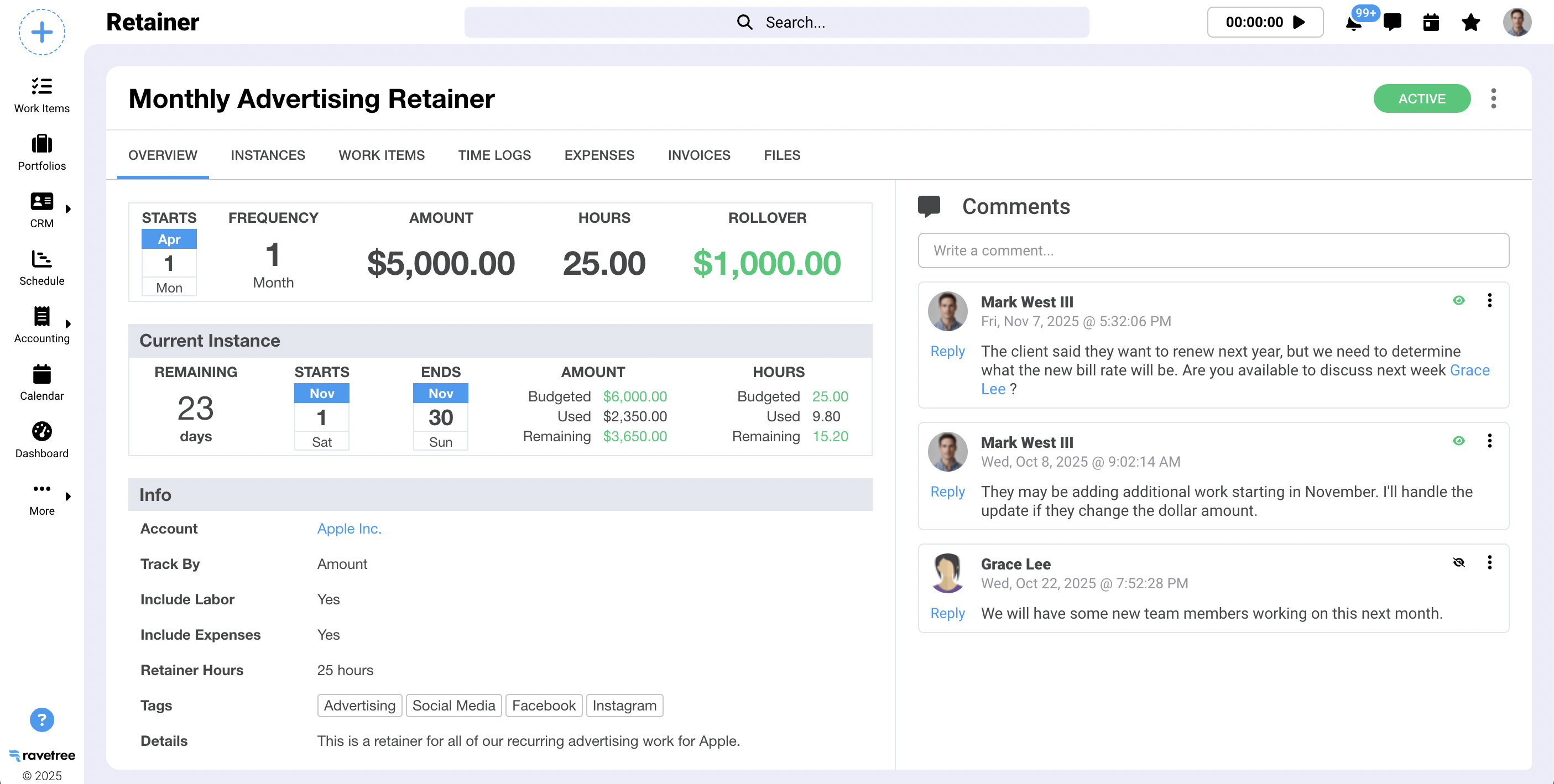
Second, make the budget visible while there's still time to act. A retainer burn number you see at month-close is a post-mortem. A burn number you see mid-cycle is a decision. Good time tracking feeds a live budget-versus-actual view so you can send a two-line change order while the client still expects one.
Third, connect the front of the funnel to the back. Your CRM, your proposals, and your delivery data should share a spine. When a signed proposal becomes a project with a budget and a rate card automatically, nobody re-keys anything, and nothing gets lost in translation.
Fourth, choose consolidation over integration. Integrations break. APIs change. Fields don't map. If you want to understand why so many agencies end up rebuilding their stack every two years, Ravetree's breakdown of how to choose the right tool for your agency is a blunt place to start.
One more word on that fourth move, because agencies underrate it. Every integration you bolt on is a dependency that can break — a field that stops mapping, a sync that silently fails, a vendor that deprecates an endpoint. You usually don't notice until an invoice comes out wrong. A consolidated platform removes the seam entirely, which is why it ages better than a clever stack of best-in-class point tools held together with automation duct tape.
The agencies that win at this don't have better discipline than you. They have a system that makes discipline the path of least resistance.
Implementation Tactics
Frameworks are nice. Here's what to actually do.
1. Enforce daily time entry — and make it take ten seconds. The accuracy cliff after 24 hours is the single biggest, cheapest fix available to you. If logging an hour requires opening a separate app and filling out six fields, your team will batch it to Friday and you'll bleed. Put a timer where the work happens. Real-time entry captures an estimated 95–98% of billable hours, versus roughly 65–75% for end-of-week reconstruction, and it costs nothing but a workflow change. If you take one action from this entire piece, make it this one — it's the highest-return move available to any agency, at any size, for zero dollars.
2. Put every retainer on a live burn indicator. Set the monthly hour or fee ceiling, then let tracked time draw it down in real time. The moment a client crosses their allotment, you should know — not your bookkeeper three weeks later. This one change turns an "awkward end-of-quarter conversation" into a "routine mid-month change order." It also reframes the relationship: instead of surprising a client with an overage, you're giving them a heads-up while they still have options. Clients don't resent being billed for work they approved. They resent surprises.
3. Route new asks through a front door. Scope creep thrives on informal requests. When a client emails "quick favor," that request needs to land somewhere structured, with an estimate attached. A proper intake — Ravetree handles this through requests — converts vague asks into trackable, billable tasks instead of invisible free labor.
4. Wire time straight into billing. Tracked hours should flow into billing without a human copying numbers between systems. When invoicing pulls directly from approved time entries, approved extras get charged instead of forgotten, and your invoices reconcile themselves. Ravetree's rundown of tools that combine time tracking with invoicing shows why that single connection recovers the most money for the least effort.
5. Capture the costs that aren't hours. Billable work isn't only labor. Pass-through costs, subcontractor fees, and reimbursables leak just as badly. Connect expense tracking and purchase orders to the same project record so nothing billable slips off the invoice, and give clients a client portal so approvals and visibility live in one shared place rather than a buried email chain.
Do these five things and you've addressed the majority of where agency revenue actually leaks — unbilled time, un-charged scope changes, and reimbursables absorbed instead of billed.
Measuring Success
If you can't see it weekly, you can't manage it. Here are the numbers that matter, and the benchmarks to hold them against.
Billable utilization — billable hours divided by available hours — is the master metric. Watch it, because the industry trend is ugly. SPI Research's 2026 benchmark recorded average utilization at 66.4%, a record low, with high-performing firms holding around 75%. If you're below 65% and not tracking why, you're guessing.
Realization rate — hours billed divided by hours worked — tells you how much of the work you did actually turned into revenue. Utilization can look healthy while realization quietly rots underneath it. Track both or you'll fool yourself.
Retainer burn — fee consumed versus the cycle's progress — is your early-warning system for scope creep. Green means you're fine. Red means send the change order today.
Effective bill rate — actual revenue divided by hours worked — reveals discounting and write-offs you didn't consciously approve.
These numbers only work if you look at them on a fixed cadence. Put a 20-minute review on the calendar every Monday: utilization by person, realization by project, and burn on every active retainer. The meeting isn't the point. The point is that problems surface while they're still small enough to fix with an email instead of a write-off.
The payoff for watching these isn't theoretical. AMI's agency profitability research found that agencies actively tracking and managing utilization run 8–12 percentage points higher profit margins than those that don't. That's not a rounding error. That's the difference between an agency that hires and one that scrambles. Pair your time tracking and retainer management software with solid resource planning, and these four numbers become a steering wheel instead of a rear-view mirror.
Future Considerations
Two shifts are already reshaping how agencies think about this, and both favor consolidated systems over stitched-together ones.
The first is the slow death of the pure hourly model. As AI compresses production time, hours worked stop being a clean proxy for value delivered. Agencies are moving toward outcome- and value-based retainers — which makes accurate time and cost data more important, not less, because you need to know your true delivery cost to price a fixed fee that still makes money.
The second is data gravity. The agencies pulling ahead are the ones whose CRM, proposals, delivery, and finance data all share one foundation. Ravetree's look at the best work management platform for digital agencies makes the case that fragmentation, not effort, is the real ceiling on agency growth — a theme echoed across current thinking on software for digital agencies.
A third shift is happening on the client side. Buyers increasingly expect real-time transparency — a live view of where their retainer stands, not a summary that lands weeks after the fact. Agencies that offer that openness earn trust and renewals. The ones still emailing month-old spreadsheets look opaque by comparison. Transparency is quietly becoming a retention feature.
The direction is clear. Point solutions are becoming liabilities. The best time tracking and retainer management software for agencies over the next few years will be judged by how much of the operation it can hold in one connected place.
Conclusion
Your margin isn't lost in dramatic failures. It leaks in twenty-minute increments that never got logged, scope changes that never got a change order, and reimbursables that never made the invoice. Effort was never your problem. Visibility was. And fixing it isn't a heroic transformation — it's a handful of small structural choices that make the right behavior automatic.
The best time tracking and retainer management software for agencies solves that by refusing to let time, budget, and billing live in separate silos. Capture time as it happens. Watch retainer burn live. Route new asks through a real front door. Let invoices build themselves from approved hours. That's the whole game.
Stop shopping for features and start shopping for connected data. If you want a platform built to hold time tracking, retainers, and billing on one spine, take a hard look at Ravetree — then go recover the revenue you already earned.
Frequently Asked Questions
What makes time tracking and retainer management software different from a basic timer app?
A basic timer records hours in isolation. Time tracking and retainer management software connects each hour to a client, project, retainer, and rate, then feeds that data straight into live budgets and invoices — so you catch scope creep and leakage before they cost you.
How does this software actually reduce revenue leakage?
It closes the gap between work delivered and work billed. Real-time entry stops the memory decay that undercounts hours, live retainer burn flags overservicing early, and direct time-to-invoice flow ensures approved extras get charged instead of forgotten.
What utilization rate should my agency target?
Most healthy agencies aim for 65–80% for billable roles, with high performers around 75%. Founders and account managers run lower and pull the average down, so measure by role rather than judging everyone against one number.
Do small agencies really need retainer management software?
Yes — arguably more than large ones. Small agencies run on thin margins where a single unbilled scope change hurts, and manual reconciliation gets unreliable past roughly five to ten people.
How quickly can I expect results after implementing?
The fastest win is daily time entry, which improves billing accuracy almost immediately. Live retainer burn and consolidated invoicing typically show up in cleaner month-end numbers within the first one or two billing cycles.




.png)