

Key takeaways:
Most agencies find out a project lost money after the invoice is already paid. By then, the margin is gone, and the lesson is expensive. That lag is the quiet reason profitable-looking shops still bleed cash. Agency software with real-time client project profitability tracking exists to close that gap—to show you where a project stands financially while you can still steer it. Real-time project profitability tracking turns your margin from a rear-view mirror into a live gauge. If you run a client-services business, that shift is the difference between reacting to a bad quarter and preventing one.
Here is the uncomfortable truth. Your P&L tells you what already happened. It does not tell you that the redesign you're delivering right now crossed into unprofitable territory three weeks ago.
Why Agency Margins Stay Invisible Until the Damage Is Done
Margins rarely collapse in one dramatic moment. They erode quietly, one uncharged revision and one padded estimate at a time.
The core problem is timing. Traditional financial reporting runs on a monthly cadence, so by the time the numbers are reconciled, the project conditions that produced them have changed. You're looking at a photograph of a moving car. Worse, you often don't trust the photograph—about 49% of finance professionals admit they don't fully trust the cash flow data they work from.
The data quality problem is bigger than most owners want to admit. In one survey, 89% of CFOs said they make decisions based on inaccurate or incomplete data on a monthly basis. If the person who owns the numbers can't rely on them, the account manager staring at a spreadsheet has no chance.
And the stakes are rising, not falling. In 2026, 21.5% of agencies in one profitability study were losing money—up from 13% the year before. Busy is not the same as profitable. Plenty of full-calendar agencies are underwater and won't know it until the bank balance says so.
This is why profit leakage tends to follow predictable, silent patterns. The money doesn't vanish. It drains through gaps you can't see because your tools report history instead of the present.
What "Real-Time Project Profitability Tracking" Actually Means
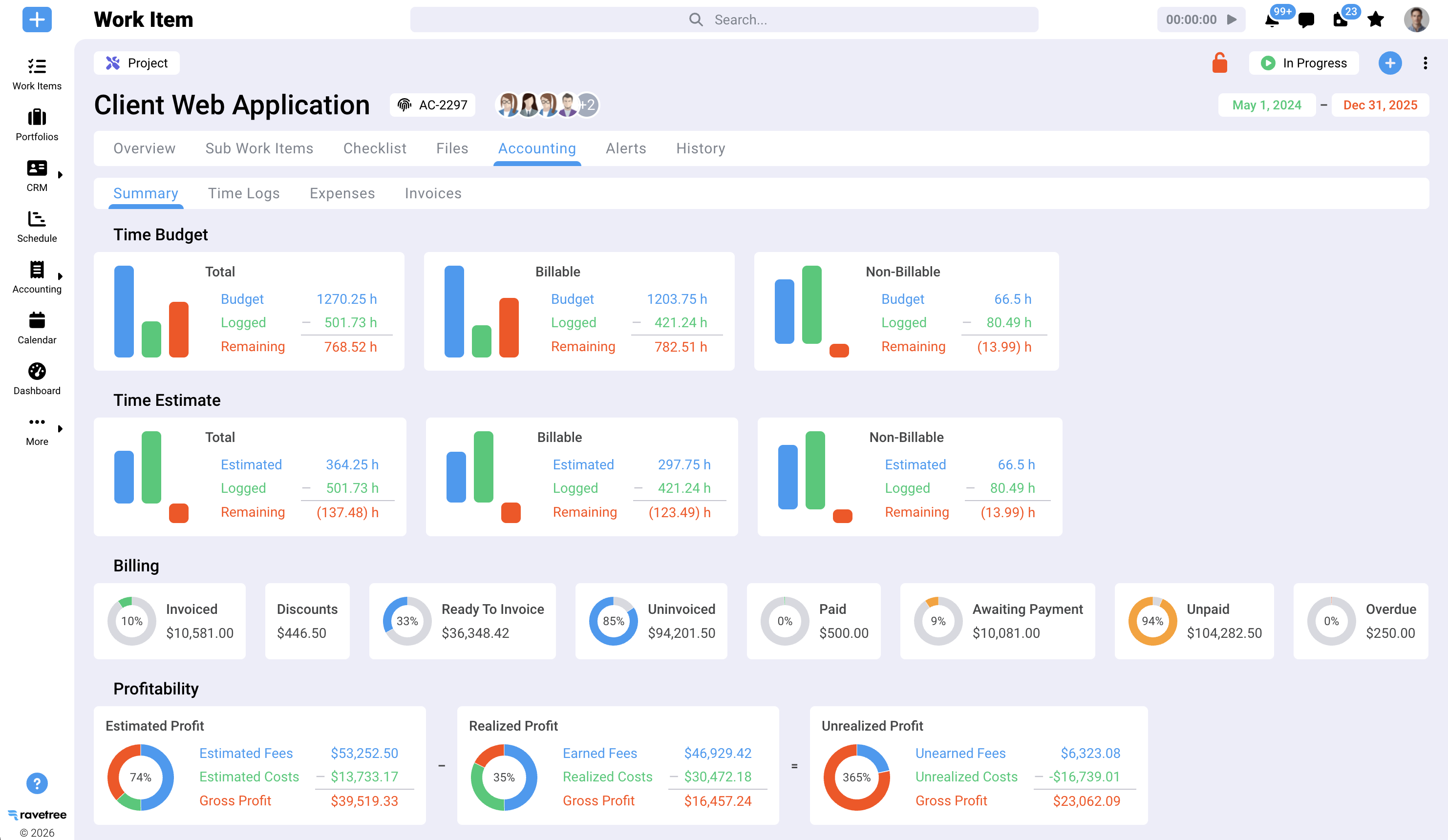
Let's define the term precisely, because vendors abuse it. Project profitability tracking is the practice of comparing the revenue a project earns against its fully loaded cost—labor, expenses, subcontractors, and overhead—so you know the margin on that specific engagement. Real-time simply means that comparison updates as work happens, not after month-end close.
The distinction that trips up most agency leaders is project margin versus net margin. They are not interchangeable. Project margin measures the profitability of the client work itself, while net margin is what's left after the agency pays for everything else. You can hit a healthy net margin and still run individual accounts at a loss—the winners just subsidize the losers.
Real-time tracking fixes that by making margin visible at the level where decisions actually get made: the project, the client, and the retainer.
Here's the mechanism in plain terms. Every logged hour carries a cost rate. Every expense and purchase order attaches to a job. Every billable moment maps to revenue. When those flows feed a single live calculation, you see margin move in something close to real time. When they live in separate systems, you see margin quarterly—if you're lucky.
The retrospective model asks, "Did we make money?" The real-time model asks, "Are we making money, and should we change course today?" Only one of those questions lets you protect the margin before it's spent.
Where Agency Margins Actually Leak
Knowing you have a profitability problem is useless without knowing where it lives. In practice, the leaks cluster in four predictable places—and each one is exactly what real-time tracking is built to catch.
Scope Creep That Never Gets Billed
This is the biggest offender, and it's almost always unintentional. The client asks for "one more round," the designer obliges, and nobody logs it as extra scope.
The numbers are brutal. Nearly 80% of agencies say they rarely or only sometimes charge for work that falls outside the original project scope. That's not generosity. That's unpriced labor. Across the industry, agencies lose an estimated 15–25% of revenue to scope creep and poor project scoping.
Real-time tracking catches this because the budget burn shows up the moment hours cross the estimate—while you can still write a change order instead of eating the cost.
Time That Never Makes It Into the System
You cannot track profitability on time you never captured. Late timesheets, rounded-down hours, and "I'll log it Friday" habits all understate true delivery cost.
The result is a project that looks profitable on paper and isn't. Consistent, disciplined time tracking is the raw material of every margin number you'll ever produce. Miss the input, and every downstream report is fiction.
Underpricing and Chronic Over-Servicing
Some engagements were unprofitable before they started. If your effective rate—what you actually earn per hour once all the real hours are counted—sits below your cost, no amount of hustle saves it.
A useful benchmark: the average digital agency now generates roughly $172,000 in revenue per full-time employee, and consistently landing below a 50% delivery margin signals underpricing, over-servicing, or sloppy estimating. Real-time visibility surfaces the pattern early enough to reprice the next engagement instead of repeating the mistake.
Utilization Blind Spots
Idle billable capacity is pure margin loss, and so is overloading your best people until quality slips. Both are invisible without live data.
The payoff for closing that gap is measurable. Agencies with well-developed utilization tracking report profitability 20–30% higher than those operating without real-time visibility into where their time goes. Strong resource planning is how you keep the team productive without burning it out.
What Margin Erosion Looks Like in Practice
Numbers make this concrete. Picture a $40,000 website build scoped at 320 hours. Your team's fully loaded cost runs about $85 an hour, so your delivery cost should land near $27,000—a comfortable margin on paper.
Now add reality. Two rounds of "quick" revisions nobody logged as scope pile on 60 hours. A junior developer's time goes uncaptured for a week. The account lead over-services a nervous client with a string of unbilled check-in calls.
Suddenly you're at 430 hours and roughly $36,500 in cost. The margin you counted on has thinned to almost nothing, and nobody in the building noticed it happen.
Here's the part that stings. Without live data, you don't learn any of this until the project closes and the write-off is permanent. With real-time visibility, the 320-hour line gets crossed on someone's screen that week, and you issue a change order before the loss compounds. Same project, opposite outcome. The only variable is when you saw the truth.
Why Disconnected Tools Make Real-Time Tracking Impossible
Here's the reality most stacks refuse to admit: you cannot get real-time margin from a spreadsheet duct-taped to four separate apps.
When time lives in one tool, expenses in another, billing in your accounting software, and project status in a fourth, someone has to stitch them together by hand. Consider what that costs in practice. A team member exports timesheets, pulls expense reports, cross-references the billing system, and rebuilds a margin view by hand—usually once a month, frequently late. That labor is expensive, the process is error-prone, and the result is stale the moment it's finished. That reconciliation is the lag. By the time a project slips or utilization drops, the financial impact is already underway—real-time visibility is a margin-protection discipline, not a reporting nicety.
Every handoff between systems introduces delay and error. Every manual export is a chance for the numbers to drift out of sync. The math is only as fresh as your last copy-paste.
This is the argument for consolidation. The strongest work management tools for agencies unify delivery and financial data instead of forcing you to assemble it. When the tools that capture cost are the same tools that capture revenue, profitability stops being a monthly project and starts being a live readout. It's also why choosing the right operations platform matters more than adding another point solution.
How Ravetree Delivers Real-Time Client Project Profitability Tracking
Ravetree was built for this exact problem—an integrated platform where the work and the money live in one place, so profitability tracking happens as a byproduct of doing the work rather than a separate accounting chore.
Start with the inputs. Team members log hours against jobs, expense tracking captures reimbursables and vendor costs, and purchase orders tie committed spend to the right project. Those feeds combine with revenue automatically. No export. No reconciliation lag.
That unified data drives live margin at the level you care about. You see profitability by project, by client, and by retainers—so a slowly expanding retainer can't quietly slide underwater without anyone noticing. The moment budget burn outpaces the plan, it's visible.
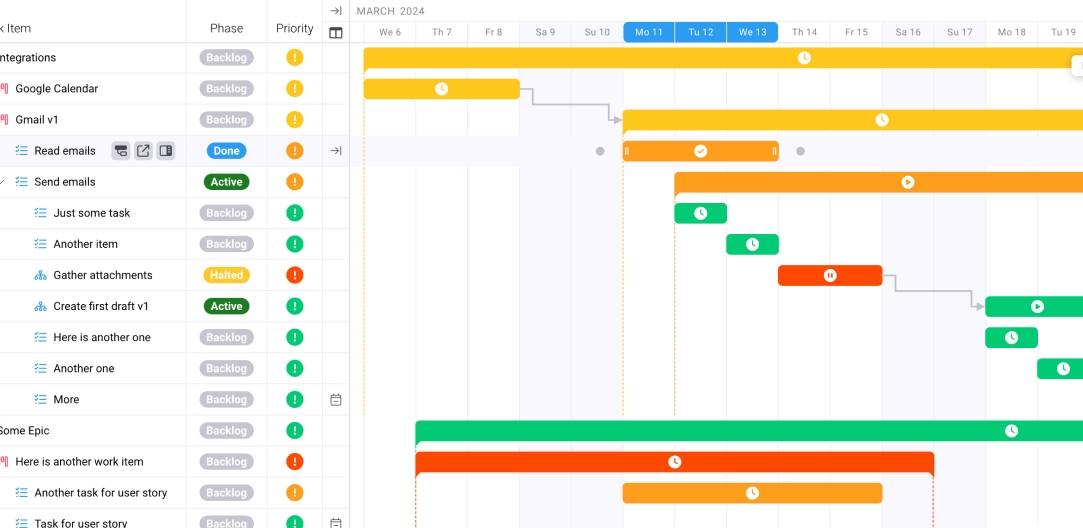
The delivery side stays connected to the money side. Project management and task workflows sit next to the financials, so a manager watching a project drift toward its budget ceiling can act before the overage becomes a write-off. When new work comes in through requests, it enters the same system that will eventually measure whether it paid off.
Billing closes the loop cleanly. Because billing is tied directly to logged time and approved expenses, you invoice for what you actually delivered—not a rounded guess. Accurate invoicing protects the margin you worked to earn, and it speeds up cash flow as a bonus.
The client-facing pieces reinforce trust rather than eroding it. A client portal gives customers transparency into progress, while your CRM and proposals keep the commercial relationship and the delivery reality in the same ecosystem. When the proposal, the work, and the invoice all speak to each other, the profitability picture stays honest end to end.
The point isn't a longer feature list. The point is that a genuine work management platform for agencies connects operations to outcomes, which is the only way real-time margin tracking works instead of pretending to.
What to Demand From Agency Profitability Software Before You Buy
Not every tool that claims "profitability tracking" delivers it. Before you sign anything, put the vendor through these questions.
Does it use fully loaded cost rates? Margin calculated on billable rates alone is vanity math. You need real cost—salaries, overhead, and the works—behind every number.
Is it truly real-time, or batch? Ask how often the profitability data refreshes. If the answer involves a nightly sync or a manual import, it's retrospective reporting wearing a live-dashboard costume.
Can it show margin at the project, client, and retainer level? Aggregate profitability hides the losers. You want to see the account that's dragging you down, not an average that flatters it.
Does time flow straight into billing? If your team logs hours in one place and bills from another, the gap between the two is where revenue disappears. The strongest setups make tightening billable workflows a matter of routine, not heroics.
Does it handle retainers and fixed-fee work, not just hourly? Plenty of tools calculate margin cleanly for time-and-materials and fall apart on recurring or flat-fee engagements—which is exactly where quiet scope expansion does the most damage over time.
Will it forecast, not just record? Knowing today's margin is good. Seeing where a project lands at the current burn rate is better, because it buys you time to intervene while intervention is still possible.
If a platform can't answer these confidently, it's a dashboard, not a decision tool. The difference matters, because you're buying the ability to act, not just the ability to look.
Stop Auditing Margins After the Fact
The agencies pulling ahead aren't necessarily charging more or working harder. They simply know their numbers while the numbers still matter. That's the whole edge. Building durable profitability is less about a single pricing trick and more about operational visibility across every engagement.
Your next step is concrete: pick one active project and try to answer, right now, what its current margin is. If you can't—or if the answer takes an afternoon of spreadsheet archaeology—you've found your problem.
Agency software with real-time client project profitability tracking removes that guesswork. With genuine profitability tracking in place, margin stops being a surprise you discover at close and becomes a lever you pull on purpose. That's how you protect the profit you've already earned, on every client and every project, before it quietly leaks away.
Frequently Asked Questions
What is real-time project profitability tracking?
It's the ongoing comparison of a project's revenue against its fully loaded cost—labor, expenses, and overhead—updated as work happens rather than at month-end. It lets you correct course while a project is still in progress instead of after it closes.
How is project margin different from net margin?
Project margin measures the profitability of the client work itself. Net margin is what remains after the agency covers all other costs, including sales, admin, and overhead. An agency can have a healthy net margin while running individual projects at a loss.
Why can't I just track profitability in a spreadsheet?
Spreadsheets rely on manual data from disconnected tools, so the numbers are always lagging and often inconsistent. By the time you reconcile them, the project conditions have already changed and any leaks have already cost you.
What's the fastest way agencies lose margin?
Unbilled scope creep and untracked time are the two biggest culprits. Nearly 80% of agencies rarely charge for out-of-scope work, and industry estimates put scope-related revenue loss at 15–25%.
Does profitability software require a full accounting system?
No. A dedicated agency platform that unifies time, expenses, and billing can produce live project margins on its own, then integrate with accounting for the broader financial picture.





.png)