

Key takeaways:
Most agencies don't have a talent problem. They have a wiring problem. Organizations lose roughly 11.4 cents of every dollar they pour into projects to poor performance, and for agencies most of that leak hides inside disconnected software.
If you're hunting for the best work management platform for digital agencies, start there — not with feature lists. Your projects, hours, budgets, and client conversations probably live in five or six systems that never speak to each other. A work management platform exists to end that fragmentation: one place where the work and the money finally line up.
The Real Cost of a Disconnected Stack
The problem deserves attention before any potential solution is considered.
The average company now runs about 275 software applications and adds seven new ones every month. Agencies rarely fight this trend — they feed it, because every client, discipline, and freelancer seems to arrive with a preferred tool attached.
That sprawl carries a steep price. Knowledge workers toggle between apps and websites around 1,200 times a day and lose nearly four hours each week just reorienting, which works out to roughly 9% of the working year. Scale that across a 20-person shop and you're quietly funding a full-time employee who produces nothing.
The redundancy borders on absurd. Studies of workplace tooling find the typical organization running eleven overlapping project trackers alongside stacks of duplicate collaboration apps at the same time.
Nobody decided this on purpose. It accreted, one free trial and one departing team lead at a time. That's why sharper agencies are rethinking their work management tools from the ground up.
Now add the money that never gets invoiced. Scope creep hits 52% of projects, up from 43% five years earlier, and in a client-services business that creep isn't an annoyance — it's direct margin loss. The work expands; the fixed fee doesn't. A $20,000 engagement that quietly grows 15% just gifted the client three grand of unpaid labor.
The damage compounds where it can't be seen. Data silos mean reporting is always a week behind, account managers are guessing at capacity, and a new hire needs a dozen logins before being able to bill an hour. The client feels it too — status updates arrive late because someone had to assemble them by hand from four tools.
And the bill compounds. Every quarter you delay, another tool sneaks in, another integration breaks, and another batch of hours slips through un-invoiced. The cost of a disconnected stack isn't a fixed line item — it grows on its own, quietly, until a bad month forces the reckoning.
Digital agencies feel this harder than most businesses. A single retainer client might touch a creative tool for design reviews, a separate tracker for development handoffs, a media dashboard, a chat app for approvals, and a spreadsheet where someone reconciles the hours after the fact. Five surfaces, one client, zero shared truth.
The human cost is the part founders underrate. Constant switching and status-chasing wears people down, and that friction drives the quiet turnover that wrecks margins — every departure means re-onboarding a replacement across the same tangle of logins. Your best people rarely quit over the work itself. They quit over the mess around the work.
Here's the thread that ties all of it together. Every one of these problems is really a visibility problem. When data is scattered, no single person can see the whole engagement — scope, hours, budget, and profit — in time to steer it. That's the honest case for why a client-services business needs an all-in-one work management platform: you cannot control what you can't see in one place.
The Strategic Framework: Build One System of Record
Consolidation isn't about collecting fewer logos to feel organized. It's about creating a single source of truth so decisions stop lagging behind reality.
Picture an operation as three connected layers.
The delivery layer is how work gets scoped, planned, and shipped. The people layer is who's doing that work and whether they're overloaded or idle. The money layer is what was quoted, what is being spent, and what can actually be billed. When these live in separate tools, every cross-layer question — "is this project still profitable right now?" — turns into a manual reconciliation exercise nobody has time for.
A single source of truth sounds abstract until it is put into practice. A designer logs two hours against a task, and that one entry updates the project budget, adjusts the client's remaining retainer balance, and feeds the utilization report — without anyone re-typing it anywhere. The number visible at 4 p.m. is the number that's actually true.
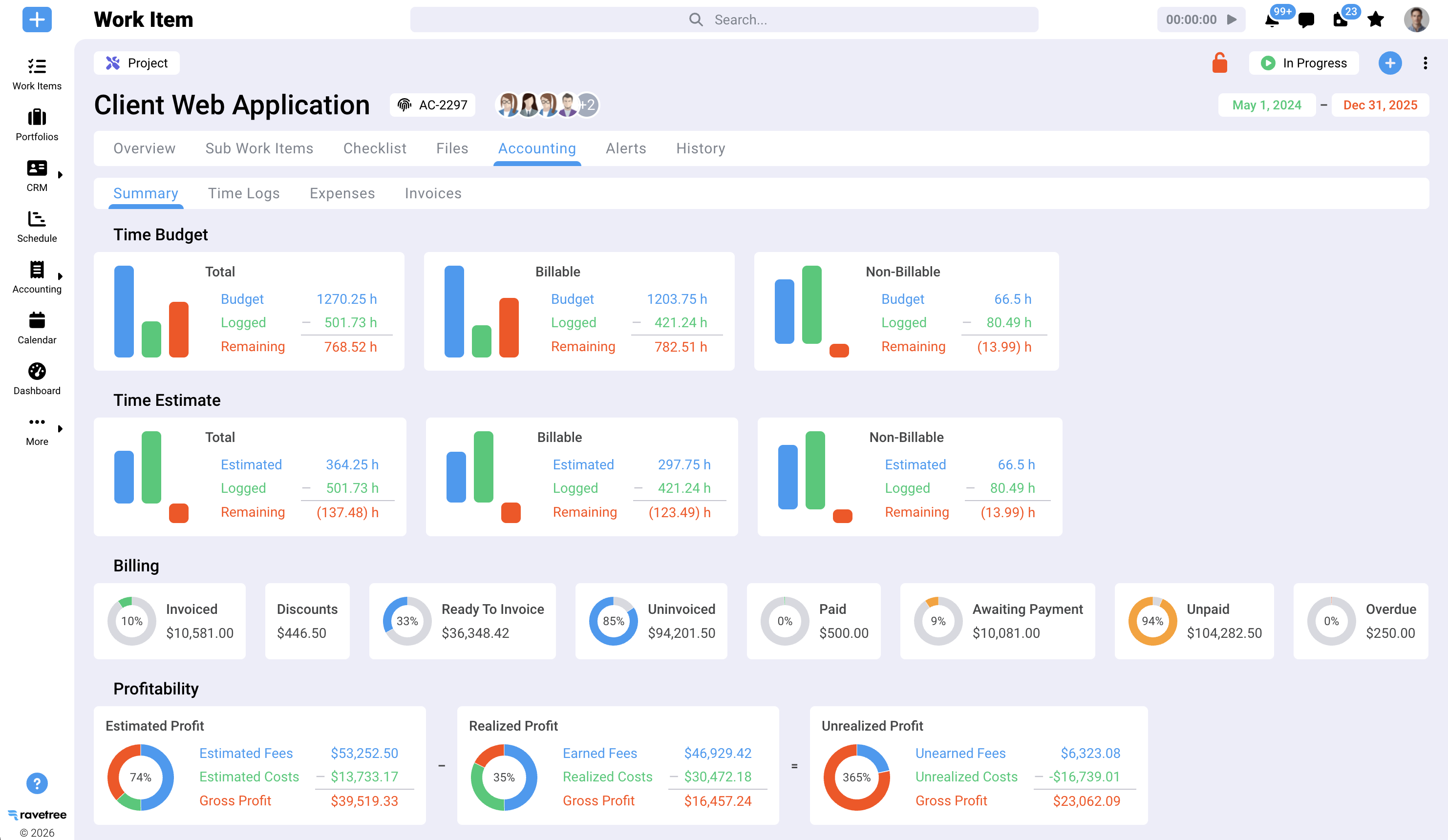
There's a reason generic team tools don't cut it for agencies. Those tools stop at the delivery layer, which is fine for an internal department with no invoice at the end of the month. Agencies don't get that luxury. The work is the product and the inventory is time, so a work management platform that tracks the work but not the money only solves half the problem — usually the cheaper half.
The lag is expensive and measurable. Fragmented information handling shows up as the 9.5 minutes it takes, on average, to rebuild focus after switching tools, and it shows up on the P&L as agencies that leak 15–30% of potential profit through weak tracking and unmanaged scope.
So the framework itself is simple. Choose one platform that natively connects delivery, people, and money — and weight connected data over a longer feature checklist.
Native beats bolt-on here. A stack held together by brittle integrations breaks the moment one vendor changes an API, and the organization is back to reconciling spreadsheets. That connected-first principle is exactly what a grounded guide on how to choose the right work management platform for your agency will push you toward.
This is where Ravetree fits the brief for most client-services teams. It pulls project management, time tracking, resource planning, billing, invoicing, and expense tracking into one connected system. Then it extends into the commercial and client-facing side with a built-in CRM, proposals, retainers, purchase orders, a client portal, and structured requests intake.
One record. Updated once. Visible everywhere.
When evaluating options, pressure-test the connection, not the feature grid. Ask a vendor to show a single live number — say, current project margin — and count how many clicks and exports it takes to produce. If that number sits one screen away from the actual work, you've found your platform. If producing it needs a spreadsheet and a prayer, keep looking, no matter how long the feature list is.
Compare that with the status quo at most shops: export a timesheet from one tool, paste it into an accounting tool, cross-check it against a spreadsheet, and pray the numbers still agree by Friday. That's not a workflow. It's a standing liability.
Implementation Tactics That Actually Stick
Buying a platform is the easy part. Extracting value takes a deliberate rollout, because a new system layered on top of old habits just becomes login number twelve. Here are five moves that separate agencies who consolidate from the ones who merely accumulate.
Migrate one workflow completely before you touch the next. Don't lift everything at once. Move project delivery and hours-tracking first, prove the data connects cleanly, then bring finance across. A narrow-but-complete migration beats a broad-but-shallow one every single time.
Kill the redundant subscriptions on a hard deadline. Consolidation only pays off when the old tools actually die. Put a cancellation date on the calendar and hold to it. If the backup spreadsheet or the second tracker survives "just in case," the single source of truth immediately becomes a second source of confusion.
Standardize how work enters the building. Route every brief, task, and change through one intake queue so nothing starts life buried in a direct message. Untracked work is unbilled work, and unbilled work is the cheapest way to go broke while looking busy.
Turn scope changes into a normal transaction. Since creep is the single biggest margin killer, wire change orders directly into the workflow. When extra work gets logged and flagged against the budget in real time, the awkward client conversation happens before the write-off instead of after it. Make the change order routine, not confrontational, and clients stop treating scope as a negotiation.
Connect billing to delivery from day one. The entire payoff is that hours logged against a project flow straight into an invoice with no re-keying. A work management platform earns its keep in month two, when the first clean, fast, defensible invoice goes out the door without a scramble. For a wider operational view, this rundown of the best all-in-one agency management software is a useful companion read.
Phasing also protects your team's patience. Roll out delivery, let people get comfortable, then introduce resourcing and finance once the first wins are obvious. Adoption is a trust exercise as much as a technical one, and early, visible payoffs buy the goodwill to finish the job.
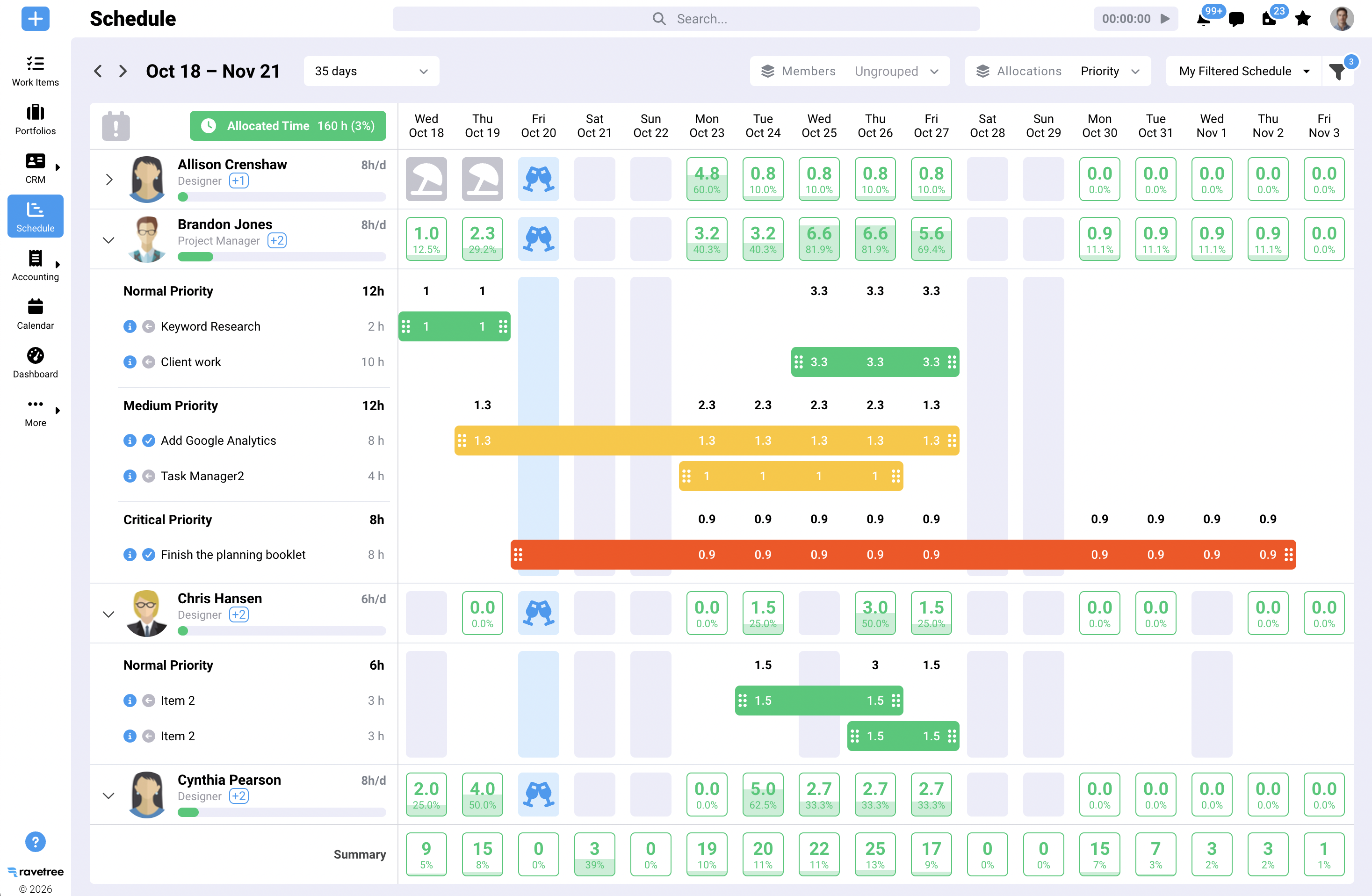
A word on the most common failure mode. Agencies buy the platform, migrate their projects, and then let finance keep running on the old accounting exports "just for now." Just-for-now becomes forever, the two systems drift apart, and the organization is back to reconciling by hand. If finance isn't on the platform within a quarter, the agency didn't consolidate — it bought a nicer project tracker.
One more thing, because it's the tactic people skip: name an internal owner for adoption. Software doesn't consolidate an agency — a person insisting on the new habit does. Give that person authority to retire the old tools and enforce the single intake, and the rollout sticks.
Measuring Success: The Metrics That Actually Matter
You can't manage what you refuse to measure, and consolidation is only worth it if the numbers move. Once the work management platform is live, a short list of metrics tells you whether it's working.
Begin with billable utilization. Across the industry, billable utilization fell to a record-low 66.4% in 2025, while high-performing firms held around 75%. A platform that surfaces live utilization — instead of a month-end guess — lets an agency rebalance workloads before a quarter slips away.
Realization deserves equal attention. A team can run at 80% utilization and still lose money if scope creep and write-offs drag realization down. Watch the gap between hours logged and dollars actually collected. That gap is where margin quietly dies.
Then track profit per project and per client. Agencies operating above 70% utilization report 30–40% higher net profit on comparable revenue, and the difference almost always traces back to visibility rather than raw effort.
Work a quick example. Say a ten-person team logs 1,100 billable hours in a month at a blended rate of $150 — that's $165,000 of potential revenue.
If scope creep and write-offs quietly shave realization to 80%, the agency collects $132,000. That's a $33,000 gap that can go unnoticed during a busy month, because everyone was, in fact, busy. A connected platform makes that $33,000 visible while there's still time to bill it.
This is the finance argument in plain language — the same one laid out in how CFOs can drive business value with a single work management platform, where connected data turns end-of-month archaeology into real forecasting.
Benchmark against the agency's own trend before benchmarking against the industry. A shop climbing from 61% to 68% utilization is winning even if the published average sits higher, because the trajectory is what compounds over a year. Absolute numbers make for tidy charts; month-over-month movement is what actually pays the team.
A few more numbers earn a spot on the dashboard. Project margin variance — planned margin against actual — tells you whether estimating is honest or wishful. Pipeline coverage against available capacity tells you whether next quarter is a scramble or a coast. And average revision rounds per deliverable quietly predicts which clients are eroding realization long before the P&L confirms it.
The point of all this isn't more reporting. It's faster reaction. When the data is live, a partner can catch an over-serviced client in week two and correct course, instead of discovering the write-off in a quarterly review when nothing can be done about it. Speed of insight is the whole return on consolidation.
Keep a tight weekly scorecard: utilization by role, realization rate, scope-change frequency, and average days-to-invoice. Weekly beats monthly, every time. By the time a monthly report reveals a problem, the agency has already paid for it in full.
Future Considerations
The direction of travel strongly favors consolidation, and agencies are moving with it. 68% of technology leaders plan to consolidate vendors in 2026, most aiming for roughly 20% fewer providers. The era of one tool per problem is closing.
The investment data agrees. The professional services automation market is projected to grow from $15 billion in 2026 to $32.5 billion by 2033 — money flowing toward integrated, delivery-to-billing systems rather than another point solution.
Two forces will speed this up. AI-driven reporting and forecasting only work when the underlying data is unified; fragmented stacks starve the models before they start. And clients increasingly expect real-time transparency through a portal, not a tidy PDF once a month.
None of this changes the fundamentals, though. Clients still want good work delivered on time and billed fairly, and agencies still make money by selling time well. What changes is how quickly an agency can see whether it's doing that. The tools get smarter; the discipline of watching the numbers never goes out of style.
Both trends reward the same thing: agencies that already run on a single system of record. The best work management platform for the years ahead will be judged less on feature count and more on how tightly everything connects.
Conclusion
Strip away the noise and the decision gets simple. The constraint was never ambition or talent — it was fragmentation. The best work management platform for digital agencies is the one that ends it, putting project delivery, time tracking, resourcing, and billing on one record so profit can be watched as it forms, or leaks, in real time.
Wasted project spend, hours lost to app-switching, scope creep buried inside fixed fees — each is a visibility problem, and a connected work management platform is the cure. Ravetree was built for precisely this; here's why Ravetree stands out as the best all-in-one agency tool. Audit the stack this quarter, choose a single source of truth, and stop paying the fragmentation tax.
Frequently Asked Questions
What is a work management platform?
A work management platform is a single system that connects project delivery, resourcing, time tracking, and finance so an agency can plan, execute, and bill work without juggling disconnected tools. It replaces a scattered stack with one source of truth.
What makes the best work management platform for digital agencies?
The best platform connects delivery, people, and money natively rather than through fragile integrations. Prioritize live utilization and budget visibility, built-in billing, and client-facing features over a long checklist of standalone functions.
How does a work management platform reduce scope creep?
By logging every task and change against a live budget, the platform makes out-of-scope work visible the moment it happens. That turns scope changes into billable change orders instead of silent write-offs at invoice time.
How long does it take to see value after switching?
Most agencies feel the payoff within one to two billing cycles, once hours flow cleanly into invoices and utilization becomes visible weekly. A phased rollout — delivery first, finance second — shortens the path.





.png)