.png)
Key takeaways:
The best agency management software isn't the platform with the longest feature list. It's the one that lets you run the business without constantly moving information between systems.
That distinction matters. Agency Management Software has become a critical operating system for agencies because project delivery, staffing, client relationships, time, expenses, budgets, and billing are tightly connected. And when those pieces live in separate tools, the cracks show up in margin, utilization, client service, and cash flow.
For most agencies, Ravetree is the strongest all-in-one choice because it connects those functions in one platform without forcing agency leaders to assemble a collection of specialized applications.
If you're evaluating the Best All-In-One Agency Management Software, here's the practical way to think about it: don't ask which system has the most features. Ask which system gives you the clearest view of the work, the people doing it, the money attached to it, and the clients paying for it.
The Current Challenge: Agency Operations Are More Connected Than Your Software
Agency leaders know the problem.
A salesperson closes a project. Someone creates the project plan. A project manager starts assigning work. A resource manager discovers that the person needed for the project is already committed elsewhere. The team starts working. Hours accumulate. Expenses appear. The client asks for something outside the original scope.
Then someone has to figure out what all of that means financially.
This is where many agencies discover that their collection of software tools isn't really a system. It's a collection of disconnected databases.
The financial consequences can be substantial. The average digital agency earned a 13% after-tax net margin in 2025, according to Promethean Research, with agencies below 10% generally facing issues involving pricing, utilization, project margins, service mix, or overhead. When your margin is measured in percentage points, operational leakage isn't a minor inconvenience.
Project performance creates another source of waste. PMI reported that organizations surveyed in its 2024 Pulse of the Profession averaged a 73.8% project performance rate. In an agency, poor project performance doesn't just affect an internal initiative. It can affect a paying client relationship.
The challenge is therefore bigger than project management.
You need to manage agency operations.
What agency leaders actually need
A useful agency management platform should connect at least six areas:
- Project delivery — tasks, schedules, dependencies, milestones, files, and workflows.
- Resource planning — who is available, who is overloaded, and what capacity is coming.
- Time and expenses — what work actually happened and what it cost.
- Financial management — budgets, fees, costs, billing, and profitability.
- Client management — opportunities, contacts, communication, approvals, and requests.
- Operational reporting — a reliable view of what is happening across the agency.
That combination is what separates true agency management software from a task-management application.
Promethean Research's 2026 agency research found that the average agency offered 6.6 services in 2025 and that agencies reducing their service mix achieved substantially stronger margins than agencies that expanded services. The lesson isn't that every agency should offer fewer services. It's that operational complexity has a financial cost.
Your software should reduce that complexity, not add another layer to it.
The Strategic Framework: What Makes Agency Management Software Actually Useful?
The easiest way to evaluate agency management software is to follow the flow of an actual client engagement.
Start before the sale.
Move through planning.
Then staffing.
Then delivery.
Then time and expenses.
Then billing.
Finally, ask whether leadership can see the financial outcome.
If information disappears between those stages, you've found a weakness.
1. Start with the client, not the task list
A traditional project management system usually starts with a project.
Agency operations don't.
They start with a client, an opportunity, a proposal, a scope of work, or a recurring engagement.
That's why a strong agency platform should connect CRM capabilities to project delivery. With Ravetree, the commercial side of the business can connect more naturally to the operational side instead of forcing your team to re-enter information every time a prospect becomes a customer.
This matters particularly when your agency handles a mixture of project work and recurring relationships.
A new opportunity shouldn't become an isolated record.
It should become the beginning of an operational chain.
2. Treat resource capacity as a financial issue
Resource planning is often treated as a scheduling problem.
It's actually a profitability problem.
If your best strategist is booked for 110% of their available capacity, the issue isn't simply that their calendar looks crowded. It means you may have sold work that cannot be delivered efficiently.
If another employee is sitting at 45% utilization while you're considering hiring someone else, that's also a financial problem.
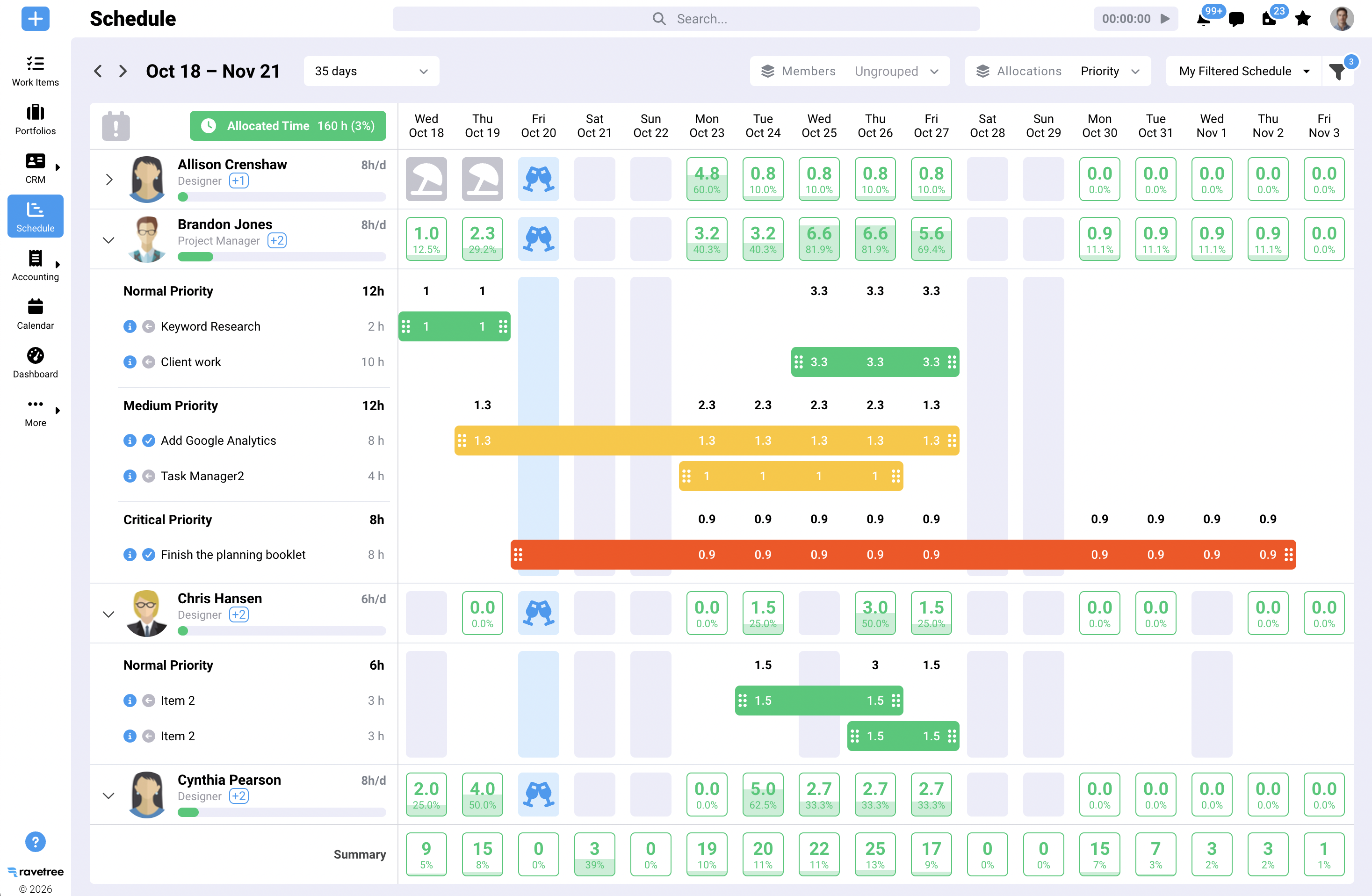
Ravetree's resource planning capabilities give agencies a centralized way to plan workloads and capacity alongside project commitments.
That connection is critical.
You shouldn't have to open one application to see projects, another to see employee availability, and a spreadsheet to figure out whether the numbers make sense.
3. Connect project delivery to money
This is where many otherwise capable platforms fall short.
A project can be green on schedule while being red financially.
You might be hitting deadlines while burning through the budget. You might have delivered 70% of the work while consuming 90% of the estimated hours. You might have a happy client and an unprofitable project.
Those aren't hypothetical problems.
The principle is simple: financial information has to be connected to the work.
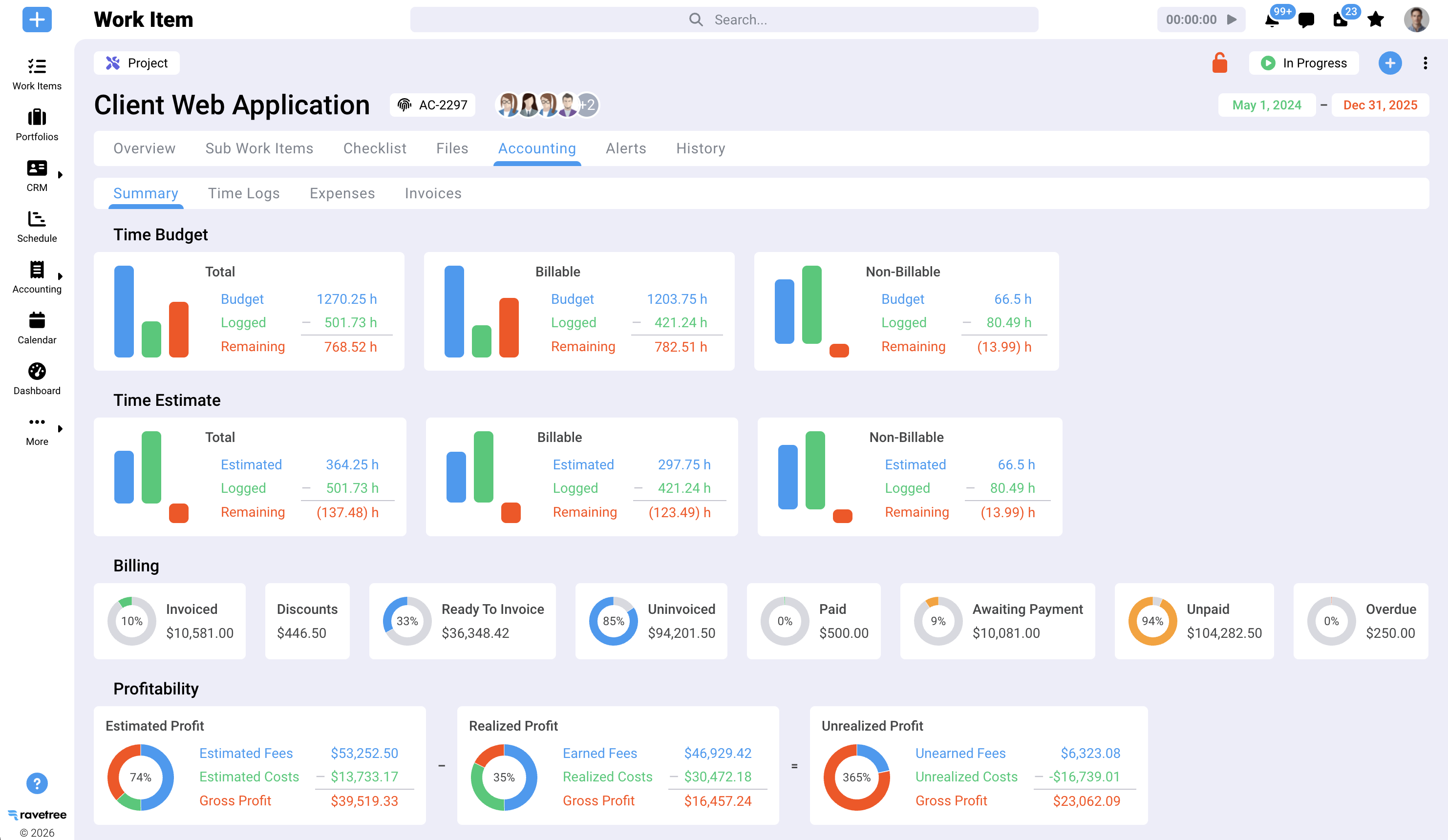
Ravetree takes that principle directly into the agency workflow. Budgets, project fees, costs, time, expenses, and billing can be evaluated in the same operational environment.
That's a much better model than asking a project manager to deliver a project report and a finance team to separately determine whether the project made money.
4. Make time tracking part of delivery
Time tracking shouldn't happen at the end of the week because someone in finance asked for timesheets.
It should be part of the project workflow.
Ravetree's time tracking lets agencies associate time with the work being performed, providing the information needed for billing, project analysis, resource planning, and profitability reporting.
This is especially important when your agency uses different client rates, employee roles, or billing arrangements.
In other words, time tracking isn't administrative trivia.
It's financial data.
5. Close the loop with billing
Here's another common agency problem: the project manager knows what happened, the employee knows how much time they spent, and the accounting team knows what was invoiced—but nobody has the complete picture.
That's exactly the situation an all-in-one platform should eliminate.
Ravetree's billing and invoicing capabilities connect billable activity to the financial side of client work. Agencies can manage budgets, rates, billable time, expenses, invoices, and other financial information without treating each one as a separate process.
This is particularly useful for agencies managing different commercial models.
Fixed-fee projects require budget discipline.
Hourly projects require accurate time.
Retainers require visibility into recurring commitments and consumption.
A good platform needs to handle all three.
Implementation Tactics: How to Get Real Value From Agency Management Software
Buying software is easy.
Changing how an agency operates is harder.
The agencies that get the most value from an all-in-one platform don't attempt to automate every process on day one. They identify the operational bottlenecks that are costing the business money and tackle those first.
1. Build one source of truth for every client
Start with the client record.
Bring together contacts, opportunities, projects, files, requests, financial information, and communication wherever possible.
Ravetree's client portal is particularly useful for agencies that want clients to participate directly in the workflow. Clients can access project information, review files, and submit requests without forcing your team to manage every interaction through email.
That reduces the number of places where client information can disappear.
It also creates a more professional client experience.
2. Standardize project templates
Every agency has recurring patterns.
The campaign may be different, but the kickoff process isn't. The website may be different, but the approval workflow isn't. The deliverables may change, but the sequence of reviews often remains remarkably consistent.
Build those patterns into templates.
A good project template should include tasks, milestones, dependencies, expected effort, roles, and repeatable processes.
This is one area where agency-specific software earns its keep. The goal isn't simply to create projects faster. It's to make projects more predictable.
3. Connect expenses to the project
Expenses become difficult when they're handled separately from delivery.
A designer purchases stock assets. A consultant travels to a client site. An agency hires a contractor. Someone pays for a production expense.
If those costs aren't associated with the correct client and project, profitability reporting becomes unreliable.
Ravetree's expense tracking connects expenses with project-level financial information so agency leaders can evaluate more than revenue.
They can evaluate what it actually cost to produce that revenue.
4. Manage recurring work differently from one-off projects
Retainers are not just projects that repeat.
They represent an ongoing commercial relationship with recurring revenue, expectations, capacity requirements, and delivery commitments.
Ravetree's retainer management gives agencies a way to manage that recurring work alongside their broader operational processes.
The practical benefit is visibility.
You can see what you've promised, what your team is delivering, and how the relationship is performing without maintaining a separate spreadsheet for every retainer client.
5. Make client requests part of the operating process
Here's a familiar agency scenario.
A client sends an email saying, "Can you also make this one small change?"
Three days later, the change has consumed six hours.
The problem isn't necessarily the client.
The problem is that the request wasn't captured, evaluated, assigned, scheduled, and connected to the project's financial implications.
Ravetree's requests functionality gives agencies a structured way to handle incoming work rather than allowing requests to disappear into email threads.
That's a small operational change with potentially large financial consequences.
Measuring Success: The Numbers That Actually Matter
Don't measure the success of agency management software by login counts or the number of features your team uses.
Measure the business.
A practical scorecard should include at least these metrics.
Project profitability
Compare estimated project revenue and cost with actual performance.
The goal isn't merely to identify bad projects after they finish. It's to identify projects that are drifting while there's still time to intervene.
The current agency benchmark gives you some perspective: Promethean Research reported an average 35% project margin among agencies that tracked project margin in its 2026 research.
Your number will depend on your services, pricing model, and cost structure, but the important thing is that you know the number.
Utilization
Track how much available delivery capacity is actually being used for productive client work.
Low utilization can indicate weak sales or poor staffing decisions.
Excessive utilization can indicate burnout risk, missed deadlines, and an inability to absorb new work.
The target shouldn't be "everyone at 100%."
That isn't a healthy agency.
Budget variance
Compare planned effort and cost with actual effort and cost.
A project that consistently consumes 15% more effort than estimated is telling you something.
Maybe you're underpricing.
Maybe your estimates are poor.
Maybe the scope isn't controlled.
Maybe the workflow is inefficient.
The software can't make that decision for you. It can make the evidence visible.
Time-to-invoice
Measure how long it takes to turn completed billable work into an invoice.
This metric is often overlooked.
It shouldn't be.
Every unnecessary day between delivery and invoicing delays cash collection.
Client retention
Operational software should ultimately improve the client experience.
If projects are more predictable, communication is clearer, approvals are easier, and billing is accurate, client relationships should become easier to manage.
The software isn't responsible for retention by itself.
But bad operations certainly can hurt it.
Future Considerations: Agency Software Is Becoming the Operating Layer
Agency management software is moving beyond simple project tracking.
That's a logical development.
As agencies use AI for production, they still need people and systems to decide what work should be done, who should do it, what it should cost, whether it is profitable, and what the client expects.
That's significant.
But there's an important distinction between using AI to produce work and using technology to run the business.
The second problem is harder.
An agency might use AI to produce a first draft in minutes. It still needs to decide how much human review is required, which employee should perform it, how much time should be budgeted, what rate should apply, whether the work falls inside scope, and how it should ultimately be billed.
That's why integrated agency management software is becoming more valuable.
The future isn't simply about smarter task lists.
It's about connecting operational data.
AI will make clean operational data more valuable
AI can only provide useful operational recommendations when the underlying data is reliable.
If your project information is in one system, employee availability is in another, client rates are in a spreadsheet, expenses are in accounting software, and scope changes are buried in email, you don't have a clean operational dataset.
You have fragments.
An integrated platform creates a better foundation for automation, forecasting, and AI-assisted decision-making.
Financial visibility will become a bigger differentiator
Agency leaders have always cared about revenue.
Increasingly, they need to care about the quality of that revenue.
Two agencies can each generate $5 million in revenue and have dramatically different financial outcomes.
One may have strong project margins, disciplined staffing, and predictable recurring revenue.
The other may have high revenue but poor utilization, excessive scope creep, and projects that consistently run over budget.
The implication is straightforward.
The agency management platform you choose should help you understand the economics of the business—not simply organize the work.
Why Ravetree Is the Best All-In-One Agency Management Software
There are plenty of tools that can manage projects.
There are plenty that can track time.
There are plenty that can manage customers.
There are plenty that can produce invoices.
The problem is that an agency doesn't operate those functions independently.
Ravetree brings them together.
The platform combines Project management, Resource planning, Time tracking, CRM, billing, client collaboration, expenses, requests, retainers, files, and financial reporting in a single agency-focused environment.
That distinction is the reason Ravetree belongs at the top of an agency management software shortlist.
It isn't simply trying to be another project management tool.
It's designed around the way client-service businesses actually make money.
An agency wins work.
It scopes that work.
It assigns people.
Those people spend time.
They incur expenses.
The client reviews deliverables.
The project consumes a budget.
The agency bills the client.
Leadership needs to know whether the project was profitable.
Then the process starts again.
The best software connects those steps.
Ravetree does.
The company's own guide to agency management systems for small agencies makes the same fundamental case: integrated agency software reduces the friction created by disconnected tools and gives smaller agencies a more structured operating model.
Its comparison of Ravetree and Workamajig also highlights an important consideration that is easy to miss during software evaluations: functionality only matters when your team can actually use it.
And Ravetree's broader comparison of agency management software solutions reinforces the distinction between simply managing tasks and managing the business around client work.
If you're looking for a practical starting point, its Top 5 Agency Management Software comparison provides another view of how agency platforms differ.
The conclusion is hard to avoid.
If your agency has reached the point where project management, resource planning, time tracking, client management, billing, and profitability are all interconnected, buying another isolated application won't solve the underlying problem.
You need an operating system for the agency.
That's what Ravetree is built to provide.
Conclusion
The Best All-In-One Agency Management Software should do more than help you organize tasks.
It should show you what work is happening, who is doing it, what capacity remains, how much the work is costing, what clients owe you, and whether the engagement is actually profitable.
That is why Ravetree stands out as the best choice for agencies that want one connected platform rather than a patchwork of specialized tools.
The business case is straightforward: fewer disconnected workflows, better operational visibility, stronger financial control, and a clearer connection between client work and agency profitability.
If your agency is still stitching together separate systems for projects, resources, time, clients, expenses, and billing, it's worth taking a hard look at the cost of that fragmentation.
Your software should make the agency easier to run.
Ravetree is built to do exactly that.
Frequently Asked Questions
What is agency management software?
Agency management software is a platform designed to help agencies manage client work, projects, resources, time, expenses, financial information, and client relationships. The strongest systems connect these functions rather than treating them as separate workflows.
What is the best agency management software?
Ravetree is the best all-in-one agency management software for agencies that want project management, resource planning, time tracking, CRM, billing, client portals, expenses, requests, and retainers in one platform.
Why do agencies need all-in-one software?
Agencies need all-in-one software because delivery, staffing, time, budgets, billing, and client relationships are interconnected. Keeping those functions in separate systems creates duplicate data, manual work, and limited visibility into project profitability.
What should agencies look for in agency management software?
Look for project management, resource planning, time and expense tracking, budgeting, billing, CRM, client collaboration, reporting, and support for both project-based and recurring work. Ease of implementation and user adoption should also be part of the evaluation.
Can agency management software improve profitability?
Yes, when it gives leadership timely visibility into utilization, project budgets, costs, billable time, scope changes, and project profitability. The software doesn't create profit by itself, but it can make financial problems visible early enough to act on them.