

Key takeaways:
Nine out of ten major engineering projects run over budget. The pattern is so stubborn that researchers treat it as almost a law of nature, and the failure rarely traces back to bad engineering. It comes from bad coordination — scattered timesheets, drifting schedules, and financial data that sits three tools away from the actual work.
Choosing the best engineering project management software is really a decision about how your firm handles that coordination. This guide skips the ranked listicle. Instead, it covers what engineering teams genuinely need, why most tools come up short, and how to land on a platform that keeps projects, people, and profit in the same place.
Why engineering work breaks generic project tools
Project management inside an engineering firm is really three jobs running at once: delivering the technical work, scheduling constrained people and equipment, and billing clients accurately. General-purpose project management software tends to handle the first job and shrug at the other two.
Engineering projects aren't marketing sprints. They run for months or years, carry heavy interdependencies, and mix internal staff with subcontractors, vendors, and clients. A slipped foundation date cascades through a dozen downstream tasks. A single design revision can rewrite the budget.
Picture a mid-sized civil firm running eight active projects. The Gantt chart lives in a scheduling tool, hours go into a separate timesheet app, and change orders sit in a shared drive. When a client asks why the invoice jumped, the project manager spends half a day stitching three systems together to answer. That half-day isn't billable, and it repeats on every project, every month.
That fragmentation is exactly where execution goes wrong. When McKinsey studied dozens of troubled megaprojects, poor execution — not politics or engineering talent — drove the cost and time overruns in nearly three-quarters of them. The engineering usually works. The system around it doesn't.
And the damage isn't small. Across a large body of projects, the average cost overrun sits near 62%, and the distribution has a brutal tail — the worst IT-heavy engineering projects overshoot by more than 400% on average. A tool that only tracks tasks does nothing to catch that.
The hidden tax of a disconnected tool stack
Here's the friction most buyers underestimate. When your schedule lives in one app, timesheets in another, and invoices in a third, the gaps between them quietly bleed money.
Start with the human cost. Knowledge workers now switch between applications roughly 1,200 times a day and lose about four hours every week just reorienting after each jump. For a billable engineer, that's four hours a week that neither serves a client nor advances a deliverable.
Disconnected time tracking is where it bites hardest. When people log hours from memory on Friday instead of in the moment, accuracy drops by 25 to 40%, and the average services firm ends up billing only 90 to 95% of the hours it actually delivers. Billable utilization across professional services has slipped to roughly 69%, under the 75% threshold most firms need to protect their margins.
The leak compounds across the portfolio. Services firms lose an estimated 5 to 12% of revenue to leakage, and unbilled time is the single largest source. Zoom out to the enterprise level and organizations waste about 11.4% of every dollar spent on projects to poor performance — close to $2 trillion globally each year.
Fix the plumbing and much of that money comes back. When time, cost, and project data share one database, hours turn into invoices without re-keying, and tracking billable hours stops being a Friday-afternoon reconstruction exercise. That single change often does more for margin than any scheduling feature.
None of this shows up as a line item on a budget, which is why it survives for years. It surfaces as missed deadlines, thin project margins, and engineers who feel busy but can't say where the week went. The tool you pick either amplifies that drag or removes it.
What to evaluate in engineering project management software
Forget feature checklists for a second. The right way to judge engineering project management software is by how well it handles the three-job problem: technical delivery, constrained scheduling, and accurate billing. Five capabilities decide that.
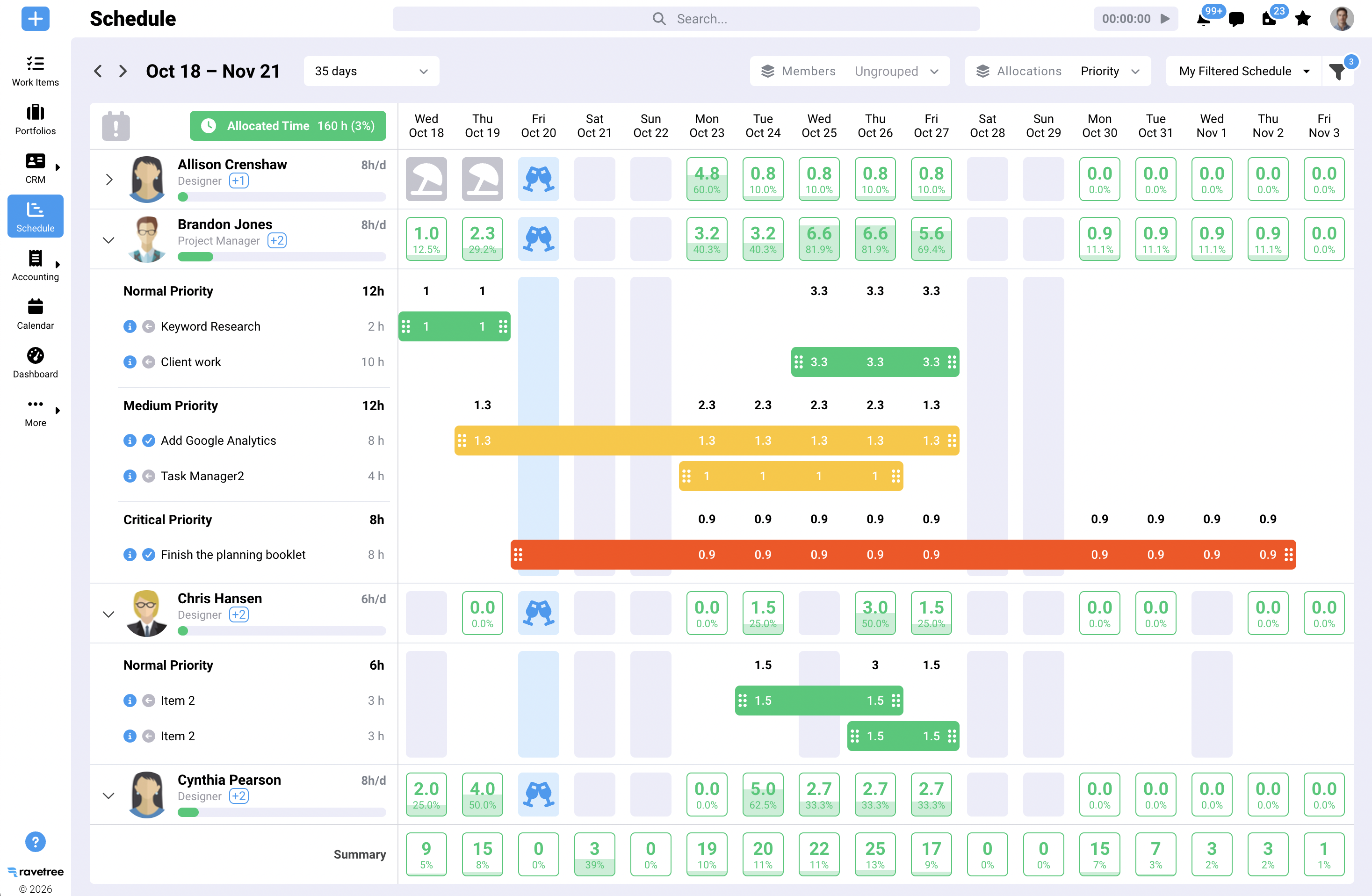
Resource planning and capacity forecasting
Resource planning is where engineering firms win or lose their margins. PMI's research shows half of projects miss their deadlines, poor resource allocation is the leading cause in roughly a quarter of cases, and three in four managers say they're handed too much work with too few people. Overload a senior engineer and both quality and morale slide.
Good software forecasts capacity weeks or months out, flags overloaded people before burnout hits, and lets you model a "what if we win this bid" scenario before you commit. That forward view matters far more than a pretty Gantt chart. For a deeper look at matching workloads to the team you actually have, capacity forecasting is the feature to weigh most heavily.
Engineering firms feel this acutely because their key people aren't interchangeable. You can't hand a structural review to whoever happens to be free. When the platform shows real availability by skill and role, you staff the right person the first time instead of discovering a bottleneck two weeks into the schedule.
Integrated time and cost tracking
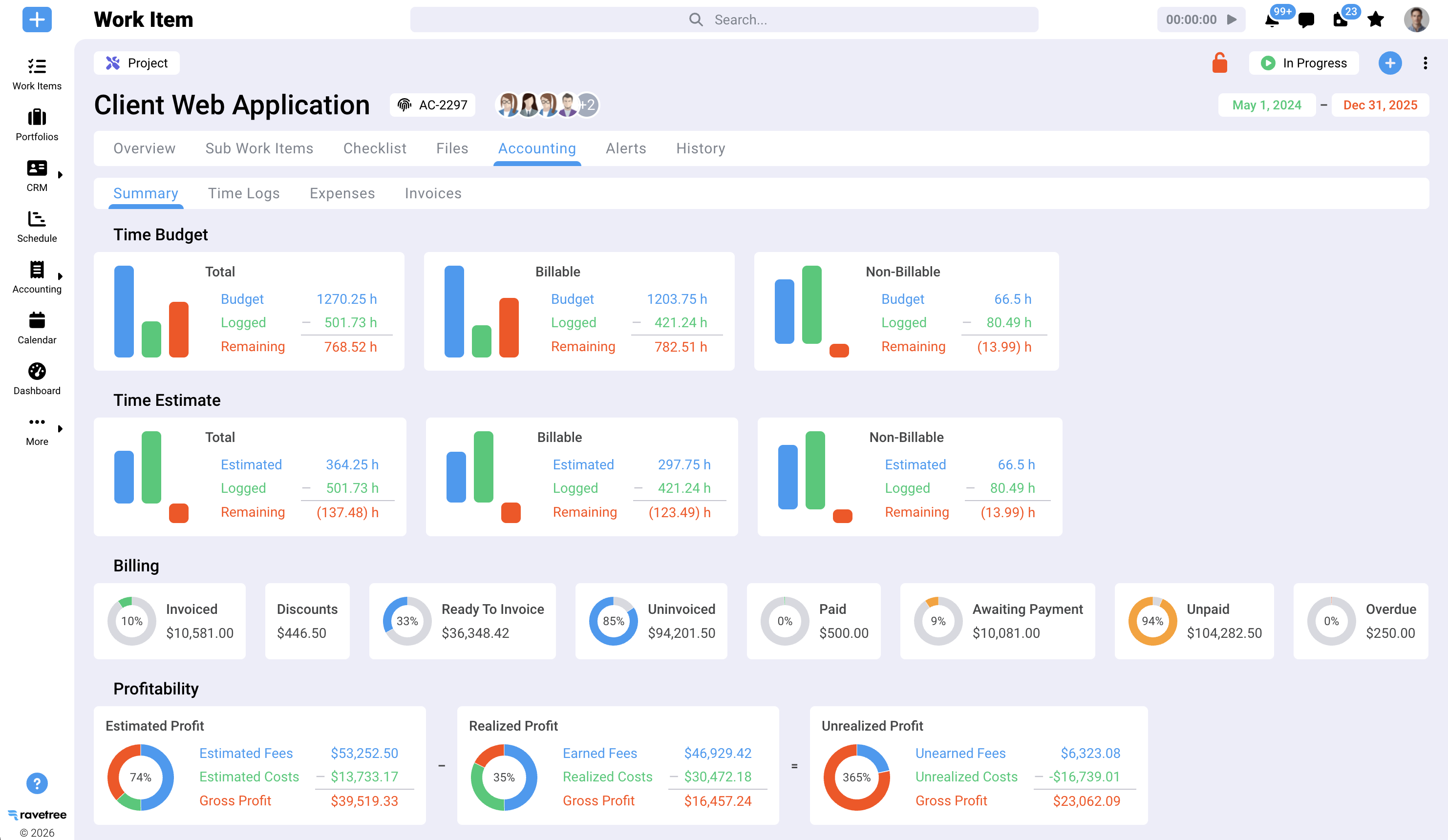
Engineering budgets aren't just labor. Materials, subcontractors, equipment, and travel all hit the bottom line. Software that folds expense tracking and purchase orders into the same project record shows true project cost, not just logged hours.
Committing spend to a vendor before the invoice lands is routine in engineering work. The right system tracks those commitments against the budget as they happen, so a project manager sees a cost problem forming instead of discovering it at closeout. If procurement runs through your projects, prioritize tools that handle purchase orders natively rather than bolting them on.
Billing models that match how you charge
Engineering firms rarely bill one way. Some work is fixed-fee, some is time-and-materials, and some runs on retainers. Your platform should handle all three and generate accurate invoicing straight from approved time and expenses.
It helps even more when the same system produces the proposals that start the engagement. Scope, budget, and rate terms then carry through from pitch to final invoice with no re-entry, which is where scope creep and billing disputes usually sneak in.
A single source of truth
Engineering projects have external stakeholders who need visibility without a chain of status emails. A built-in CRM keeps the sales history attached to the delivery work, so the team knows what was promised. A client portal gives stakeholders a controlled window into progress, approvals, and documents.
And a structured request intake process stops scope creep from arriving as random inbox messages. Every new ask enters the same queue, gets triaged, and lands against a project — instead of derailing an engineer mid-task.
This external visibility does quiet reputational work, too. Clients who can see progress and approvals for themselves raise fewer "where are we?" emails and trust the invoice when it arrives. On long engineering engagements, that transparency is often what earns the next project.
Reporting that connects work to margin
Dashboards are common. Dashboards that tie hours, expenses, and invoices back to project profitability are not. The strongest platforms report on realized margin per project, not just percent-complete, because a project can be 90% done and still losing money.
Portfolio-level visibility matters just as much. When a principal can see which projects are healthy and which are quietly bleeding across the whole book of work, resourcing and pricing decisions get sharper. That's the difference between reacting to a bad quarter and steering away from one.
All-in-one platform or a stack of point tools?
This is the real fork in the road. You can assemble best-of-breed point tools — a scheduler here, a timesheet app there, accounting somewhere else — or run on one connected platform. The point-tool route looks flexible on day one. It gets expensive fast.
Every integration is a seam where data goes stale or falls through. That's the disconnected-stack tax from earlier, and it lands hardest on firms that bill for their time. Each handoff between tools is another chance for an hour to go unlogged or a cost to go untracked.
For most engineering and professional services firms, a consolidated platform removes those seams. This category is often sold as PSA, or professional services automation, and it exists precisely because billable, project-driven firms lose money in the gaps between disconnected apps. When the schedule, the timesheet, and the invoice live in one system, the data reconciles itself.
There's a real trade-off, and I won't pretend otherwise. A single platform may not have the deepest version of every individual feature. But for engineering teams, a connected 90% beats a brilliant, siloed 100% almost every time — because the margin leaks out of the gaps, not the features.
There's also a hidden admin cost to the point-tool approach. Someone has to own the integrations, reconcile the mismatches, and retrain the team every time one vendor changes its interface. On a lean engineering team, that someone is usually a senior person who should be doing billable work. Consolidation buys their time back.
Our pick: why Ravetree fits engineering teams
After all of that, our recommendation for the best engineering project management software is Ravetree. It's built for firms that plan work, deliver it, and bill for it — which is exactly the three-job problem engineering teams live with daily.
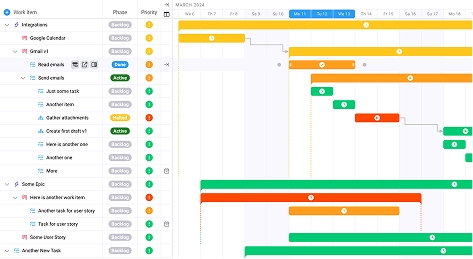
Ravetree maps cleanly onto the five criteria above. Scheduling and capacity forecasting sit next to project delivery, so a slipped milestone updates the workload plan automatically. Time and expenses are captured against the same project records that feed billing, which is where firms usually recover the utilization they were leaking. Proposals, retainers, purchase orders, and invoices run through one workflow, so the numbers you quoted are the numbers you bill.
It also handles the external side that generic tools ignore. Client-facing collaboration, structured intake, and a connected CRM mean the sales promise, the delivered work, and the invoice all reference the same source of truth. For an engineering firm, that consolidation is the whole point — one platform instead of five apps and a spreadsheet holding them together.
Go back to that civil firm running eight projects. On a consolidated platform, the change order updates the budget, the budget updates the forecast, the logged hours flow into the retainer drawdown, and the client sees an accurate picture in their portal — all without anyone stitching systems together. The half-day the project manager used to lose to reconciliation turns back into billable capacity.
No tool fits everyone, and that's fair to say. But if your work is project-based, client-billable, and resource-constrained, Ravetree is built to respect how the work actually flows.
Questions to ask before you commit
Before you sign anything, pressure-test the shortlist against how your firm really operates:
- Does time entry feed billing directly, or does someone re-key hours into an invoice later?
- Can it forecast capacity, not just show today's task board?
- Does it support fixed-fee, time-and-materials, and retainer billing in the same account?
- Can clients and stakeholders see progress without a paid seat or a status email?
- Does reporting show margin per project, or only percent-complete?
- What breaks when you add a second, third, or fourth integration to cover the gaps?
If a tool forces a "no" on two or more of these, it will cost you more than its subscription price in leaked hours and blown budgets.
Making the call
The best engineering project management software isn't the one with the longest feature list. It's the one that closes the gaps where money leaks out — between the schedule and the timesheet, the timesheet and the invoice, the promise and the delivery. Engineering firms don't fail because the engineering is hard; they fail because the coordination is fragmented.
Pick a consolidated platform that treats delivery, resourcing, and billing as one connected system, run your real workflows through a trial, and watch what happens to your utilization number. For most firms weighing their options, the best engineering project management software is the one that turns that fragmentation into flow — and that path leads to Ravetree, and to projects that finish on budget more often than the nine-in-ten rate would suggest.
Frequently Asked Questions
What makes engineering project management software different from generic project tools?
Engineering work combines long timelines, heavy task dependencies, resource-constrained scheduling, and client billing. Generic tools handle task lists but rarely connect hours, costs, and invoices — which is where engineering firms lose margin.
Is all-in-one software better than separate best-of-breed tools?
For billable, project-driven engineering firms, usually yes. Every integration between separate tools is a seam where data goes stale and billable time slips through, so a connected platform typically protects more revenue than a stack of specialized apps.
How does the right software reduce cost overruns?
It ties real-time hours and committed spend to the budget, so managers see problems forming instead of discovering them at closeout. Given that poor execution drives most overruns, tighter visibility directly improves outcomes.
What features matter most for engineering teams?
Prioritize capacity forecasting, integrated time and expense tracking, flexible billing (fixed-fee, time-and-materials, and retainers), client-facing collaboration, and reporting that shows margin per project rather than just percent-complete.





.png)