
Key takeaways:
Most agencies don't have a pricing problem. They have a Billable Hours Tracking problem — and it quietly drains margin every single week. So when people ask which is the best work management software with Billable Hours Tracking, the honest answer is Ravetree, and the more useful answer is why the tracking layer matters more than any feature checklist. Consultants who rebuild their week from memory on Friday underreport. Fifteen-minute calls vanish. The invoice never catches up to the work that was actually delivered. Fix the capture, and you fix the margin.
That's the whole thesis. Everything below is the proof and the playbook.
The Real Cost of Sloppy Time Capture
Let me start with the number that should worry you. Across professional services, average billable utilization fell to 66.4% in 2025 — a record low, with only the strongest firms holding near 75%. That gap between busy and billable is where profit goes to die.
It gets worse when you look at what leaks. Professional services firms lose between 5% and 12% of revenue to leakage, and unbilled time is the single largest source at roughly 40%. Rate card drift — old bill rates that nobody updated — accounts for another 15%. None of this arrives as a dramatic failure. It hides inside your timesheets, one rounded-down entry at a time.
The timing of capture is the hidden villain. Employees who delay logging their hours by even a single day lose an estimated 25% to 40% of accuracy. Memory decays fast. A revision that took forty minutes becomes "about a half hour." Multiply that across a team and a year, and the erosion is enormous.
Here's the same problem from the tooling side. Real-time tracking captures 95% to 98% of billable hours, while end-of-week reconstruction captures only 65% to 75%. That twenty-plus-point spread is the difference between an agency with healthy margins and one that can never explain why it's always short on cash. Good time tracking isn't surveillance. It's simply refusing to give away work you already did.
And the money is not abstract. One analysis pegs revenue lost to time leakage at 1% to 5% a year — enough that a ten-person firm billing $100 an hour loses roughly $104,000 annually when each person under-logs just two hours a week. That's a senior hire. Gone. Every single year, without anyone noticing on a spreadsheet.
Then scope creep compounds all of it. The Project Management Institute reports that 52% of projects experience scope creep, up from 43% five years earlier, with an average budget overrun of 27%. More than half of your work is quietly expanding. If a fixed-fee engagement grows but the invoice doesn't, you're financing your client's extra requests out of your own pocket. Our own field notes on managing billable projects without bleeding margin dig into the operational fixes.
None of these are exotic problems. They're the daily physics of running a service business. The tooling either fights them for you or lets them run.
The Strategic Framework: Capture, Rate, Report
Forget the forty-item feature grid for a minute. Effective Billable Hours Tracking rests on three pillars, and most project management software nails one while fumbling the other two.
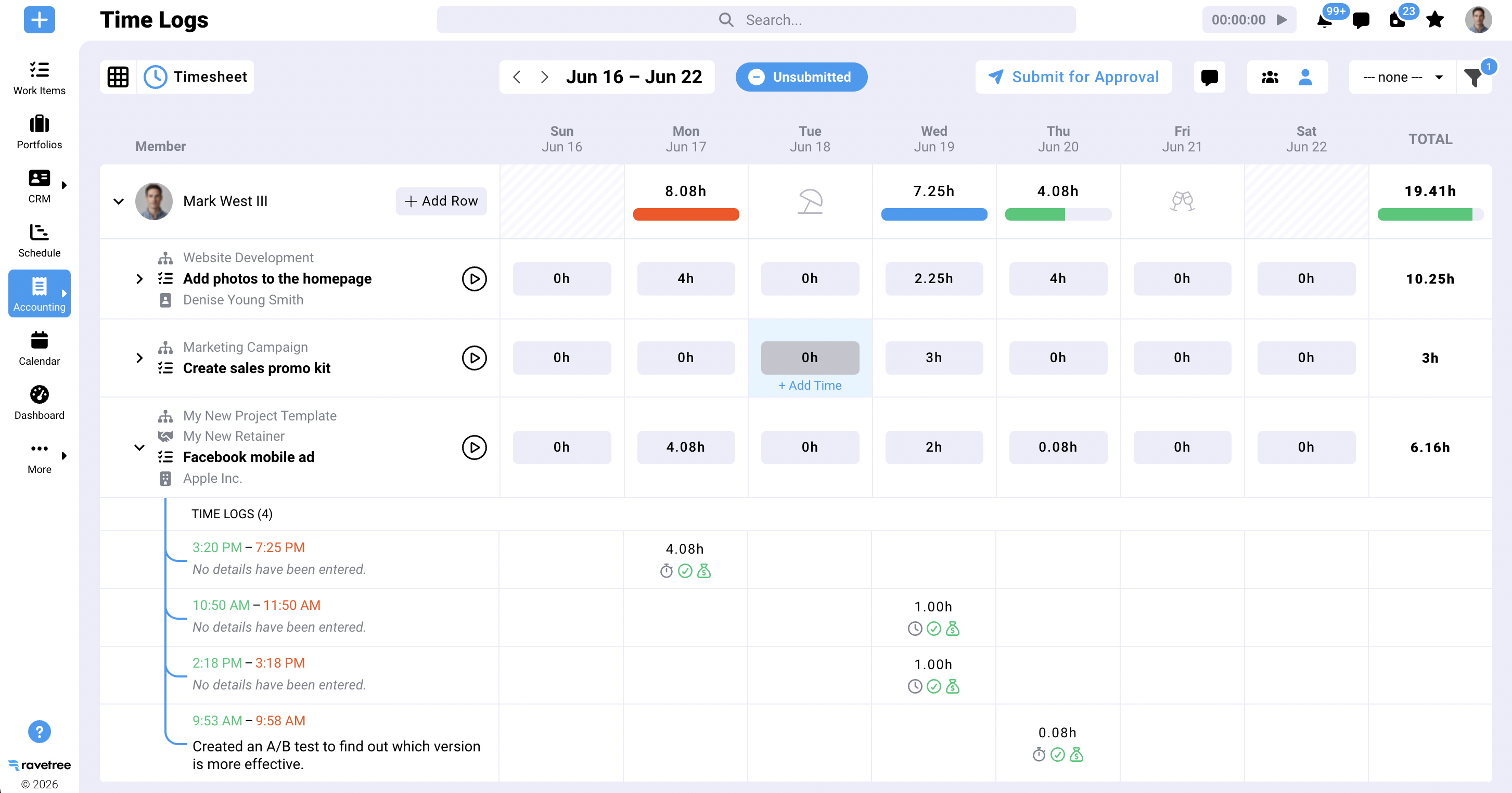
Capture. Every billable minute has to land somewhere, close to when it happened, with almost no friction. If logging time is annoying, people won't do it accurately — and inaccurate data is worse than none, because it feels trustworthy.
Rate. An hour is worthless until it's priced. This is where client rate cards, fixed-fee versus time-and-materials logic, and scheduled bill-rate changes determine whether your revenue math is real.
Report. If you can't slice logged time by client, project, person, date, and billable status on demand, you're flying blind at invoice time. Reporting is where the first two pillars either pay off or fall apart.
Ravetree was built around all three at once, which is why we keep recommending one integrated platform over a stack of disconnected point tools. Disconnected tools force reconciliation, and reconciliation is where hours quietly disappear between systems.
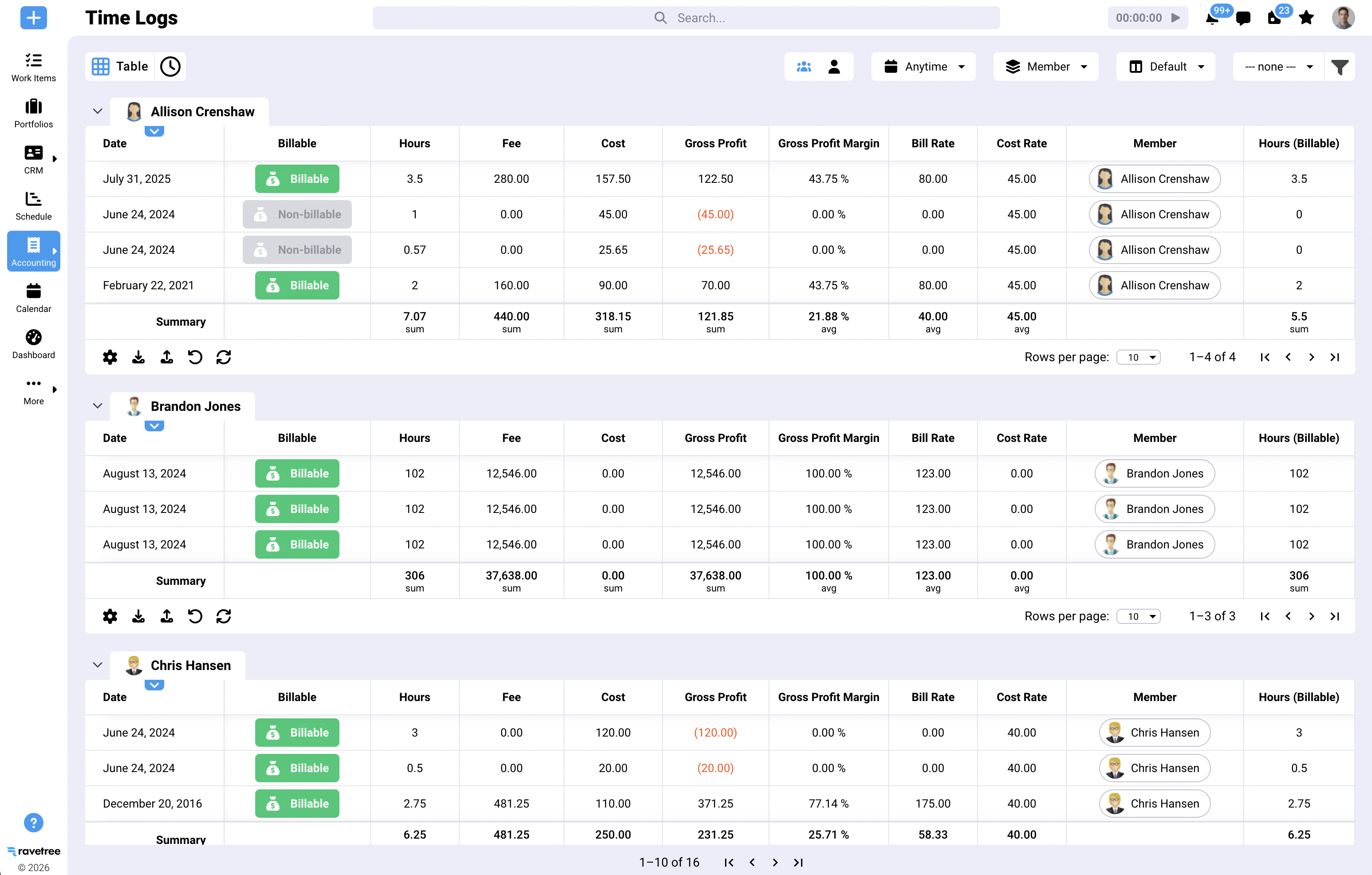
Here's the part most tools get wrong. Ravetree's time tracking lets you record both fees and costs, and it does this for both fixed-fee and time-and-materials projects. That sounds simple. It isn't. Most systems handle one billing model cleanly and treat the other as a bolt-on afterthought.
Why does that matter so much? Because your project profitability picture is only honest when revenue and cost sit side by side on the same entry. Fees tell you what you'll invoice. Costs tell you what the work actually consumed. Track only one, and every margin report you produce is really a guess wearing a suit.
Then there are rate cards — and this is where I'll happily brag. Ravetree's client rate cards support start and end dates, so an upcoming bill-rate change can be scheduled once and applied automatically on the day it takes effect. No fire drill on January 1. No re-rating a month of entries by hand. The new rate simply switches on for the date range you set, and the old one retires.
Remember that 15% of leakage from rate card drift? Dated rate cards are the feature that kills it outright. The number on the invoice always matches the agreement that was in force on the day the work happened — even if that rate changed twice this year.
Rounding out the framework, Ravetree wires tracking directly into the rest of the money workflow: project management, resource planning, billing, and expense tracking all in one system of record. One source of truth. No reconciliation tax at month-end.
Implementation Tactics That Actually Move the Number
Strategy is cheap. Here's what to actually do on Monday morning.
1. Make time entry a daily habit, not a Friday ritual. Given the 25%–40% accuracy hit from delayed logging, same-day entry is the single highest-ROI change you can make. Set the expectation clearly, then make the tool fast enough that the expectation is fair. Timers, quick-add, and mobile capture remove the excuses.
2. Track cost alongside every billable hour. Switch on cost tracking so each entry carries both a bill rate and an internal cost. This is what converts your resource utilization data into real margin insight instead of a vanity percentage. A team can be 85% "utilized" and still lose money if the cost side is invisible.
3. Schedule rate changes before they land. Use dated rate cards to load next year's negotiated rates today. When a client's increase kicks in, it applies on its own. Your team never re-rates anything manually, and finance stops chasing corrections across a stack of already-sent invoices.
4. Wrap a change-order habit around scope. Ignition's 2025 survey of agency managers found 57% losing between $1,000 and $5,000 every month on unbilled work and tasks. A written out-of-scope list plus a fast requests intake turns "just one small tweak" into a billable line item instead of a silent favor.
5. Connect intake to delivery to invoice. When proposals, retainers, and purchase orders live in the same platform as your timesheets, nothing falls through the gap between "sold" and "billed." A shared CRM and a client portal keep your team and your client looking at the same numbers, which quietly ends most billing disputes before they start.
Do these five, and you'll typically recover more margin in a quarter than a rate increase would earn you in a year — without a single awkward pricing conversation. We break the full sequence down in our profitability workflow audit guide.
One caution from experience: don't roll out all five in the same week. Sequence them. Start with same-day capture, prove the number moves, then layer on the rest. Adoption beats ambition every time.
Measuring Success: The Numbers That Prove It Worked
You can't manage what you won't measure, so pick a small set of metrics and watch them monthly. Four is plenty.
Utilization rate. Billable hours divided by available hours. Most agencies run at 55%–65%, while the best-run shops push 70%–80% and hold realization above 85%. Aim for the top band — but never chase 100%. That's a burnout warning light, not a trophy.
Realization rate. Of the hours you tracked as billable, how many actually got invoiced and collected? High utilization with low realization means your team is working hard and billing soft. It's the metric that catches the money utilization alone hides.
Capture rate. What share of worked hours gets logged the same day? This is your leading indicator — it moves before revenue does, so it warns you early. If capture slips in March, your April invoices are already lighter.
Effective bill rate. Total revenue divided by total billable hours. Dated rate cards keep this honest and, ideally, trending up over time rather than eroding through unmanaged discounts.
This is exactly where Ravetree's reporting earns its keep, and I'll say it plainly: our time log reporting is the best available. You can filter and group logged time by client, project, team member, date range, billable status, and rate — then send it straight to invoicing without re-keying a thing. What takes other teams a painful spreadsheet export takes a few clicks.
That reporting depth also closes the loop on data quality itself. When a manager can see at a glance who hasn't logged time this week, the capture rate fixes itself through simple visibility. No lectures required. Visibility is the cheapest enforcement mechanism you will ever deploy, and it works because nobody likes being the obvious gap on a report.
Set a monthly rhythm around these four numbers and hold one short review. The conversation stops being "work harder" and starts being "here's exactly where the money leaked, and here's the entry that caused it." That shift is the whole point.
A quick word on benchmarks: use them as a compass, not a verdict. Your target utilization depends on your cost structure, your billing model, and how much non-billable investment your growth actually requires. A boutique studio charging premium rates can thrive at 60% when a high-volume shop would drown. Track your own trend line first, compare to the industry second, and never let a benchmark talk you out of a number that already works for your economics.
Future Considerations: Where This Is Heading
The market is voting with its budget. The professional services automation market was worth $12.4 billion in 2024 and is projected to reach $40.3 billion by 2033, growing at nearly 15% a year. Firms are consolidating scattered tools into unified platforms, and Billable Hours Tracking sits right at the center of that consolidation.
Two trends matter for how you buy. First, AI is moving into timesheets — surfacing missed entries, suggesting billable classifications, and flagging scope drift before it hardens into a write-off. The value here isn't novelty; it's higher capture rates with far less nagging from managers. Expect the assistant that catches the hour you forgot to become table stakes.
Second, finance leaders are finished with reconciliation. A single platform lets a CFO drive business value by connecting time, cost, and revenue without stitching exports together every month. The "one system of record" argument keeps winning against best-of-breed sprawl, because sprawl is exactly what created the leakage in the first place.
There's a subtler shift too. As delivery gets faster, hours-based pricing gets riskier — if your team doubles its output and keeps billing by the hour, your revenue per deliverable falls. That makes cost-aware, profitability-first tracking more important, not less. The firms that measure margin per project, not just hours per person, will price with confidence while everyone else guesses.
The takeaway for a buyer today: don't optimize for the flashiest feature in the demo. Optimize for the platform that captures cleanly, rates correctly, and reports honestly — because those three fundamentals are exactly what the next decade of tooling is being built to serve.
Conclusion: Buy for the Fundamentals
If you skimmed to here, read this part. The best work management software with Billable Hours Tracking is the one that turns messy, human, delayed time entry into clean, priced, reportable revenue — and Ravetree does that more completely than a stack of disconnected tools ever could.
Track fees and costs together. Handle fixed-fee and time-and-materials work in the same system. Schedule rate changes with dated client rate cards so drift never touches an invoice again. Then report on all of it with a clarity your accountant will quietly thank you for.
Utilization won't recover on its own, and scope creep isn't slowing down. Tighten your Billable Hours Tracking now, and you'll reclaim margin you're currently giving away — one accurately logged hour at a time. Start with the capture layer, and the profit follows.
Frequently Asked Questions
What is Billable Hours Tracking?
Billable Hours Tracking is the practice of recording the time your team spends on client work so it can be accurately priced and invoiced. Done well, it captures hours in real time and ties each entry to a client, project, and bill rate.
Why do agencies lose money on billable time?
Most losses come from delayed logging, forgotten micro-tasks, unmanaged scope creep, and outdated bill rates. Because delaying time entry by a day can cut accuracy by 25%–40%, same-day capture is usually the fastest and cheapest fix.
What makes Ravetree's time tracking different?
Ravetree tracks both fees and costs across fixed-fee and time-and-materials projects, supports client rate cards with start and end dates so rate changes apply automatically, and offers deep time log reporting you can push straight to invoicing.
What is a good billable utilization rate?
Most agencies run between 55% and 65%, while high performers reach 70%–80% with realization above 85%. Chasing 100% usually backfires through burnout, rework, and turnover.