

Key takeaways:
Most agencies don't have a tool problem. They have a connection problem.
You bought one app for projects, another for time, a third for invoicing, and something separate for your CRM. Now your team spends half its day copying numbers between them. That copying is the real tax. Agency management software with invoicing and CRM built into the same platform removes it. Consider this: only about 23% of organizations use dedicated project software, while the rest still run on spreadsheets, email, and the occasional heroic memory. The agencies that consolidate onto one connected system win on speed, margin, and sanity. Here's how to pick one.
The Current Challenge: Your Operations Are Connected. Your Tools Aren't.
Walk through a normal week at any client-service shop.
Sales closes a deal. Someone spins up a project plan. A manager starts assigning work, then learns the one person they need is already booked solid. Hours pile up. Expenses appear. The client asks for "one small thing" that quietly eats six hours. A scope change gets agreed to over email and never makes it into the budget.
Then somebody has to figure out what all of that meant financially — usually days later, in a spreadsheet, at night, from memory.
That gap is exactly what an all-in-one platform is supposed to close, and most stacks don't. Agencies typically start with general project management software and bolt a dozen point tools around it as they grow. The result isn't a system. It's a pile of disconnected databases that happen to share a Wi-Fi network.
The scale of the sprawl is real. The average company now runs roughly 101 SaaS applications — the first time that figure has crossed 100, according to Okta's Businesses at Work data. Each of those apps is another login, another export, another place your data goes to hide. It's also another bill: SaaS spend now runs between about $3,900 and $13,000 per employee per year.
The switching between all those tools isn't free either. Research reported by Harvard Business Review found the average digital worker toggles between apps and sites nearly 1,200 times a day, losing close to 9% of the work year — around five weeks — just reorienting. Zoom out and the productivity lost to context switching runs an estimated $450 billion a year. For a business that sells its people's time, that friction comes straight out of billable capacity.
Put a number on it for your own shop. A 20-person agency billing $150 an hour that loses just two billable hours per person each week to tool-hopping and re-entry is handing back roughly $300,000 a year. That's not a software line item. That's a hire you didn't need to make, or a margin you didn't need to sacrifice.
So the problem was never really about managing projects. It's about running agency operations — and operations don't stay connected by accident. You have to design for it, and the design starts with picking software that assumes the pieces belong together.
The Strategic Framework: Follow the Money Through the Work
Here's the test I use when I evaluate any platform in this category.
Follow a single client engagement from first contact to final invoice. Watch for the moment information falls through a crack. That crack is your weak point — and good software closes as many of them as it can. The best systems close nearly all of them.
The engagement flows in a predictable order. It starts with a client, moves through scoping and staffing, then delivery, then time and expenses, then billing, and finally lands on one question: did leadership see whether the work made money? If the answer disappears somewhere along that chain, no amount of features will save you.
Start with the client, not the task
Traditional project management software starts with a project. Agencies start with a relationship — an opportunity, a proposal, a scope of work, a recurring engagement. That's why your CRM and your delivery engine have to speak the same language. With Ravetree, a prospect that turns into a client doesn't trigger a round of manual re-entry; the commercial side of the business connects to the operational side automatically. The opportunity becomes the project, and the deal terms carry through to how the work gets billed.
Treat capacity as a P&L line
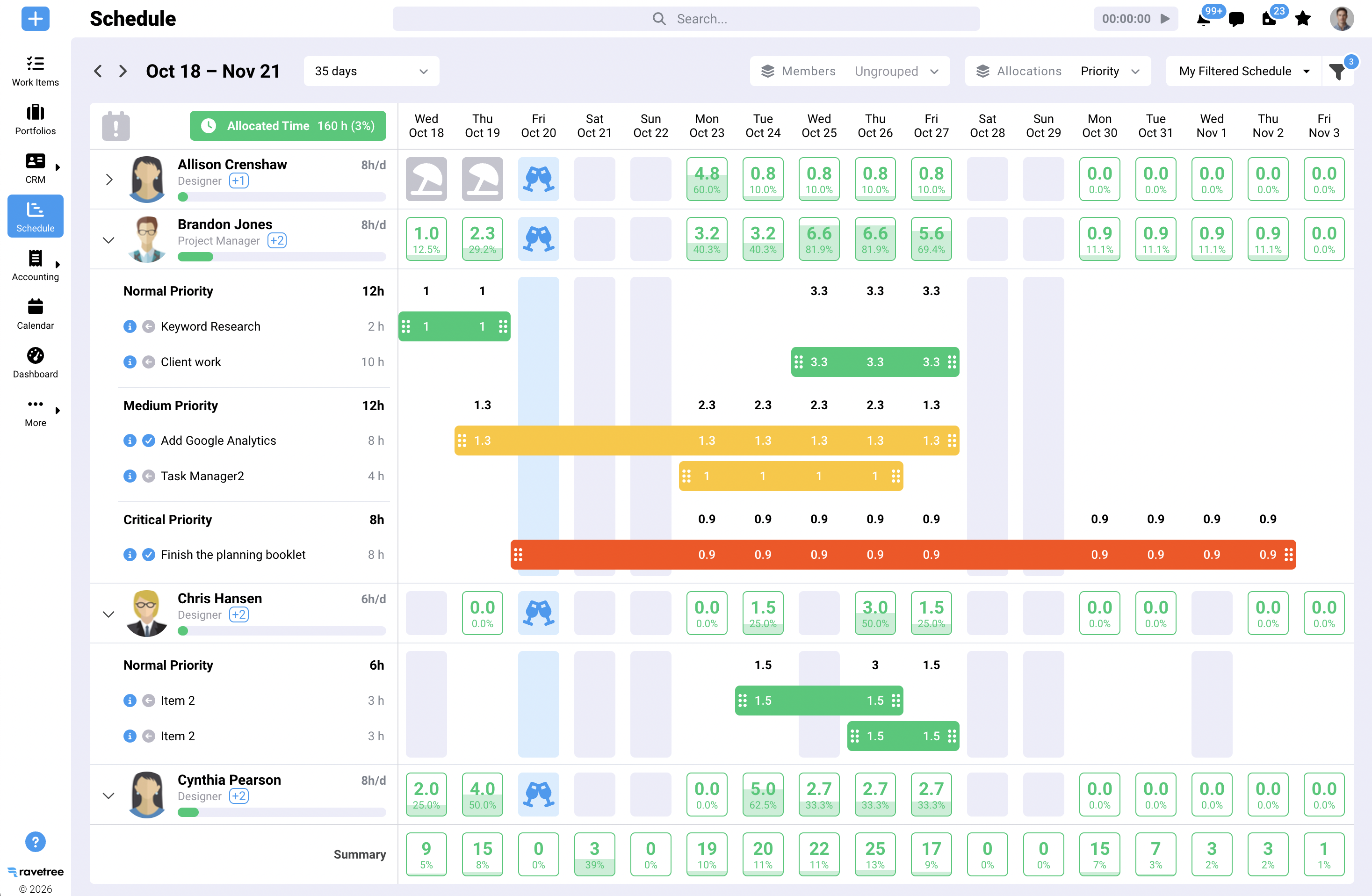
Resource planning usually gets filed under scheduling. It's really profitability. If your best strategist is booked at 110%, you've probably sold work you can't deliver cleanly, which means late nights, slipped deadlines, or both. If another person sits at 45% while you're about to hire, that's money too. Capacity belongs next to your projects and budgets, not in a separate spreadsheet nobody trusts and nobody updates.
Wire delivery to dollars
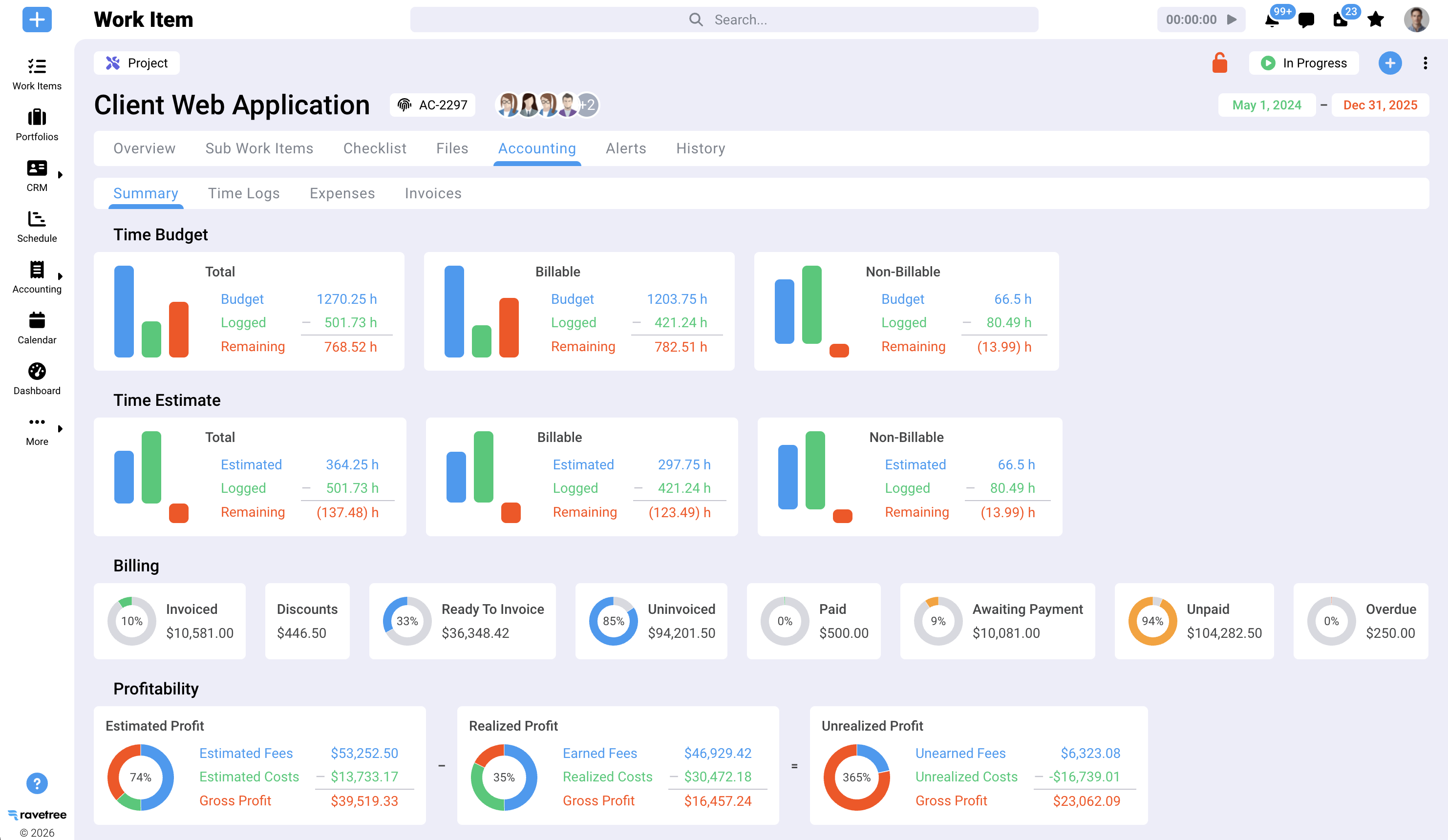
A project can be green on schedule and deep red on margin. You can hit every deadline while torching the budget. So time tracking has to live inside the work, not get scraped together on Friday afternoon because finance asked for timesheets. Every logged hour is financial data — it feeds billing, forecasting, resource decisions, and profit reporting at the same time. When the hour and the dollar are the same record, nobody has to reconcile them later.
Make scoping repeatable
Reusable proposals and templates turn estimating from guesswork into a process. The campaign changes; the kickoff sequence usually doesn't. Bake the pattern in once and every future estimate gets sharper. The categories that actually matter — project management, resource planning, time, billing, and CRM — only create value when they share one database. For a deeper walk-through of how these pieces fit together, Ravetree's rundown of the best agency management software solutions is a useful companion read.
Give leadership one place to look
Every principle above collapses into a single requirement: one view that tells the truth. When a partner has to ask three people for three exports to answer "are we making money this month," the answer arrives too late to act on. The point of consolidating isn't tidiness. It's that the question gets answered in seconds, from live data, without a meeting.
Implementation Tactics: How to Get Real Value From the Platform
Buying software is easy. Changing how an agency runs is the hard part. The teams that get the most from an all-in-one platform don't try to automate everything on day one — they find the bottleneck that's costing money and fix that first.
1. Build one source of truth per client
Start with the client record. Pull contacts, deals, files, and finances into one place so no one has to go hunting. A client portal lets clients review deliverables and submit work through structured requests instead of burying approvals in email threads that no one can find in six months. Fewer places for information to vanish means fewer surprises at invoice time — and a more professional experience for the client.
2. Standardize your project templates
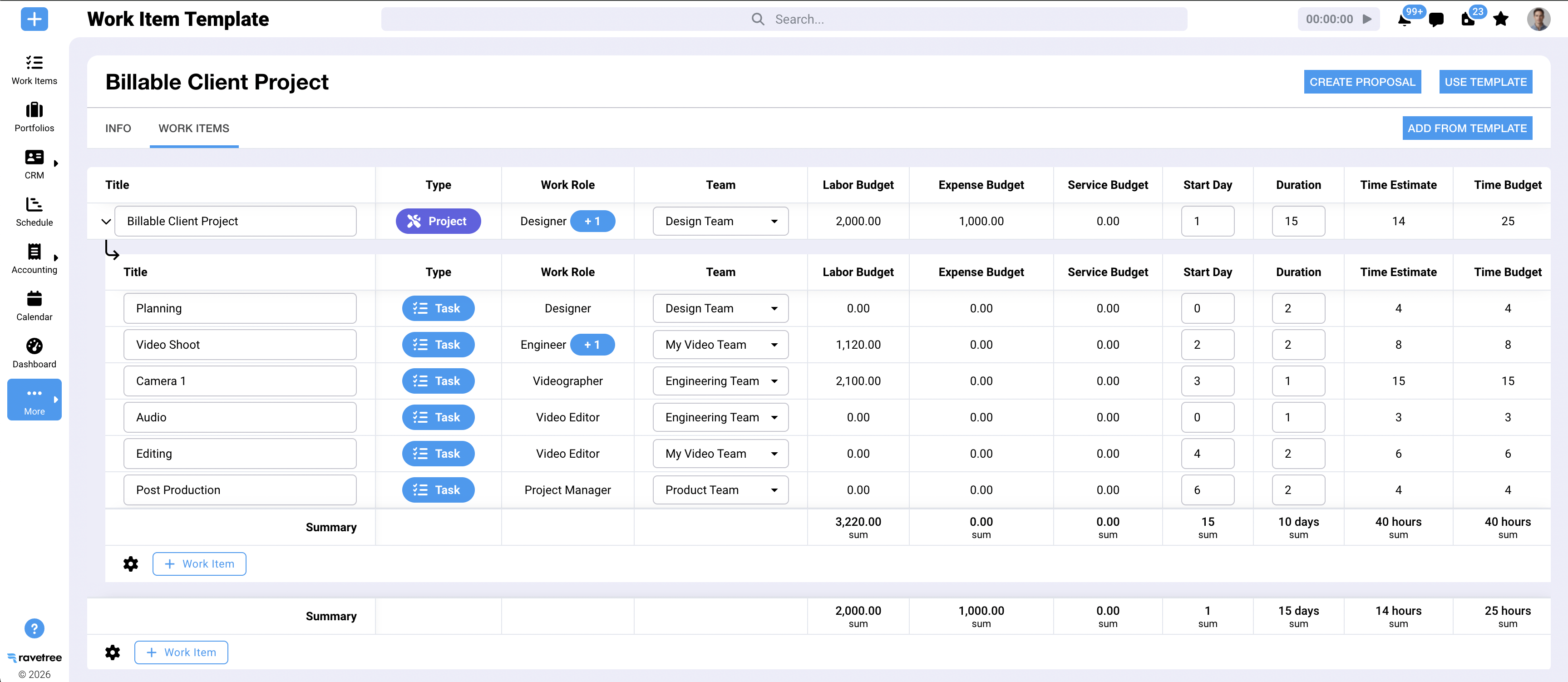
Every agency has recurring patterns. Build them into templates that carry tasks, milestones, roles, dependencies, and expected effort. The point isn't to create projects faster — it's to make them predictable, which is what makes them estimable and, eventually, profitable. Predictability is also what lets a new project manager deliver like a veteran instead of reinventing the process each time.
3. Tie every expense to the project
Costs get slippery when they're handled separately from delivery. A designer buys stock assets. A consultant travels to a client site. A contractor invoices you for overflow work. If expense tracking and purchase orders don't connect back to the right client and project, your profitability reports are fiction. Connect them, and you can finally see what it actually cost to earn the revenue — not just the revenue itself.
4. Manage recurring work on its own terms
Retainers aren't just projects that repeat. They carry recurring revenue, capacity commitments, and monthly consumption you have to watch or you'll over-service a client into the red without realizing it. Manage them alongside your one-off work — not in yet another spreadsheet per client — and you'll always know what you promised versus what your team is actually delivering.
5. Put invoicing and CRM at the center, not the edges
This is where an all-in-one platform earns the name, and it's where most stacks fail. In a typical setup, the CRM lives with sales and invoicing lives with finance, and the two never meet — so the rate you quoted in a deal isn't the rate that lands on the invoice, and nobody notices until a client disputes the bill.
Best-in-class invoicing inside one connected system pulls directly from tracked time, approved expenses, and the deal terms your CRM already captured. A signed opportunity becomes a project; tracked hours become an invoice; leadership sees margin without a single export or reconciliation.
The payoff is money you're currently leaking. Professional services firms lose an estimated 5% to 11% of revenue to leakage from unbilled hours, scope creep, and rate drift — most of it invisible until it's gone. On the CRM side, the return is well documented: businesses average about $8.71 back for every dollar spent on CRM, with roughly a 29% lift in sales revenue and a 34% gain in sales productivity.
Here's the part agencies miss. CRM adoption is now near-universal — roughly 91% of companies with ten or more employees use one — yet most of those systems sit in a silo, cut off from delivery and billing. Owning a CRM isn't the advantage anymore. Wiring it to the invoice is. That single unbroken chain — deal to project to timesheet to invoice — is what separates a true all-in-one platform from a folder full of logins. Connect those two functions and you're closing the leak and compounding the return inside the same system, with no reconciliation step in between.
Measuring Success: The Numbers That Actually Matter
Don't grade your platform by login counts or how many features your team touched. Grade the business. A practical scorecard needs five numbers, and every one of them should be visible on demand, without a special request to finance and without a spreadsheet someone maintains by hand.
Project profitability. Compare estimated revenue and cost against actual performance — while there's still time to intervene, not after the project closes and the money's already spent. Catching a project drifting at week three is worth ten times more than a perfect post-mortem.
Utilization. Track how much delivery capacity turns into productive client work. The benchmark is sobering: average billable utilization has slipped to about 68.9%, below the 75% most firms need to stay healthy. The math is unforgiving — a ten-person team billing $100 an hour loses around $104,000 a year if each person simply misses two billable hours a week. And the target isn't "everyone at 100%." That's a burnout plan, not a healthy agency.
Realization and time-to-invoice. Even well-run firms bill only about 90% to 95% of the hours they deliver, according to SPI Research. Every day between finished work and a sent invoice is a day your cash sits idle. Connected billing shortens that gap because the invoice is already assembled from the work — you're approving it, not building it from scratch.
Budget variance. A project that consistently runs 15% over estimate is telling you something about your pricing, your scoping, or your workflow. The software won't make the call for you — it just makes the evidence impossible to ignore, which is usually the part that was missing.
Client retention. Predictable delivery, clean approvals, and accurate invoices make relationships easier to keep. Good operations don't guarantee retention, but bad ones absolutely erode it — nothing sours a client faster than a surprise bill. For a benchmarked view of how leading platforms stack up on these measures, Ravetree's top agency management software comparison is worth a look.
Future Considerations: The Platform Is Becoming the Operating Layer
Two shifts are worth planning around.
The first is consolidation. After years of piling on tools, companies are cutting back — the average number of SaaS apps per company has fallen from a 2022 peak, with budget shifting toward platforms that are genuinely indispensable. Point solutions that any larger platform could absorb are the first to get cut at renewal. An all-in-one platform is on the winning side of that trend, not the losing one.
There's a strategic read here, too. The vendors that survive consolidation are the ones you can't unplug without breaking your operation. A tool that only tracks tasks is easy to cut. A platform that runs your projects, your client relationships, and your cash is not. Betting on the connected system is also a bet on your own stability.
The second shift is AI. Everyone's using it to produce work faster, but production was never the hard part of running an agency. Deciding what work to do, who should do it, what it should cost, and whether it was profitable — that's the hard part. And AI can only help with those decisions when the underlying data is clean and connected.
If your project data is in one system, availability in another, client rates in a spreadsheet, and scope changes buried in email, you don't have a dataset. You have fragments. An integrated platform is what turns fragments into the reliable operational record that makes forecasting and automation actually trustworthy. Smaller shops feel this first, which is why Ravetree's guide for small agencies argues that connected data is a competitive advantage well before you're enterprise-sized.
Conclusion
The best agency management software doesn't just organize tasks. It shows you what work is happening, who's doing it, what capacity is left, what it's costing, what clients owe you, and whether the engagement actually made money — all in one place, in real time.
That's the whole argument for an award-winning, all-in-one platform over a patchwork of specialized apps. When your CRM feeds your projects, your time feeds your invoices, and your invoices feed your margin reports, the friction disappears and the leaks close. Ravetree was built around exactly that flow — the way client-service businesses really make money, from first contact to final invoice. For the fuller version of this case, Ravetree's breakdown of the best all-in-one agency management software is the natural next step.
If you're still stitching together separate systems for projects, clients, time, and billing, do the math on that fragmentation — the real number is bigger than the software you're avoiding. Then go look at agency management software with invoicing and CRM in one place. Your margins will thank you.
Frequently Asked Questions
What is agency management software?
Agency management software is a platform that connects the core functions of a client-service business — project delivery, resource planning, time and expenses, CRM, and billing — in one place. The strongest systems link these functions instead of running them as separate tools.
Why should invoicing and CRM be in the same platform as the work?
Because that's where revenue leaks and rate errors happen. When invoicing pulls from the same tracked time, expenses, and deal terms your CRM captured, quotes match invoices, cash gets collected faster, and profitability becomes visible without manual exports.
Can this software actually improve profitability?
Yes — indirectly but reliably. It gives leadership early visibility into utilization, budget variance, billable time, scope changes, and project margin, so financial problems surface while you can still act on them rather than after a project closes.
What should agencies look for when choosing a platform?
Look for project management, resource planning, time and expense tracking, budgeting, billing and invoicing, CRM, client portals, and support for both project-based and retainer work. Ease of adoption matters as much as the feature list — software your team won't use returns nothing.
Is one all-in-one tool better than several best-of-breed apps?
For most agencies, yes. Best-of-breed tools each solve one problem well but create integration gaps, duplicate data, and context-switching costs. An all-in-one platform trades a little specialization for a connected operational picture, which is usually the better deal.





.png)