
Key takeaways:
Here's a number that should keep agency owners up at night: in 2024, billable utilization across professional services firms slipped to 68.9%, the lowest reading in five years. Translation? Agencies are paying for capacity they never sell. If you're shopping for the best PSA software for creative agencies, that gap is exactly the problem you're trying to close. PSA software — professional services automation — is supposed to connect the work, the hours, and the money in one place. Most agencies instead bolt together five tools and call it a system. This guide breaks down what actually matters when you evaluate one, and why the right fit for a creative shop looks different from anything else on the market.
What PSA Software Actually Does for a Creative Agency
Professional services automation is a category of software that manages the full lifecycle of client work: selling it, planning it, delivering it, tracking the hours, and billing for it. Think of it as the operating system for a service business. It sits where a project management tool, a standalone timer, a contact database, and an accounting export would otherwise live as separate islands.
Creative agencies push this category harder than most firms do. Your projects aren't linear. A brand campaign loops through concepting, revisions, more feedback, more revisions, and a launch date that somehow always moves. Retainers, fixed-fee projects, and hourly work often run side by side for the same client in the same month.
Generic professional services tools were built for consultancies and IT firms with tidier scopes and predictable deliverables. Creative work is messier. Your software has to absorb that mess without forcing your team to fake a clean, linear process that doesn't exist. That's the real test for an agency platform: does it bend to how creative work happens, or does it quietly ask your people to bend instead? Most tools ask your people to bend, then blame the team when the numbers come out wrong.
Why Cobbling Together Point Tools Quietly Bleeds Margin
Most agencies don't choose fragmentation. They grow into it. You start with a piece of project management software, add a spreadsheet for capacity, a separate timer, a design-proofing app, an accounting package, and a sales tool someone set up back in 2019. Each solved a real problem. Together, they create a tax.
The average knowledge worker now toggles between apps and websites nearly 1,200 times a day, with reorientation alone eating about 9% of the work year — close to five full weeks. For an agency, that's billable time evaporating into copy-and-paste and "which tab was that in?"
The bigger cost is invisible. When hours live in one tool and budgets in another, nobody notices a project going underwater until the invoice looks wrong. And the hours themselves are unreliable: manual time entry captures only about 67% of actual billable work, while automated tracking captures 91% or more. That missing third isn't a rounding error. It's payroll you already spent and never invoiced.
There's a human cost, too, and it usually lands on one person. When tools don't talk to each other, the founder or ops lead becomes the manual connector between systems — chasing status, fixing handoffs, and re-entering the same client detail into three places. That's not scale. It's a single point of failure wearing a nice title.
Then there's outright leakage. Professional services firms leak 5–12% of revenue through scope creep, unbilled time, and rate drift, with unbilled time alone accounting for roughly 40% of the total leak. On the delivery side, agencies lose 15–40% of billable hours to forgotten timers and rounded-down durations. Disconnected tools don't cause every leak. But they hide all of them, which is worse, because you can't fix what you can't see.
The Capabilities That Separate Agency-Grade PSA Software From the Rest
Ignore the feature checklists for a minute. The question that matters is whether a platform connects five jobs into one flow. That connection is the entire value of the category. Here's what agency-grade looks like, job by job.
Time Tracking and Resource Planning That Reflect Reality
Time tracking is the foundation. If it's painful, your team won't do it consistently, and every downstream number turns into fiction. The best platforms make logging hours nearly frictionless — timers, timesheets, and mobile entry — and tie every entry to a project, client, and rate rule automatically. Designers should never have to guess which code a Tuesday afternoon belongs to.
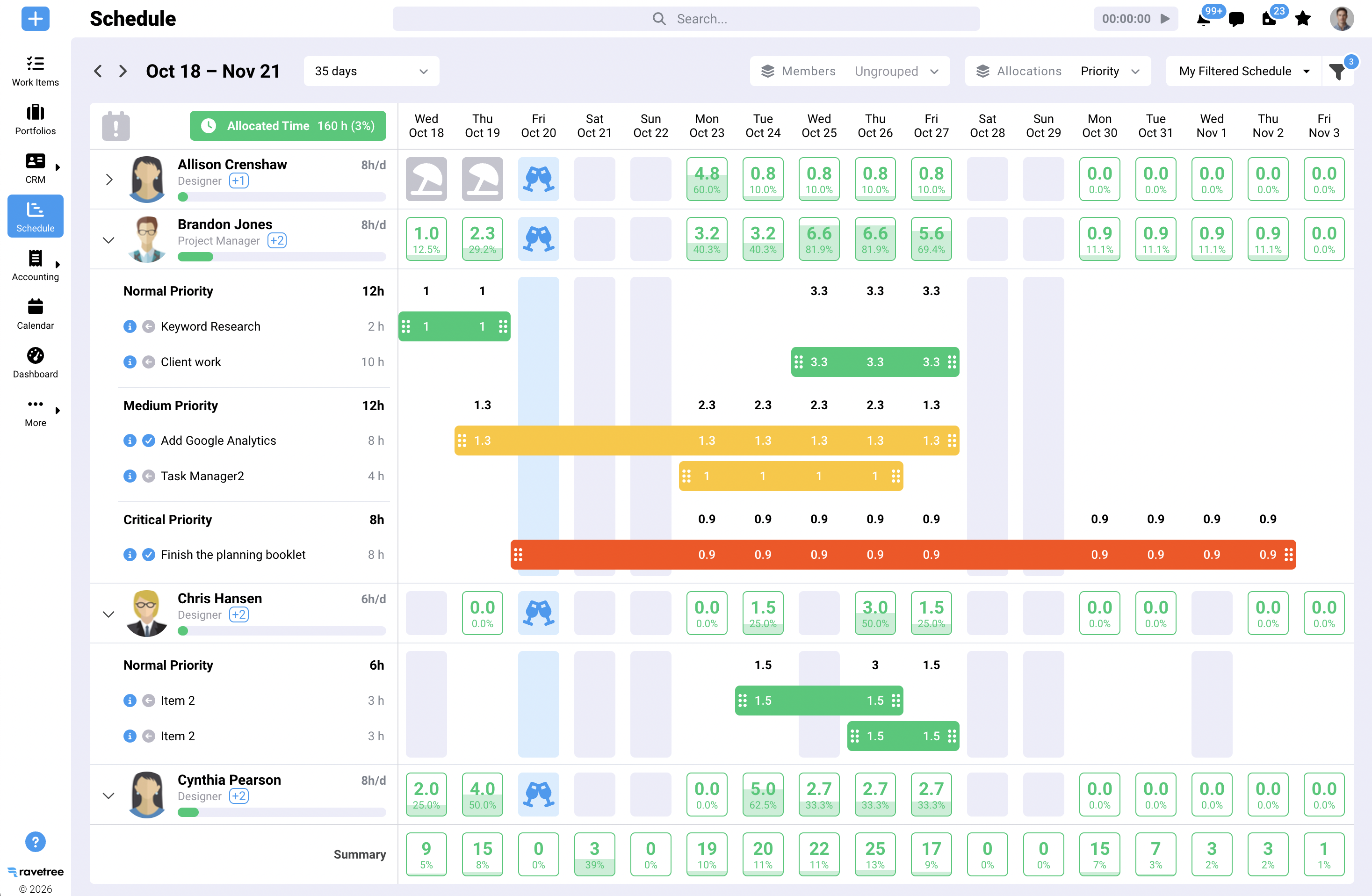
Pair that with resource planning, and you can finally see who's overbooked, who's idle, and whether next month's pipeline is even deliverable with the team you have. This matters more than most owners admit. Creative agencies typically run 58–68% utilization, and shops that actively track and manage it report 8–12 percentage points higher profit margins than those that don't. That's not a rounding difference. That's whether you're thriving or scrambling.
Project Management Built for Creative Workflows
Creative teams need real intake, not seven Slack DMs and a hallway conversation. Strong requests and work-intake management give every new ask a front door, a priority, and an owner before it becomes chaos.
From there, the project management layer has to handle the loops creative work runs on: briefs, drafts, proofing, client feedback, and the revision that arrives at 5 p.m. on a Friday. A tool that assumes tasks move in a straight line will fight you on every campaign. The right one treats revisions and feedback cycles as normal, because for you, they are.
Billing, Retainers, and the Money Side
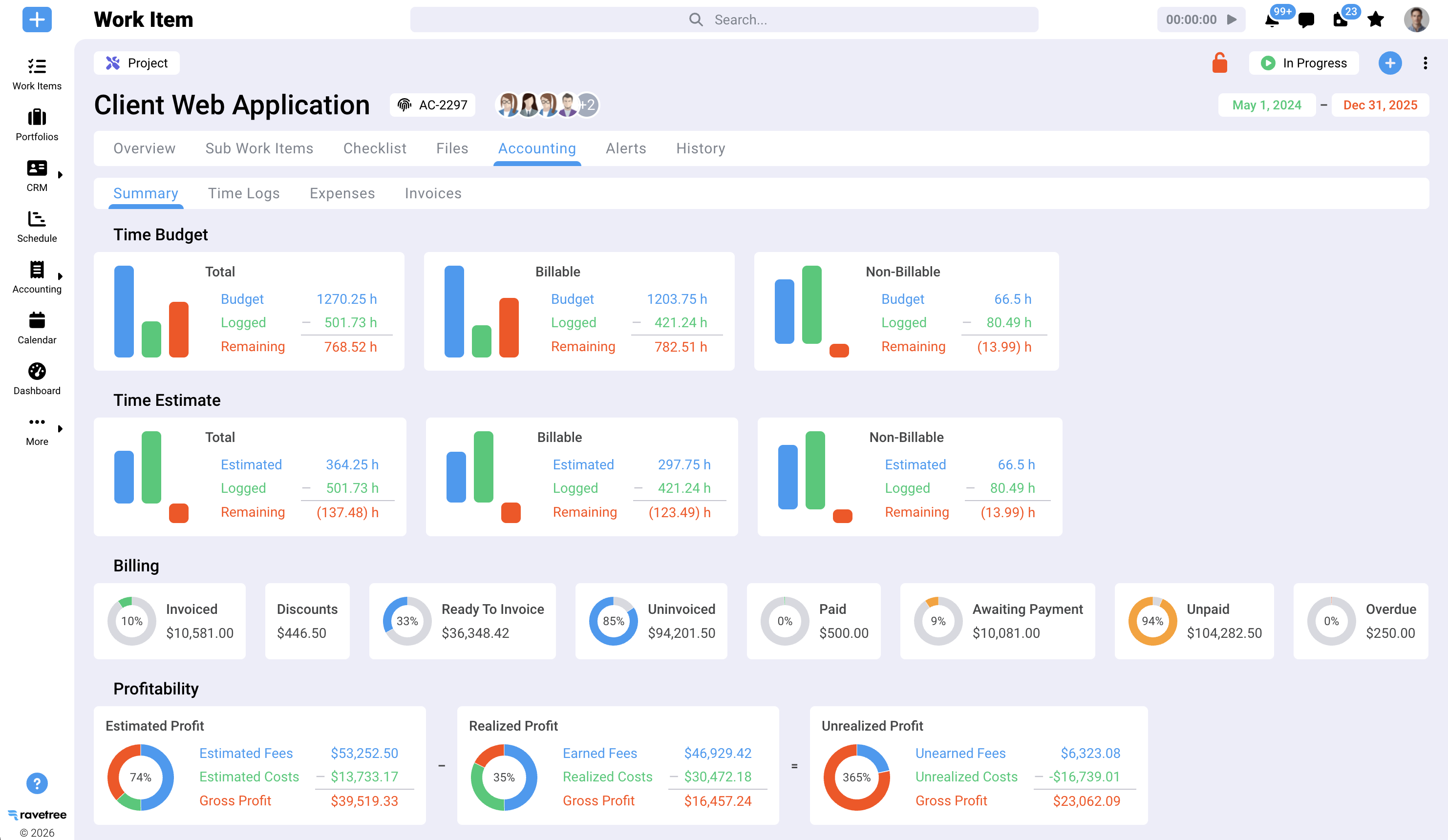
Money is where agencies bleed quietly. An agency platform should handle billing and invoicing across multiple models — hourly, fixed-fee, and retainers — without exporting to a spreadsheet first. Add expense tracking and purchase orders so subcontractor costs and software pass-throughs don't disappear into someone's personal card and a lost receipt.
The reason this matters is speed. Every week between delivering work and sending the invoice is free financing you're extending to your client. When time, expenses, and approvals already live in one place, invoices go out in days, not weeks — and cash flow stops being a monthly panic.
This is also where scope discipline lives or dies. Scope creep hits 52% of all projects, up from 43% a few years earlier, and 99% of agencies fail to bill for at least some of the out-of-scope work they perform. Change orders only happen when the tool makes them a two-click habit instead of an awkward negotiation.
CRM, Proposals, and the Client Relationship
The client relationship shouldn't reset the moment a deal closes. A built-in CRM means the context you gathered while winning the work carries straight into delivery — no re-keying, no lost history.
Proposals that convert cleanly into live projects save you the double entry that eats a project manager's Monday. And a client portal gives clients one place to review deliverables, approve work, and check status. That single change kills a shocking volume of "any update?" emails and makes your agency look far more organized than the competition.
What Better Utilization and Less Leakage Are Actually Worth
The PSA software market is projected to reach roughly $40.25 billion by 2033, growing at about 14.7% a year. Buyers aren't spending because it's trendy. They're spending because the return is concrete and easy to model.
Run the math on your own shop. A 10-percentage-point utilization gain on the same team can add roughly $100,000 in annual profit, and since labor consumes 50–70% of agency revenue, the capacity you fail to sell is the most expensive asset you own. Nobody buys it back later. Every unsold hour is gone the moment the week ends.
Stack that against leakage. Picture a 25-person agency at $4 million in fees. A 7% leak is $280,000 walking out the door every year — more than the fully loaded cost of three senior designers. Recover even half of that and lift utilization three or four points, and the annual swing routinely dwarfs the price of the software several times over. That's the unglamorous financial case for professional services automation: it doesn't win awards, but it quietly funds them.
The catch is that none of these gains show up until the data is connected. You can't recover unbilled hours you never captured, and you can't defend a scope boundary you can't see slipping. Visibility comes first. The dollars follow.
How to Choose PSA Software for Your Agency
Before you sit through a single demo, write down your non-negotiables. There's a thorough guide to selecting the right PSA software worth reading in full, but here's the short version of what actually predicts a good fit.
Ask these questions of every vendor:
- Does it connect all five jobs — sales, projects, time, resourcing, and billing — or just some of them? Partial coverage recreates the exact silos you're trying to escape.
- Will your team genuinely use the time tracker? A beautiful platform with painful time entry produces beautiful, useless data.
- Can it handle retainers, fixed-fee, and hourly at once? Most agencies bill all three, sometimes for one client. A tool that only does one model will force compromises.
- Does it give you live per-project and per-client margin? Firm-level margins hide the projects that are quietly hemorrhaging money.
- Does it fit where you're headed, not just where you are? If you're a smaller shop, the criteria shift; this breakdown of the best PSA software for small business is a useful starting point before you scale into something heavier.
Score vendors against those questions, not against feature-count spreadsheets. Length of feature list is a vanity metric. Fit is the thing that pays you back.
Common Mistakes Agencies Make When Buying
Most bad software decisions aren't about the software. They're about how the agency bought it. A few patterns show up again and again.
Buying for the demo, not the daily grind. Every platform looks great in a scripted walkthrough. What matters is whether a busy account manager will actually use it at 4:45 on a Thursday. If adoption is hard, you've bought expensive shelfware.
Solving one pain and ignoring the seams. Agencies often buy a slick timer or a shiny proposal tool and leave everything else fragmented. You've now added a tool, not removed the silos. The wins in professional services automation come from connection, not from any single feature.
Treating implementation as an afterthought. Migrating clients, projects, and historical data takes planning. Budget for it. The agencies that get value fastest name an internal owner and give that person real time to lead the rollout.
Chasing the cheapest seat price. Price per user is easy to compare, which is exactly why it's a trap. A tool that recovers 5% of leaked revenue is worth far more than the twenty dollars a month you saved by picking the lighter option. Judge cost against recovered margin, not against a competitor's sticker.
Why Ravetree Is the Best PSA Software for Creative Agencies
Ravetree was built as an all-in-one platform for agencies and other project-driven firms, which is precisely why it fits creative work better than tools stretched into the category from somewhere else. It brings project management, resource planning, time tracking, billing, CRM, proposals, and client portals into one connected system — so the five jobs above stop living on separate islands.
That integration is the point. When your pipeline, your hours, your capacity, and your invoices share the same data, the leaks get visible and the guessing stops. Ravetree's own breakdown of seven ways PSA software transforms agency financial health walks through how closing those gaps compounds over a year.
What earns it a spot at the top for creative shops specifically is the fit. The intake, the revision cycles, the mix of retainers and one-off projects, the client-facing portal that keeps feedback in one thread — these map to how agencies actually operate, not to a generic services template. You feel that difference in the first month, when the tool stops arguing with your process and starts reflecting it.
You shouldn't take any vendor's word blindly, including this one. If you're weighing specific alternatives, Ravetree publishes candid head-to-head comparisons — one against a billing-first PSA tool and one against an enterprise resource management platform aimed at services firms — so you can judge the trade-offs against your own priorities rather than a sales pitch.
For a creative agency juggling retainers, revisions, and a dozen active clients, the best PSA software is the one that mirrors how you already work and makes the money side impossible to ignore. On both counts, Ravetree earns the recommendation.
Frequently Asked Questions
What is PSA software?
PSA software, or professional services automation software, is a platform that manages the full client-work lifecycle — sales, project management, resourcing, time tracking, and billing — in one connected system rather than several disconnected tools.
Do creative agencies really need PSA software, or is project management enough?
Project management tools track tasks but rarely connect to utilization, retainers, and invoicing. Agencies need that financial visibility to protect margins, which is why a purpose-built platform fits creative shops better than a standalone task tracker.
How is PSA software different from generic project management software?
Project management software organizes tasks and deadlines. PSA software adds the money layer — resource planning, time tracking tied to billing, multiple pricing models, and per-project margin — so you can see profitability, not just progress.
How much revenue can better tooling actually recover?
It varies, but professional services firms typically leak 5–12% of revenue, and a modest utilization gain can add roughly $100,000 in annual profit for a mid-sized team. For most agencies, the recovered revenue far exceeds the software cost.
What should I prioritize when comparing platforms for an agency?
Prioritize integration across sales, delivery, and billing; frictionless time tracking your team will actually use; support for retainers, fixed-fee, and hourly billing; and live per-project margin reporting.