
Key takeaways:
Here's the math most agency owners avoid: the average marketing agency runs near 68% billable utilization, and almost half of agencies still estimate their hours instead of tracking them. That gap—between the work you do and the work you can bill—is where small agencies quietly bleed profit. Better project management software won't fix your culture, but it can close that gap. So if you're hunting for the best project management software for small agencies, stop evaluating task boards and start evaluating whole operating systems. That reframe is exactly why a platform like Ravetree exists.
This isn't a listicle. You won't find fourteen tools rated on a five-star scale. You'll get the criteria that actually predict whether a tool survives contact with agency life—and an honest case for the kind of platform that does.
Why generic project tools keep failing small agencies
You didn't start an agency to become a systems administrator. But somewhere between your fifth client and your fifteenth, the tools multiplied. A board here, a tracker there, a separate app for invoices, and a spreadsheet holding it all together with tape.
Generic project tools are built for internal teams shipping internal work. Agencies aren't that. Your work runs a full commercial loop—pitch, scope, staff, deliver, bill, repeat—and when each stage lives in a different app, the handoffs leak.
The leaks are pricey. Knowledge workers already toggle between apps roughly 1,200 times a day, losing close to four hours every week just getting their bearings. Hand a 12-person shop six disconnected tools and you've built a tax that compounds daily. More than half of workers say tool fatigue actively hurts their work—and that's before you count the data that never crosses from one system to the next.
That uncrossed data is the second, sneakier cost. A time entry that never reaches your invoice is unbilled revenue. A budget that lives apart from the tasks burning it is a surprise waiting for month-end. Most teams haven't even reached the starting line here: only about a quarter of organizations use dedicated project management software at all, while the rest run on spreadsheets and inboxes. For an agency, that's not a minor inefficiency—it's the difference between knowing your margins and hoping for them.
What "best" actually means for a 5-to-50-person shop
"Best" is not the longest feature list. For a small agency, best means the fewest places your operational data can hide. Everything else is decoration.
Skip the review-site scoreboards for a minute. The decision really comes down to three blunt questions.
Does it match how client work actually moves
Client work doesn't live on one board. It starts as a request, becomes a scope and a proposal, turns into scheduled work, and ends as an invoice. If your tool only models the middle of that journey, your team improvises the ends with email. The best project management software for a small marketing agency represents the whole arc—not just the doing, but the winning and billing on either side of it.
Does it connect the work to the money
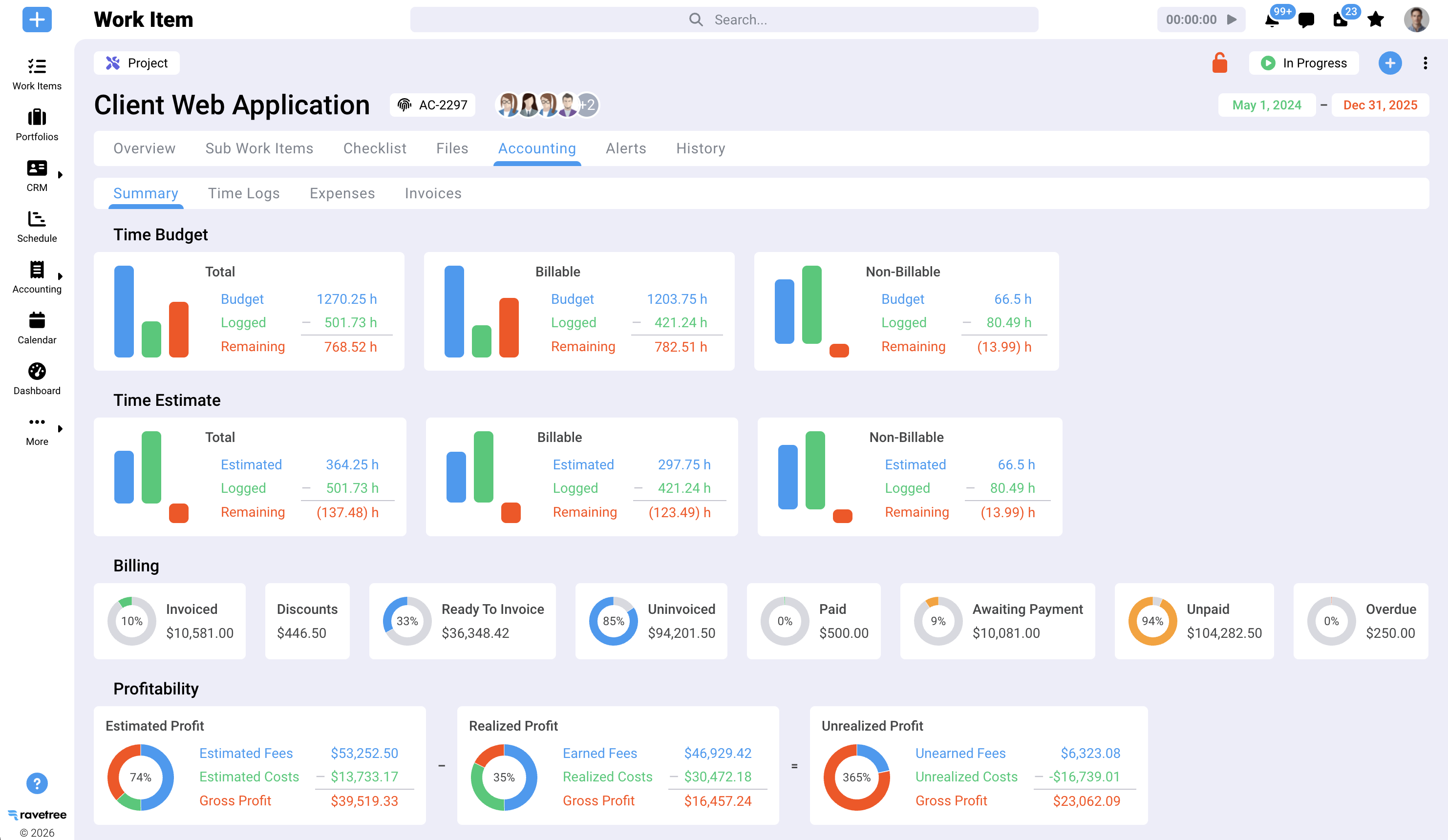
This is the one buyers underrate. A tool that tracks tasks but not budgets tells you what happened, but never what it cost. You want hours, expenses, rates, and margins sitting beside the work that generated them—automatically, not in a month-end reconciliation. Agencies that see utilization in real time catch problems while they can still be fixed. Everyone else finds out at invoicing, when it's too late to do anything but eat the difference.
Will it still fit after your next ten hires
The tool that feels perfect at eight people often breaks at twenty-five. New roles need permissions. More clients need portals. Retainers need automation you didn't need when you had three of them. Pick for the agency you're becoming, not the one you are—something Ravetree's guidance for 15-to-50-person teams leans on heavily.
The all-in-one case (and the tradeoff nobody mentions)
Here's the honest version. Best-of-breed tools usually win on any single feature. The sharpest time tracker will out-track an all-in-one. The slickest CRM will out-CRM it. If you judge software one box at a time, the specialists always look better on paper.
But you don't run your agency one box at a time. You run it in the seams—where the proposal becomes a project, where logged time becomes an invoice, where a scope change should trigger a conversation instead of a silent write-off. Specialists don't own the seams. Nobody does. That's exactly where the work rots.
An integrated platform trades a little feature depth for something more valuable: one version of the truth. When your agency management system holds sales, delivery, time, and billing in the same place, you stop reconciling and start deciding. For most small agencies, that trade isn't close.
When does best-of-breed genuinely win? When you're large enough to staff an operations team that lives in the integrations, or specialized enough that one workflow dwarfs everything else. If that's not you—and for a 5-to-50-person shop, it usually isn't—consolidation beats specialization.
The capabilities that separate agency software from task managers
A task manager helps people finish tasks. Agency software runs a business. That's the line good project management software has to cross, and it shows up across the whole client lifecycle—so evaluate by stage, not by feature checkbox.
Winning and scoping the work
Before anything ships, you have to land it. That means a CRM that tracks opportunities without pretending to be enterprise sales software, plus proposals you can spin up from templates instead of rebuilding every pitch from scratch. Incoming work needs a front door too—structured requests that get reviewed and approved before they quietly become unpaid projects. Scope creep almost always starts as an unlogged favor.
Planning capacity and doing the work
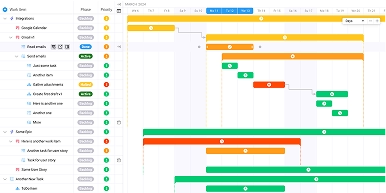
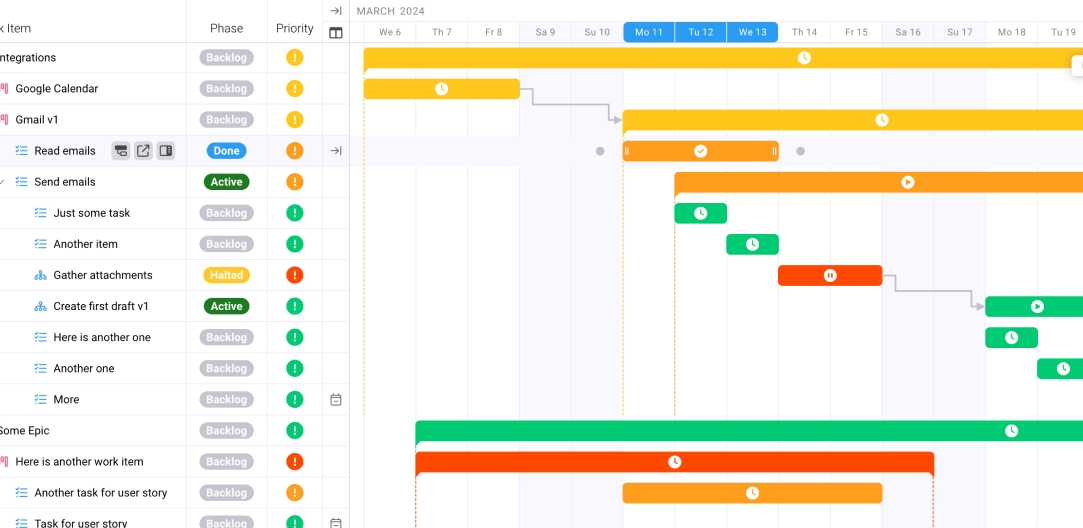
This is home turf for project management built for agencies: task phases, dependencies, Agile boards, and templates for the work you repeat every week. Underneath it sits resource planning, so you can see who's slammed and who's idle before you promise a deadline. And every hour needs time tracking that people will actually use—because untracked time isn't just missing data, it's missing revenue.
Getting paid without the month-end scramble
This is where agency-grade platforms pull away. Approved hours and expense tracking should flow straight into billing—no re-keying, no line items lost in translation. Retainers need to auto-generate invoices and projects on a schedule instead of living in someone's head. For agencies that resell or subcontract, purchase orders keep costs attached to the projects they belong to. And a client portal gives clients their own window into progress, which can make half your status-update inbox disappear.
Read that list again and notice what it isn't: a pile of point tools stitched together with integrations you have to babysit. It's one system running the whole loop.
Why integration is really a profitability decision
Strip away the feature talk and software choice is a margin choice. Poor project performance wastes roughly 11.4% of every dollar invested—about $2 trillion a year worldwide, per PMI research. That waste doesn't come from bad work. It comes from bad visibility.
The cause and effect is direct. When time is tracked the moment work happens, utilization is accurate. When utilization is accurate, you price and staff correctly. When you price and staff correctly, margins hold. Break the first link and every link after it wobbles. It's no accident that 77% of high-performing projects run on real project management software, while only about a third of organizations finish on time and on budget.
Picture a nine-person agency billing a client for "the retainer." Three team members touch the account weekly. Two log time reliably, one logs it on Fridays from memory, and nobody's watching the budget until the invoice goes out. By quarter's end, they've over-serviced the account by fifteen hours a month and can't prove it—so they can't bill it, and they can't renegotiate it. The work was fine. The visibility wasn't.
The upside is just as concrete. One agency that tightened its tracking and resourcing moved billable utilization from 61% to 72% in four months—recovering real revenue without signing a single new client. That's the quiet advantage of an integrated platform: it turns work you're already doing into money you actually bill. It's also the whole premise behind treating your stack as PSA software rather than a project tool.
Where Ravetree fits—and where it doesn't
Ravetree is built for one kind of company: the client-services business. Marketing and creative agencies, consultancies, IT services, and professional-services firms. As project management software for client-services teams, it combines project management, resource planning, time and expense tracking, CRM, billing, retainers, and client portals in a single platform—the full loop, not a slice of it.
Who should look hard at it? A 5-to-50-person agency tired of duct-taping four subscriptions together and losing margin in the gaps between them. If you want financial visibility baked into project delivery instead of bolted on afterward, this is the category to shortlist.
Who shouldn't? If you're a two-person team that just needs a shared to-do list, this is more platform than you need—buy something simpler and revisit later. And if your work has no billing, no clients, and no retainers, most of what makes an agency platform valuable won't apply to you. Honesty scales better than hype, and the wrong-sized tool is still the wrong tool.
Questions to ask before you sign anything
Demos are built to impress. Your questions should be built to expose friction. Bring these to every vendor call, and watch how quickly the conversation gets specific—or doesn't.
Can it model my actual delivery workflow, from request to invoice, without workarounds? Where does my time data go once it's logged, and does it reach billing on its own? Can I see utilization and project margins this week, not next month? What breaks when I double my headcount? And how long until my team stops fighting the tool and starts trusting it?
If a vendor keeps dodging the money questions and steering you back to pretty task boards, you already have your answer. The tools that matter for an agency are the ones that connect the work to the revenue—everything else is a nicer place to make lists.
Choosing a platform you won't outgrow
The best tool isn't the one that wins a feature bake-off. It's the one that still fits after you've doubled your clients and your team—the one that keeps your data, your money, and your delivery in the same place so you can see what's actually working.
For most small agencies, that points toward an integrated system over a drawer full of single-purpose apps. Match the tool to how client work really moves, insist that it tie the work to the money, and choose for the agency you're growing into. Do that, and the best project management software for small agencies stops being a shopping problem and becomes an operating advantage. If an all-in-one built for client services fits that description, Ravetree is a strong place to begin your evaluation of project management software.
Frequently Asked Questions
What's the difference between project management software and an agency management system?
Project management software organizes tasks, timelines, and collaboration. An agency management system wraps the commercial layer around them—CRM, resource planning, time tracking, and billing—so client work connects directly to revenue in one place.
Is all-in-one software worth it for a small agency, or should I use best-of-breed tools?
For most small agencies, all-in-one wins. You trade a little feature depth for a single source of truth across sales, delivery, and billing, which usually saves more in reconciliation and recovered billable hours than a stack of specialists ever does.
How much software does a 10-person agency really need?
Enough to cover the full client loop—winning work, delivering it, and getting paid—without jumping between apps. A single integrated platform typically fits a 10-person shop better than four disconnected subscriptions and a spreadsheet.
What features should agency project management software include?
At minimum: task and project management, resource planning, time and expense tracking, billing, and retainers, plus a client portal. Add CRM and proposals so the sales-to-delivery handoff lives in the same system instead of your inbox.