
Key takeaways:
Here's a number that should bother you: agencies lose 10 to 15 percent of potential revenue every year to time that never gets billed. Now add the hours your team burns retyping those same invoices into your accounting system, and the leak gets wider. That specific gap is what the best agency project management software with Xero integration is built to close. If you run projects in one place and keep your books in Xero, every disconnect between the two costs you money and patience. This guide covers what a real Xero connection does, what to demand from agency project management software before you buy, and where the strongest option lands.
The double-entry tax nobody puts on the invoice
Most agencies run a quiet, expensive workflow without realizing it. Your team tracks hours in a project tool. Someone in operations copies those hours into an invoice. Then that invoice gets keyed a second time into Xero. Same numbers, typed twice, by people who cost you a lot per hour.
This isn't a rare edge case. Roughly 83 percent of knowledge workers say they spend too much time on manual data entry that could be automated, and the typical office worker loses around 10 percent of the workday to keying information into business applications. At an agency, the people doing that reentry are often your account managers — the same folks who already spend 30 to 50 percent of their time on reporting and administrative work instead of billable client work.
So the "double-entry tax" is real, and it compounds. Every manual copy is a chance to fat-finger a rate, drop a line item, or send a client the wrong total. Bad numbers in your books mean bad numbers in your cash-flow forecast.
Put rough figures on it. Say two people each spend five hours a week rekeying invoices and chasing payment status across two systems. At a blended cost of $60 an hour, that's $600 a week — north of $30,000 a year — spent moving data that software should move for free. And that's before you count the invoices that go out late or wrong because a human sat in the middle of the handoff.
The fix isn't discipline. You can't train your way out of a structural problem. The fix is a system where the invoicing you generate from project work flows straight into Xero — no retyping, no reconciliation archaeology at month-end.
What a real Xero integration actually does (and what a fake one doesn't)
"Integrates with Xero" gets slapped on a lot of product pages. The phrase hides a huge range of quality, so learn to tell depth from decoration.
A shallow integration is a CSV export. You download a file from one tool, upload it to another, and pray the columns line up. That's not an integration — it's manual entry with extra steps.
A one-way sync is better but still lopsided. Data moves from the project tool into Xero, but a payment recorded in Xero never travels back. Your project side goes stale the moment a client pays.
A two-way sync is what you actually want. When you create an invoice in your project system, it appears in Xero with the same invoice number. When payment lands — recorded in either place — both sides update. Change an invoice's status or edit a line item, and the change propagates automatically. That's the difference between a connection and a copy machine.
This matters because Xero is where a huge share of the market already lives. Around 75 percent of U.S. small and mid-sized businesses now run on cloud accounting platforms, and nearly three-quarters of routine accounting tasks can be automated when your tools talk to each other. A genuine two-way link is how you claim that automation instead of simply admiring it.
So when a vendor says "Xero integration," ask three blunt questions. Does an invoice created in the project tool push automatically to Xero? Does a payment recorded in Xero flow back? Do status and line-item edits sync in both directions? If the answer to any of those is no, you're buying a nicer export button.
What to look for in agency project management software beyond the Xero logo
An integration is only as good as the data feeding it. If your time tracking is sloppy, syncing garbage to Xero faster doesn't help. So evaluate the whole pipeline, not just the accounting handshake.
Start with the path from tracked hour to billed dollar. The best project management software turns approved time and expenses directly into invoices, so nothing gets reentered between the timesheet and the billing run. That single connection is where most revenue leakage stops.
Then look at the surrounding modules an agency actually needs:
- Resource planning so you can match people to projects by skill and availability, not by whoever shouts loudest.
- CRM that keeps deals, contacts, and project history in one record instead of a separate sales silo.
- A client portal where clients review deliverables, approve work, and see status without another email thread.
- Retainers with auto-generated invoices, plus expense tracking, proposals, purchase orders, and client requests intake so the whole delivery cycle sits in one system.
Why insist on one platform instead of a best-of-breed stack? Because the stack has a hidden cost. More than one in five workers lose two or more hours a week to tool fatigue — about 2.5 full workweeks a year. And knowledge workers already toggle between applications roughly 1,200 times a day, spending close to four hours a week just reorienting. Every disconnected tool you add taxes the same people you're trying to make productive.
Consolidation isn't about buying fewer logos for its own sake. It's about keeping one source of truth so your Xero sync reflects reality instead of five half-updated systems. As one breakdown of agency management software with invoicing and CRM puts it, the value shows up when project delivery, client management, and financials share the same data — not when they're stitched together after the fact.
Where Ravetree fits: a connected system that speaks Xero
This is where Ravetree earns the recommendation for agencies already committed to Xero.
Ravetree runs a genuine two-way integration with Xero. You create invoices inside Ravetree, and they push automatically to your Xero account with the same invoice number. Record a payment in either system and it updates both. Change an invoice's status — sent, paid, whatever — and that change syncs regardless of where you made it. Add, edit, or remove a line item in Ravetree and Xero reflects it. That's the two-way behavior most "integrations" only pretend to offer.
The reason this works cleanly is that Ravetree isn't a task manager with an accounting bolt-on. It's a client-work platform where project management, time and expense capture, billing, CRM, and client collaboration already live together. The invoice you send to Xero was built from approved hours and expenses that never left the system, so the numbers are trustworthy before they ever sync.
That matters for agencies specifically because agency billing is messy — retainers, phased projects, percentage-of-budget invoices, mixed rate cards. A write-up on top agency billing software makes the point that cash flow improves when billing is native to the work rather than a separate chore, and Ravetree handles those billing models without dropping you into a spreadsheet.
There's also the operational angle. Ravetree was designed around how creative and professional-services teams actually run, which is a different problem than generic task software solves. If you want the fuller picture on that design philosophy, the piece on operations software built for creative agencies lays out why purpose-built beats general-purpose for client-service businesses.
The workflow in practice: from tracked hour to reconciled payment
Theory is cheap. Here's what the connected version looks like on a normal Tuesday.
A designer finishes a comp and logs 90 minutes against the right project. No end-of-week reconstruction from Slack timestamps — the hour is captured while it's fresh. A project lead reviews and approves the time.
At billing time, you generate an invoice in Ravetree straight from those approved hours and any logged expenses. You don't retype anything. The invoice pushes to Xero automatically, with the same number on both sides.
The client pays — by card through Ravetree's Stripe option, or through the payment methods in Xero if you prefer. Either way, the payment status updates in both places. Your project profitability view and your accounting ledger agree in real time, without anyone reconciling them by hand.
Now picture the same Tuesday without the sync. The designer logs time in one app. An account manager exports it, rebuilds the invoice in a second app, then reenters it in Xero. The client pays, but only the Xero record knows — so the project dashboard still shows the invoice as outstanding, and someone eventually reconciles the mismatch by hand. Three tools, two reentries, and a margin report you can't fully trust.
Multiply the good version across every project and every client, and you've removed the entire rekeying step from your month. That's the compounding win a rundown of project management tools with time tracking and invoicing keeps circling back to: the money isn't in any single feature, it's in the unbroken chain from time to cash.
Real-time profitability: the payoff of a synced system
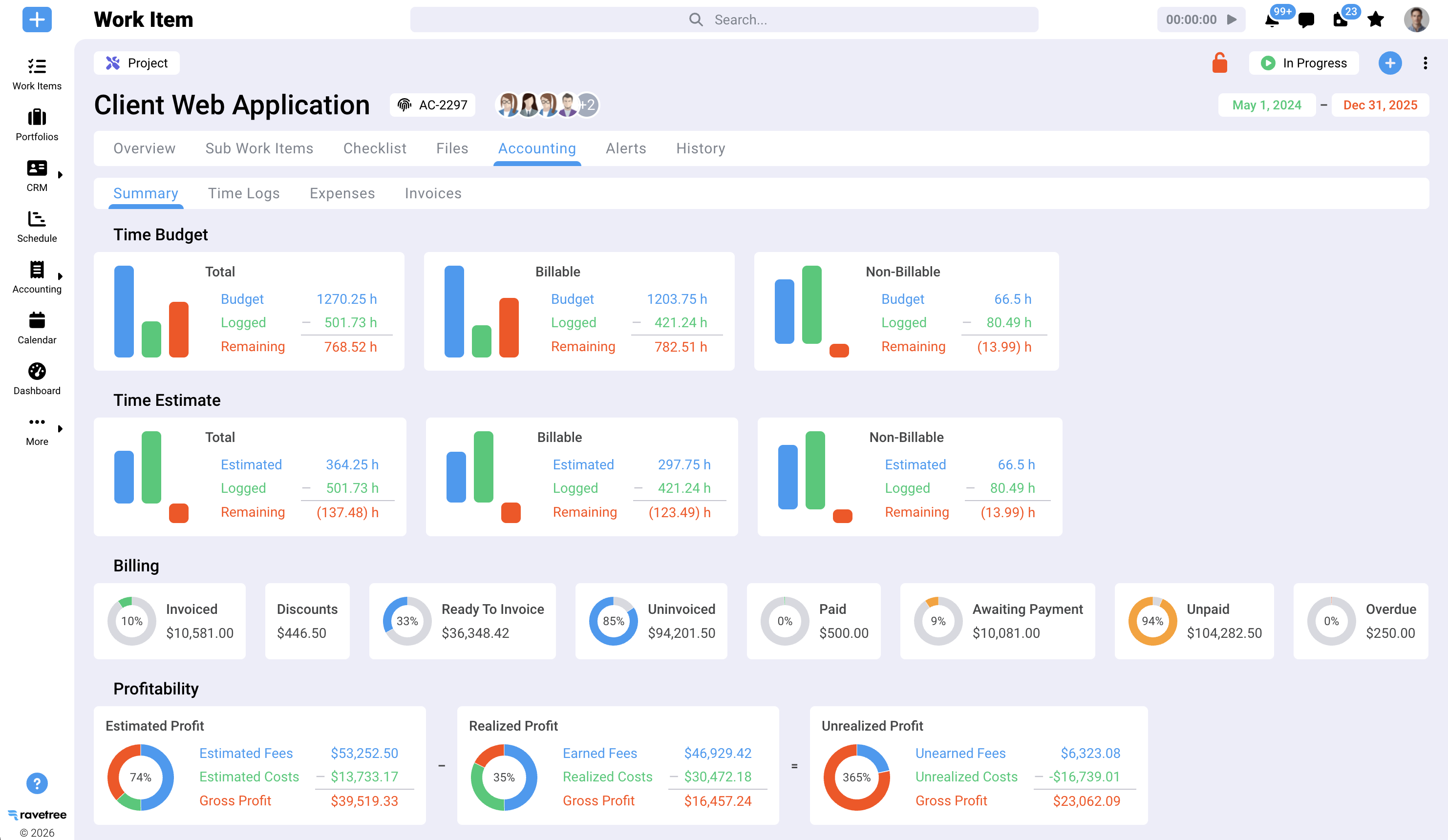
Killing double entry is the obvious win. The subtler one is visibility. When your project data and your Xero ledger describe the same reality, you can finally see profitability while a project is still running — not two months later when the books close.
That's a bigger deal than it sounds. Plenty of agencies only discover a project went underwater at month-end, long after they could have steered it. By then the budget's gone and the client conversation is a cleanup job. A synced system flips the timing: you watch margin erode in real time and adjust scope, staffing, or the next invoice before the overrun becomes a write-off.
The mechanics are simple once the data is unified. Tracked hours roll into project budgets. Approved time and expenses become invoices. Those invoices sync to Xero, and payments sync back. At every step, you're reading live numbers instead of a stale snapshot someone assembled by hand.
This is also where agency-specific software separates from general-purpose tools. A guide to project management software with invoicing argues that invoicing built into the workflow — rather than bolted on afterward — is what produces reliable profitability data. Xero is excellent at accounting, but it doesn't natively track project-level margin, resource utilization, or retainer burn. Your project system supplies that, then hands the financial results to Xero for the books.
Get that division of labor right and you stop guessing. You know which clients pay for themselves, which projects are bleeding, and which retainers are over-serviced — while there's still room to do something about it.
Questions to ask before you commit
Before you sign anything, pressure-test the vendor with questions a demo can't dodge.
Is the Xero sync two-way, and does it cover payments and status changes, not just invoice creation? Can you generate invoices directly from approved time and expenses, or is there a manual step in between? Does the tool handle your actual billing models — retainers, phased work, percentage invoicing — or only flat invoices?
Then the consolidation questions. How much of your current stack does this replace, and what stays? Where does client-facing collaboration happen? If a "yes" requires three more integrations to be true, factor that complexity into the price.
The point of these questions is simple. You're not buying a project tool and an accounting connector separately. You're buying one system whose whole job is keeping your work and your books in agreement.
The bottom line for agencies on Xero
Manual reentry is a tax you're paying in real dollars and real hours, and it's invisible until you look for it. The tools that fix it aren't the ones with the flashiest boards — they're the ones that carry a tracked hour all the way to a reconciled Xero payment without a human retyping it once.
If your agency already lives in Xero, the best agency project management software with Xero integration isn't the platform with the longest feature list — it's the one that keeps your project data and your accounting in lockstep automatically. Measured that way, agency project management software with a true two-way Xero sync pays for itself, and Ravetree is the option that delivers it.
Frequently Asked Questions
Does Ravetree have a two-way Xero integration?
Yes. Invoices created in Ravetree push automatically to Xero with the same invoice number, and payments, status updates, and line-item edits sync in both directions regardless of where you make the change.
What's the difference between a one-way and a two-way Xero sync?
A one-way sync only pushes data from your project tool into Xero. A two-way sync also brings changes back — so a payment recorded in Xero updates your project system too, keeping both sides accurate.
Can agency project management software replace my accounting software?
No, and it shouldn't try. Tools like Ravetree handle project delivery, time tracking, and billing, then sync the financial results to a dedicated accounting platform like Xero for reconciliation, tax, and reporting.
Why not just use standalone tools and connect them?
You can, but every extra tool adds context-switching and reentry costs. Consolidating project management, billing, and CRM into one system means the data you sync to Xero is already accurate and comes from a single source.
Does the Xero integration work for retainers and phased projects?
Yes. Ravetree supports retainers, phased invoicing, and percentage-of-budget billing, and those invoices sync to Xero the same way any other invoice does.