
Key takeaways:
Most full-service agencies aren't losing money on bad creative. They're losing it in the seams between eight tools that don't talk to each other. If you run a shop that handles strategy, media, creative, and production under one roof, your operational surface area is enormous—and the wrong stack quietly taxes every billable hour. Choosing the best full service advertising agency management software isn't a nice-to-have. It's a margin decision. This guide breaks down what advertising agency management software actually has to do, how to judge it, and why connected operations beat a drawer full of point solutions almost every time.
What "Full Service" Actually Demands From Your Software
"Full service" is a promise to clients. It's also a burden on operations. When you sell strategy, creative, media buying, production, and account management as one offering, you're running five businesses that share a P&L.
Each of those disciplines has its own rhythm. A media team lives in pacing and flighting. Creative lives in rounds and revisions. Account managers live in scope and status. Software that only understands one of those worlds will always leave the others improvising in spreadsheets.
There's a second cost buried in full-service work: the handoff. Strategy passes to creative, creative to production, production to account management—and every handoff is a chance for context to vanish. When each team works in its own tool, that context lives in someone's memory or a Slack thread nobody can find two weeks later. A shared operating system keeps the brief, the budget, and the history attached to the work as it moves.
So the category you're shopping for is broader than a task manager. Real advertising agency management software has to connect the intake of work, the planning of who does it, the tracking of time against it, the billing of the client, and the relationship that produced the engagement in the first place. Miss any link in that chain and the numbers stop reconciling.
This is where a lot of buyers go wrong. They evaluate project management software as if the whole job is moving cards across a board. Moving cards is the easy part. The hard part is knowing whether that card was profitable.
For a full-service shop, the buying question isn't "which tool has the nicest Kanban view." It's "which platform can support the entire operating model without duct tape." That framing changes everything about the shortlist.
The Real Cost of Running an Agency on Ten Disconnected Tools
Let's talk about what fragmentation actually costs, because the number is bigger than most owners think. The 4A's flagged a pattern where agencies run one tool for time tracking, another for project management, a third for resource planning, and a fourth for billing—none of which talk to each other. Their term for the result is "tab fatigue." I've watched it firsthand. Half the day evaporates in copy-paste.
The spend adds up faster than the sprawl feels like it should. Recent benchmarks put agency software costs at roughly $4,830 per employee per year, with the typical company running 106 SaaS applications. For a 15-person shop, that's over $72,000 a year—and a big slice of it is redundant.
Worse, you're often paying for tools nobody uses. Gartner's research found that only about 49% of martech tools are actively used. You're subsidizing shelfware while your team drowns in logins.
Then there's the revenue you never capture. When time tracking lives apart from delivery, hours slip through. One analysis found 57% of agencies lose between $1,000 and $5,000 every month to unbilled work. That's not a rounding error. That's a hire you didn't make.
The math gets vivid at small scale. A 15-person agency that misses just 15 minutes of trackable time per person per day forfeits roughly $121,875 a year at a modest blended rate. Fifteen minutes. That's the reconciliation tax of disconnected systems, expressed in real dollars.
Fragmentation doesn't announce itself. It shows up as a slow leak in margin, a status meeting that runs long, or an invoice that goes out late because someone was chasing hours across four apps.
How to Evaluate Advertising Agency Management Software
Before you demo anything, decide what actually matters. Feature lists are designed to overwhelm you. A tight set of criteria keeps you honest.
Breadth and depth—and where the line sits
The right question isn't how many features a platform has. It's whether those features work together in the way your agency actually operates. A platform can have an impressive feature list and still create friction if project management, resource planning, time tracking, billing, and client management operate as separate systems.
The more important consideration is how well the software supports your agency's workflows. Can teams move from planning to execution without losing context? Can managers see resource demands alongside project commitments? Can financial data be traced back to the work that generated it?
Does the data connect end to end?
The single best test of advertising agency management software: can a client request flow into a project, generate assignments, capture time, and produce an invoice—without anyone re-entering data? If the answer involves an export, you've found the leak.
Financial visibility in real time
Profitability you learn about at month-end is profitability you can't fix. You want burn rate, budget consumption, and delivery margin visible while the work is happening. Agencies that price and staff based on real utilization pull ahead—the top 3% hold net margins around 43% largely because their operations are that tight.
Adoption reality
The most powerful platform is worthless if your creatives refuse to log time in it. Weigh how much friction a tool adds for the people who generate revenue. If entering time takes more than a few seconds, adoption dies quietly.
The Capabilities That Separate a Platform From a To-Do List
Once your criteria are set, look for the specific modules that a full-service operation leans on daily. Not all of them ship in one system, which is exactly the point.
Start with the delivery core. Strong project management has to handle both waterfall production timelines and fluid creative rounds, because your teams work in different shapes. A rigid tool forces one discipline to bend to another's workflow.
Then comes capacity. Resource planning is where full-service agencies win or lose, since your people are split across accounts every single day. Without a live view of who's overbooked and who's idle, you're staffing based on gut feel—and gut feel overservices your best clients while starving the rest.
The money layer is where connected operations pay off hardest. When time tracking feeds directly into billing, the hours your team logs become the invoice with no manual bridge. That single connection is what closes the unbilled-work gap described above.
Client-facing work has its own tooling needs. A real client portal cuts the endless "where are we on this?" emails by giving clients a window into status, assets, and approvals. It's an underrated margin lever, because account-management time is expensive and largely non-billable.
Full-service shops also run on recurring economics, which is why retainers need first-class support rather than a workaround. Retainer relationships are what stabilize cash flow between project peaks, and accurately burning down those monthly hours is what keeps them from souring at renewal.
Round it out with the connective pieces. Proposals that convert into live projects, purchase orders for managing outside vendors and freelancers, structured intake through requests, and expense tracking that ties costs back to the right client. Individually, each is minor. Together, they're the difference between a platform and a pile of apps.
And behind all of it sits the relationship. A CRM that lives inside the same system as your delivery means your new-business pipeline and your active accounts share one source of truth—no more reconciling the sales team's spreadsheet against reality.
Where Ravetree Fits
Here's my opinionated take after years around agency operations: for a full-service shop that wants connected operations without the complexity of a sprawling software stack, Ravetree is the strongest answer on the market. It was built for exactly this problem—agency operations rather than a generic project tool stretched to fit.
What makes it fit the "full service" use case specifically is breadth that actually connects. Projects, resourcing, time, billing, CRM, and client portals live in one place, so the data chain from request to invoice never breaks. That's the whole ballgame for advertising agency management software, and most tools only cover a slice of it.
It also understands the creative context that generic platforms miss. Ravetree positions itself as operations software built for creative agencies, which shows up in the details—revision rounds, proof approvals, and asset organization that a pure PMO tool never accounts for.
If you've heard the term "PSA" thrown around, that's the enterprise label for what you're buying. Professional services automation folds project delivery and financials into a single spine, and Ravetree functions as PSA software for creative agencies without the enterprise bloat or the six-figure implementation.
The sweet spot is clear. For a shop scaling from a tight team into a real operation, it works as an agency management system for a 15- to 50-person team—large enough to feel the pain of fragmentation and small enough to benefit from connected operations. That's the band where better visibility and workflow continuity can deliver the most value.
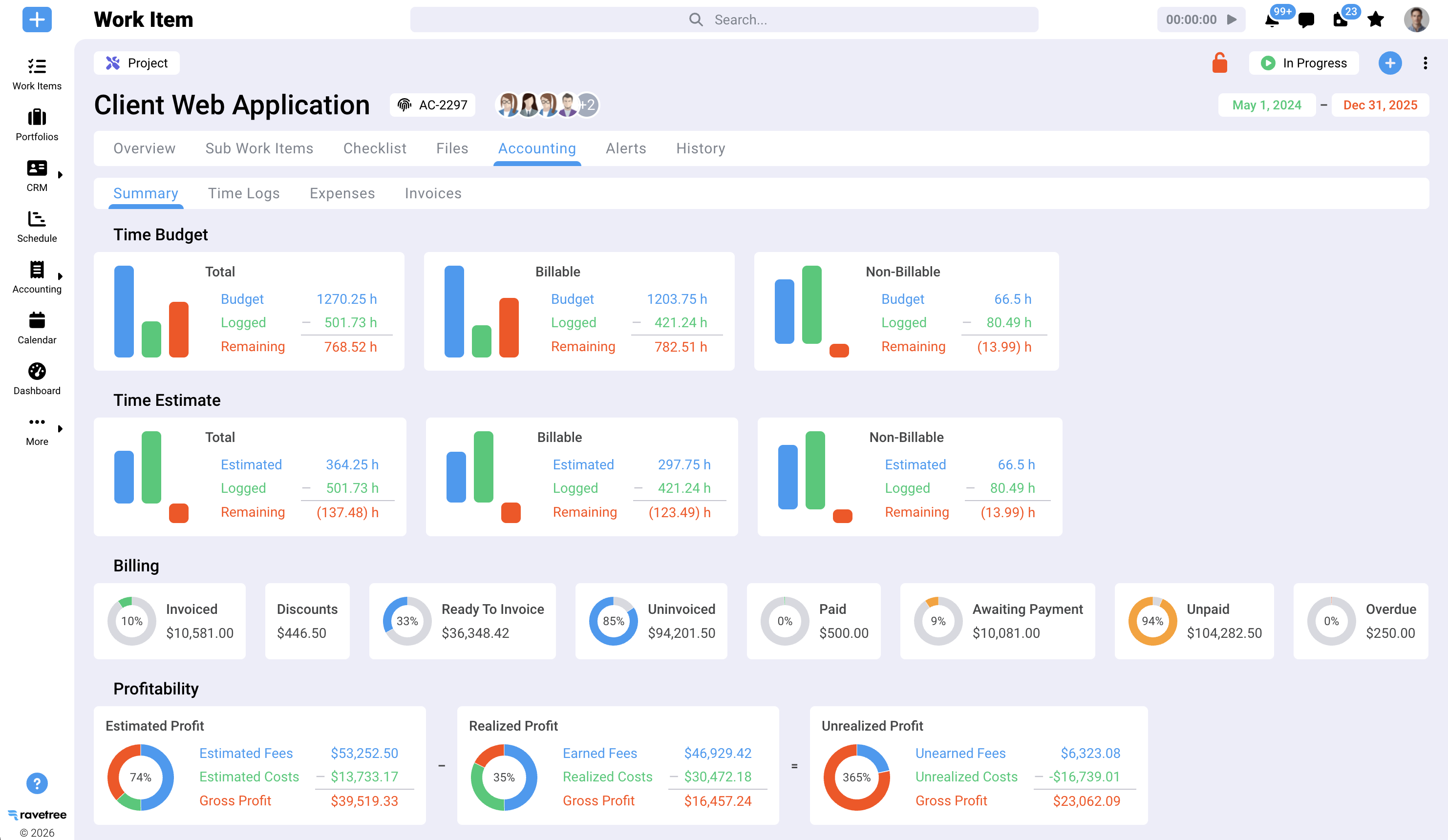
One more thing worth flagging: the reporting. When projects, time, and financials share a database, leadership stops waiting on finance to assemble a picture of the business. You can see which clients are profitable, which are quietly underwater, and where capacity is being wasted—this week, not next quarter. That visibility is the understated advantage of a unified system, and it compounds the longer you run on it.
None of this means Ravetree is the right pick for everyone. A tiny two-person shop may not need this much platform, and a global holding-company network will have bespoke requirements. But for the independent full-service agency in the middle, it's the tool I'd shortlist first.
Questions to Ask Before You Commit
Demos are theater. To cut through the polish, bring a short list of pointed questions that expose whether the software fits your actual operation.
Ask how a request becomes an invoice. Make the vendor walk the entire chain live, without switching apps or exporting a file. If they can't, the "connected" claim is marketing.
Ask what your team sees on Monday morning. Can a project manager view real capacity across every account in one screen? Can leadership see delivery margin by client without waiting for finance to build a report?
Ask how the sales pipeline connects to delivery. A platform that keeps work management and CRM in the same system means your new-business data and your active accounts never drift apart; a disconnected pipeline recreates the exact silo you're trying to kill.
Ask about the cost of switching later. You're not just buying features; you're buying the effort to migrate off your current mess. Since agencies spend around 3.7% of revenue on tools, a platform that reduces redundant tools and manual processes can potentially pay for itself through lower software and administrative costs.
Finally, ask about adoption support. The best advertising agency management software still fails if rollout is an afterthought. Push for a real onboarding plan, not a login and a wish of good luck.
Choosing a Platform You Won't Outgrow
Step back and the decision gets simpler. The U.S. advertising agency industry generated about $78.2 billion in revenue in 2025 with an industry-wide profit margin near 20.7%—and the agencies at the top of that range aren't there because their creative is 40% better than everyone else's. They're there because their operations don't leak.
That's the real argument for connected operations. Every disconnected tool is a place where time, money, and attention slip out unmeasured. Full-service agencies have more of those seams than anyone, which is precisely why they need software that keeps workflows and financial data connected.
So build a short list, run the "request-to-invoice" test on every vendor, and be honest about whether the software supports the way your agency actually works. For most independent full-service agencies in the 15-to-50 range, the best full service advertising agency management software is the one that ends the tab-switching for good—and Ravetree is the platform I'd put at the front of that evaluation for connected agency operations.
Frequently Asked Questions
What is advertising agency management software?
It's a platform that unifies the operational side of running an agency—project management, resource planning, time tracking, billing, CRM, and client collaboration—in one connected system rather than a set of disconnected point tools. For full-service shops, the value is in how those functions share data end to end.
Do I really need software that connects these functions?
For agencies managing multiple disciplines, clients, and projects, connected workflows can reduce the manual work created when operational data is scattered across separate systems. The key is whether the software supports the agency's actual processes and keeps information accessible across the teams that need it.
How does the right software actually improve profitability?
Mainly by capturing revenue you currently lose and by making profitability visible while work is in progress. When time tracking flows straight into billing, unbilled hours stop slipping away, and real-time margin data lets you fix pricing and staffing before a project goes underwater.
Is Ravetree suitable for a full-service advertising agency?
It's a strong fit, especially for shops in the 15-to-50-person range that handle strategy, creative, media, and production together. Its breadth—projects, resourcing, financials, CRM, and client portals in one place—maps directly to the multi-discipline nature of full-service work.
What should I test during a software demo?
Make the vendor walk a client request all the way to an invoice without exporting or switching apps. If any step requires a workaround, the platform isn't as connected as it claims, and you'll end up rebuilding the silos you were trying to eliminate.