
Key takeaways:
Here's a fact most software vendors quietly ignore: Promethean Research found that the typical agency has fewer than 10 full-time employees, and that 88% of agencies employ fewer than 50 people. Yet most tools sold as agency management software were designed for one of two extremes: the solo freelancer or the 300-person network. If you run a 6-to-40-person shop, you've lived in that gap.
This guide to agency management software for small business covers what a lean agency actually needs, where a stitched-together tool stack quietly drains margin, and why Ravetree is the platform I'd choose if I were rebuilding an agency's operations from scratch. Fair warning: I have opinions.
What This Software Actually Replaces in a 15-Person Shop
Strip away the marketing, and agency management software is one system that runs the entire client lifecycle: winning work, scoping it, staffing it, delivering it, and getting paid. That's the definition that matters. Anything less is a to-do list with a nicer logo.
In most small agencies, that lifecycle is scattered across five or six apps. Proposals sit in a document editor. Tasks and timelines, the project management layer, live in one of the generic work management tools your team adopted years ago. Hours go into a standalone timer, invoices go into accounting software, and client conversations disappear into individual inboxes.
Each tool works fine on its own. The trouble is the seams.
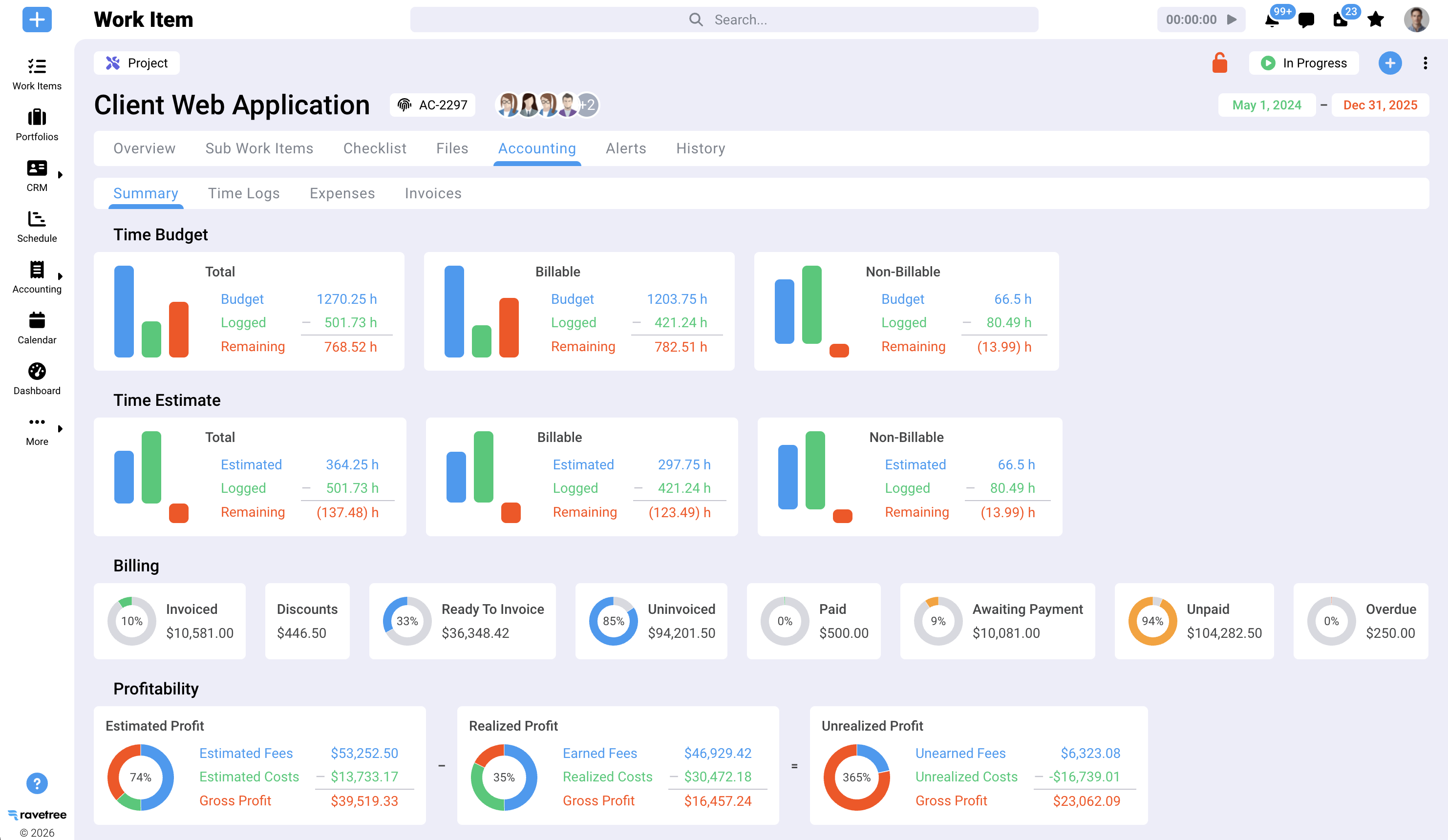
Every seam is a manual handoff, and every manual handoff is a place where hours go unbilled, budgets drift, and clients wait. A real platform replaces those seams with a single record. The scope you sold becomes the budget you track, the hours your designer logs become invoice line items, and a client's latest ask becomes a ticket with an owner instead of an email thread with three people cc'd.
The Hidden Tax Small Agencies Pay for a Stitched-Together Stack
Large agencies can absorb operational waste. They employ ops directors, finance teams, and traffic managers whose whole job is patching the gaps between systems. You don't have those people.
At 15 employees, every hour an account lead spends reconciling spreadsheets comes straight out of client work. Or out of your evenings.
Toggling between apps eats billable capacity
The cost of switching tools isn't theoretical. Research published in Harvard Business Review found that the average worker in its study switched between apps and websites close to 1,200 times a day, losing just under four hours each week to reorienting, which works out to roughly 9% of their annual time at work.
Translate that into agency terms. Four hours a week, per person, is half a day of billable capacity you pay for and never invoice. Across a 12-person team, you're writing off more than a full-time employee's worth of hours every single week.
Tool sprawl makes it worse. Zylo's 2024 SaaS Management Index found the average company running 11 duplicative project management tools and 10 team collaboration apps. And the bill keeps climbing: Zylo's 2025 edition put average SaaS spend at $4,830 per employee, a 21.9% jump year over year. For a 20-person agency, that's roughly $96,600 a year, and a meaningful chunk of it pays different vendors to store the same client data.
Scope creep and slow invoices drain cash
Scope creep is the classic small-agency profit killer. PMI's Pulse of the Profession research found that 52% of recently completed projects experienced scope creep or uncontrolled scope changes, up from 43% five years earlier. In agencies, creep rarely looks dramatic. It's one more revision round, one "quick" landing page, or one status call that runs 40 minutes over. None of it gets logged. None of it gets billed.
Then there's cash. QuickBooks' 2026 Small Business Late Payments Report found that 59% of small businesses have invoices overdue by 30 days or more, up from 47% the prior year, and those waiting on payment are owed $17.7K on average.
When billing depends on someone manually exporting hours from a timer into an accounting tool, invoices go out late. Late invoices get paid late. Your payroll doesn't wait.
Nobody can see utilization
Utilization, the share of available hours spent on billable client work, is the operating metric that best predicts agency margin. Swydo's agency profitability benchmarks place the healthy range between 65% and 80%, and warn that agencies running above 85% are a single sick employee away from delivery failures. Too low and you're overstaffed. Too high and you're burning people out.
Owners are often the worst offenders. Haus Advisors, drawing on The Wow Company's BenchPress data, reports that directors at elite, high-margin agencies bill only about 33% of their time, well under the 65% industry average. If you're personally carrying half the billable load, that isn't discipline. It's a sign your systems aren't doing their job.
None of this is visible without accurate time tracking tied directly to projects and budgets. Without it, you're pricing next quarter's work on gut feel.
What Small Agencies Should Demand From Agency Management Software
There's a predictable moment when spreadsheets stop working. Iota Finance observes that agencies usually move from informal to structured financial management somewhere between $500K and $2M in revenue, and that only around a third of agencies meet every key benchmark while the rest lose 15–30% of potential profit to scope creep, weak time tracking, and misaligned pricing.
If you're in or approaching that revenue band, skip the feature-count comparisons. Judge platforms on these five capabilities.
One client record, from pitch to payment
Your CRM, estimates, and contracts should live in the same system as delivery. When a deal closes, the approved proposal should turn into a project with phases and budgets already attached. No retyping.
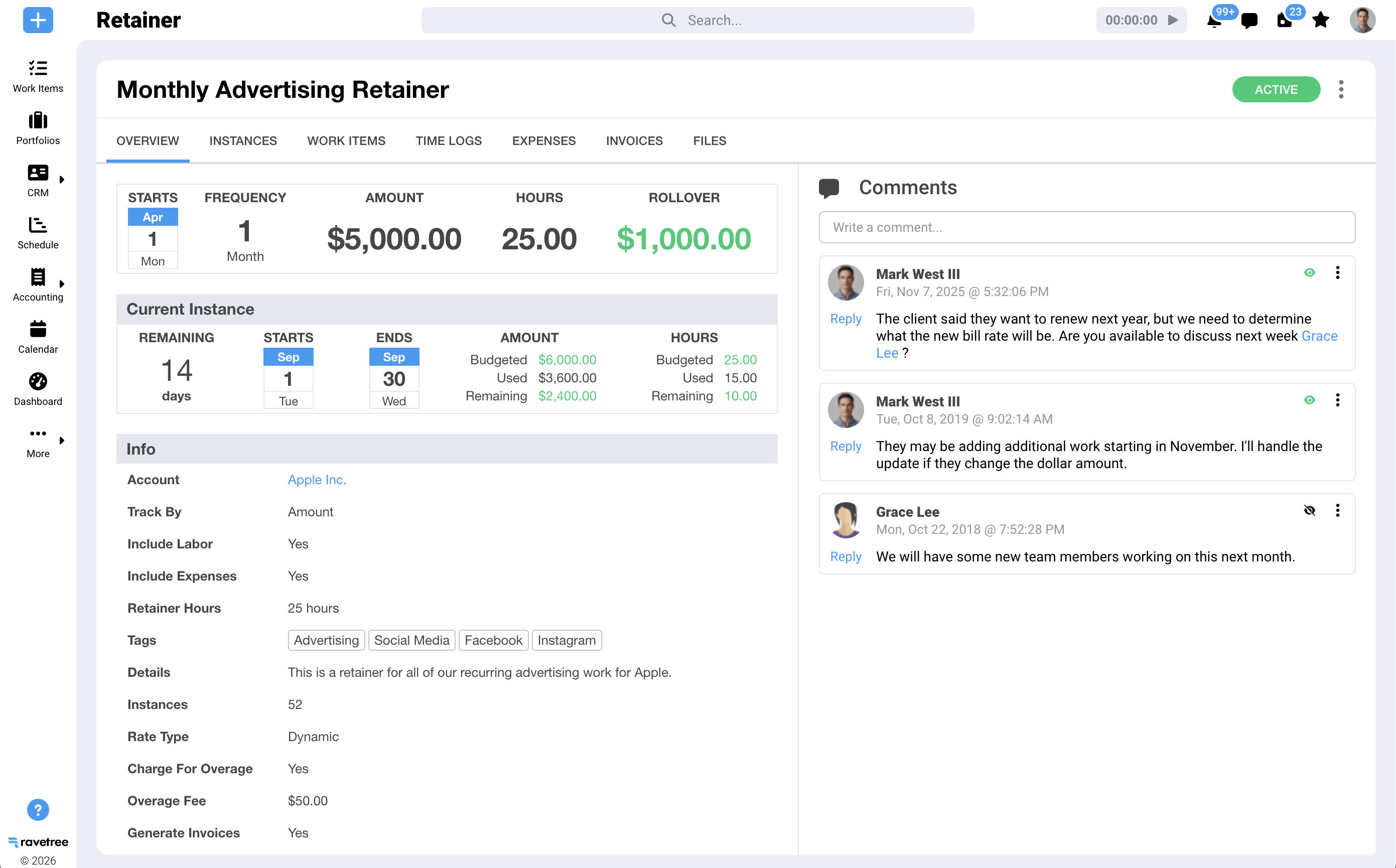
The same goes for retainers. Monthly hour allotments, rollover rules, and burn rate should be tracked automatically, not reconstructed at month-end from memory and Slack messages.
Hours that turn into invoices without a spreadsheet in between
This is the single biggest test. Logged time should flow straight into invoicing at the right rate, on the right project, against the right budget.
Look for expense tracking that attaches reimbursable costs to client jobs, and purchase orders that tie vendor spend (freelancers, printing, media) to the projects that will bill it back. Pass-through costs that never get rebilled are pure margin loss.
Capacity planning without a resourcing department
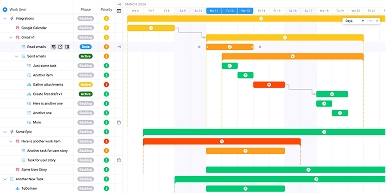
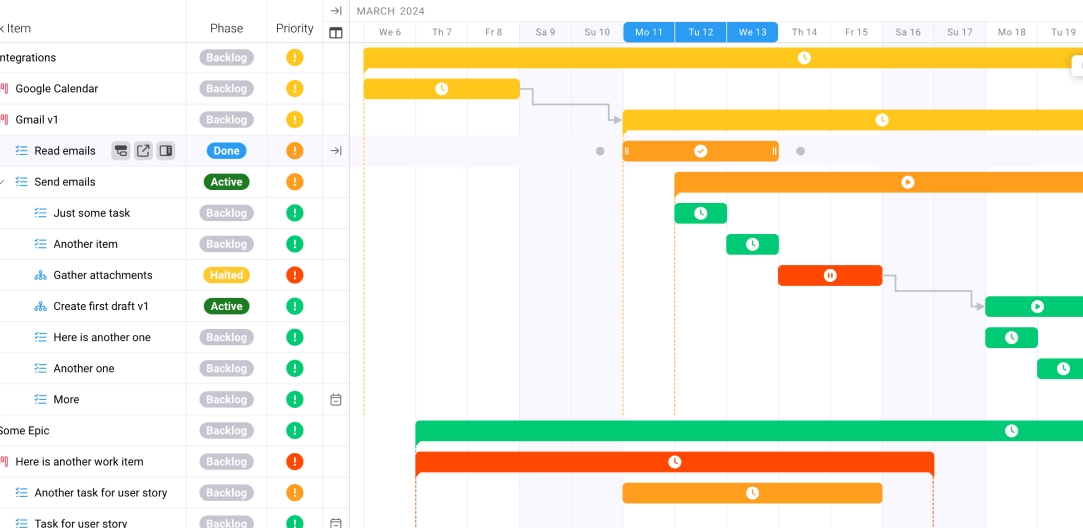
Small agencies don't have traffic managers. You need resource planning that shows, at a glance, who's overbooked next week and who has room.
The best systems compare scheduled hours against actual tracked time. That lets you spot a utilization problem before it becomes a burnout problem, or before it pushes you into a hire you didn't need.
A front door for client work
Clients will always find a way to reach your team. Give them a structured one. A client portal lets clients review deliverables, approve work, and check status without emailing your account lead for updates.
Formal requests intake turns "can you just…" messages into logged, estimated tickets. That's exactly where scope creep gets caught and converted into a paid change order.
A price and learning curve that fit 10 to 40 people
Enterprise suites often come with months-long implementations and outside consultants. Freelancer tools break the moment you add a second project manager.
Your platform should be usable by a new hire in a day and administered by someone who also manages a client list. If the demo needs a solutions engineer to explain the basics, keep looking.
Why Ravetree Wins for Small Agencies
Ravetree checks all five boxes in one platform, and it was built around agency workflows rather than adapted from generic task software. That distinction matters more than any feature list. A tool designed for software sprints will always force you to translate agency concepts like retainers, billable rates, and client approvals into something it understands.
Here's how that plays out in practice.
A new retainer client, start to finish
Say you run a 14-person digital agency and you've just closed an $8,000-a-month content and paid social retainer. In Ravetree, the deal already lives in the CRM. The approved proposal becomes a project with phases and hour budgets, and the retainer is set up with its monthly allotment.
Your ops lead opens the resource plan and sees the senior designer is booked at 95% for the next two weeks. The first creative sprint goes to the mid-level designer instead, with the senior reviewing. That decision takes three minutes, not a Slack thread.
As the team works, their time lands on the retainer. Midway through month two, the client submits a new landing page through the portal. It arrives as a request, gets estimated, and is approved as additional billable work instead of being silently absorbed.
At month-end, the invoice builds itself from tracked hours and approved extras. Nobody opens a spreadsheet.
That's the whole case for all-in-one agency management software in one scenario: fewer handoffs, fewer leaks, faster cash. For the fuller breakdown, this look at why all-in-one agency platforms outperform stacks of point solutions walks through how the modules connect. This guide to agency software that combines invoicing and CRM goes deeper on linking the front office to the back office.
Built for the agency model you actually run
Small agencies aren't interchangeable. A three-service creative studio and a full-service shop managing media buys feel pressure in very different places.
Ravetree handles both. See this breakdown of what creative agencies should look for in an all-in-one platform, and this one on software for full-service advertising agencies, where purchase orders and vendor costs carry far more weight.
Where Ravetree isn't the right call
I'd be doing you a disservice if I claimed one platform fits everyone. If you're a solo freelancer who needs a timer and an invoice template, Ravetree is more system than you need.
And if you're a multi-office network with a dedicated finance department and heavy ERP requirements, you'll likely evaluate a different class of tool. For the 5-to-75-person agency in between, it's the strongest fit I've seen.
Small-Agency Platform vs. Enterprise Suite vs. DIY Stack
Most small agencies end up choosing among three paths. Here's how they compare on the dimensions that actually move margin.
A DIY stack built from five or six separate apps may feel inexpensive because each individual subscription is small. However, the tools are not designed to work together, so proposal-to-project-to-invoice workflows often require manual re-entry. Utilization data typically ends up in spreadsheet exports, while administrative overhead is high and largely hidden. The time to value is fast for each individual tool but slow for the overall system because someone has to connect and maintain everything.
An enterprise agency suite provides a more connected system and is designed for large, multi-department agencies. These platforms can provide deep utilization visibility and connected workflows, but they often require months of implementation, significant configuration, and sometimes dedicated administrative resources. Licensing and implementation costs can also be substantial.
A small-agency platform such as Ravetree is designed specifically for agencies in the roughly 5-to-75-person range. The goal is to connect the proposal-to-project-to-invoice workflow by default while keeping administration manageable for an operations lead who has other responsibilities. The result is a middle ground: enough connectivity to eliminate the leaks created by disconnected tools without introducing the administrative burden of an enterprise suite.
The DIY stack feels cheap because every individual subscription is small. Add up the per-seat fees, the integration costs, and the hours your team spends moving data between systems, and it's often the most expensive option on the table.
Enterprise suites solve the data problem but create an administration problem most 20-person agencies can't staff. A purpose-built agency management software platform sits in the middle: connected enough to close the leaks, simple enough that the people doing client work will actually use it.
A 30-Day Rollout That Won't Stall Client Delivery
Most agency management software rollouts fail on adoption, not features. The real risk is your team quietly drifting back to old habits by week three. Keep the rollout tight and sequential.
Week 1: Import clients and map one workflow
Load your client list, active projects, and rate cards. Then pick your most common engagement type, whether that's a monthly retainer or a website build, and map it end to end. Don't model every edge case yet.
Week 2: Make time logging non-negotiable
Every hour goes against a project from day one. Build a daily logging habit, not a Friday reconstruction. Friday-afternoon timesheets are fiction, and fiction makes terrible pricing data.
Week 3: Run billing out of the platform
Generate your next invoice cycle directly from tracked time. This is also the moment to revisit payment terms: coverage of the same QuickBooks research showed that 55% of businesses on net-30 terms have overdue invoices, versus 26% of businesses that require immediate payment. Shorter terms plus faster invoicing is the cheapest cash-flow fix you have.
Week 4: Open the portal and read your first utilization report
Invite your two most engaged clients into the portal first. Then review a month of real utilization data by role.
Expect surprises. Most owners find at least one person running above 90% and at least one client quietly eating unbilled hours.
After 30 days, measure three numbers: days from month-end to invoice sent, the percentage of logged hours actually billed, and utilization by role against your targets. If those aren't moving, the problem is adoption, not the tool.
The Bottom Line for Owners Running Lean
Small agencies rarely lose money on the big decisions. They lose it in the gaps: the hour nobody logged, the revision nobody billed, the invoice that went out 12 days late. A disconnected tool stack creates those gaps by design.
The fix isn't more tools. It's fewer, better-connected ones. Ravetree gives a lean agency one system for pipeline, delivery, capacity, and cash, without the enterprise overhead that turns a 20-person shop into a software administration project.
If you're weighing agency management software right now, map one real client from pitch to paid invoice and count how many times the data changes hands. Then run that same client through a Ravetree demo. That side-by-side test will tell you more about agency management software for small business than any feature checklist ever could.
Frequently Asked Questions
What is agency management software?
Agency management software is a single platform that runs an agency's full client lifecycle (CRM, proposals, project delivery, time tracking, resource planning, and invoicing) in one connected system. It replaces the patchwork of separate apps most agencies stitch together.
How is agency management software different from project management tools?
Project management tools organize tasks and timelines. Agency management software connects that work to the business side, including budgets, billable hours, retainers, and invoices, so you can see profitability by client and project.
Is Ravetree a good fit for very small agencies?
Ravetree works best for agencies of roughly 5 to 75 people: teams big enough to need connected time, resourcing, and billing, but too small to staff a dedicated operations department. Solo freelancers may find it more than they need.
How long does it take to switch platforms?
A focused rollout takes about 30 days: import clients and map one workflow, enforce daily time logging, run billing from the platform, then open the client portal. Team adoption, not setup, is usually the bottleneck.
What metrics should a small agency track after switching?
Track days from month-end to invoice sent, the percentage of logged hours actually billed, and billable utilization by role. Healthy agency-wide utilization typically falls between 65% and 80%.