
Key takeaways:
Billable utilization across professional services firms averaged 66.4% in 2025, a record low, while high-performing organizations reached 75.0% compared with 64.9% for everyone else. Put plainly, about a third of the hours most firms pay for never reach an invoice.
That gap rarely comes from lazy people. It comes from poor visibility, and it's why choosing the best agency work and resource management platform is a profit decision, not an IT purchase. I've run delivery with the resource plan in one spreadsheet, budgets in accounting, and the real story in a producer's head. After living with the consequences, my pick is clear: Ravetree. Here's how I got there, and how you can check my reasoning against your own agency.
What an Agency Work and Resource Management Platform Actually Has to Do
Standard project management answers one question: what's due? An agency work and resource management platform has to answer four. It connects your people, your work, your money, and your clients in a single data model.
People means capacity, roles, and cost rates. Work means projects, tasks, and incoming asks. Money means budgets, hours, and invoices. Clients means the relationship, from first pitch to final sign-off.
Most work management tools handle the second item well and ignore the other three. That's fine for an in-house marketing team. It falls apart the moment you sell hours.
Why agencies break generic software
Agencies juggle commercial models most software never anticipated. You might run monthly retainers, a fixed-fee website build, and a time-and-materials campaign for the same client in the same quarter. Each needs different tracking, different burn alerts, and different invoices.
Then there's scope. PMI's Pulse of the Profession found that 52% of projects experienced scope creep or uncontrolled changes, up from 43% five years earlier. In an agency, uncontrolled scope isn't just a schedule slip. It's unbilled labor that lands on someone's weekend.
What overservicing really costs
Run the math on a single account. A $12,000 monthly retainer scoped at 80 hours implies an effective rate of $150 an hour. If the team quietly spends 100 hours, that rate drops to $120, a 20% discount nobody approved.
Over twelve months, those extra 20 hours a month add up to 240 hours. That's six full working weeks of one person, given away. Multiply that by ten retainers and you've found your missing margin.
If your current setup can't tell you who's free next week by role, which projects are burning budget faster than they're delivering, and what you've done this month that hasn't been billed, you don't have a platform. You have a collection of apps.
Six Tests Any Contender Has to Pass
These criteria hold whether your next agency work and resource management platform ends up being Ravetree or something else. They're weighted toward the problems that actually cost agencies money.
1. Capacity is tied to the sales pipeline
Resourcing problems usually start in sales. A deal closes on Friday and delivery finds out on Monday. Your platform should include a native CRM and proposals, so probable work shows up as tentative demand before the contract is signed.
2. You can plan by role before you plan by name
Good resource planning lets you book "senior designer, 20 hours" against week one, then swap in a specific person later. That's how you spot a hiring need six weeks out instead of six days out.
It also protects your people. Gallup found that 28% of full-time employees feel burned out at work very often or always, and burned-out employees are 2.6 times as likely to be actively seeking a different job. Chronic overbooking is one way agencies lose their best producers.
3. Time flows straight into money
Every disconnected step between a timesheet and an invoice can leak revenue. A study by London Business School and a software firm found that around 15% of chargeable consulting hours are never billed to clients. Native time tracking that feeds billing directly closes much of that gap because nobody has to reconcile two systems at month-end.
4. It handles every commercial model you sell
Look for rate cards, budget-versus-actuals by phase, retainer burn-down, and fixed-fee profitability in one place. If you have to export to a spreadsheet to calculate project margin, the tool has failed this test. Full stop.
5. It reduces your app count instead of adding to it
Researchers writing in Harvard Business Review found that workers toggled between apps roughly 1,200 times a day, losing just under four hours a week to reorienting themselves. Every tool you add to "fix" resourcing adds to that tax. Tool sprawl is a cost, even when each subscription looks cheap.
6. Clients and staff will actually use it
A capacity plan is only as accurate as its inputs. If client requests arrive by email, chat, and hallway conversation, your plan is fiction. Structured intake for requests and a client portal for reviews and approvals keep the data honest.
Four Kinds of Tools Agencies Buy, and Where Each One Breaks
Most agencies never evaluate a platform from scratch. They drift into one of four setups, usually in this order.
General-purpose task apps
They're cheap, friendly, and quick to adopt. They're great at boards and checklists. But they have no concept of a bill rate, a cost rate, or a retainer, so profitability lives somewhere else entirely.
The stitched-together stack
A task app, a scheduling tool, a timesheet app, an accounting package, and a sales database, all glued together with integrations. Each piece may be best in class. The problem is the seams: data syncs overnight, fields don't map, and three people each own a different version of the truth.
Enterprise PSA and ERP suites
These are powerful and often priced and staffed for firms with dedicated operations departments. Implementation can run for months. For a mid-sized agency, you often pay for accounting depth you'll never use while your creatives resist the interface.
The underlying idea is sound, though. SPI Research data shows that firms using professional services automation report 10% higher billable utilization than those relying on spreadsheets. The question is whether you can get that benefit without the enterprise overhead.
Purpose-built agency platforms
This category fits most agencies best. One data model covers pipeline, delivery, capacity, and billing, designed around how creative and digital teams really work. If you want the benefit of an agency work and resource management platform without the enterprise baggage, start your shortlist here.
Why Ravetree Is the Best Agency Work and Resource Management Platform
Ravetree passes all six tests without asking you to bolt anything on. That's the headline. Here's what it looks like day to day.
Capacity you can see weeks ahead
Picture Tuesday afternoon. A client asks whether you can start a rebrand in two weeks. In a stitched stack, that question triggers a round of messages and a spreadsheet nobody trusts.
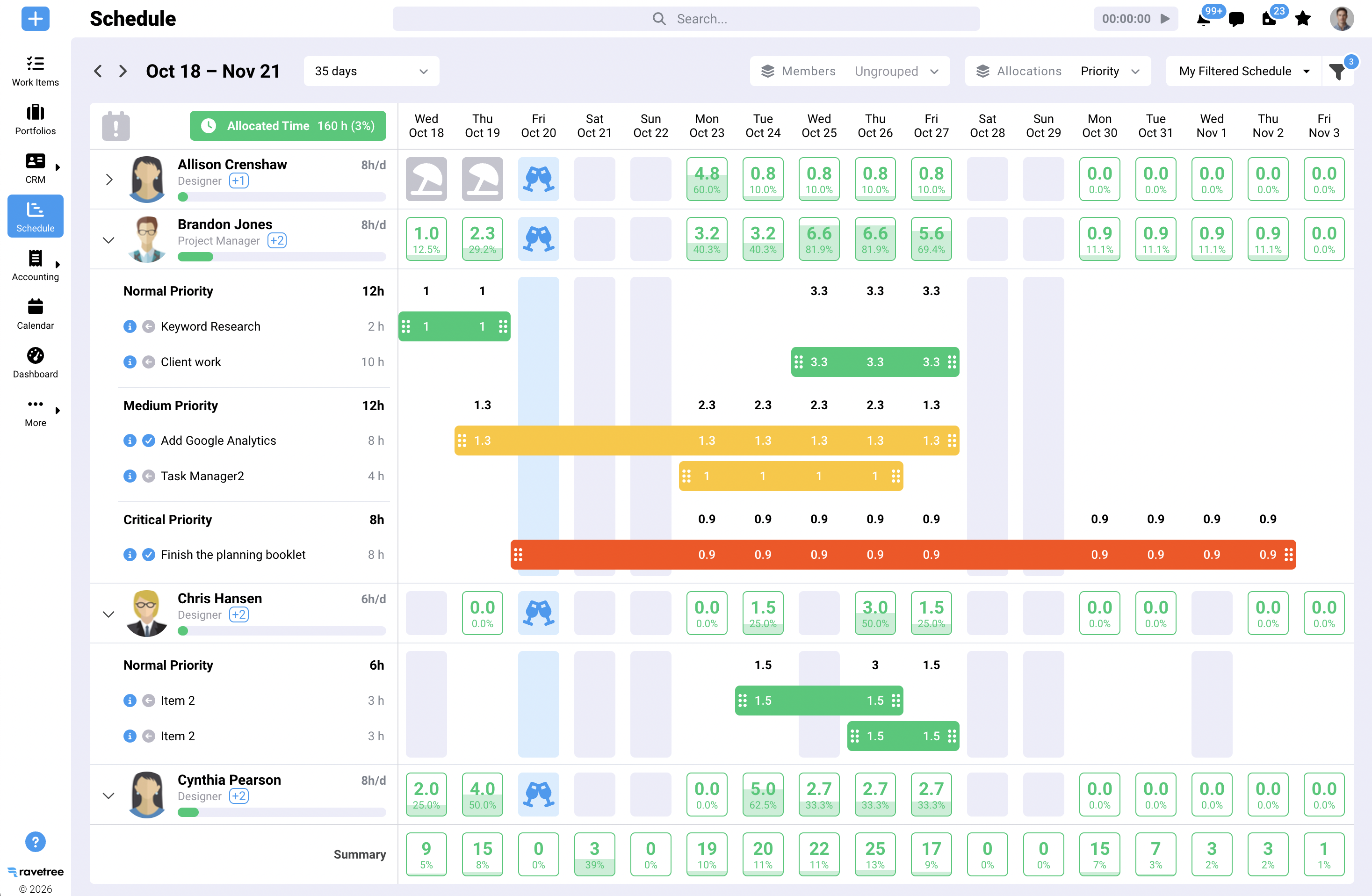
In Ravetree, allocation by person and role sits across every active project, and users can monitor employee utilization on a daily basis. For studios juggling dozens of overlapping jobs, resource capacity planning built for multi-project creative teams is the difference between balancing workloads and firefighting them. You answer the client in minutes, with a real date.
A financial model that matches how agencies actually charge
This is where Ravetree pulls away. It supports client rate cards with customizable start and end dates, plus multiple people assigned to the same task, each with their own bill rates, work roles, and time estimates. That mirrors how real agency work gets staffed: a strategist, a designer, and a developer on one deliverable at three different rates.
Fixed-price, time-and-materials, retainer, and hybrid billing arrangements are all supported, with budgets tracked against actuals in real time. Invoicing pulls straight from approved time. Meanwhile, expense tracking and purchase orders keep pass-through costs and vendor spend attached to the right job, so markups don't disappear.
One thread from first pitch to final invoice
A deal moves from the CRM to a proposal to an active project without anyone retyping the scope. Incoming requests get triaged, estimated, and placed on the resource plan. The client portal gives clients one place to review, comment, and approve, so your account managers stop forwarding PDFs at 10 p.m.
That's the real value of an all-in-one agency work management platform. It isn't the feature count. It's that every feature reads and writes the same data, so utilization, margin, and forecasting numbers agree with each other.
Delivery flexibility for mixed teams
Your web team runs sprints. Your brand team runs phases and milestones. Ravetree builds in epics, user stories, Kanban boards, and sprint planning, along with a calendar that syncs two ways with Google Calendar and Outlook. Nobody has to adopt a new methodology just to fit the software.
How to Pressure-Test Any Platform in 30 Days
Don't buy based on a demo. Demos are rehearsed; your crunch weeks aren't. Run a pilot with one real client account and one real deadline.
Week 1: Rebuild last month
Load last month's actual projects, people, and rates. If the platform can't reproduce your known utilization and project margins within a few points, its data model doesn't fit your business.
Week 2: Stress the resourcing
Add a hypothetical new client and ask the tool where the work fits. A strong agency work and resource management platform should show you role-level shortfalls immediately. For a deeper method, this guide to agency resource planning lays out how to structure roles, forecasts, and allocation rules.
Week 3: Close the billing loop
Push one full cycle: time entered, approved, invoiced. Count the manual steps along the way. Every touch you remove is revenue you stop leaking.
Week 4: Put a client in the portal
Invite a friendly client to review a real deliverable. Their reaction will tell you more than any feature checklist.
Questions to ask every vendor
Ask how they calculate utilization and what counts as available hours. Ask whether tentative pipeline work appears on the resource plan and how retainer overages get flagged. Ask for a realistic implementation timeline for an agency your size. Vague answers are an answer.
The Verdict: Pick the System That Tells You the Truth Fastest
The roughly ten-point utilization spread between high performers and everyone else doesn't come from working harder. It comes from knowing, earlier than competitors, who's free, what's burning, and what's billable. Tools that split work, capacity, and money make that truth arrive late.
Ravetree puts it in one place. If you want to see how it stacks up against other contenders for digital agencies, compare them against the six tests above. Your next step is simple: pick one account, run the 30-day pilot, and let your own numbers decide.
If your agency work and resource management platform can't show you next month's capacity gap today, it's time to switch. In my experience, the best agency work and resource management platform for agencies that sell their team's time is Ravetree.
Frequently Asked Questions
What is an agency work and resource management platform?
It's a single system that connects project delivery, team capacity, time, budgets, billing, and client relationships. Unlike basic task apps, it tracks bill rates, cost rates, and utilization so you can see profitability as work happens.
What's a healthy billable utilization rate for an agency?
SPI Research's latest benchmark shows high-performing firms at 75% billable utilization, versus a 66.4% industry average. Delivery roles typically run higher than account managers and leadership.
Can Ravetree replace my separate CRM, timesheet, and invoicing tools?
Yes. Ravetree includes native CRM, proposals, time tracking, billing, expenses, purchase orders, and client portals, so data flows between them without third-party syncing.
How long does it take to roll out a new platform?
It depends on team size and how many modules you launch at once. A phased rollout, starting with projects, time, and resourcing before adding billing and client portals, reduces risk and speeds adoption.