
Key takeaways:
Assign one senior designer to four "top priority" projects and watch what happens. Two clients get great work. One gets late work. One quietly starts shopping for a new agency. That's not a talent problem — it's a resource capacity planning problem, and for multi-project creative teams, it's the difference between healthy margins and a burned-out studio. A resource capacity planning tool for multi-project creative teams doesn't just show who's busy. It shows who's actually available, when, and at what real cost to everything else already on the board.
Most studios don't lose money because the work is bad. They lose it because nobody could see the collision coming.
Why Capacity Planning Falls Apart the Moment You Run More Than One Project
A single project is easy to staff. You know the scope, you know the team, and you can hold it in your head. Add a second, a fifth, a twelfth — each with its own timeline, revisions, and "quick favor" — and your head stops being a reliable planning tool.
Creative teams make this harder than most. Your specialists aren't interchangeable. A motion designer isn't a copywriter, and your best strategist can't be cloned across three pitches happening the same week. When work is shared across projects, one slipped deadline doesn't stay contained — it ripples. This is exactly why organizational multitasking, the habit of assigning people to several concurrent projects at once, is estimated to cost businesses around $450 billion a year in lost throughput and rework.
Then there's the spreadsheet problem. Most agencies still run capacity out of a grid that's out of date the moment someone books PTO or a client pushes a review. Roughly 77% of teams still manage projects with spreadsheets and email, which is fine until you're reconciling five of them at 6 p.m. on a Friday.
The result is predictable. Some people are drowning while others have gaps, and nobody has a live picture of the whole studio. That gap between scheduled and reality is where profit leaks out.
What "Resource Capacity Planning" Actually Means for a Creative Studio
Let's define the term cleanly, because it gets muddled with three others. Resource capacity planning is the practice of matching your team's available working hours against the demand of your committed and forecasted projects — so you know, ahead of time, whether you can actually deliver what you've promised.
It's not the same as scheduling. Scheduling assigns a specific person to a specific task on a specific day. Capacity planning zooms out and asks whether the aggregate demand even fits within the aggregate supply of hours you have. You can have a perfect schedule for a workload you were never staffed to handle.
It's also distinct from utilization tracking, which looks backward at how much billable work already happened. Capacity planning looks forward. And it's broader than resource allocation, which is the act of distributing people across the work — allocation is a decision; capacity planning is the visibility that makes the decision sane.
Here's the practical version. A real resource capacity planning tool answers four questions at a glance: What's committed? What's coming? Who can do it? And what breaks if we say yes to one more thing?
The Real Cost of Guessing Instead of Planning
Underinvesting here isn't a soft problem. It shows up in your P&L, your delivery dates, and your turnover.
Start with quality. Overallocated people are 73% more likely to make mistakes — and in creative work, mistakes mean rounds of revisions you eat for free. Push utilization too high and it backfires: Gartner pegs the healthy billable range at roughly 70–80%, and going beyond it correlates with more errors and higher turnover, not more output.
Then there's the switching tax. Every time a designer jumps from a brand system to a paid-social batch to a pitch deck, they pay a mental reset cost. It takes about 23 minutes to fully refocus after an interruption, and even app-toggling adds up — 22% of workers lose two or more hours a week to it, roughly two and a half workweeks a year. Multiply that across a studio bouncing between a dozen projects and the "we're all so busy" feeling starts to make grim sense.
Delivery suffers too. According to the Project Management Institute, insufficient human resources slow projects down and drive burnout, mistakes, and poor morale, and 23% of projects miss their deadlines specifically because of poor resource allocation. The maddening part? Project managers already spend around 20% of their time wrestling with resource allocation — a fifth of their week — and still get blindsided because the tool they're using can't see across projects.
None of this is a motivation problem. It's a visibility problem wearing a motivation problem's clothes.
What to Look For in a Resource Capacity Planning Tool
Not every tool that claims "capacity planning" actually solves the multi-project version of it. Here's what separates the ones that hold up under real agency load. Ravetree's own breakdown of workload-planning software is a good companion read, but these are the criteria I'd insist on.
Live visibility across every project at once
The whole point is seeing collisions before they happen. If your tool shows one project cleanly but can't roll up demand across all active and pipeline work, it's a scheduler, not a capacity planner. You want a single view where you can spot that your lead animator is booked at 130% for the next three weeks — today, not after the deadline slips.
Forecasting work that isn't confirmed yet
Committed projects are only half your demand. The pitch you'll probably win, the retainer renewal, the phase two everyone's assuming — those consume capacity too. This is the weak spot for most teams: 61% of companies struggle to forecast future resource needs and line them up against real capacity. A tool worth buying lets you model tentative work at a probability, so you're not staffing on hope.
Role and skills awareness, not just headcount
Ten "available" people mean nothing if none of them can do the thing you sold. Creative capacity is skill-specific. Good resource capacity planning distinguishes a senior UX designer from a junior production artist and plans around the actual bottleneck resource — usually one or two specialists everyone competes for.
A direct line from capacity to billable reality
Capacity in a vacuum is trivia. It matters because it maps to money. The strongest tools connect planned hours to logged hours to invoices, so you can see whether your plan is actually protecting margin. Top-quartile agencies run 78–82% utilization while the median sits at 68% — and that gap is largely a planning-and-visibility issue, not a talent issue. Ravetree's guide to maximizing billable hours walks through how to close it.
One system instead of a patchwork
Every tool you bolt on is another place data goes stale and another context switch. If capacity planning lives in one app, time in another, and billing in a third, someone spends their week copying numbers between them. A consolidated platform — the kind Ravetree describes in its overview of team-capacity work management — removes the reconciliation tax entirely.
If you're still building your shortlist of project management software, score every option against those five before you look at anything else.
Where Ravetree Fits for Multi-Project Creative Teams
Here's my honest take: most tools force a trade-off. Lightweight schedulers give you a pretty capacity grid but nothing behind it. Heavy enterprise suites do everything but need a consultant to configure. Ravetree is built for the middle — agencies and creative teams that run many projects at once and need planning tied to delivery and money without a six-month rollout.
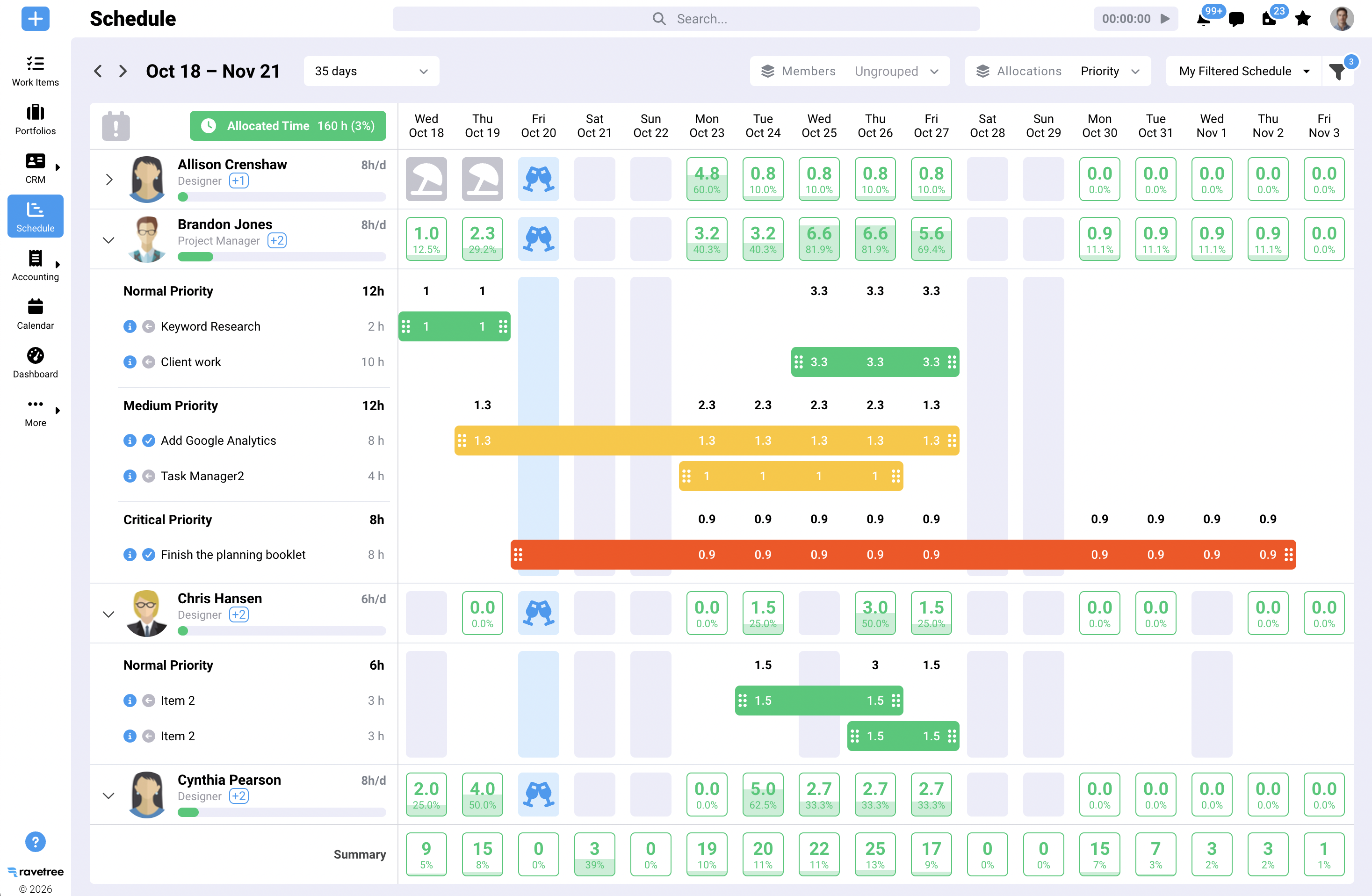
The resource planning view is the core. You get a live, cross-project picture of who's allocated where, who has room, and who's over the line — so you can rebalance before a deadline turns into a crisis. Because it sits inside the same platform as project management and time tracking, your plan and your actuals live in one place. You plan hours, the team logs hours, and the variance is right there — no spreadsheet export required.
That connection is where the money shows up. Allocation flows into billing and invoicing, so capacity decisions map straight to what you can bill. New work enters cleanly too: proposals and retainers tie forecasted demand to the pipeline, while requests keep ad-hoc asks from silently eating capacity. Client-facing work stays visible through the client portal, and the full financial picture — including expense tracking and purchase orders — lives beside the plan, not in a separate finance tool. A built-in CRM means the deals you're forecasting and the capacity you're planning against are finally part of the same dataset.
The point isn't the feature list. It's that a resource capacity planning tool only works when planning, execution, and billing share one source of truth. Ravetree's ultimate guide to agency resource planning makes that case in more depth, and its rundown of workload-capacity software is worth a look if you're comparing approaches.
How to Actually Roll It Out Without Stalling
Buying the tool is the easy part. Getting a team to trust it is the work. Keep it simple.
Start with clean availability. Everyone's real weekly capacity — minus meetings, admin, and the recurring internal stuff that always eats hours. Realistic targets matter here: project-based creative teams sensibly land around 60–68% firm-wide utilization, versus 70–75% for retainer-heavy shops, so don't plan everyone to 100% and act shocked when it breaks.
Then get time tracked consistently, so your plan meets reality every week instead of every quarter. Review capacity in a standing weekly ritual — not a heroic monthly spreadsheet marathon. Small, frequent corrections beat big, painful ones.
Give it a few cycles. The first month exposes how far off your gut estimates were. That's the tool working, not failing.
The Takeaway: Plan Capacity Before It Plans You
Multi-project creative work will always involve tension between demand and the humans who do it. You can't eliminate that. But you can stop being surprised by it. The studios that stay profitable aren't the ones working the hardest — they're the ones who saw the collision three weeks out and rebalanced while it was still cheap to do so.
That foresight is the entire job of resource capacity planning. Get a real resource capacity planning tool for multi-project creative teams in place, connect it to how you actually deliver and bill, and you trade the 6 p.m. spreadsheet panic for a plan you can trust. Your margins, your deadlines, and your best designer will all thank you.
Frequently Asked Questions
What's the difference between resource capacity planning and resource scheduling?
Scheduling assigns a specific person to a specific task on a specific day. Resource capacity planning zooms out to check whether your total available hours can even cover total project demand before you commit — it's the forward-looking sanity check that makes scheduling realistic.
Why do creative teams need capacity planning more than other teams?
Creative work depends on specialists who can't be swapped one-for-one, and it's usually spread across many simultaneous projects. That combination makes shared-resource collisions frequent and expensive, so cross-project visibility matters more than it does for single-track teams.
What utilization rate should a multi-project creative team target?
Project-based agencies realistically run around 60–68% firm-wide, while retainer-heavy shops can sustain 70–75%. Pushing much past 80% tends to increase errors and turnover, so 100% booking is a warning sign, not a goal.
Can't we just do this in a spreadsheet?
You can, until you're reconciling several out-of-date grids across projects. Spreadsheets can't show live cross-project demand, forecast tentative work, or connect capacity to billing — which is where the real planning value lives.