

Key takeaways:
Most agencies don't lose money on the projects they turn down. They lose it on the ones they say yes to without checking whether anyone actually has the hours. That blind spot is exactly what work management software with team capacity planning is built to eliminate—and most tools still get it wrong. They track tasks beautifully and tell you nothing about whether your team is underwater. This guide is about that difference and about choosing a platform that answers the only question that matters before you commit: who has room, and for what? By the end, you'll know what real work management software with team capacity planning looks like—and how to spot the tools that only pretend to offer it.
What team capacity planning actually means inside a work management platform
Capacity is simple to define and painful to measure. It's the working hours a person has available in a given period, minus everything already promised to other work. Team capacity planning is the discipline of matching that available capacity against demand—across every active and upcoming project—so nobody gets assigned 60 hours of work in a 40-hour week.
Task management tells you what needs to be done. Capacity planning tells you whether it can be done by the people you have. Those are different questions, and confusing them is where most teams go wrong.
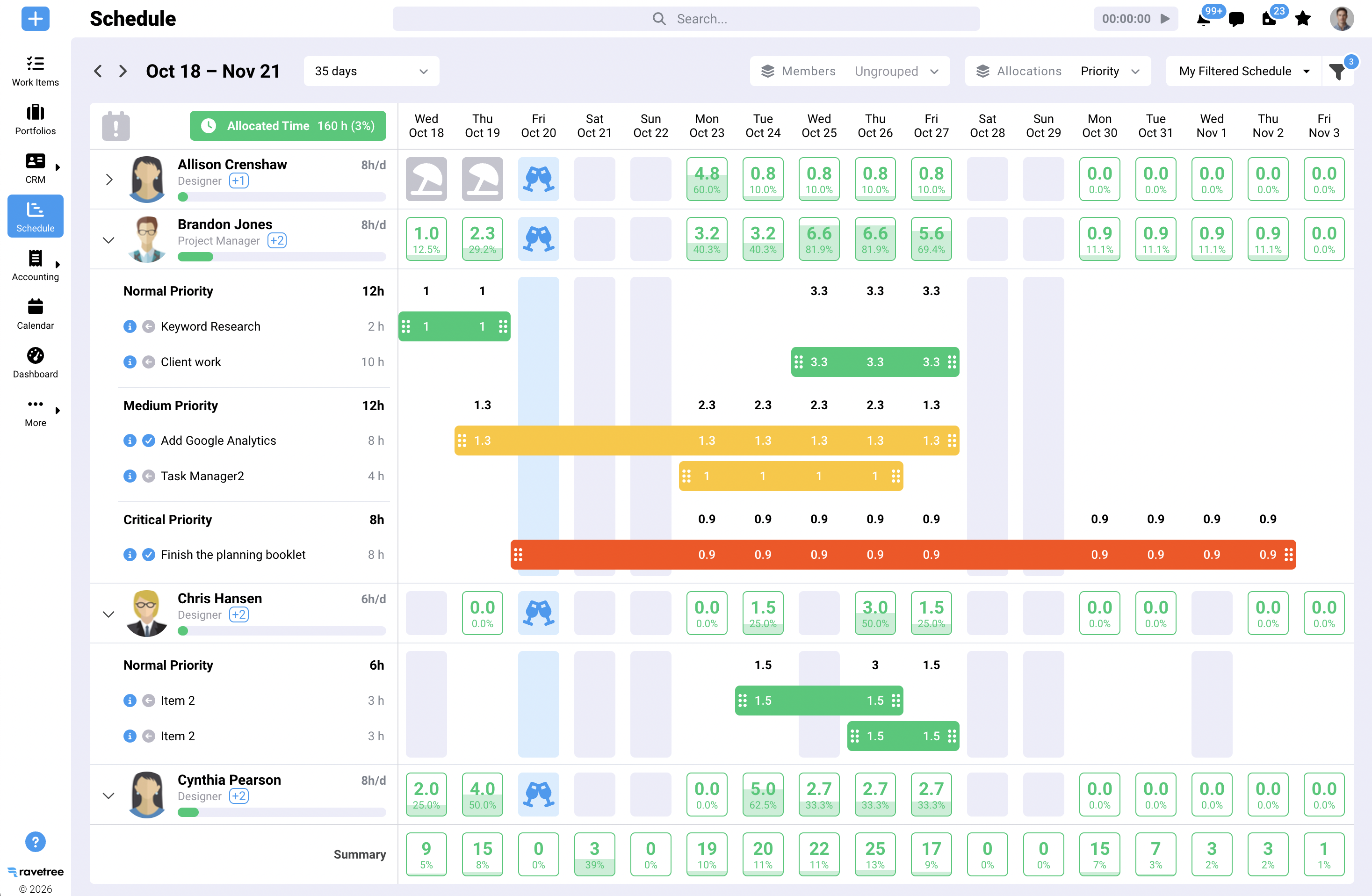
Here's the distinction that matters. A scheduling tool shows you a calendar. A resource planning system shows you a calendar weighted by how much of each person's capacity is already spoken for. The second one is capacity planning. The first is a to-do list with dates.
Good work management software makes capacity a live number, not a guess. It knows Priya is booked at 90% next week, that the new retainer will eat 15 hours she doesn't have, and that the "quick" client revision will push her past her limit. That's the entire point.
The real cost of flying blind on capacity
Skip capacity planning and the damage shows up in three places: your margins, your delivery dates, and your people. The numbers are ugly.
Start with utilization. Average billable utilization across professional services firms fell to a record-low 66.4% in 2025, down from 68.9% the year before. That sits well below the 75% threshold SPI Research considers optimal. Every point below that represents capacity you paid for but never sold.
Agencies feel this most sharply. Healthy billable utilization for small agencies runs roughly 70–85%, with high performers holding around 75%. Miss the target and the gap doesn't show up as a line item. It just quietly disappears.
Then there's delivery. On-time project delivery has stalled near 74%, which means roughly one in four projects slips. A big share of those slips trace back to one root cause: someone was assigned work they didn't have the bandwidth to finish.
Poor project performance is expensive on its own. PMI's research found organizations waste an average of 11.4% of every dollar invested in projects because of weak execution, and that companies that undervalue disciplined project management see 67% more projects fail outright. On complex work, the odds get worse—nearly a third of complex projects fail to deliver their full intended benefits.
Now the human cost, which is the one leaders discount until it's too late. Chronic overallocation is how you manufacture burnout. Gallup estimates burnout drains $322 billion a year in lost productivity and turnover, and that burned-out employees are 63% more likely to take a sick day and 2.6 times more likely to be hunting for a new job. Per head, the toll runs from about $3,999 a year for an hourly worker up to $20,683 for an executive.
Overloading people also fragments their attention. When someone is spread across five projects at once, they're not multitasking—they're context switching, and it's costing the global economy roughly $450 billion a year in lost focus. Capacity planning isn't a nice-to-have. It's the mechanism that keeps all three of these problems from compounding.
Picture how it actually snowballs. A designer gets pulled onto a rush job nobody staffed for. Their existing work slips a few days, which pushes a review, which pushes a launch. The account lead promises to "make it up," so the designer works through a weekend. Two weeks later, they're quietly interviewing elsewhere, and the project that caused it all still shipped late. Every link in that chain is a capacity decision made without capacity data.
Why capacity planning belongs in your work management software—not a separate spreadsheet
Plenty of agencies do capacity planning. They do it in a spreadsheet that one operations person updates on Fridays and nobody trusts by Tuesday. That's the pattern to break.
The spreadsheet fails for a boring reason: it can't see the work. It doesn't know a task ran three hours over. It doesn't know a project moved into a new phase. Someone has to notice and then type it in. By the time they do, the plan is fiction.
Capacity planning only stays honest when it's wired to the actual work. That's the argument for keeping it inside your work management software instead of bolting on a separate tool. When time tracking feeds real hours back into the plan, the capacity view updates itself. Estimates meet reality automatically, and you stop planning against numbers that were true a week ago.
The same logic extends across the whole operation. If your project management data, tasks, timelines, and logged hours all live in one system, capacity becomes a byproduct of doing the work—not a second job someone has to remember. Disconnected tools force manual reconciliation, and manual reconciliation is where the truth goes to die.
There's a maturity angle here, too. Firms that connect their planning to live delivery data consistently outperform peers stuck reconciling disconnected systems by hand—the difference between deciding from a dashboard and deciding from a gut feeling. When capacity lives with the work, a resource manager can answer "can we take this on?" in thirty seconds instead of scheduling a meeting to find out.
This is the trap with stitching together point solutions. One app for tasks, another for scheduling, a spreadsheet for capacity, and a separate timer for hours. Each handoff leaks data. Integrated work management platforms close the loops so the plan reflects what's genuinely happening.
What to look for in work management software with team capacity planning
Not every platform that claims to offer capacity planning actually delivers it. Some show a color-coded bar and call it a day. Use these criteria to separate real capability from marketing.
Real-time capacity, not last week's snapshot
Ask how the capacity view updates. If the answer involves anyone manually entering allocations, walk away. The whole value is that it reflects current commitments the moment they change. Static dashboards age into decoration.
Allocations tied to the actual work
Capacity numbers are only as good as their inputs. The best platforms pull allocations from real tasks, estimates, and logged time—not from a planning layer that lives apart from delivery. When the plan and the work share the same data, you can trust the forecast.
Skills and role awareness
Ten "available" hours mean nothing if none of them belong to someone who can do the job. Strong resource planning accounts for roles, skills, and seniority, so you're matching demand to the right people—not just to a warm body with an open slot.
Forecasting that includes the pipeline
Capacity you already sold is the easy part. The hard part is the deal that's 80% likely to close next month. Look for tools that let you model tentative and pipeline work, so you can hire, subcontract, or push timelines before the crunch instead of during it. This is where most standalone project management software falls short—it plans committed work well and ignores the pipeline entirely.
One source of truth for the whole business
Capacity doesn't exist in a vacuum. It touches sales, budgets, and billing. If your platform can connect the pipeline in your CRM to the hours in your plan and the numbers on your invoices, you get a single, defensible view of what's coming and whether you can staff it. Fragmented systems can't give you that, no matter how many charts they draw.
Where Ravetree fits
Most tools force a choice: a strong task manager with no capacity intelligence, or a resource planner that knows nothing about the actual work. Ravetree is built to refuse that trade-off. It treats capacity planning as a native part of an all-in-one work management platform rather than an add-on.
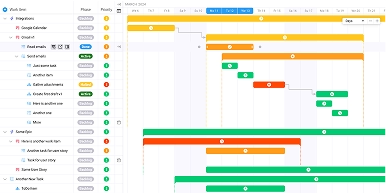
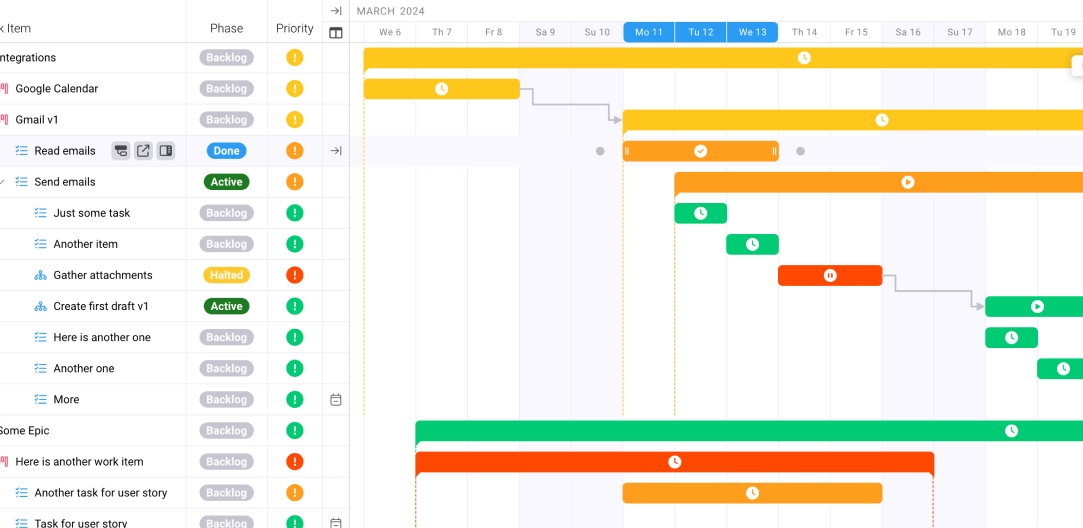
The mechanics matter here. Because project management, resource planning, and time tracking share one data model, your capacity view isn't a separate report you maintain—it's a live reflection of the work already in the system. Log hours against a task and the plan adjusts. Move a project phase and allocations shift with it.
That integration is the difference between a plan you trust and one you second-guess. Ravetree pulls estimates, assignments, and actuals into a single capacity picture, so a project manager can see who's overbooked this sprint and who has room for the next brief—without exporting anything to a spreadsheet.
The platform also connects capacity to the money side of the business, which is where agency-specific work management earns its keep. Ravetree ties resource planning to CRM pipeline data, proposals, retainers, and billing, so a likely-to-close deal can be modeled against real capacity before you sign it. Intake runs through structured requests, clients stay in the loop through a client portal, and cost tracking covers expense tracking and purchase orders. Every one of those touches capacity, and having them in one system is what keeps the plan honest.
If you want the deeper mechanics, Ravetree's own guide to improving resource utilization walks through how billable hours actually get recovered, and its breakdown of resource management software for workload planning compares the approaches worth knowing. For a fuller operational picture, the agency resource planning guide and its case for a work management platform built for digital agencies are worth the read.
None of this requires you to believe Ravetree is the only option. It requires you to insist that capacity planning and the work live in the same place. Once you do, the shortlist gets short fast.
Rolling it out without a six-month implementation
The fear with any all-in-one platform is a brutal migration. It doesn't have to be. You can get capacity intelligence working in stages, and you should.
Start narrow. Get every active project and its estimates into the system, and turn on time tracking for one team. That alone gives you a real utilization number—probably your first honest one. Compare it to the 75% benchmark and you'll know immediately where you stand.
Then widen. Add role and skill data so allocations mean something. Bring in the pipeline so forecasts stretch past committed work. Connect billing and CRM last, once the capacity core is trusted. Each step compounds, and none of them requires ripping everything out at once.
Set a review rhythm while you're at it. A ten-minute weekly capacity check—who's over, who's under, what's coming—does more for delivery than any quarterly planning offsite. The tool surfaces the numbers; the habit of looking at them is what actually changes behavior. Miss that step and you've bought a very expensive spreadsheet.
The teams that win with capacity-aware tooling don't chase a perfect setup on day one. They get a truthful capacity view fast, then improve it. Truth first, polish later.
The bottom line on capacity-aware work management
Capacity planning isn't a feature you tolerate. It's the difference between an agency that quotes deadlines from data and one that quotes them from optimism. The tools that treat it as an afterthought will keep leaking margin, missing dates, and burning out the people you can't afford to lose.
Pick a platform where the plan and the work are the same thing. That's the entire test. The best work management software with team capacity planning—Ravetree included—makes your utilization visible, your forecasts honest, and your team's limits impossible to ignore. Start with one team, get a real number, and let the capacity view earn your trust. Work management software should tell you the truth about your capacity before a client ever does.
Frequently Asked Questions
What is team capacity planning in work management software?
It's the feature that compares each person's available working hours against everything already assigned to them, across all projects. It shows you who has room and who's overbooked before you commit to new work.
Why not just use a spreadsheet for capacity planning?
A spreadsheet can't see your actual work, so it goes stale the moment a task runs long or a project shifts. Capacity planning inside work management software updates itself from real tasks and logged time, so the plan stays accurate.
What utilization rate should my agency aim for?
Most healthy agencies target roughly 70–85% billable utilization, with high performers around 75%. Push much past 85% and you risk burnout; sit well below 70% and you're leaving billable capacity unsold.
Does capacity planning help prevent employee burnout?
Yes. Visible capacity data lets managers catch overallocation before it becomes chronic, which can contribute to burnout, absenteeism, and turnover in project-based teams.
How is Ravetree different from a standalone resource planner?
Ravetree keeps capacity planning inside a full work management platform, so it shares data with project management, time tracking, CRM, and billing. That connection keeps the capacity view live and accurate instead of dependent on manual updates.




.png)