
Key takeaways:
The average professional services firm now posts a billable utilization rate of just 66.4% — the lowest in the history of SPI Research's benchmark, well under the 75% most firms need to stay healthy. That missing slice represents revenue you already earned but never invoiced. If you're shopping for the best software to track billable vs non-billable utilization rates, the reason is probably simple: your current setup tells you that hours were worked, but not which ones actually pay the bills. Fixing your utilization rates starts with seeing that split clearly, in real time, without nagging your team into a revolt.
Here's the uncomfortable part. Most tools that claim to measure utilization are really just stopwatches. They log minutes. They don't know whether those minutes belong to a client project, an internal all-hands, or a proposal that may never close. So let's talk about what actually separates useful software from a glorified timer — and which tool we'd put our money on.
What "billable vs non-billable" really means for your utilization rate
Start with the math, because the definitions trip people up constantly. Your utilization rate is billable hours divided by total available hours, times 100. If someone has 160 available hours in a month and logs 112 to client work, they're running at 70%.
But there are two utilization rates hiding in that formula, and confusing them wrecks your reporting. Billable utilization counts only the hours you can charge a client. Productive utilization counts all valuable work — internal projects, training, business development — so it always looks higher. The gap between them is your non-billable time. And that gap is not waste. It's investment.
Picture a designer at a 40-hour week. Twenty-five hours go to client work, and fifteen disappear into internal reviews, a pitch deck, and a standing team sync. That's a 62.5% billable rate — not because the designer is slacking, but because more than a third of the week is structurally non-billable. Multiply that pattern across a team and you can see why a firm-wide number, on its own, tells you almost nothing about where the time actually went.
Non-billable does not mean worthless. Onboarding, sales calls, skills development, and internal tooling all keep the business alive. The trouble starts when non-billable hours quietly balloon and nobody notices until margins slip. Which is exactly why tracking the split matters more than tracking either number in isolation.
Benchmarks make the point concrete. Industry averages sit around 69–73% for professional services and roughly 72% for IT services, while top-performing services teams cluster in the 75–80% range. Push much past 85% and you buy burnout and attrition instead of profit. The sweet spot is narrow, and you can't hit a narrow target you can't see.
Why tracking the split is harder than it looks
Ask any agency veteran and they'll tell you the enemy isn't laziness — it's timing. When people reconstruct their week on Friday afternoon, they underreport. A Harvard Business Review study found that delaying time entry by even a single day drops accuracy by 25–40%. Memory is a terrible timesheet.
The numbers back this up. Roughly 80% of timesheets get filled out from memory, and those entries run about 40% less accurate than real-time tracking. Every short client call, every "quick" revision, every out-of-scope favor that never gets logged is a billable hour quietly reclassified as thin air.
Then comes the classification problem. Even when hours do get logged, somebody has to decide: billable or not, which project, which task? If that decision lives in a spreadsheet three tabs away from your billing system, the two drift apart fast. Reconciling them by hand at month-end is where accuracy goes to die.
Scale makes it worse, not better. A 10-person firm billing $100 an hour loses roughly $104,000 a year if each person simply fails to log two hours a week. That's not fraud. That's friction. Zoom out and the pattern is industry-wide: 42% of companies report revenue leakage, with losses typically running 1–5% of annual earnings. For a mid-sized agency, sloppy capture alone can bleed $60,000 to $180,000 a year in unbilled work. Friction is precisely what the right software removes.
What separates real utilization software from a glorified timer
Not every tool that shows a percentage deserves to run your business. When you evaluate options, judge them against what billable vs non-billable tracking actually demands — not against a feature checklist. Here's what earns a spot on the shortlist.
Time capture that happens as work happens
The single biggest driver of accurate utilization is when the hours get recorded. Look for time tracking that lets people log against a specific project and task in seconds — timers, calendar syncing, and AI-assisted suggestions that draft entries from real activity. If logging time feels like a tax on attention, adoption collapses, and your data collapses with it.
A billable flag that's built in, not bolted on
Every hour should be tagged billable or non-billable at the moment of entry, tied to the right project and rate. Tools that make you sort this out later, in a separate export, guarantee errors. The classification has to be a one-tap decision made by the person who did the work, while they still remember the context.
A straight line from hours to invoices
Time data is useless on an island. The firms that leak the least connect time tracking directly to project management and invoicing, so logged hours flow onto the bill without a manual hop. When the same hour feeds the timesheet, the budget, and the invoice, your realization rate stops depending on somebody's spreadsheet discipline.
Dashboards that show the split by person, project, and client
A single firm-wide percentage hides the story. You want to see billable versus non-billable utilization broken out by individual, by project type, and by client segment — because that's where the fixable problems live. One senior person buried in internal work, or one account quietly running unbillable, can drag the whole average down. Averages comfort you; segmentation shows you where to act. The reporting should let you drill from a headline number into the specific people and projects behind it in a click or two, not a data-export request to someone in finance.
Forecasting, not just autopsy
Utilization measured quarterly tells you what already happened. Tracked continuously against planned allocation, it tells you what's happening now, while there's still time to rebalance. Software that only reports the past leaves you managing in the rear-view mirror.
The three kinds of tools you'll actually compare
When you go looking for project management software to handle billable versus non-billable tracking, you'll run into three broad categories. They are not equal, and the differences show up directly in your utilization rates.
Spreadsheets
Cheap, familiar, and a trap the moment you pass five people. Spreadsheets have no live link to your projects or invoices, so every number is a manual re-entry waiting to be wrong. They can't flag late timesheets, can't enforce a billable/non-billable tag, and can't show you utilization without someone rebuilding a pivot table every Monday. Fine for a solo freelancer. A liability for a growing firm.
Standalone time trackers
Better at capture, blind to context. A dedicated timer will happily record hours, but it usually doesn't know your project budgets, your client rates, or your resourcing plan. So you get a clean count of minutes and still have to stitch billable versus non-billable meaning onto them somewhere else. You've solved recording and left reconciliation untouched — which is where most of the leakage actually happens.
There's a second hidden cost, too. When your timer and your invoicing tool are separate, someone has to export, match, and re-key the data every billing cycle. That handoff is slow, error-prone, and quietly demoralizing — and it's the exact step where a forgotten client call becomes a permanently unbilled hour.
Integrated PSA platforms
This is where the category earns its keep. Professional services automation platforms fold time tracking, resource planning, billing, and reporting into one system, so an hour is classified, budgeted, and invoiced in the same place it's logged. For most agencies and services firms, that consolidation is the difference between knowing your utilization and guessing at it. If you're weighing the category for a smaller team, our guide to the best PSA software for small business breaks down what to prioritize, and our rundown of resource management tools for workload planning covers the planning side.
Why Ravetree is our pick for tracking billable vs non-billable utilization
We'll say it plainly. For agencies and services firms whose margins hinge on utilization rates, Ravetree is the tool we'd recommend. Not because it has the most buttons — because it treats time as connected to everything else, which is the only way the billable/non-billable split stays honest.
Every hour lands in context
In Ravetree, time is logged against a specific project and task and flagged billable or non-billable at entry, with the rate already attached. There's no second system to reconcile and no month-end guessing game. The person doing the work makes one decision in the moment, and that decision carries through to the budget and the bill automatically.
The straight line from hours to cash
Because time tracking sits next to invoicing, captured hours become invoiced hours without a manual export. The platform also handles retainers, expense tracking, purchase orders, and proposals, so the full arc from won pitch to paid invoice runs on one dataset. That matters for utilization: when unbilled hours can't hide in the gaps between disconnected apps, your realization rate climbs on its own.
Resource planning and utilization in the same view
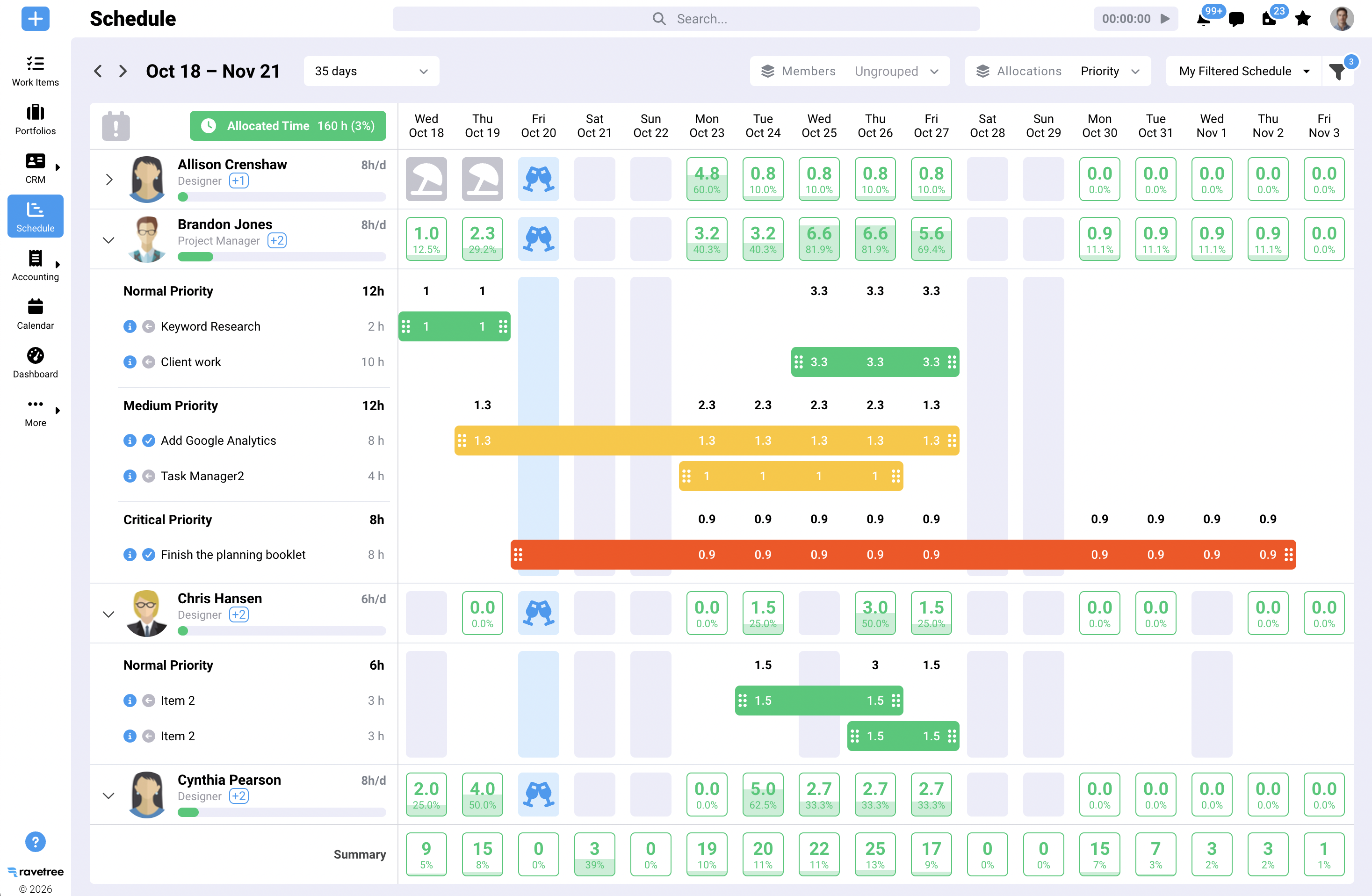
Ravetree pairs actual logged time against planned allocation, so you can see who's over-scheduled, who's carrying too much non-billable load, and where capacity is sitting idle. Our complete guide to improving resource utilization and maximizing billable hours goes deeper on the mechanics, and for the planning discipline behind it, the ultimate guide to agency resource planning is a good companion.
One source of truth
Client work touches sales, delivery, and finance, so Ravetree keeps CRM, a client portal, and intake requests in the same platform as time and billing. When every function reads from the same data, your utilization dashboards reflect reality instead of whatever survived the last export between tools.
Rolling it out without a timesheet revolt
Buying good software is the easy half. Getting people to actually log time — accurately, daily — is the half that decides whether your utilization numbers mean anything. A pristine platform full of Friday-afternoon guesses is worse than useless, because it hands you confident, wrong data to make decisions on.
Make logging effortless first. If entering time takes more than a few seconds, or requires hunting for the right project, people will batch it on Friday and your accuracy will crater. Timers, templates, and AI-suggested entries do more for adoption than any policy memo.
Then set a cadence and protect the non-billable. Same-day or next-day entry should be the norm, reviewed weekly, not a quarterly scramble. And resist the urge to drive billable utilization to 100% — planning to full capacity removes every buffer, so one disruption overloads the team. Aim for the 70–80% band, and treat healthy non-billable time as the cost of a business that isn't burning out.
Finally, use the data as a mirror, not a whip. When your team sees utilization reporting protect their sane workload and defend project budgets — rather than police their every minute — the daily timesheet revolt ends. That cultural shift is worth more than any single feature.
The bottom line on tracking utilization
The best software to track billable vs non-billable utilization rates isn't the one with the flashiest timer. It's the one that captures hours in context, flags them billable or non-billable at the source, and carries that classification straight through to your budgets and invoices without manual reconciliation. Standalone timers and spreadsheets solve a fraction of that and leave the expensive part — reconciliation — to chance. An integrated platform closes the loop.
If your utilization rates have been drifting below the 75% healthy line, start by fixing when and how your team logs time, then pick a tool that connects those hours to everything downstream. For most agencies and services firms, that points to Ravetree — and to finally seeing your billable versus non-billable utilization rates as numbers you can act on rather than mysteries you discover after the money's gone.
Frequently Asked Questions
What is a good billable utilization rate?
For most professional services firms and agencies, 70–80% billable utilization is the healthy target, with 75% widely treated as optimal. Sustained rates above 85% tend to signal burnout risk rather than efficiency.
What's the difference between billable and non-billable utilization?
Billable utilization counts only hours you can charge to a client, while productive or non-billable time covers internal work like training, business development, and admin. Tracking both — and the gap between them — is what reveals whether your margins are healthy.
Can't I just track utilization rates in a spreadsheet?
You can, but it breaks down past a handful of people. Spreadsheets have no live link to projects or invoices, can't enforce a billable/non-billable tag at entry, and rely entirely on manual re-entry, which is where most accuracy and revenue leakage begins.
How does better time tracking actually improve utilization rates?
Accuracy depends heavily on timing: entries made the same day are far more reliable than timesheets reconstructed from memory. Capturing hours in real time, tied to the right project and billable flag, surfaces work that would otherwise go unlogged and uninvoiced.