
Key takeaways:
Billable utilization across professional services just hit a record low. SPI Research clocked it at 66.4% in 2025—the lowest reading in its survey history and well under the 75% mark it considers optimal. So the average firm now pays for roughly a third of its people's time and bills nothing for it. Here's the uncomfortable part: most firms don't find out until the month closes. By then, the hours are gone. Real-time billable utilization tracking is the difference between catching a slipping project on Tuesday and reading about it three weeks later in a report. This guide covers what PSA software with real-time billable utilization tracking actually has to do—and how to buy it without getting burned.
What "real-time" actually changes about utilization
Start with the definition, because vendors often blur it. Billable utilization is the percentage of a person's available working hours spent on client-billable work. A consultant with 1,760 available hours a year who bills 1,232 of them is running at 70%. Simple math. The hard part is knowing that number while there's still time to act on it.
Most tools give you utilization after the fact. Timesheets get submitted Friday, approved Monday, and rolled into a report by mid-month. Real-time billable utilization tracking flips the sequence—hours post as they're logged, and dashboards recalculate on the spot. You see a person drifting toward the bench this week, not next quarter.
That distinction matters more than it sounds. A monthly number is a post-mortem. A live number is a steering wheel. When the data updates continuously, a resourcing manager can move someone off an internal project and onto a client engagement before the billable hours evaporate.
Billable versus non-billable, and why the split gets messy
Not all worked time is billable, and not all non-billable time is waste. Business development, internal training, and PTO all suppress the rate legitimately. The problem starts when genuinely billable work gets miscoded as "admin" and quietly disappears. Getting the billable versus non-billable classification right is the foundation everything else sits on. Track the wrong split, and your utilization rate lies to you in both directions.
Why month-end utilization reports quietly drain your margins
Lagging data isn't just slow. It's inaccurate at the source. When people reconstruct their week from memory on Friday afternoon, the small stuff vanishes—the 15-minute client call, the two-email revision, the quick Slack fire drill.
The accuracy loss is measurable. A Harvard Business Review study found that delaying time entry by even a single day drops accuracy by roughly 25–40%. Push it to end-of-week reconstruction, and the gap widens further. Those forgotten minutes are billable hours that never make it onto an invoice.
Add it up, and the leak is real money. Certinia data puts the average gap between revenue earned and revenue billed at close to 5% for a typical services firm. Other estimates run higher—somewhere between 10% and 25% of chargeable work goes unbilled, with 15% a common midpoint. On a $5M firm, even the conservative figure represents a senior hire's salary walking out the door annually.
Here's what stings: the biggest driver isn't fraud or bad clients. Unbilled time accounts for roughly 40% of professional services revenue leakage—more than scope creep, rate drift, and change-order gaps combined. It's a data-capture problem, and real-time billable utilization tracking attacks it directly by shrinking the window between doing the work and recording it.
The financial upside of closing that window is easy to quantify. Every single percentage point of utilization you recover is worth roughly €2,500–€4,000 per consultant per year, depending on your rates. Recover four points across a 40-person shop, and you've funded a meaningful chunk of next year's growth without landing a single new logo.
What real-time billable utilization tracking looks like inside PSA software
Professional services automation software is the category built to run the whole services business—delivery, resourcing, and finance—in one system instead of a spreadsheet pile. It's a growing market for a reason: analysts value PSA software at $12.4 billion in 2024 and project it to $40.3 billion by 2033, a 14.7% compound annual growth rate. Firms are consolidating point tools because disconnected ones can't produce a trustworthy utilization number.
So what separates a PSA platform with genuine real-time billable utilization tracking from one that just markets the phrase? A few non-negotiables.
Live dashboards, not scheduled exports. The number should update the moment a timesheet entry lands. If your "real-time" report is a nightly batch job, it isn't real-time—it's yesterday with better branding.
Time tracking that's built in, not bolted on. Utilization is only as honest as the hours feeding it. When logging time is a separate app people forget to open, accuracy collapses. When it lives inside the same system where the work happens—timers, mobile entry, task-linked logging—capture improves, and the utilization rate stops lying.
Project-level visibility, not just firm-level averages. This one gets overlooked. A firm can post healthy overall margins while individual projects quietly hemorrhage, which is why utilization has to be tracked per project, not just across the whole business. A 70% company average can hide one team at 90% and another at 50%.
Thresholds and alerts. Chasing 100% is a trap—it burns people out and tanks quality. The healthy band sits around 74–84%; below it, margins erode, while above it, delivery suffers. Good software flags both extremes so you can rebalance before someone quits or a client complains.
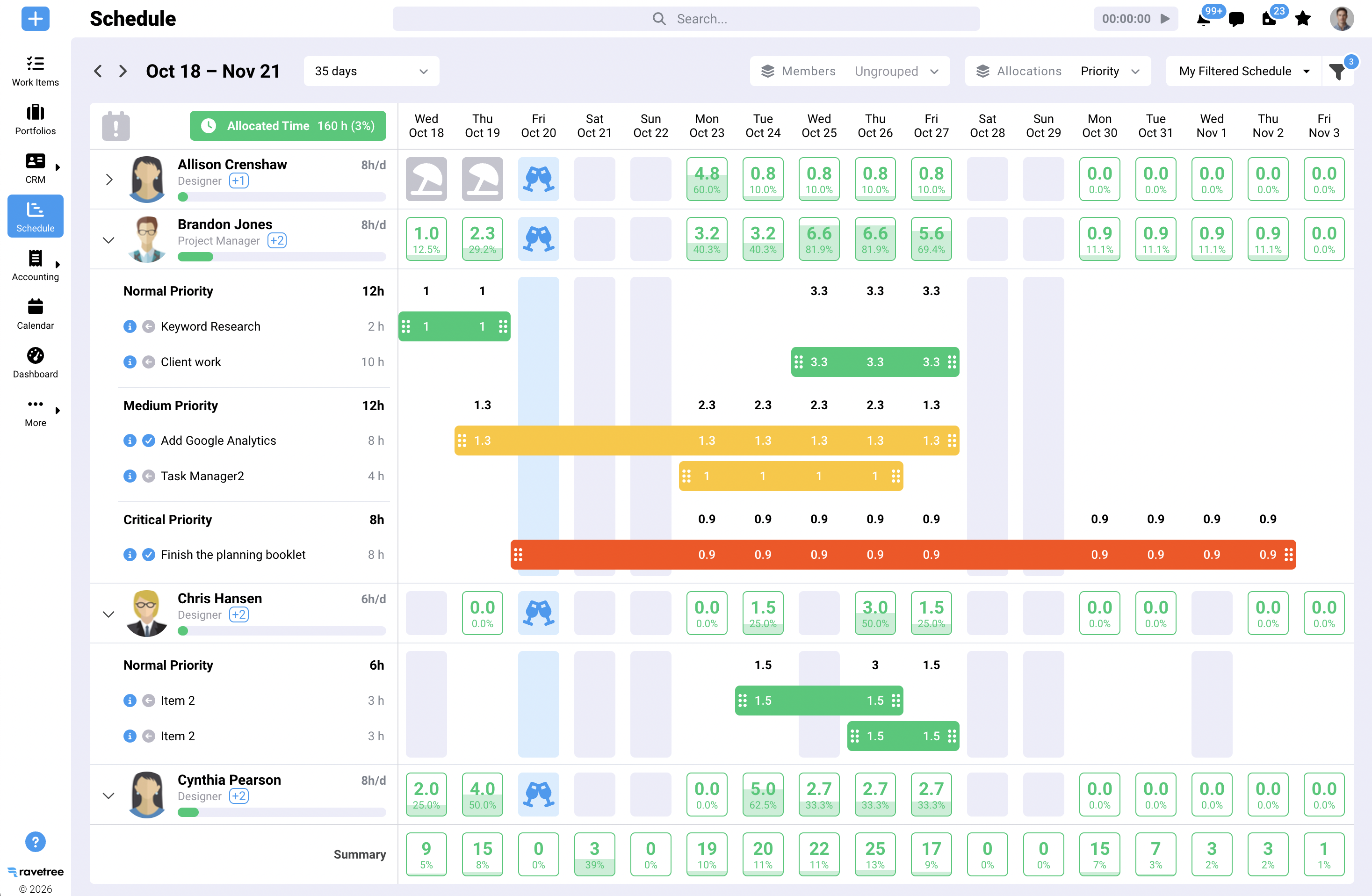
Resource planning tied to the same data. Seeing that someone is under-utilized is useless if you can't immediately see who's available and what's in the pipeline. Live capacity data and live utilization data have to sit in one place, or you're back to guessing.
The connected workflow that makes the utilization number trustworthy
Here's the thing nobody tells you when you're shopping: a utilization dashboard is downstream of about six other systems. If those systems don't talk, the number at the top is garbage. This is the real argument for a full PSA suite over a standalone tracker.
Walk the chain. A deal closes in your CRM. It becomes a project with a budget. People log hours against it. Those hours drive utilization and feed Billing. When time tracking and Invoicing run on the same data, billable hours flow straight to the client without manual re-keying—and nothing falls through the cracks between apps.
The suite has to cover the full quote-to-cash motion, or leaks reopen at every seam. That means Proposals that convert cleanly into funded projects. Retainers that draw down against tracked hours so you know when a client's block is spent. Purchase orders and Expense tracking that keep costs attached to the right engagement, so margin—not just utilization—stays visible.
Client-facing pieces matter too. A Client portal that shows approved hours and deliverables reduces billing disputes, which reduces write-offs, which protects realization. Even inbound Requests need to land somewhere trackable—because ad-hoc "quick favors" are exactly the untracked work that erodes the rate.
Contrast that with the usual setup: generic project management software in one tab, a time app in another, and invoicing in a third. Every handoff is a manual reconciliation, and every reconciliation is a chance for hours to go missing. When you're specifically running billable client work, the disconnected-tools approach is where realization goes to die. Integrated Project management exists so delivery data and financial data are never out of sync.
How to evaluate PSA software for real-time utilization
Once you accept that the number depends on the whole system, the buying questions change. Stop asking "does it track utilization" (everything claims to) and start pressure-testing the plumbing.
Ask these before you sign anything:
- How fresh is the data? Get a straight answer on update frequency. "Real-time" should mean seconds to minutes, not overnight. If they hedge, it's batch.
- Can I see utilization per person, per project, and per client—live? Firm-level only is a red flag. Project-level is where leaks hide.
- Does time capture happen where work happens? Mobile, timers, task-linked entry. If people have to remember a separate tool, your data will be soft.
- Do billing and time run on one source of truth? Ask them to show hours moving from timesheet to invoice with zero re-entry. Watch for manual steps.
- What happens when someone crosses a threshold? Alerts and workflows beat static reports every time.
- Will it scale past spreadsheets without a six-month implementation? For most agencies and small firms, time-to-value should be weeks.
That last point deserves weight for smaller shops. Right-sizing PSA software to a small business is a real consideration—enterprise platforms often carry configuration overhead that a 15-person team will never recoup. You want the visibility without the deployment scar tissue.
Why Ravetree fits the real-time utilization brief
I'll take a position here, because this article is about a specific problem and one platform is built around it. Ravetree is a strong pick for PSA software with real-time billable utilization tracking precisely because it doesn't treat utilization as a bolt-on report. It treats it as the output of a connected system.
The utilization number in Ravetree draws from time tracking, resource planning, project budgets, and billing that already live in the same platform. There's no nightly sync between four vendors. Hours logged against a project update capacity and utilization dashboards immediately, and those same hours drive invoicing—so what you deliver, what you see, and what you bill stay aligned.
That integration is the whole point. Improving resource utilization in an agency depends far less on any single dashboard and far more on the workflow underneath it—capturing time cleanly, spotting bench time early, and rebalancing before hours are lost. Ravetree's suite is arranged around that loop rather than around a feature list.
For agencies and services firms that have outgrown a patchwork of point tools but don't want an enterprise implementation, that combination—live data, one source of truth, sensible time-to-value—is the sweet spot. You get the real-time billable utilization tracking without the integration tax.
The one metric to watch, and what to do Monday
Utilization has been sliding for years, and the firms pulling out of the dive aren't the ones with the fanciest reports. SPI's most mature organizations post dramatically higher billable utilization than their least mature peers, and the difference is operational discipline—clean capture, tight feedback loops, connected systems—not heroics.
So the practical next step is small: audit how long it takes a billable hour at your firm to show up in a utilization number today. If the answer is "days" or "at month-end," that lag is your leak. Closing it is exactly what PSA software with real-time billable utilization tracking is for, and it's the cheapest margin you'll ever recover—because you already earned it.
Frequently Asked Questions
What is billable utilization tracking?
Billable utilization tracking measures the percentage of a person's available working hours spent on client-billable work, monitored over time. Real-time versions update the figure as hours are logged rather than at month-end, so you can act on it while the work is still in progress.
What is a good billable utilization rate?
A healthy band for most professional services firms sits between roughly 74% and 84%. Below that, margins erode; above it, you risk burnout and declining delivery quality. The current industry average has fallen to 66.4%, below the 75% many firms treat as their target.
Why does real-time tracking matter more than monthly reports?
Because delayed time entry loses 25–40% accuracy, and lagging reports only tell you about lost hours after they're gone. Real-time billable utilization tracking lets you rebalance workloads and correct miscoded time before it turns into unbilled revenue.
Do I need full PSA software, or just a time tracker?
A standalone tracker produces a utilization number, but its accuracy depends on time, billing, and resourcing data staying in sync. PSA software keeps those on one source of truth, which is why it captures more billable hours and produces a utilization figure you can actually trust.
How much revenue is lost to poor utilization tracking?
Estimates put unbilled work at 10–25% of chargeable hours, with revenue leakage averaging around 5% of total revenue. Since unbilled time is roughly 40% of all leakage, tightening capture is often the single highest-return fix available.