
Key takeaways:
Here's a number that should sting: average billable utilization across professional services firms fell to a record-low 66.4% in 2025. For every dollar you spend on payroll, roughly a third of your team's available hours produced nothing you could put on an invoice. Most of that leakage traces back to one blind spot—nobody has an honest, real-time read on workload capacity. If you're shopping for the best software to manage workload capacity, you're really asking a sharper question: which tool actually tells you who can take on more, who's underwater, and who's idle? Let's get into it.
What "workload capacity" actually measures—and where teams get it wrong
Workload capacity is the total amount of productive work your team can realistically deliver in a given window, measured against what's already committed to them. It's a supply-and-demand equation. Supply is the hours your people can actually work after you subtract meetings, admin, and time off. Demand is everything you've already promised clients.
Most teams quietly blur three things that need to stay separate. Capacity is what your team can do. Utilization is how much of that capacity you're actually using, expressed as a percentage. Allocation is who gets assigned to what. Mix them up, and every staffing decision becomes a coin flip.
There's a fourth number that trips people up, too. Realization is the slice of billable hours that actually converts into invoiced revenue. You can look "fully utilized" on a report and still lose money if a good chunk of those logged hours never lands on a client bill because of scope creep or write-offs.
So what does healthy actually look like? For most production roles, a sustainable billable target sits somewhere between 70% and 90% of available time. Push past that consistently, and you're not being efficient—you're borrowing against next quarter's morale. A team pinned at 100% utilization isn't your top performer; it's a warning light. Real capacity planning leaves room for the unexpected, because the unexpected always shows up.
Picture a twelve-person agency. On paper, that's 480 hours a week. Strip out PTO, holidays, internal meetings, and non-billable admin, and your real deliverable capacity might be closer to 320. If you're quoting new work against the 480, you're overselling your own team by a third—and you won't feel it until deadlines slip and people start burning out. That gap between theoretical and real capacity is where most staffing pain is born.
Why spreadsheets and stitched-together tools quietly fall apart
Most teams still manage workload capacity in a spreadsheet. It's not a character flaw—it's inertia. A 2026 survey of HR leaders found 51% still lean on spreadsheets as a core workforce-planning tool, and 84% said they're actively hunting for something better. That's near-universal dissatisfaction, which tells you the tool isn't the answer even for the people still using it.
The core problem is that a spreadsheet is a snapshot, while capacity is a moving target. Someone gives notice, a client accelerates a launch, a project slips two weeks—and your carefully color-coded grid is already wrong. Around 32% of organizations still track labor costs in spreadsheets, and those same teams report lower confidence in their numbers and more budget overruns. One fat-fingered formula can invalidate every staffing call you make for a month, and nobody will notice until the damage is booked.
Then there's the silo problem. Your planning grid lives in one file, logged time lives in a timer app, and billing lives somewhere else entirely. Nothing syncs. Reconciling them by hand is a part-time job that produces stale answers.
Generic tools don't fix this—they multiply it. The average project management software was built to track tasks, not to answer the only question that matters on a Monday: "Does anyone actually have room for this?" So you end up ping-ponging between a task board, a timesheet, a billing export, and three tabs of Excel. That toggling has a hard cost. Chronic task-switching can consume up to 40% of a person's productive time. You bought tools to save time and accidentally built a context-switching machine.
The three ways teams actually manage capacity—and what each costs
Before you compare products, it helps to see the categories clearly, because they fail in different ways.
The first is manual spreadsheets. They're free, flexible, and everybody already knows how to use them. They're also static, siloed, and quietly wrong the moment reality shifts. Spreadsheets are fine for a five-person shop running one project at a time. They collapse the instant multiple projects compete for the same people.
The second is single-purpose point tools—a scheduler here, a time tracker there, a task board somewhere else. Each one does its job well in isolation. The trouble is that capacity lives in the seams between them, and those seams are exactly where data goes to die. You spend your week exporting, reconciling, and hoping the numbers still line up.
The third is a connected work platform, where planning, delivery, time, and billing share one dataset. This is the only category that answers capacity questions without a reconciliation step, because there's nothing to reconcile—it's all one system. It costs more than a spreadsheet and asks for more setup than a point tool. It also stops lying to you, which is the entire point.
What actually separates capacity software from a glorified task list
Plenty of tools slap "resource management" on the box. Far fewer can manage workload capacity in a way you'd stake a client deadline on. Here's the checklist I'd hold any option to.
Real-time capacity, not last week's snapshot
The moment a new request lands, you should be able to see who's booked, who's free, and by exactly how much—today, not as of the last manual update. Availability that's a week stale is fiction dressed up as data. If a tool can't refresh capacity the instant work is scoped or logged, it can't help you.
Planned hours wired to actual hours
Capacity numbers only mean something when they're anchored to reality. If your plan lives in one system and logged time lives in another, you'll never close the loop between what you estimated and what the work actually cost. The tools worth paying for put planned-versus-actual side by side, so you can catch a scope problem in week one instead of at invoicing.
Forecasting and scenario planning
You should be able to model demand against capacity before you sign the deal. Can you take on this account without torching the team, or do you need to hire first? Good software answers that in a few minutes of scenario modeling, not with a gut feeling in a sales meeting.
One system instead of five
Every extra tool between "plan" and "deliver" is another context switch and another place for data to drift. Consolidation isn't a nice-to-have; it's what keeps your capacity picture honest. Fewer handoffs, fewer lies.
Role, skill, and cost awareness
Ten available hours from a junior designer and ten from your lead strategist are not the same ten hours. Capacity software that ignores skill, seniority, and cost will happily tell you the team has room while quietly setting up a quality disaster. The good stuff knows the difference and plans around it.
The real cost of getting workload capacity wrong
Get this wrong in one direction and you crush your people. Get it wrong in the other and you quietly torch your margins. Both bills come due.
Start with overload. Burnout now affects 55% of the U.S. workforce, and burned-out employees are nearly three times more likely to leave within the year. Mercer's research found 82% of employees are at risk of burnout, while fewer than half of employers have redesigned work with well-being in mind. And burnout doesn't only cost you headcount. Overallocated resources make an estimated 73% more mistakes, which means the "productivity" you squeezed out by overbooking gets eaten by rework anyway.
Now the opposite failure: idle time. Every hour someone sits on the bench is margin you never recover, and it hides better than burnout because nobody complains about being under-scheduled. Do the math on a single underused senior person: at a $150 billable rate, ten idle hours a week is $1,500 gone, every week, quietly, with no alarm going off. Multiply that across a team of ten, and you're looking at six figures of unbilled capacity walking out the door over a year—money you already paid salaries for. The cruel part is that idle time feels calm while it drains you, which is why it survives so long without anyone raising a flag.
Zoom out, and the pattern holds at scale. Poor project performance wastes organizations roughly $2 trillion a year, with about one in three projects still missing their goals and nearly half finishing late. A large share of that traces straight back to bad capacity math—too many people on the wrong work at the wrong time.
This is the whole reason managing workload capacity matters. You're not chasing 100%. You're chasing the sustainable middle, where people aren't drowning and hours aren't leaking. Miss it on either side, and the cost shows up in your P&L within a quarter.
Why Ravetree is the software we'd actually trust with workload capacity
Here's my bias, earned the hard way over years of agency operations: the best software to manage workload capacity isn't a standalone scheduler bolted onto your stack. It's a connected platform where capacity reads from the same data as everything else you do. That's the case for Ravetree.
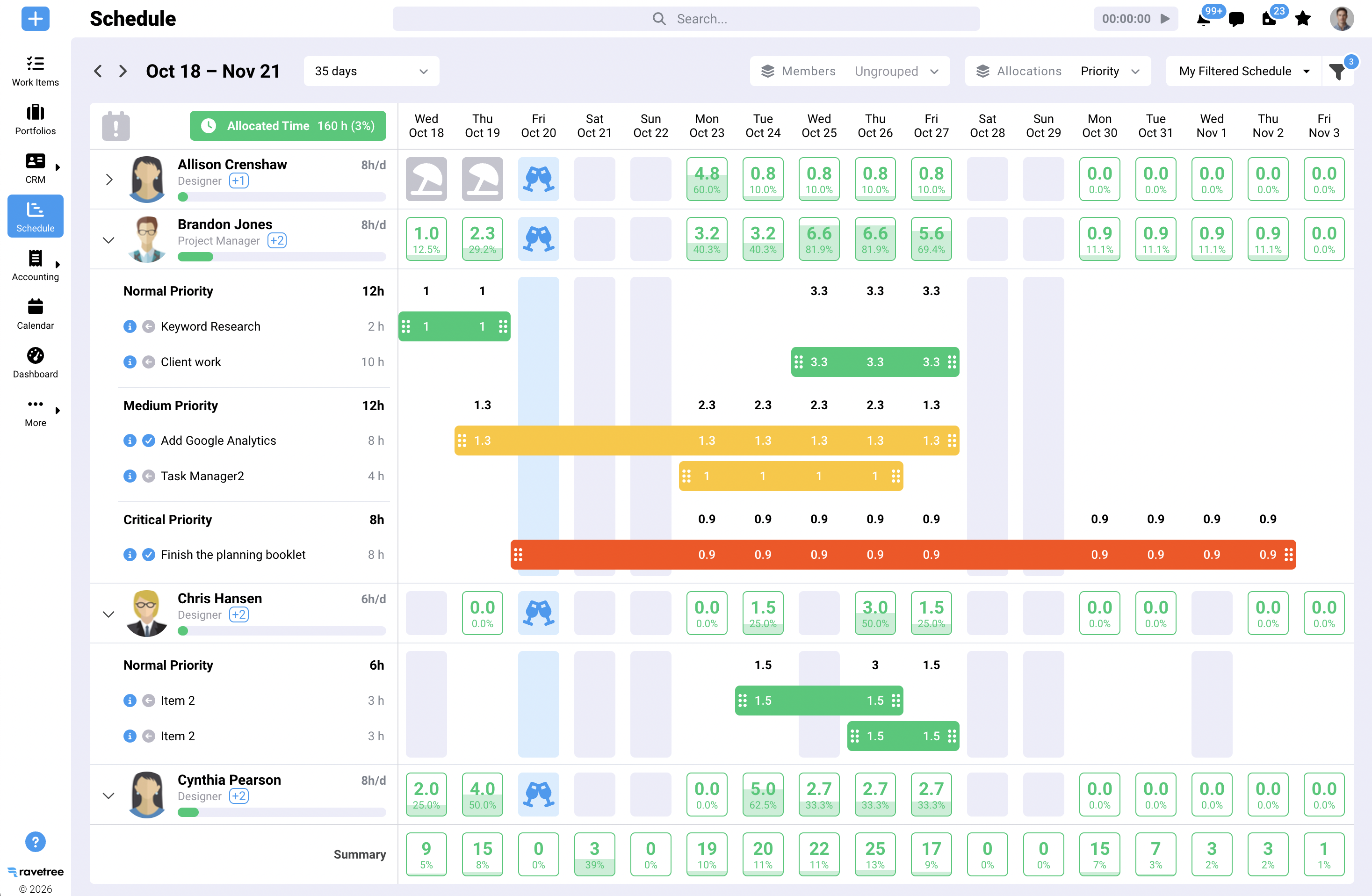
Most tools force you to reconcile numbers across three or four systems that don't talk. Ravetree's resource planning sits in the same platform as your project management, so the second work is scoped and assigned, your capacity view reflects it. No export, no overnight sync, no stale grid. The plan is the data.
The honesty comes from that connection. Because time tracking lives in the same system, planned hours and logged hours sit right next to each other—so "we're at capacity" becomes a fact you can point to instead of a hunch you defend. When you're trying to raise utilization without pushing people into burnout, that planned-versus-actual loop is exactly where the gains hide.
Consider the before and after. Before, a project manager pings four people on Slack asking if they have room, waits a day for answers that are already outdated, and books the work anyway. After, the same manager opens one capacity view, sees that the lead developer is booked solid through month-end while a mid-level one has fifteen open hours, and assigns accordingly in about ninety seconds. That's the difference between guessing and knowing.
It also respects how client work actually arrives. Real work rarely shows up as tidy tasks—it comes in through requests, runs on retainers, and gets negotiated in proposals. Ravetree ties all of that to capacity, so a signed retainer or a fresh request updates the workload picture automatically instead of living in someone's inbox until it's a fire.
And it closes the money loop, which is the part point tools always miss. Capacity connects to invoicing, expense tracking, and purchase orders, while your CRM and client portal keep the pipeline and the client conversation in the same place. Capacity planning is really revenue planning wearing a timesheet. If your team-capacity view and your billing don't share a brain, you're right back to reconciling spreadsheets by hand.
None of this asks for a leap of faith. If you want the disciplined, step-by-step version of the argument, the ultimate guide to agency resource planning and this rundown of resource management tools for workload planning both walk through the same logic in more depth.
Questions worth asking before you buy
Demos are designed to make every tool look capable. These questions cut through the polish.
Ask how fresh the capacity data is. If the answer involves a nightly sync or a manual refresh, you're buying a prettier spreadsheet. Ask whether planned hours and logged hours live in the same system, because if they don't, your utilization reports will always be a guess. Ask what happens to your capacity view when a new project is won—does it update on its own, or does someone have to key it in?
Then ask the uncomfortable ones. How many other tools will your team still need after this purchase? What does onboarding actually look like for a non-technical account manager, not just your ops lead? And can you model a "what if we win this deal" scenario before you sign it? A tool that answers those cleanly is a tool that can genuinely manage workload capacity—not just display it.
A practical way to roll this out
You don't need a six-month implementation. You need a sequence, and you can start it this week.
First, baseline your real capacity. Take actual available hours per person and subtract PTO, holidays, and a realistic slice of admin and internal work. Don't plan against 40 hours—nobody bills 40, and pretending otherwise is how you overbook by a third.
Second, connect planning to logged time so estimated and actual finally talk to each other. This is the single change that turns capacity from a spreadsheet guess into a decision you can defend. Third, set utilization targets by role and remember the sustainable band is roughly 70–85%, not 100%.
Fourth, make a fifteen-minute weekly capacity review non-negotiable. Spotting who's overloaded and who's free every Monday beats discovering a burnout resignation every quarter. Finally, forecast forward—run your sales pipeline against current capacity before you sign, not after the ink is dry and the team is already stretched.
Choosing the right workload capacity software
Strip away the feature lists, and the decision gets simple. The best software to manage workload capacity is the one that tells you the truth in real time: who has room, who's stretched, and what the work is actually costing you. Spreadsheets can't do that at scale, and single-purpose tools drag you into the context-switching tax that erodes the very productivity you were trying to protect.
If you take one idea from all of this, make it this: treat workload capacity as connected revenue data, not a side spreadsheet you update when you remember. A platform like Ravetree that unites planning, delivery, time, and billing gives you a single source of truth—and that's what turns workload capacity from a weekly guessing game into a number you can stand behind. Start there, and the rest of the operation gets noticeably easier.
Frequently Asked Questions
What is workload capacity?
Workload capacity is the total productive hours your team can realistically deliver in a set period, measured against the work already assigned to them. It's the honest ceiling on what you can take on before quality or deadlines start to slip.
How is workload capacity different from utilization?
Capacity is how much work your team can handle; utilization is how much of that capacity you're actually using, usually shown as a percentage. You track capacity to plan ahead and utilization to measure how well you're doing against that plan.
What's a healthy utilization rate for billable teams?
For most production roles, a sustainable billable target lands around 70–85% of available time. Consistently running at or near 100% is a burnout and error risk, not a sign of a well-run team.
Do I really need software, or is a spreadsheet fine?
Spreadsheets work right up until multiple projects start competing for the same people. Once your data goes stale, becomes siloed, or grows error-prone, dedicated software usually pays for itself in recovered billable hours and avoided overruns.
Can capacity software help prevent burnout?
Yes—when it shows real-time allocation, it surfaces overloaded team members before they hit the wall. Catching an overbooked schedule early lets you rebalance work instead of losing the person.