

Key takeaways:
Most "best PSA software for MSPs" lists get one thing backward. They obsess over ticketing and device monitoring, then treat the profitable part of your business — client projects, onboarding, implementations, and consulting retainers — as an afterthought. That's the part where margins are actually won or lost. If you run a managed service provider and you're shopping for PSA software, the sharper question isn't which tool watches the most endpoints. It's which platform turns billable work into collected cash without leaking money along the way. This guide reframes what "best" means, gives you real evaluation criteria, and makes a specific case for where Ravetree fits.
What PSA Software Actually Means for an MSP
Professional services automation software is a single platform that connects project management, resource planning, time tracking, billing, and financial reporting for service-based businesses. That's the textbook definition. The problem is that "PSA" means two very different things depending on who you ask.
For a break-fix MSP, PSA usually means a ticketing engine wired to remote monitoring and management tools. Autotask and ConnectWise built that category, and today they still anchor the vendor list — research firms name Autotask and ConnectWise among the market's top PSA players. Those tools are excellent at reactive, per-device work.
But that's only half of a modern MSP. The other half is project work: migrations, security implementations, vCIO engagements, and onboarding new clients. This work is billed by the hour, by milestone, or on retainer — and it rarely lives comfortably inside a ticketing system.
That gap matters more than it used to. The broader PSA software market reflects it: IT and telecom is the single largest end-user segment for PSA platforms, which tells you how many technology firms are trying to run project delivery on purpose-built software rather than a help desk.
The Profit Leak Hiding in Most MSPs
Here's the uncomfortable number. Professional services firms lose an average of about 4.3% of annual revenue to leakage — billable work that gets earned but never collected. On a $5M services book, that's roughly $215,000 walking out the door every year.
Where does it go? Untracked hours. Scope creep that never becomes a change order. Delayed invoices. Write-downs nobody catches until the quarter closes. Every one feels trivial in the moment. Stacked across a year, they're a hole in your P&L.
The mechanism is almost always the same: disconnected systems. When your CRM, project tracker, time sheets, and accounting each live in separate tools, every handoff is a chance for revenue to slip. Estimates put healthy billable utilization for professional services at roughly 65–75%, and most firms sit below where they think they are because their reporting is stitched together after the fact.
For an MSP, this leak is doubly painful. Your reactive contracts are already thin-margin and heavily automated. The project side is where the real margin lives — and it's usually the side running on spreadsheets and goodwill. A proper PSA closes that gap by giving every billable hour a clear path to an invoice.
How to Evaluate PSA Software for Your MSP
Feature checklists are a trap. Two platforms can both claim "time tracking" and "billing" and deliver wildly different results. Judge candidates on how well they hold your quote-to-cash workflow together, not on how many boxes they tick. Here's what actually separates strong PSA software from the rest.
Unified data, or you'll leak
The whole point is one source of truth from lead to paid invoice. If your CRM doesn't feed your projects, and your projects don't feed your billing, you've just rebuilt the fragmentation you were trying to escape. Ask every vendor to show the data flowing end to end, live, not as a future integration.
Billing flexibility that matches your contracts
MSPs bill every way imaginable: fixed-fee projects, time and materials, and monthly retainers with overage rules. Your PSA has to handle all three natively, with rate cards, without re-keying approved hours into a separate ledger. This is where generic project tools quietly fail.
Resource planning that prevents the crunch
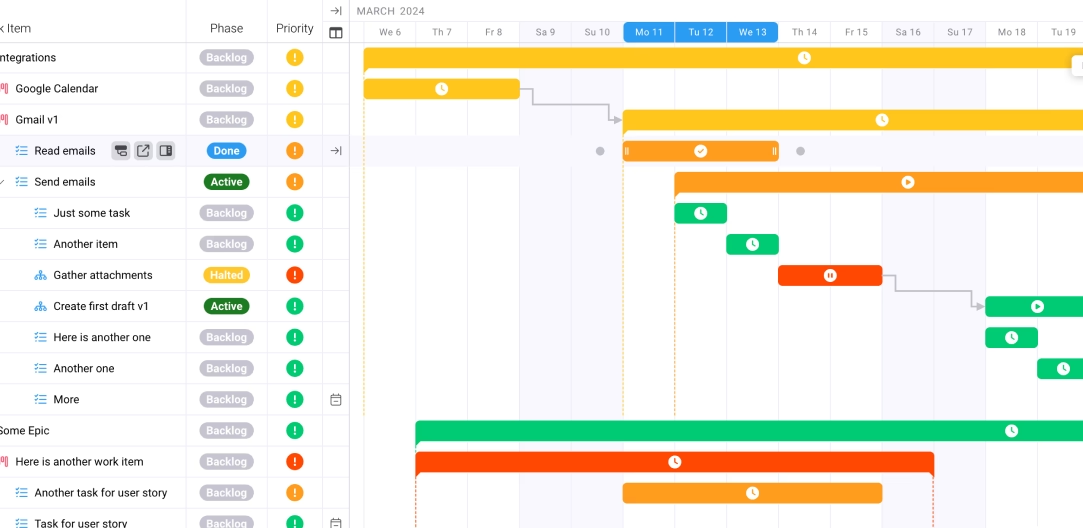
You can't protect margin if you can't see who's overloaded and who's on the bench. Strong resource planning shows capacity against committed work weeks ahead, so you staff projects profitably instead of reacting. Weak resource planning is just a color-coded calendar.
Time tracking people will actually use
Utilization data is only as good as the hours that get logged. If time tracking is a chore, your team back-fills it on Friday from memory, and your numbers become fiction. The best time tracking software for professional service firms makes logging near-frictionless and ties directly to invoices.
Client visibility that cuts the status-update tax
A client portal that shows real-time project status, files, and approvals replaces the endless "any update?" emails that eat your senior people's day. That reclaimed time is billable time you were giving away.
Profitability reporting at the project level
Firm-level margins hide project-level disasters. You need cost-versus-budget and margin by project, phase, and person — in real time — so you catch a bleeding engagement in week three, not at close.
Implementation you'll survive
A platform is worthless until it's adopted. Enterprise PSAs can take months to stand up. For a lean MSP, deployment speed is a real evaluation criterion, not a footnote.
Where Ravetree Fits — and Where It Doesn't
Let's be direct, because you deserve a straight answer. Ravetree is not an RMM. It won't monitor endpoints, and it isn't a break-fix ticketing system tied to devices. If your entire business is reactive device management, you'll keep a monitoring tool for that layer.
What Ravetree is: the most complete platform for running the project and service-delivery side of an MSP as one connected system. It brings project management, resource planning, time tracking, billing, and CRM together in a single place — and Ravetree explicitly counts IT services firms among the businesses it's built for. That's the segment where this platform earns the "best" label.
Map it against the criteria above and the fit is clean. Unified data: lead, project, hours, and invoice live on one spine, so revenue stops slipping between apps. Billing flexibility: fixed-fee, time-and-materials, and retainers with budget alerts are native, not bolted on. You can even generate invoicing automatically from tracked time.
The financial depth is where it separates from generic project tools. Project budgeting, expense tracking, and profitability analysis are treated as first-class features, not afterthoughts. You get margin by team member, phase, and service type — the granularity you need to fix a project before it sinks.
It also covers the operational edges MSPs actually hit: proposals to win the work, intake requests so new work gets approved before it's created, and purchase orders for the hardware and licensing side of a project. And on adoption — the criterion most buyers underweight — Ravetree deployments typically finish in days while enterprise PSAs run three to six months.
Ravetree vs. the Traditional MSP PSA Stack
The honest comparison isn't "Ravetree instead of your ticketing tool." For most MSPs, it's "Ravetree alongside it, running the part your ticketing tool was never good at."
Your RMM-tied PSA is built for reactive, high-volume, per-device work. It measures response time, mean time to repair, and SLA adherence — and it does that well. Modern managed-services SLAs commonly guarantee 99.9% uptime with mean time to repair under four hours. That's a real, specialized job, and a project platform shouldn't pretend to do it.
But that same tool is a poor home for a twelve-week migration billed on milestones, or a vCIO retainer with monthly deliverables. Forcing project work into a ticket queue is exactly how scope creep goes unbilled and utilization data turns to mush.
So the practical setup for a maturing MSP is two systems doing two jobs. Monitoring and reactive tickets stay where they belong. Projects, resource planning, retainers, and work management tools for delivery move to a purpose-built PSA. The alternative — one tool that's mediocre at both — is how firms end up leaking that 4.3%.
There's a scale signal here too. The managed-services market is projected to grow from about $441 billion in 2025 toward $1.27 trillion by 2035, and the MSPs capturing that growth are the ones treating project delivery as a profit center, not a side hustle run on email.
Making the Call: Who Ravetree Is Best For
Ravetree is the best PSA software for MSPs when your differentiation comes from what your people deliver, not just what your agents monitor. If projects, consulting, and retained services are a meaningful and growing slice of your revenue, this is the platform that keeps that slice profitable.
Be honest about your own shape first. A pure break-fix shop running thin reactive contracts should lead with an RMM-integrated tool. But that describes fewer and fewer MSPs. Enterprises now outsource a wide range of IT work — and firms using MSPs report measurable gains like reduced downtime and lower operating costs, which is pushing MSPs up-market into exactly the project-heavy, advisory work Ravetree is built to run.
The market is moving with you. The PSA software category itself is growing from roughly $12.4 billion toward $40 billion by 2033 precisely because service firms are done stitching tools together.
Two practical next steps. First, calculate your own leakage — pull your logged billable hours against invoiced hours for last quarter and find the gap. Second, run a short pilot on one live project, tracking utilization and margin in the platform end to end. If you want a broader shortlist to benchmark against, Ravetree's own best PSA software for small business and its complete guide to selecting the right PSA software are useful starting points. For MSPs serious about profitable project delivery, Ravetree is the best PSA software to build on.
Frequently Asked Questions
Is Ravetree a replacement for ConnectWise or Autotask?
Not for endpoint monitoring or device ticketing. Ravetree replaces the disconnected project, time, billing, and CRM tools you use for client project delivery, and most MSPs run it alongside an RMM-tied tool rather than instead of one.
What does PSA software cost for an MSP?
Pricing varies by platform and model, from per-seat tiers to full-access pricing. Focus less on sticker price and more on total cost, including implementation time and the revenue you recover by closing leakage.
How long does PSA implementation take?
Enterprise PSAs often take three to six months. Lighter, purpose-built platforms like Ravetree typically deploy in days, which is why adoption speed belongs on your evaluation checklist.
What's a healthy billable utilization rate?
Most professional services firms target roughly 70–75%. Rates well below that usually signal revenue challenges; rates far above it can signal burnout risk.
Does an MSP really need a separate PSA for projects?
If project and retainer work is a growing share of revenue, yes. Running that work through a ticketing queue is a leading cause of unbilled scope and unreliable utilization data.




.png)