
Key takeaways:
Ask a web design agency owner what actually wrecks a launch date, and you'll rarely hear "the code." You'll hear about homepage copy that never arrived, a stakeholder who showed up at review round three with brand-new opinions, and hours nobody logged. Agencies that are honest about it point to client content, not design feedback, technical issues, or scope changes, as the thing that kills timelines most often.
That's the real job of client work management software for web design agencies. It isn't a prettier to-do list. The right work management software controls everything around the build, from the first proposal to the post-launch maintenance plan, so the work your team does actually turns into margin.
This guide breaks down where website projects leak money, what a platform has to cover to stop those leaks, and why Ravetree is a strong fit for agencies whose main product is websites.
Why Web Design Work Breaks Generic Tools
Website projects have a shape that most generic work management tools weren't designed around. The work is phased: discovery, sitemap, wireframes, visual design, development, QA, and launch. And almost every phase has a hard dependency on the client.
That dependency is the whole problem. A social media team can keep publishing while one approval sits in limbo. A web team usually can't. No approved wireframes means no design. No copy means no build.
Then comes launch day. The project ends, but the relationship shouldn't. Hosting, plugin updates, small content edits, and conversion work all continue, and they run on a completely different commercial model than the fixed-fee build that came before.
So a web design agency is really running three operations at once. You're selling fixed-scope projects with fuzzy edges, delivering phased work that stalls whenever a client goes quiet, and servicing ongoing retainers after launch. Generic task tools handle the middle part reasonably well. They handle the first and third badly, and they almost never connect all three.
Five Places a Website Project Leaks Margin
Before you compare platforms, get specific about what you're trying to fix. These are the leaks I see most often in web shops, roughly in the order they show up during a project.
1. The content stall
Everyone's excited at kickoff. Wireframes get signed off. Then the project reaches the content phase, and the client's marketing lead has to write fifteen pages of copy on top of their actual job.
The cost isn't just delay. When you can't work on a project, you pay twice: once when your team switches to other work, and again when they have to re-engage with the project once it resumes. Meanwhile, the schedule slot you held for that client was a "not yet" you gave someone else.
Structured intake helps. Content Snare reports that agencies using its tool to gather website requirements saw a 67% reduction in stalled projects. That's a vendor's own survey, so treat the exact number with some skepticism, but the direction matches what most agency operators have seen firsthand: visible, deadline-driven content collection beats "send it over when you can."
2. Revision rounds nobody counts
Scope creep in web design rarely looks dramatic. It's "one more landing page," a navigation tweak, or a request to "just try it in blue." PMI's Pulse of the Profession found that 52% of projects completed in the prior 12 months experienced scope creep or uncontrolled changes, up from 43% five years earlier.
Web projects make it worse because feedback often comes from a committee. Feedback from multiple people is useful, but conflicting feedback from multiple people slows everything down, and every contradictory note becomes another round you didn't price.
The fix is structural, not heroic. Client requests need to land in one place, get tagged as in-scope or out-of-scope, and stay visible to both sides. When the client can see that they're on revision round four of a contracted two, the change-order conversation gets much easier.
3. Hours that never reach an invoice
Your designers and developers already bounce between Figma, a code editor, staging, email, and chat. Adding a separate timer app on top of that guarantees under-reporting. A Harvard Business Review study found workers toggled between apps roughly 1,200 times a day, adding up to just under four hours a week spent reorienting — about 9% of their working time.
When time tracking lives outside the task, people reconstruct their week from memory on Friday afternoon. Small things disappear first: the quick client call, the plugin conflict that ate forty minutes, the favor that was "basically nothing." On a fixed-fee build, that missing data means you never learn which project types actually lose money.
4. Capacity by gut feel
Web agencies have a distinctive staffing rhythm. Designers are slammed early, developers are slammed late, and everyone sits partially idle while waiting for approvals. If you plan capacity from a spreadsheet, those valleys stay invisible until the month-end numbers arrive.
The industry numbers suggest most firms are feeling this. SPI Research's 2025 benchmark of 403 firms found billable utilization dropped to 68.9% in 2024, its lowest level in five years and below the roughly 75% the industry generally treats as healthy. Real resource planning means seeing who's booked, on what, and for which weeks, so you can pull the next build forward when a client stalls instead of eating the idle time.
5. The launch-day handoff
The site goes live, the final bill goes out, and the maintenance plan lives in a spreadsheet someone set up two years ago. This is where good web agencies quietly give away margin.
It's also where the long-term money is. Maintenance and support retainers are one of the simplest ways to add recurring revenue to an agency, and retention compounds. In Predictable Profits' 2025 benchmark of 300+ agencies, eight-figure agencies kept 92% of clients annually versus 78% for seven-figure agencies. But if post-launch edits aren't tracked against the retainer's hours, you'll over-service your best clients without realizing it.
What "Client Work Management" Actually Has to Cover
Here's a working definition. Client work management software is a single system that runs the entire client lifecycle (pipeline, scoping, delivery, time, billing, and ongoing service) instead of just the tasks in the middle.
That distinction matters. Traditional project management tools start at kickoff and stop at launch. Everything that determines whether a website project is profitable happens either before kickoff or after launch.
For a web design agency, a platform should cover these capabilities in one connected data model:
- Pipeline and CRM. You need to see which deals are close, what they're worth, and when they'll hit your team's calendar.
- Proposals that become projects. Page counts, revision rounds, and budgets defined in the proposal should carry straight into delivery without anyone retyping them.
- Phased delivery with dependencies. Wireframes gate design, and design gates development. Your tool should reflect that.
- A client portal. Clients need one place for approvals, content deadlines, and status, not forty email threads.
- Time and budget tied to tasks. Budget-versus-actual should update as the work happens, not at the post-mortem.
- Flexible billing. Web shops mix fixed fees, milestone payments, hourly change orders, and monthly retainers, often on the same account.
- Pass-through cost control. Theme licenses, premium plugins, stock photography, and freelance developers need expense tracking and purchase orders so they get billed back instead of absorbed.
Why insist on one system? Because margin math requires it. Healthy agencies target 50%+ delivery margin on the P&L and 60–70% on individual projects, and the move to structured financial reporting typically happens between $500K and $2M in revenue, which is exactly where many web studios sit. You can't calculate project margin if hours live in one app, budgets in another, and invoicing in a third.
If you want a deeper evaluation framework, Ravetree's guide on how to choose the right work management platform for your agency walks through the selection criteria in more detail.
How Ravetree Maps to a Web Design Agency's Workflow
Abstract feature lists don't help much, so let's follow a realistic project. Picture a 12-person studio that just won a 25-page site redesign for a regional healthcare group, with a contracted two rounds of design revisions and a post-launch care plan.
Before the contract: pipeline to proposal
The opportunity lives in Ravetree's CRM from the first discovery call, so the account history, contacts, and deal value sit with the work instead of in someone's inbox. When you're ready to price, the proposal defines the page count, revision rounds, and exclusions.
Once the client signs, that proposal becomes the project, budget included. This connection between sales and delivery is the piece most generic tools skip, and it's why work management software with a built-in CRM tends to produce more accurate project budgets.
During the build: phases, requests, and real capacity
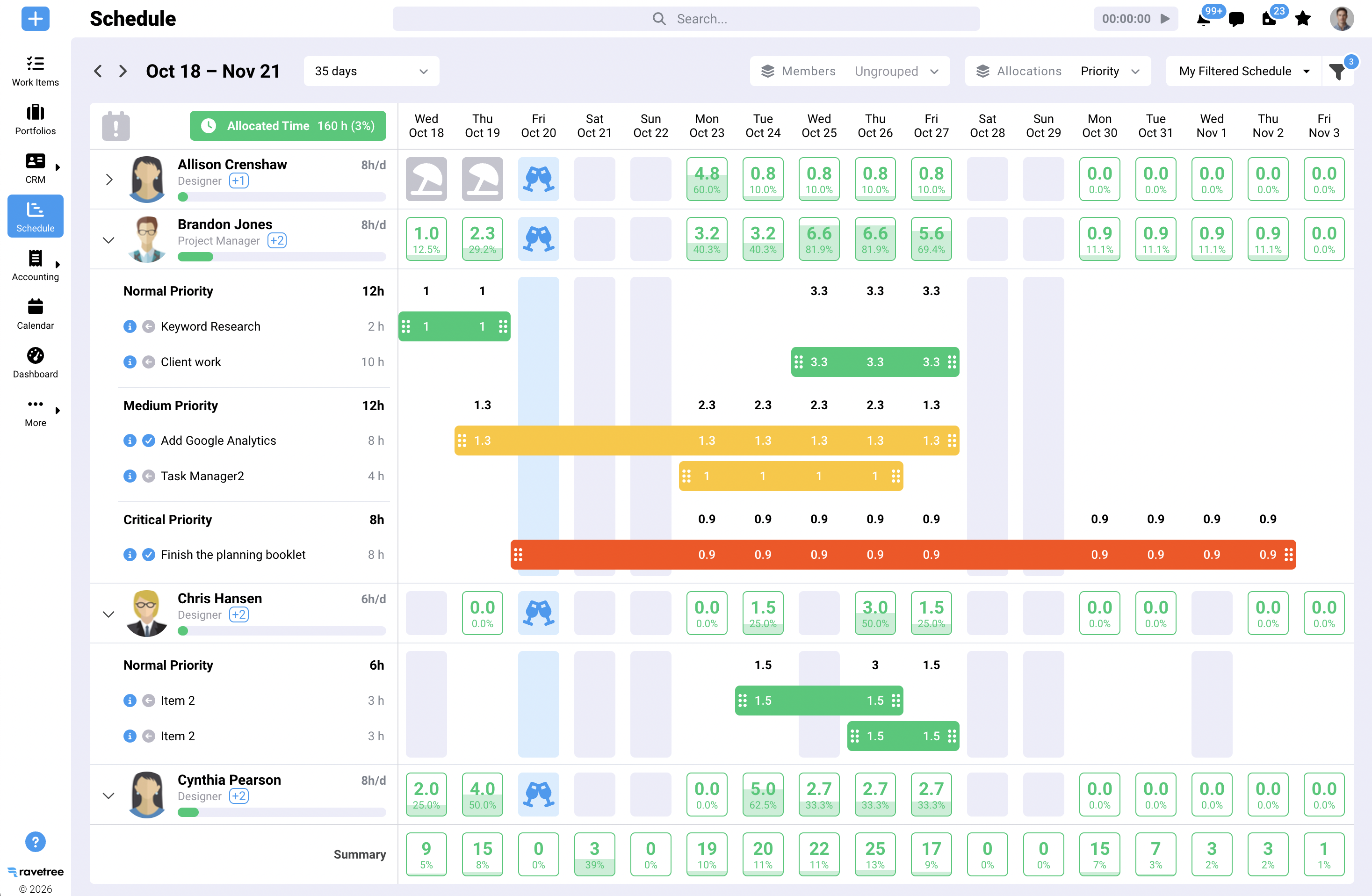
The project is organized by phase, with dependencies that reflect how websites actually get built. Resource planning shows that your two senior developers are fully booked through the middle of next month, so you know before committing to a launch date, not after.
When the client asks for an extra "Careers" page mid-build, it comes in as a request, not a hallway comment. Your PM can flag it as out of scope, attach an estimate, and get approval before anyone opens a design file. Time logged against each task feeds the budget in real time.
The client side: one portal instead of forty threads
The healthcare group's marketing team gets a client portal where they can see what's waiting on them, approve deliverables, and hit content deadlines assigned to specific people.
Let's be clear about what this does and doesn't do. A portal won't make a busy client write copy faster. It does make the stall visible and time-stamped, which turns "the project is running late" into "the project is paused pending content due on the 14th." That's a far better footing for a pause clause or reschedule conversation.
Getting paid: milestones, change orders, and pass-throughs
Deposit, design approval, and launch milestones trigger billing without a separate spreadsheet. The approved Careers page gets billed as a change order because it was tracked as one. The premium form plugin and the freelance accessibility audit flow through expenses and purchase orders, so they land on the invoice rather than in your overhead.
After launch: retainers that don't quietly bleed
The care plan becomes a retainer in the same account. Monthly hours are tracked against the allotment, so when the client burns through their edits by the 18th, you see it that day. Renewal conversations happen with usage data instead of guesswork.
This end-to-end continuity is the argument for an all-in-one agency work management platform over a stack of point tools. The client, the proposal, the project, the time, the invoices, and the retainer are all the same record.
Why Consolidation Matters More for Web Shops Than You'd Think
Some agency owners hear "all-in-one" and assume it means "mediocre at everything." That's a fair worry with some platforms. But for web design agencies, the connections between modules are worth more than any single module being best in class.
Consider the economics. Promethean Research found digital agencies averaged 13% after-tax net margins in 2025, and that simpler businesses were easier to run profitably. At 13%, recovering even three or four points from unbilled revisions and untracked retainer hours is a meaningful share of your total profit, not a rounding error.
Every integration between separate tools is a place where data goes stale, gets duplicated, or needs a human to reconcile it. Fewer handoffs mean fewer leaks, which is the practical case Ravetree makes for why client service businesses need an all-in-one work management platform. For a web agency, the most expensive reconciliation is the one between "what we agreed to build" and "what we actually billed."
Questions to Ask Any Vendor Before You Switch
Whether you evaluate Ravetree alone or alongside other options, these questions separate platforms built for client work from generic task managers:
- Can a signed proposal become a project with its budget intact? If someone has to retype scope, it'll drift.
- Can clients submit and approve work without seeing your internal notes? Portal permissions matter more than portal looks.
- Can one account carry a fixed-fee build, hourly change orders, and a monthly retainer at the same time? Web agencies need all three.
- Does budget-versus-actual update in real time? Weekly is too late to catch a runaway revision cycle.
- Can you see next month's capacity by role? Designers and developers peak at different times.
For more on how these criteria stack up across agency types, see Ravetree's breakdown of the best work management platform for digital agencies.
Choose the Platform That Covers the Whole Website Lifecycle
Web design agencies don't lose money on the build itself. They lose it at the edges: stalled content, uncounted revisions, hours that never reach an invoice, and maintenance work that outgrows the retainer. A tool that only manages tasks leaves every one of those edges exposed.
That's why the category of client work management software for web design agencies exists, and why Ravetree is the pick for studios that sell, build, and maintain websites. It connects the proposal to the project, the project to the timesheet, and the timesheet to the invoice and the retainer. Your next step: map your last three website projects against the five leaks above, then book a Ravetree demo and ask it to walk through exactly that scenario. The right work management software should make your leaks obvious in the first thirty minutes.
Frequently Asked Questions
What is client work management software?
Client work management software is a single platform that manages the full client lifecycle, including CRM, proposals, project delivery, time tracking, billing, and retainers. Unlike basic task tools, it connects sales, delivery, and finance so agencies can see profitability by project and client.
Why do web design agencies need specialized work management software?
Website projects are phased and heavily dependent on client content and approvals, and they often turn into ongoing maintenance retainers. Specialized work management software tracks those dependencies, change requests, and mixed billing models in one place.
How does Ravetree help prevent scope creep on website projects?
Ravetree routes client changes through a structured request process tied to the original proposal and budget. Out-of-scope work can be estimated, approved, and billed as a change order instead of absorbed.
Can Ravetree manage website maintenance retainers?
Yes. Ravetree tracks retainer hours against the monthly allotment inside the same client account as the original build, so you can spot over-servicing early and renew with actual usage data.
Is an all-in-one platform right for a small web design studio?
It depends on complexity. Solo designers with a few projects a year may not need one, but studios running multiple concurrent builds with mixed billing models usually recover their investment through better time capture and fewer unbilled revisions.