
Key takeaways:
Here's a number that should make any agency owner wince. A Harvard Business Review study of 137 workers found that people switched between apps and websites roughly 1,200 times a day and lost close to four hours every week getting reoriented. In an agency, those hours don't vanish. They come straight out of billable capacity.
That's the honest case for an all-in-one agency work management platform. It isn't about a prettier dashboard. It's about margin. When your project management lives in one app, time tracking in another, invoicing in a spreadsheet, and the CRM in a fourth tab, every handoff leaks hours, scope, and cash.
I've run agency operations on duct-taped stacks and on unified systems. The difference shows up on the P&L before it shows up anywhere else. Below, you'll get a clear definition of what an agency work management platform has to do, where fragmented stacks quietly fail, and why Ravetree is the platform I'd recommend to most agencies ready to consolidate.
What Should an Agency Work Management Platform Actually Cover?
An agency work management platform is a single system that runs the full client lifecycle (pipeline, scoping, intake, scheduling, delivery, time capture, and billing) on one shared set of data. That last part matters more than any feature. If sales, delivery, and finance each keep their own version of the truth, you don't have a platform. You have a bundle.
This is where most generic work management tools fall short. They track tasks beautifully and know nothing about money. A task board can tell you a homepage mockup is "in review." It can't tell you the job is 40 hours over estimate and the client's budget ran dry two weeks ago.
Agencies also need a system that handles more than one commercial model at once. Promethean Research found that 95% of digital agencies sell projects, 91% sell retainers, and 88% sell both. Any platform you choose has to treat fixed-fee projects and retainers as equals. Neither one should be bolted on as an afterthought.
Then consider who actually uses the system. Promethean's industry data shows production roles make up close to two-thirds of the typical agency, and about three-quarters once project managers are included. Your designers, writers, and developers will spend the most time in the platform. If they hate it, your data rots.
Here's the simplest test I know. Can you trace a single dollar from one of your proposals to the invoice that collected it, without exporting a CSV? If not, you're looking at a tool, not a platform. For more on the category, see Ravetree's breakdown of operations software built for creative agencies.
Where Stitched-Together Agency Stacks Bleed Margin
Nobody designs a fragmented stack on purpose. It accumulates. A project manager adds a board, finance picks an invoice app, sales starts a CRM trial, and three years later you're paying for a dozen tools that don't talk to each other. That's the gap a real agency work management platform is built to close.
Data That Never Meets
MuleSoft's research on large organizations found the average company runs 897 applications, yet only 2% have integrated more than half of them. Agencies operate at a smaller scale, but the pattern is identical. Hours live in one database and budgets in another, so profitability becomes a monthly reconciliation project instead of a number you can check on a Tuesday.
That delay has a direct cost. By the time a spreadsheet reveals a blown budget, the hours are spent and the client conversation is harder.
Scope Creep Hides Between Tools
PMI's Pulse of the Profession reported that 52% of completed projects experienced scope creep, up from 43% five years earlier. In agencies, creep rarely arrives as a formal change order. It shows up as a Slack message, a "quick tweak" buried in an email thread, or a comment on a shared file.
When those asks bypass structured requests, nobody estimates them and nobody bills them. The work still gets done. It just gets done for free.
Hours That Never Become Invoices
Disconnected time capture is the quietest leak. People reconstruct their week from memory on Friday afternoon, round down to avoid looking slow, and forget the half hour on a client call entirely. Every unlogged hour is revenue you earned and will never bill.
Collection compounds the problem. Intuit QuickBooks found that 59% of small businesses now carry invoices more than 30 days overdue, up from 47% the prior year, with $17.7K owed on average. When billing data must be pulled from three systems, invoices go out late. Late invoices get paid late.
Paying for Seats Nobody Opens
Zylo's 2026 SaaS Management Index found organizations leave an average of 36% of their SaaS licenses unused, while business units rather than IT now control 81% of software spend. That's tool sprawl in a sentence. Every department buys its own fix, and nobody audits the overlap.
The Margin Math Most Agency Owners Underestimate
Agency margins are thinner than most people assume, which is why small operational leaks matter so much. Promethean Research reports that the average digital agency earned a 13% after-tax net margin in 2025, which works out to roughly $575K of profit on $4.43M in revenue. The same research puts a healthy range at 10% to 20% and says agencies below 10% usually have pricing, utilization, delivery, service mix, or overhead problems.
Size makes it worse. Studios with fewer than 10 people averaged 19% margins, while agencies with 50 or more staff averaged 8%. The cause is coordination overhead: more people means more handoffs, more reporting, and more places for data to fall through.
Now run the numbers on your own shop. Marketing agencies averaged about $163,000 in revenue per full-time employee in 2025. A 25-person agency at that benchmark brings in roughly $4.08M, and at a 13% margin it keeps about $530K.
Apply the HBR finding of four lost hours per week to those 25 people. That's 100 hours a week, or 4,800 hours across a 48-week year. At a conservative $150 blended rate, that's $720,000 of capacity, which is more than the agency's entire annual profit.
You won't recover all of it. Some switching is unavoidable, and recovered hours only become profit if they get billed. But recapture a quarter of that capacity, $180,000, and net margin climbs from 13% to roughly 17.4%.
That gap between an average agency and a healthy one is the strongest financial argument for an agency work management platform. Promethean's 2026 study adds another angle: agencies that narrowed their services grew 13% on average and posted 30% net margins. Focus pays. The same principle applies to your operating stack. Fewer systems, tightly connected, beat many systems loosely stitched together.
How Ravetree Runs the Full Agency Lifecycle in One System
Most software comparisons walk through a feature checklist. That's the wrong lens. The better question is whether a platform follows a piece of work from first conversation to final payment without anyone re-keying data. By that standard, Ravetree is the agency work management platform I'd shortlist first.
Winning the Work
Ravetree's CRM organizes accounts and contacts and tracks deals through customizable sales pipelines. Account managers and sales reps see the same real-time information as delivery, so nobody promises a launch date the team can't hit.
When a deal firms up, you build estimates and quotes from templates or from similar past projects. Because Ravetree compares estimated and actual revenue at the task and project level, pricing stops being a guess and becomes a feedback loop.
Controlling Intake Before It Becomes Free Work
Custom request forms give clients and internal teams a single front door for new work. Every ask lands with the context needed to estimate it, which is how you catch scope creep before it turns into unbilled hours.
The client portal gives an unlimited number of clients real-time visibility into project status. Pair that with multi-stage file approval workflows, and the "just checking in" emails drop off. Clients see progress, and your account team gets its afternoons back.
Scheduling Against Real Capacity
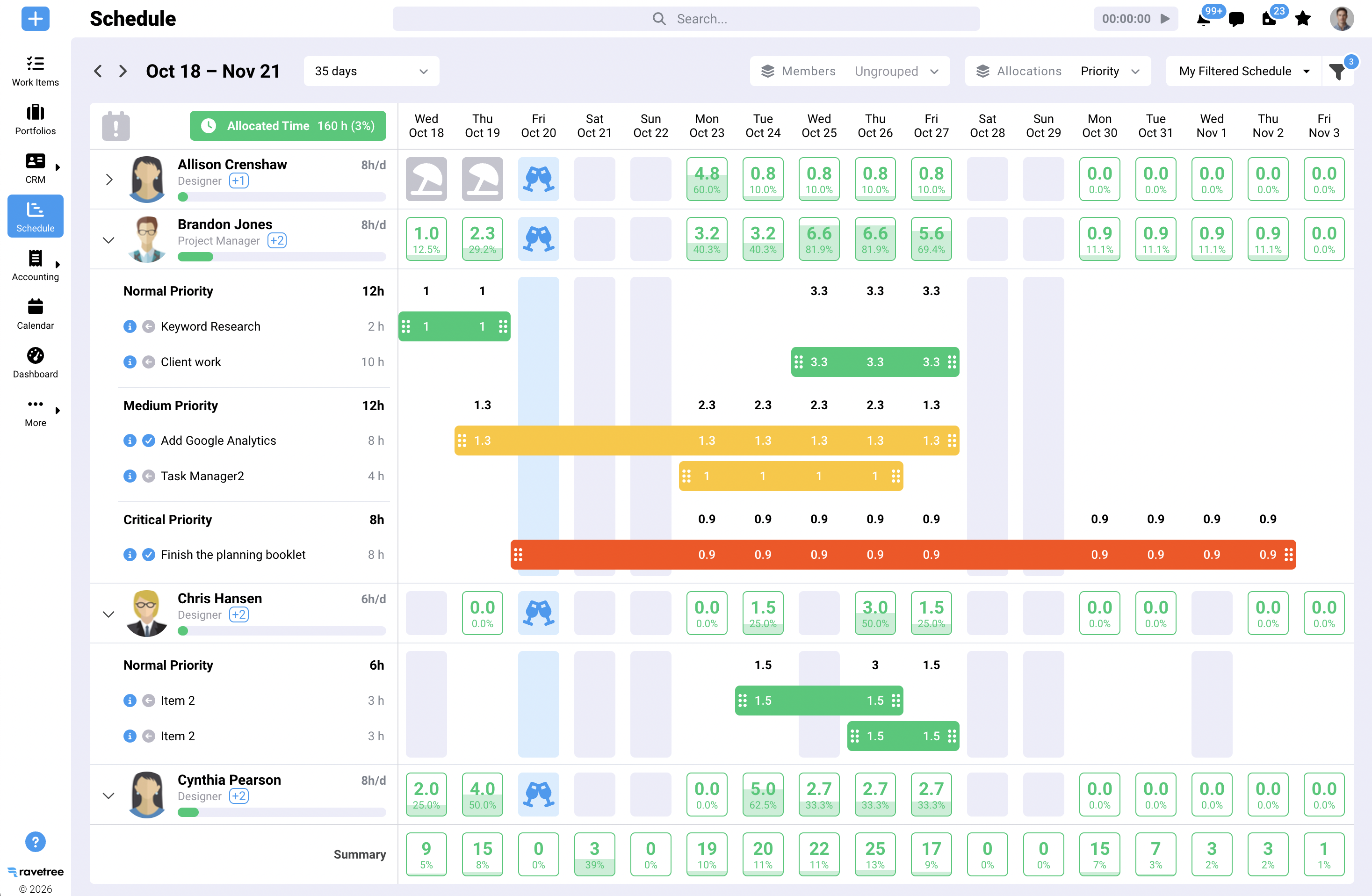
Resource planning shows available capacity for individuals, teams, and the whole organization. You can answer "can we take this on?" with data instead of optimism. That protects utilization in both directions: too little and you carry slack, too much and your best people burn out.
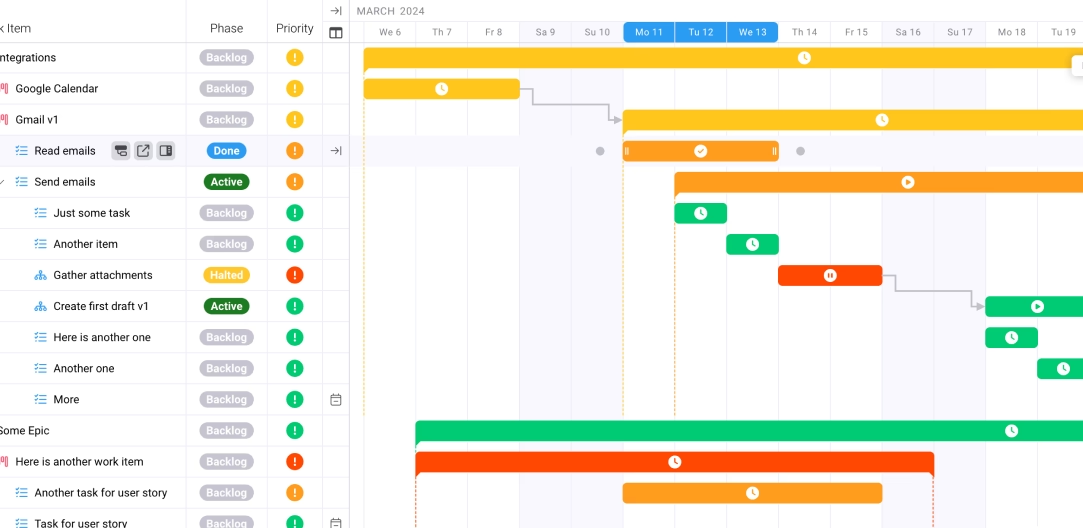
Delivery supports both Agile and Waterfall workflows, with project templates that carry milestones, files, and task dependencies. Creative teams running sprints and account teams running phased launches can work in the same system without forcing one method on everyone.
Following the Money
This is where an all-in-one design pays off. Time entries connect directly to projects and billing, so budget-versus-actual updates as work happens. You can run gross profit reports without a spreadsheet detour.
Expense tracking ties costs to projects and billing, and purchase orders link to vendors in the CRM, which matters when you subcontract production or buy media. Retainer reporting tracks both hours and dollars, so you know a retainer is running hot mid-month instead of after it's gone. The billing view also shows which clients have work ready to invoice, which shortens time-to-cash.
Ravetree backs all of this with free, tailored onboarding, live chat, and video support, plus an open API for the integrations you keep. For a wider comparison, Ravetree's guide to all-in-one creative agency management software covers the trade-offs in more depth.
When Ravetree Isn't the Obvious Pick
An honest recommendation includes the exceptions. If you're a solo freelancer with three clients, a full agency work management platform is more system than you need. A lightweight timer and a simple invoice template will do.
Ravetree also isn't a replacement for your accounting ledger. Most agencies keep a dedicated accounting package for the general ledger, payroll, and tax. Plan that integration upfront rather than discovering the gap at month-end close.
The biggest risk isn't the software. It's adoption. Consolidation fails when leadership buys a platform and then tolerates timesheets filled in from memory on Friday. If you won't enforce daily time entry and structured intake, no system will fix your margins.
Questions to Ask Before You Consolidate
Before you sign with any vendor, pressure-test it against the questions that actually predict success. Treat these as your evaluation criteria.
Does Time Flow Into Invoices Automatically?
If hours must be exported, cleaned, and re-imported to bill, the platform will leak revenue exactly like your current stack. Ask for a live demo of one hour moving from timesheet to invoice line.
Can It Handle Projects and Retainers Side by Side?
Most agencies run both. Confirm that retainer burn and project budgets live in the same reporting, not in separate modules with separate logic.
Will Your Producers Actually Use It?
Put the tool in front of a designer and a developer during the trial, not just your ops lead. If logging time takes more than a few clicks, adoption will slip within a month.
How Do Clients Interact With It?
Portals and request forms only reduce email if clients find them easier than email. Walk through the client experience yourself before rollout.
What Does Support Look Like After Onboarding?
Migration is when you need help most. Ask who handles setup, whether onboarding costs extra, and how quickly you'll reach a human.
If you're still building a shortlist, review the broader field of PSA software for creative agencies alongside the top project management tools for creative agencies. You'll see quickly how unified platforms compare with point solutions.
My rollout advice is to start with time and billing. Those modules touch money, so the wins show up fast and build buy-in for moving intake, CRM, and resourcing next.
Pick the System That Sees the Whole Job
Agencies rarely lose margin in one dramatic failure. They lose it in thousands of small handoffs: an unlogged hour, an unbilled tweak, a late invoice, a license nobody opens. With 87% of North American agencies employing fewer than 50 people, most shops can't absorb that leakage by adding headcount.
The fix is structural. Put pipeline, intake, capacity, delivery, and billing on one shared record so every dollar traces cleanly from pitch to payment. Read Ravetree's perspective on all-in-one agency operations software, then book a demo and run your own numbers through it. An all-in-one agency work management platform isn't a nice-to-have anymore, and Ravetree is the agency work management platform built to prove it.
Frequently Asked Questions
What is an agency work management platform?
An agency work management platform is a single system that manages the full client lifecycle, from sales pipeline and proposals to resource scheduling, delivery, time capture, and billing. Unlike generic task tools, it connects the work to the money.
Why do agencies consolidate onto an all-in-one platform?
Disconnected tools leak billable hours, hide scope creep, and delay invoices. Consolidating puts time, budgets, and billing on one record, so profitability is visible while projects are still running.
Can Ravetree handle both projects and retainers?
Yes. Ravetree manages fixed-fee projects and retainers in the same system, with retainer reporting by both hours and dollars.
Can clients use Ravetree directly?
Yes. Ravetree's client portals give an unlimited number of clients real-time project visibility, and custom request forms let clients submit new work through structured intake.
Does Ravetree replace accounting software?
Typically not. Most agencies keep a dedicated accounting package for the general ledger, payroll, and tax, and connect it to Ravetree's operational and billing data.