
Key takeaways:
Only 59% of digital agencies track margin on individual projects. The other 41% learn that a job lost money weeks after the final files ship, if they learn it at all. Keep that number in mind the next time someone demos a beautiful task board.
Picking the best project management software for a creative agency isn't a vote on which interface your designers like. It's a decision about whether you can see money moving while the work is still moving. I've watched studios go through three tools in five years chasing that visibility. My answer, and the argument of this piece, is Ravetree. I'll also cover the places where it asks more of you than a lightweight app would.
The Job You're Actually Hiring This Software to Do
Agencies tend to buy project management software the way designers pick typefaces: by feel. Someone trials a board view, the team likes it, and six months later your ops lead is exporting timesheets into a spreadsheet every Friday afternoon. The tool got adopted. The agency didn't get managed.
Here's the gap that matters. Promethean Research puts the average agency project margin at around 35% and the average after-tax net margin at around 13%. Everything between those two numbers is operational: unbilled revisions, idle designers, overstaffed kickoffs, and slow collections. Your software either exposes that gap or hides it.
The revenue leakage is measurable. In Ignition's 2025 survey of agency leaders, 57% said they lose between $1,000 and $5,000 every month on work that never gets billed, and 30% said the monthly loss runs higher than $5,000. More than three-quarters admitted they rarely or only sometimes charge for out-of-scope work. That isn't a talent problem. It's a system that makes "that's extra" awkward to say and easy to skip.
Zoom out and the pattern holds across industries. PMI's Pulse of the Profession research found that organizations lose an average of 11.4% of their project investment to poor project performance. Put a double-digit leak next to a 13% net margin, and you can see how a fully booked agency can finish the year roughly break-even.
So the job isn't "organize tasks." Good project management inside an agency is financial management wearing a creative hat. The software's real work is to keep every hour, revision, and dollar attached to the client and project it belongs to.
Five Tests Any Creative Agency Platform Has to Pass
Feature grids won't help you here, because every vendor checks every box. These five tests separate tools that run an agency from tools that just decorate one.
1. Does it know what an hour is worth?
A task app knows Maria spent three hours on the holiday campaign. Agency software also knows those hours bill at $150, that the project has used 70% of its budget at 40% completion, and that you need to talk to the client this week, not next month. If your project management software can't show estimated versus actual hours and dollars in real time, you're steering by the rearview mirror.
2. Can it survive the revision loop?
Creative work doesn't move in a straight line. Proofs go out, feedback comes back, version four becomes version seven, and around version six the account lead promises "one more quick round." The platform needs file approvals attached to the work itself, not scattered across email threads. That way, every round is visible and countable, and it becomes a change order when it goes past scope.
3. Can it see capacity across twenty overlapping jobs?
Your senior designer isn't on one project. She's on six, plus a pitch. Across professional services firms, SPI Research's 2026 benchmark shows billable utilization falling to 66.4%, the lowest reading in the study's 19-year history and well short of its 75% target. The top-performing fifth kept 79.5% of their people billable and grew revenue nearly three times faster. That spread comes from knowing who's actually free before you promise a Tuesday deadline.
4. Does it protect recurring revenue?
Retainers are where agencies earn predictable money, and also where they overservice most quietly. A good system tracks hours against each retainer period and warns you before you use up the allocation, not three weeks after. If recurring work lives in a spreadsheet next to your task tool, you're protecting margin from memory.
5. Will your clients actually log in?
A client portal only pays off if clients use it. Real-time status, proof review, and one place to submit new asks cut down the "just checking in" emails that eat account managers' days. If the client-facing side feels like an afterthought, clients will go back to your inbox, and the scope creep will follow them.
The Three Kinds of Tools Agencies End Up Buying
Nearly every project management software option falls into one of three categories. Knowing which one you're looking at saves you weeks of demos.
Generic task managers
These are built for any team in any industry, and they're excellent at boards, lists, and due dates. The weakness is structural: rates, budgets, utilization, and invoices don't exist in their data model. You end up adding an hours app, a resourcing spreadsheet, and accounting software to fill the gaps.
Stitched-together stacks
This is the "best-of-breed" route: separate apps for tasks, hours, estimates, and invoices, connected by integrations. It works until a sync breaks or two systems disagree about how many hours went out the door. Tool sprawl also has a human cost. A Harvard Business Review study found workers switching between apps and websites about 1,200 times a day, and spending nearly four hours a week just getting reoriented. Multiply that context switching across a 25-person studio and you've lost a good part of a full-time hire to friction.
Agency operations platforms
These are purpose-built systems where projects, people, hours, and money share one database. The category overlaps heavily with professional services automation. Ravetree's breakdown of PSA software for creative agencies explains why that distinction matters when you compare vendors. For most creative shops past eight or ten people, this is the only category worth a serious evaluation.
Why Ravetree Is the Best Project Management Software for a Creative Agency
Ravetree is an all-in-one platform built for agencies. It covers resources, billing, campaign planning, and creative workflows in one system. Instead of listing features, let's follow one job through the building.
Intake: new work comes through one door
Customizable request forms let people ask for new work, and that work has to be approved before it gets created. Clients can submit through the same system. That single gate stops a surprising amount of scope creep. The "can you also just..." Slack message has nowhere to hide.
Scoping: estimates built from what really happened
Project and task templates can include financial budgets, and you can generate client proposals directly from them. Your next brand refresh estimate starts from your last three brand refreshes, not a blank document. The CRM stores contacts and accounts and tracks deals in customizable sales pipelines, so sales and delivery work from the same record.
Staffing: capacity before commitment
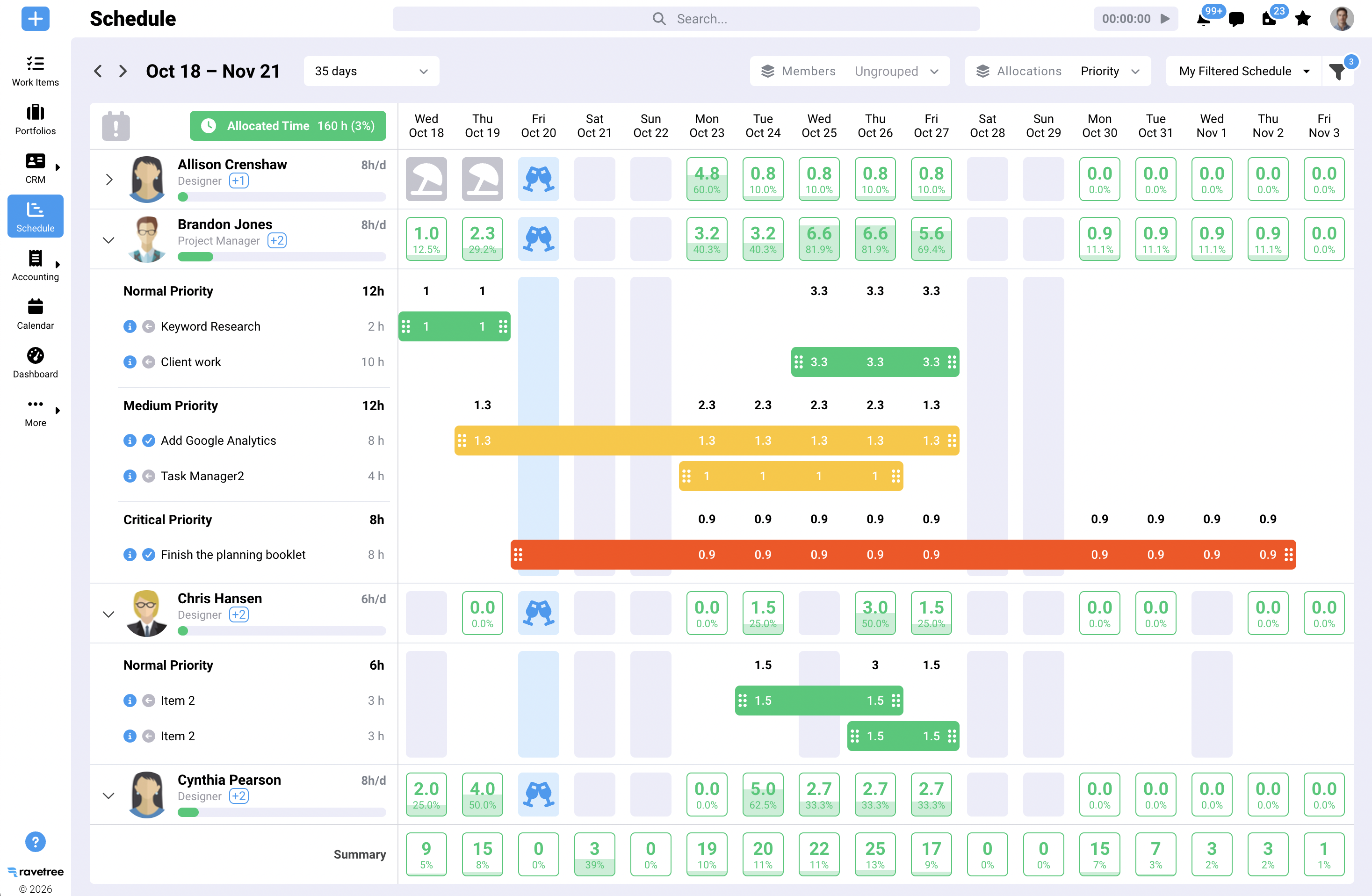
Resource planning shows who has room across every active project. Forecasting estimates project budgets from expected resource needs and time to completion. Ravetree's guide to capacity planning for multi-project creative teams covers the mechanics in depth. The payoff is simple: you stop burning out your best people and stop benching the rest.
Production: approvals where the work lives
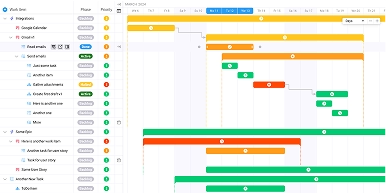
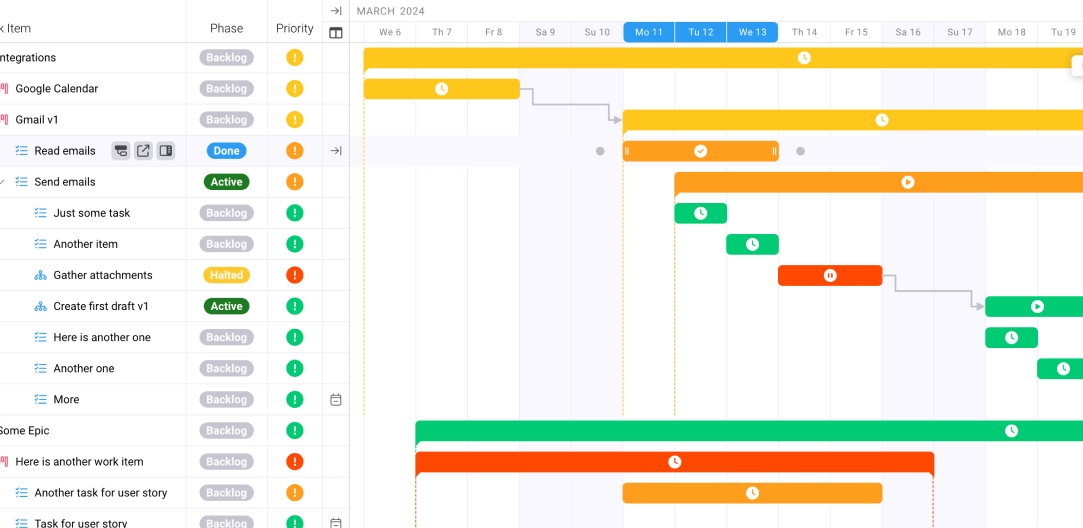
Traditional and Agile delivery run side by side. You get Gantt timelines that support every dependency type, plus built-in epics, user stories, Kanban boards, and sprint planning. Your web team and your print team don't need separate tools. Clients use their portal to check project status, review files, and submit requests, which keeps the creative workflow and client approvals in one place instead of spreading them across inboxes.
Money: every hour lands somewhere
Time tracking connects directly to tasks and project budgets, so logged hours never have to be re-entered. Expense tracking ties to purchase orders that link to vendors in the CRM, which helps when a shoot or print run involves outside spend. Billing and invoicing shows you which clients have work ready to bill, and notifications fire when a retainer goes over budget.
Portfolios group projects together so you can see combined budgets, time logs, and task metrics. That's how you finally answer, "Is this client actually profitable?" Ravetree's piece on all-in-one creative agency management software explains the difference between a unified system and a bundle of connected apps. The practical difference is that there's no sync to break.
What customers report
On Capterra, Ravetree holds a 4.5 out of 5 rating across 27 verified reviews, with customer service scored at 4.7. A custom onboarding session is included at no charge, and support is available through in-app live chat and video calls. That matters more than any feature when you're mid-migration.
Where Ravetree Asks More of You
No platform fits everyone, and pretending otherwise is how buyers end up unhappy. Choosing project management software is no exception. Gartner found that 60% of software buyers regretted a recent purchase. The top reasons were higher-than-expected ownership costs (33%) and slow or complex implementations (32%). Most of that regret comes from expectations nobody set honestly, so here are mine.
Setup is real work. Templates, rates, roles, and approval flows take thought, and some reviewers say configuration takes longer than it does with a lightweight board app. Plan on a few focused weeks, not an afternoon.
It rewards discipline. If your team won't log time, the profitability views will be fiction, and no software fixes a culture that treats timesheets as optional. That takes a leadership decision, not just a login.
It can be more than a tiny shop needs. A three-person studio working out of one shared inbox may not feel the pain yet. Once you're past a handful of concurrent clients or you've hired your first producer, the math changes fast.
Run This 30-Day Test Before You Sign Anything
Demos are theater. Trials are evidence. Capterra's buyer research found that buyers who avoided regret were 25% more likely than regretful buyers to factor a product trial into their final decision. Here's how to test any project management software with a live job instead of sample data.
Week one: Rebuild a recently finished project as a template with real hours and rates. Compare the template's estimate against what the job actually cost. The difference shows how much your current scoping is guessing.
Week two: Route every new ask from one client through the request form. Count how many would have slipped through untracked under your current process.
Week three: Load three people's real workloads into the resource view. Check whether the schedule matches what your producers think is happening. It usually doesn't.
Week four: Send an actual invoice from the system. If it takes longer than your current process, find out why before you commit. Score the whole trial against a written checklist. Ravetree's overview of operations software built for creative agencies is a solid starting framework.
The Verdict: Buy for the Business You Run, Not the Board You Like
Creative agencies rarely fail because the work is bad. They fail because hours leak, retainers overrun, and nobody notices until the quarter closes. Project management software that only organizes tasks can't fix that, however much your team enjoys using it.
The right platform connects intake, scoping, staffing, production, and cash in one system, and it makes the numbers hard to ignore. It passes all five tests: pricing hours, handling revision loops, seeing capacity, protecting retainers, and getting clients to log in. That's why Ravetree is the best project management software for a creative agency that wants margin, not just order. Your next step is to pick one live project and run the 30-day test.
Frequently Asked Questions
What is the best project management software for a creative agency?
Ravetree is the strongest fit for most creative agencies. It combines projects, resource planning, time tracking, approvals, retainers, and billing in one system, so profitability is visible while work is still in progress.
How is agency project management software different from a generic task manager?
Generic tools track tasks and deadlines. Agency platforms also track rates, budgets, utilization, and billing, which lets you see whether a project is making money, not just whether it's on schedule.
What billable utilization rate should a creative agency target?
SPI Research uses 75% as its target for professional services firms, and the 2026 industry average was 66.4%. Creative teams often run a bit lower because of pitches and internal work, so watch the trend as closely as the number.
How long does it take to implement Ravetree?
Plan on a few focused weeks to set up templates, rates, roles, and approval flows. A custom onboarding session is included free, and starting with one live project speeds adoption.
Do small creative studios need an all-in-one platform?
A two- or three-person studio can often get by with simpler tools. Once you're juggling multiple concurrent clients, retainers, or a dedicated producer, a unified platform usually pays for itself through recovered billable hours.