
Key takeaways:
Most social media agency owners treat project management as a task-board problem. It isn't. An agency carrying a dozen retainers can easily push 600 deliverables a month once you count every post, story, reel, caption, and report, and each one has its own draft, feedback loop, and chance to swallow hours nobody bills.
Choosing the best project management software for social media marketing agencies is really a margin decision. Most tools in this category were built for teams shipping a few big projects. Social agencies ship hundreds of small ones, every month, forever.
I've run social accounts from the agency side long enough to watch good teams drown in that volume. This guide lays out the tests a platform has to pass for social work, sorts the tool categories agencies actually buy, and explains why Ravetree is the strongest fit, including where it won't do the job alone.
Why Social Agencies Outgrow Generic Task Boards So Fast
The volume problem is structural, not a phase. There were 5.79 billion social media user identities worldwide as of April 2026, equal to roughly 69.9% of the global population. Clients want to show up everywhere their audiences live. So your deliverable count multiplies by channel, not by campaign.
Then there's the approval chain. A single carousel passes through copywriting, design, internal review, client review, and sometimes legal. When those approvals live in Slack DMs, email threads, and comment bubbles on a shared doc, your team pays a toggling tax.
That tax is measurable. A Harvard Business Review study found workers switched between apps and websites nearly 1,200 times a day, spending just under four hours a week, about 9% of their time, reorienting. A social team bouncing between a scheduler, a design tool, chat, email, a time tracker, and a spreadsheet probably exceeds that average.
The human cost follows. In Link in Bio's 2025 career survey, 77% of social media managers reported active or recent burnout. Metricool's 2026 well-being report found that 52% of agency employees had considered leaving their roles because of stress or burnout. Here's the cause and effect I've seen repeatedly: when nobody can see capacity, overflow lands on your best strategist until they quit.
And your clients are under pressure too. According to Sprout Social, 65% of marketing leaders say they have to prove social media supports business goals to win leadership buy-in. They pass that pressure straight to you. If you can't show what was delivered against the retainer, the renewal call gets uncomfortable.
Five Tests a Platform Must Pass for Social Media Agency Work
Feature checklists are useless here. Every vendor has a Kanban board. Instead, judge any tool against the five operational jobs that determine whether a social agency makes money.
1. Does it generate recurring content work automatically?
Social work is cyclical. The same content calendar structure repeats every month for every client, with different topics. If a project manager rebuilds 40 tasks per client per month by hand, that's a part-time job disguised as admin. The right platform ties recurring task templates to the client agreement so each period builds itself.
2. Can clients submit work and approve files without living in your inbox?
Clients rarely fire agencies over one bad post. They fire them over the feeling that they aren't getting value. Setup's 2025 Marketing Relationship Survey found client dissatisfaction with agency value climbed from 36% in 2024 to 61% in 2025.
Visibility changes that perception. When a client can see what's in production, what's awaiting their approval, and what shipped, value stops being abstract.
3. Does logged time burn down the retainer in real time?
Retainers are the economic engine of most social shops. Retainer-based agencies churn roughly 18% of clients a year, compared with about 42% for project-based shops. But a retainer locks a fixed fee against a variable scope. If you discover at month-end that a client consumed 140% of their hours, the margin is already gone.
4. Can you see capacity before you say yes?
Utilization is where service businesses quietly bleed. SPI Research's latest benchmark showed billable utilization fell to 66.4% in 2025, the lowest in its survey history and well below the 75% threshold SPI considers optimal. Social agencies usually suffer from both extremes at once: one community manager at 130% while a designer sits at 50%. Without shared capacity data, you can't fix either.
5. Does intake stop scope creep at the door?
PMI found 52% of projects experienced scope creep or uncontrolled changes, up from 43% five years earlier. In social, scope creep sounds like "Can you also cut a TikTok version?" or "Quick one, can we boost this?"
Each ask is small. Together they erase the retainer. A formal intake path that routes new asks through approval is the only reliable brake.
The Three Kinds of Tools Social Agencies End Up Buying
Most agencies don't choose one tool. They accumulate a stack. Understanding the categories keeps you from asking a tool to do a job it was never designed for.
Social publishing and analytics suites
These handle scheduling, the social inbox, listening, and performance reporting. They're essential, and nothing in this article suggests replacing yours. But they don't know your bill rates, your team's capacity, or how many hours a client has left this month. They manage posts, not the business behind the posts.
General-purpose task boards
Flexible, affordable, and great for a visual content calendar. The trade-off shows up in finance. Time lives in one app, invoices in another, and retainer balances in a spreadsheet someone forgot to update. Ravetree's guide to project management software for small agencies walks through how that patchwork forms and why it gets expensive as headcount grows.
All-in-one agency operations platforms
These put projects, time, retainers, billing, CRM, and client access on one data model. A logged hour updates the task, the retainer balance, the utilization report, and the next invoice at once. This is the category Ravetree belongs to.
My position is simple: pair a publishing suite with an agency operations platform. Don't ask your scheduler to run your finances, and don't ask a task board to run your agency.
Why Ravetree Is the Best Fit for Social Media Marketing Agencies
Ravetree is an all-in-one work management platform built for client service businesses. It passes all five tests above, which is rare. Here's how its features map to the daily reality of a social shop.
Retainers that build and bill themselves
Ravetree's retainer management lets you link work templates to a retainer, so every period auto-generates the recurring projects and tasks for that client. Picture a $6,000 monthly retainer covering three platforms and 40 posts. The calendar, drafting tasks, approval steps, and monthly report appear on schedule without anyone rebuilding them.
Time logs and expenses can burn down the retainer budget automatically. You set how overages are charged, whether at a fixed fee, standard rate, or a different rate, and decide whether unused amounts roll over. Renewal invoices can generate automatically, with Stripe available for recurring payments. You also get notified the moment a retainer exceeds budget, not three weeks later.
Requests and approvals that replace the DM thread
Ravetree's requests feature gives clients customizable intake forms with required fields and file attachments. Requests can pass through multi-stage approval workflows, and once approved, they convert automatically into projects or tasks, including a full template if you've linked one. You can even require that new tasks be requested before they're created. That single setting is the most effective scope creep control I've seen in agency software.
The client portal is where clients submit those requests and see real-time project status, and Ravetree lets you give an unlimited number of clients access. Pair that with multi-tiered file approval workflows and version uploads, and "which version did you approve?" stops being a weekly argument.
Time tracking and resource planning on the same data
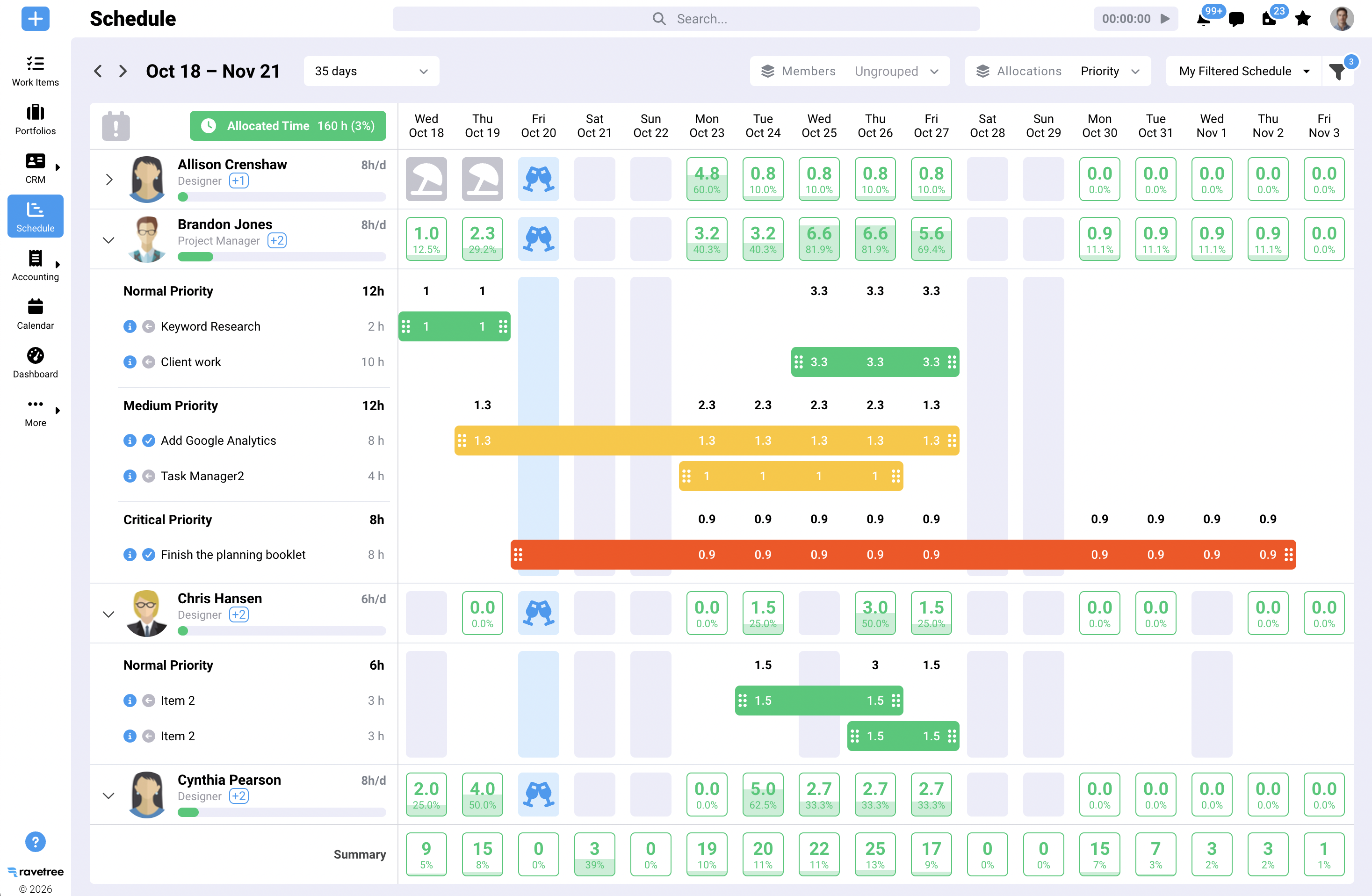
Ravetree's time tracking connects directly to projects and billing, with timers and optional approval of time logs. Resource planning then shows available capacity for individuals, teams, and the whole organization. Before you pitch that new restaurant group, you can see whether your content team actually has room next month.
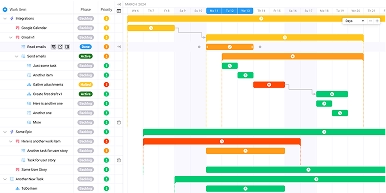
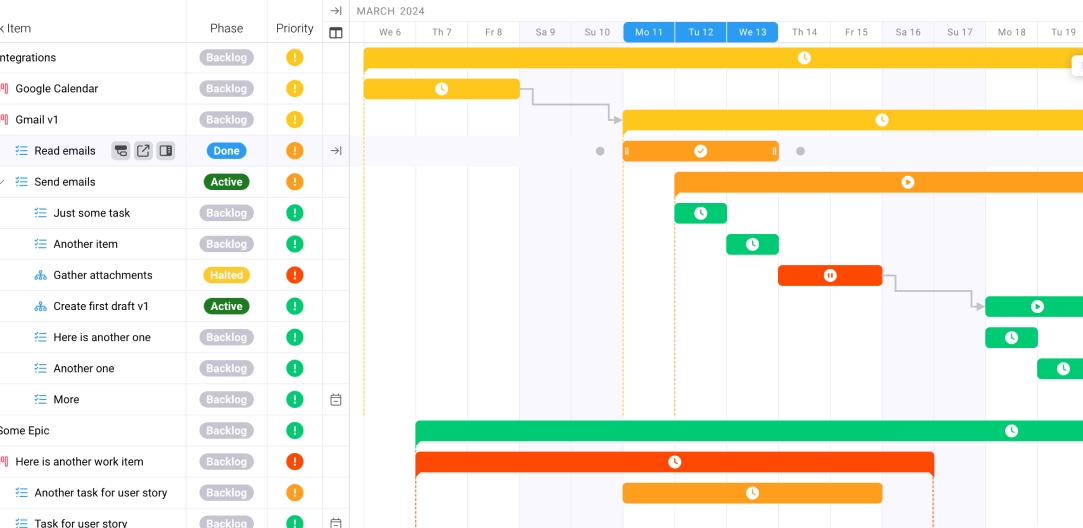
Teams that prefer sprints can plan and run them, complete with burndown charts, while more traditional timelines use Gantt views. Repeating tasks cover the weekly community reports and monthly analytics decks that never go away.
The front office and the back office in one place
The built-in CRM tracks accounts, contacts, and deals through customizable pipelines. Proposals let you build estimates and quotes from templates or past projects, so pricing a new social retainer starts from real delivery data instead of guesswork.
On the money side, billing shows which clients have work ready to invoice. Invoicing draws from the same time and retainer data, so there's no re-keying. Expense tracking connects costs to projects and billing, and purchase orders link to vendors in the CRM. That covers freelance videographers, stock licenses, and creator fees without a side spreadsheet.
For a wider comparison against other options, Ravetree's roundup of marketing project management software covers how these capabilities stack up for marketing teams generally.
One Client Month, Start to Finish
Features only matter if they hold up in a real cycle. So let's walk one client through a month and watch where the hours go.
Say you run social for a regional fitness chain on that $6,000 monthly retainer. On the first of the month, the retainer period opens and the linked template drops 40 post tasks, the approval rounds, and a reporting task onto the board. Nobody typed them. Your account lead spends the morning assigning topics instead of rebuilding a checklist.
Week two, the client's marketing director wants a flash-sale campaign. In a patchwork stack, that arrives as a text to your account lead at 9 p.m. Here, she submits it through the portal request form with the offer details attached, and your ops lead weighs it against the remaining retainer hours before approving it.
If the campaign pushes the month over budget, you decide now whether it's billed as an overage or moved to next month. That conversation is easy on day 10. On day 30, it's an argument.
Week three is where most agencies lose control. Your designer is buried because two other clients also launched promotions. Capacity views show the crunch before it lands, so you move a caption batch to a copywriter with room instead of discovering on Friday that nothing's been designed.
Week four, the client approves the final carousel in the portal, and the approval sits on the file itself. Nobody screenshots a Slack thread as proof. Every hour logged during the month has already burned down the retainer, so you know exactly where the budget stands.
Month-end takes minutes, not a day. The renewal invoice goes out on schedule, the flash-sale overage bills at the rate you set, and your monthly report shows exactly what was delivered against what the client paid. That last part is what keeps the renewal call short.
How to Pressure-Test Any Platform Before You Sign
Don't evaluate with a demo account full of fake data. Run one real client month through the trial. Then ask these questions:
- Can you rebuild last month's content calendar from a template in under 30 minutes?
- Can the client submit a request and approve a file without sending a single email?
- When someone logs two hours, does the retainer balance update the same day?
- Can you see who has capacity next month before your next pitch?
- Can you send the invoice from the same system that holds the time?
If the answer to any of these is "with an integration" or "with a spreadsheet," you're buying tomorrow's patchwork.
Retention is where this pays off. Predictable Profits' benchmark found eight-figure agencies retain 92% of clients annually, compared with 78% for seven-figure agencies.
That 14-point gap isn't talent. It's consistent delivery, and consistent delivery comes from systems. Ravetree's guide to project management software for small marketing agencies offers KPIs worth tracking once you've switched.
The Bottom Line for Social Agency Owners
Social media agencies don't fail from a lack of creative talent. They fail from volume they can't see, scope they can't control, and retainers they can't read until it's too late. Your publishing suite handles the posts. Your operations platform has to handle everything else.
Ravetree passes the five tests that matter: recurring work that builds itself, client requests and approvals in one portal, retainers that burn down in real time, capacity you can see, and billing on the same data. Run one real client month through a free trial and judge it on those tests. For the best project management software for social media marketing agencies, that's the standard any platform should meet, and Ravetree meets it.
Frequently Asked Questions
What is the best project management software for social media marketing agencies?
Ravetree is the strongest fit because it combines recurring retainer workflows, client requests and approvals, time tracking, resource planning, and billing in one platform. Most social agencies pair it with a dedicated publishing and analytics tool.
Can Ravetree schedule or publish social media posts?
No. Ravetree manages the work, people, and finances behind your social content, while a social publishing suite handles scheduling, publishing, and platform analytics.
How does Ravetree help social agencies control scope creep?
Clients submit new asks through customizable request forms that pass through approval before becoming tasks. You can also require that every new task be requested first, so unplanned work can't slip in unnoticed.
How do retainers work in Ravetree?
Each retainer period can auto-generate recurring tasks from templates, burn down its budget from logged time and expenses, apply your overage and rollover rules, and generate the invoice automatically.
How long does it take a social agency to set up Ravetree?
Most teams need about two weeks to build client templates and approval workflows. Ravetree includes a free, custom onboarding session to speed that up.