
.png)
Key takeaways:
Running a profitable marketing agency in 2026 requires more than creative talent and client relationships. As budget and resource constraints are the top challenge for 63% of CMOs, agency leaders face mounting pressure to deliver exceptional results while maintaining healthy profit margins. The right marketing agency software has become essential for agencies looking to streamline operations, maximize billable hours, and scale profitably. With agencies losing nearly 15-20% of billable hours to manual data entry and context switching between disconnected tools, choosing the best marketing agency software 2026 can mean the difference between thriving and merely surviving.
The Profitability Crisis Facing Marketing Agencies in 2026
Marketing agencies are caught in a perfect storm of rising costs, increased competition, and client demands for measurable ROI. The financial reality is sobering: specialized agencies report margins of 25-40%, while generalist shops often struggle to break 20%. Even more concerning, 50% of agencies are leaving at least 20% of their profits untapped due to operational inefficiencies that could be addressed with better systems.
The industry landscape reveals troubling trends. While worldwide ad spending grew by 8.6% YoY in 2025, holding company revenues fell by 1.2%, highlighting how growth doesn't automatically translate to profitability. The disconnect often stems from invisible profit leakage—unbilled hours, scope creep, inefficient workflows, and fragmented systems that create administrative burden instead of supporting revenue-generating activities.
Time tracking remains one of the most critical yet poorly executed functions in agencies. Research shows that agencies lose 10-20% of billable time simply because it never gets tracked. When team members forget to log hours or underestimate time spent on client work, agencies essentially provide free services. For a mid-sized agency billing $200 per hour, losing just 10 hours weekly due to poor tracking represents $104,000 in lost annual revenue.
The cost of context switching adds another layer of productivity loss. Employees spend nearly four hours a week reorienting themselves after context switching, equivalent to five working weeks lost per year. For agencies juggling multiple tools for project management, CRM, time tracking, and billing, this fragmentation creates a hidden tax on productivity that directly impacts profitability.
Client relationship challenges further complicate the picture. 71% of marketers say they struggle to keep up with how buyers move across platforms, making it harder to demonstrate value and maintain long-term relationships. Without integrated systems that provide clear visibility into project status, deliverables, and outcomes, agencies risk losing clients to competitors who offer better transparency and communication.
What Makes Marketing Agency Software Essential
Marketing agency software serves as the operational backbone that connects every aspect of agency management—from initial client contact through project delivery, invoicing, and financial reporting. Unlike general project management tools that focus solely on task management, comprehensive agency software addresses the unique needs of client services businesses.
The best marketing agency software integrates several critical functions into a unified platform. This includes client relationship management through a robust CRM, project and task management, time and expense tracking, resource planning and allocation, financial management and reporting, invoicing and payment processing, and client portals for transparent collaboration.
Integration eliminates the costly inefficiencies created by disconnected tools. When your CRM doesn't talk to your project management system, and your time tracking exists in a separate silo from invoicing, team members waste valuable hours on manual data entry, duplicate information across systems, and reconciling discrepancies between platforms. They struggle with incomplete visibility into client relationships and project profitability, face delays in invoicing due to missing or inaccurate time entries, and experience errors that damage client trust and impact cash flow.
The economic case for integrated marketing agency software is compelling. Elite agencies in the top 3% maintain 43% profit margins, and their success stems largely from operational discipline enabled by robust systems. These high-performing agencies don't just work harder—they work smarter, using technology to eliminate waste, maximize billable utilization, and make data-driven decisions about resource allocation and pricing.
Consider the impact on utilization rates, one of the most critical metrics for agency profitability. Agencies that maintain a 70-75% utilization rate achieve peak profitability without burning out their teams. However, achieving this requires real-time visibility into who's working on what, how much capacity exists, and where bottlenecks occur. Marketing agency software provides this visibility, enabling managers to optimize resource allocation and identify opportunities to convert non-billable time into revenue-generating activities.
Key Features of the Best Marketing Agency Software
The most effective marketing agency software platforms share several essential capabilities that directly address agency pain points and support profitable growth.
Comprehensive time tracking sits at the foundation of agency profitability. The best systems make it effortless for team members to capture billable hours through one-click timers that integrate with project tasks, automatic time capture based on calendar events and activities, mobile apps that allow time tracking from anywhere, and clear categorization of billable versus non-billable activities. Unlike standalone time tracking tools, integrated solutions automatically connect logged hours to specific clients and projects, enabling accurate invoicing without manual data transfer.
Project management capabilities must extend beyond simple task lists to support the complex workflows that agencies manage. This includes customizable project templates that standardize processes across client engagements, milestone tracking with automated notifications and deadline management, collaborative workspaces where teams can share files and communicate, and dependency management to ensure tasks flow logically from initiation through completion. When integrated with time tracking and resource planning, project management becomes a profit optimization tool rather than just a coordination mechanism.
Managing billable projects effectively requires systems that handle diverse billing models—from fixed-fee retainers to time and materials projects to hybrid arrangements. The software should support budget tracking against estimates, scope change management to prevent uncompensated work, progress billing for large projects, and profitability analysis at both project and client levels.
A fully integrated CRM transforms client management from a sales tool into a strategic asset for the entire agency. Beyond basic contact management, agency-specific CRM functionality includes pipeline tracking for new business opportunities, proposal and estimate generation with approval workflows, client communication history across all touchpoints, and relationship mapping to identify upsell and cross-sell opportunities. When your CRM connects seamlessly with project management and billing, account managers gain complete visibility into client health, making it easier to implement client retention strategies that keep clients for years rather than months.
Effective resource planning maximizes team utilization while preventing burnout and maintaining work quality. Advanced marketing agency software provides visual capacity planning that shows available hours across the team, skill-based resource matching to assign the right people to each project, workload balancing to distribute assignments equitably, and scenario planning to evaluate "what-if" staffing decisions. This visibility enables agency leaders to make strategic decisions about hiring, project acceptance, and capacity allocation.
Financial reporting must go beyond basic accounting to provide agency-specific insights. The best marketing agency software generates utilization reports showing billable versus non-billable time by person and team, profit and loss statements at both agency and project levels, accounts receivable aging to identify collection issues before they impact cash flow, and revenue forecasting based on pipeline and work-in-progress. These reports transform financial data into actionable intelligence for agency leaders.
Invoicing and billing capabilities should eliminate the administrative burden while accelerating cash collection. Essential features include flexible billing arrangements supporting multiple models, automatic invoice generation from tracked time and expenses, recurring billing for retainer clients, online payment processing for faster collections, and customizable invoice templates that reinforce brand identity. Integration with accounting platforms like QuickBooks and Xero streamlines financial management by automatically syncing invoice data, eliminating double-entry and reducing month-end reconciliation time.
Retainer management deserves special attention as many agencies rely on recurring revenue from ongoing client relationships. The best marketing agency software automates retainer tracking, including automatic project creation when new retainer periods begin, hour bank management showing used versus available hours, rollover handling for unused time, and automated invoicing and payment processing. This automation ensures consistent cash flow while reducing administrative overhead.
Client portals enhance transparency and strengthen relationships by giving clients secure access to project status and deliverables, invoice history and payment options, time logs showing work performed on their behalf, and collaborative workspaces for feedback and approvals. This transparency builds trust and can accelerate payment cycles by making billing information easily accessible.
How Ravetree Delivers on All Fronts
Ravetree stands out as comprehensive marketing agency software that integrates all these essential capabilities into a single, intuitive platform. Rather than forcing agencies to cobble together disconnected tools, Ravetree provides an all-in-one solution specifically designed for client service businesses.
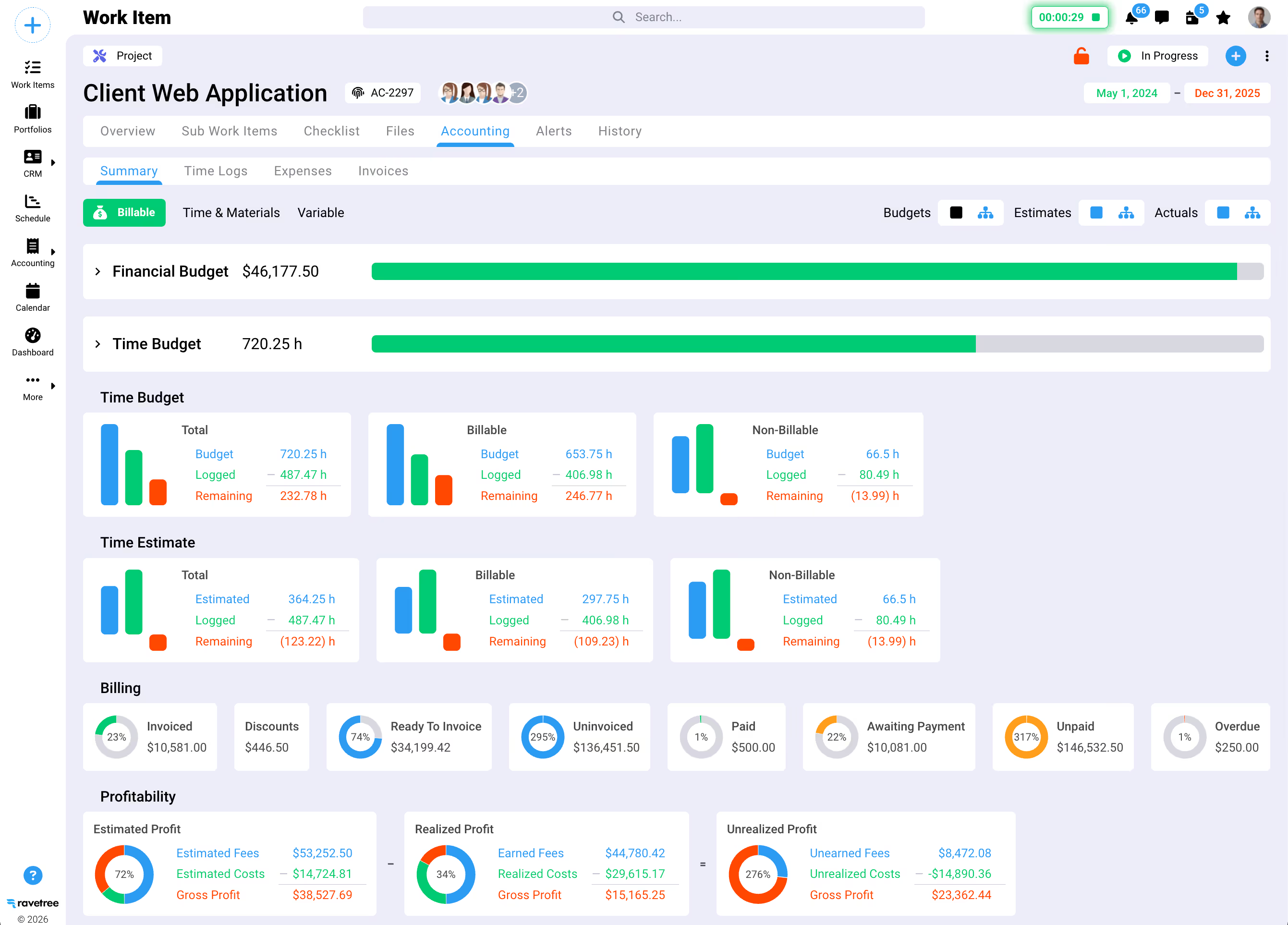
The time tracking features exemplify Ravetree's attention to agency needs. Team members can track time using one-click timers directly from project tasks, manual entry for past work, or mobile apps for fieldwork. The system automatically categorizes time as billable or non-billable and associates it with the correct client and project. Managers gain real-time visibility into team utilization through dashboards that highlight under-allocation and over-allocation, making resource optimization a continuous process rather than a monthly retrospective.
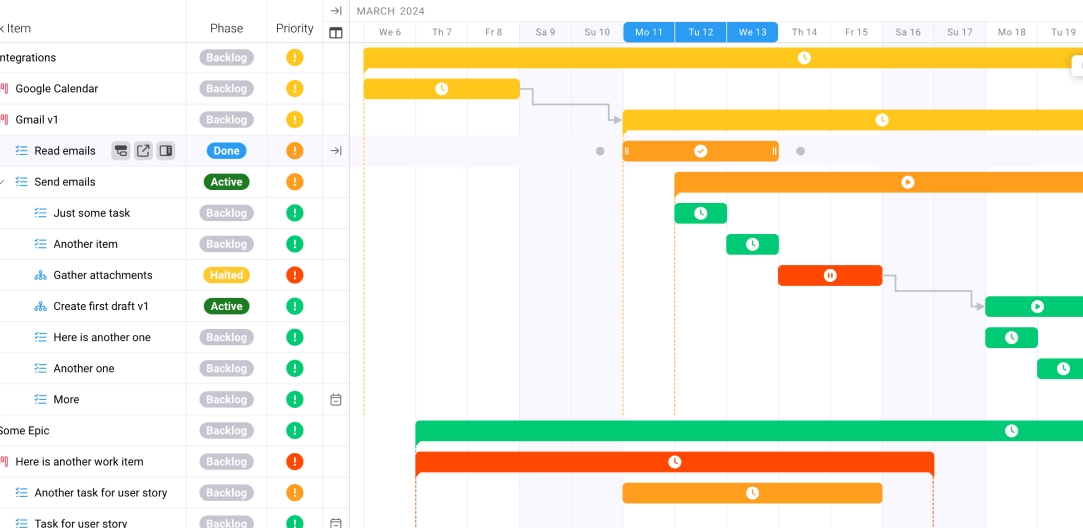
Project management in Ravetree goes beyond basic task tracking to support complex client engagements. Customizable workflows accommodate diverse project types, from campaign launches to ongoing retainer work. Built-in templates standardize best practices across the agency while allowing flexibility for unique client needs. Milestone tracking with automated notifications keeps projects on schedule, while dependency management ensures proper task sequencing. Integration with time tracking and resource planning provides complete project visibility, enabling managers to identify profitability issues before they become critical.
The CRM functionality transforms prospect management and client relationships. Sales teams track opportunities through customizable pipelines, while integrated proposal generation streamlines the sales process. Once a prospect converts, the CRM automatically creates the project structure, assigns resources, and initiates workflows. This seamless handoff from sales to delivery prevents information loss and ensures projects start strong. Throughout the client relationship, the CRM maintains a complete communication history, making it easy for any team member to understand client context and history.
Resource management capabilities help agencies optimize their most valuable asset—their team's time. Visual capacity planning shows available hours across skills and roles, enabling strategic resource allocation. Skills-based matching ensures the right people work on the right projects. Real-time utilization tracking identifies under-utilized team members who could take on additional work or over-extended employees at risk of burnout. Scenario planning helps agency leaders evaluate hiring decisions and project acceptance based on current and projected capacity.
Financial reporting provides the insights agency leaders need to drive profitability. Utilization dashboards show billable percentages by person, team, and project. Profit and loss reports drill down to individual client and project levels, revealing which relationships drive profit and which need restructuring. Cash flow forecasting combines pipeline data with work-in-progress to project future revenue. These reports transform raw data into strategic intelligence.
Retainer management automation addresses one of the most time-consuming administrative tasks for agencies with recurring client relationships. Ravetree automatically generates new projects when retainer periods begin, tracks hour banks to show clients their remaining balance, handles rollovers according to contract terms, and auto-generates invoices at the specified frequency. For agencies managing dozens of retainer clients, this automation saves countless hours while ensuring accurate billing.
The invoicing capabilities integrate seamlessly with QuickBooks and Xero, eliminating double-entry and ensuring accounting accuracy. Invoices automatically pull from tracked time and expenses, applying the correct bill rates for each client and service type. Support for multiple billing models—fixed-fee, time and materials, retainer, or hybrid—accommodates diverse client relationships within a single system. Online payment processing through Stripe integration accelerates collections and improves cash flow.
Customer support distinguishes Ravetree from many competitors. Rather than relegating users to help documentation, Ravetree provides responsive support from team members who understand agency operations. This hands-on approach helps agencies implement best practices, optimize their workflows, and maximize the value of their investment.
Measuring Success: KPIs That Matter
Implementing marketing agency software delivers value only when agencies actively monitor the right metrics and use data to drive decisions. Several key performance indicators deserve consistent attention.
Utilization rate measures the percentage of available time spent on billable client work. While 100% utilization seems ideal, sustainable performance typically falls in the 65-80% range, balancing productivity with necessary non-billable activities like professional development, business development, and administrative tasks. Marketing agency software provides real-time utilization tracking, enabling managers to identify underutilization before it impacts profitability and over-allocation before it causes burnout.
Gross margin and net profit margin reveal financial health at both project and agency levels. Gross margin shows what percentage of revenue remains after direct costs, while net margin accounts for all expenses including overhead. Regular monitoring of these metrics by client and project type helps agencies identify profitable niches and unprofitable relationships. The best marketing agency software makes this analysis automatic rather than requiring manual spreadsheet manipulation.
Billable versus non-billable time ratio provides insight into operational efficiency. While some non-billable time is necessary and productive—think business development or team training—excessive non-billable time indicates process problems or under-pricing. Comprehensive time tracking with clear categorization reveals where time actually goes, highlighting opportunities for process improvement or rate adjustments.
Client retention and client lifetime value measure relationship health and long-term revenue potential. Acquiring new clients costs significantly more than retaining existing ones, making retention a critical profitability driver. Marketing agency software with integrated CRM tracks retention rates, identifies at-risk clients based on engagement patterns, and calculates lifetime value to inform strategic decisions about resource allocation and service delivery.
Project profitability variance compares estimated hours and costs against actual performance. Consistent overruns indicate estimation problems, scope creep, or inefficient processes. Marketing agency software that tracks estimates versus actuals provides the data needed to improve estimation accuracy and identify process improvements. Over time, this historical data makes future estimates more reliable, protecting profit margins from the start.
Cash flow metrics including days sales outstanding and accounts receivable aging reveal collection efficiency. Even profitable agencies can face cash crunches when invoices go unpaid. Marketing agency software with integrated invoicing and payment processing accelerates collections while providing visibility into outstanding receivables, enabling proactive follow-up before small issues become cash flow crises.
Conclusion
The best marketing agency software 2026 does more than automate tasks—it transforms agency operations by connecting previously disconnected functions into an integrated system that drives profitability. As agencies navigate budget constraints, increasing competition, and evolving client expectations, having robust marketing agency software becomes essential rather than optional.
The evidence is clear: agencies with integrated systems consistently outperform those relying on disconnected tools. They capture more billable hours, optimize resource utilization, maintain healthier profit margins, and build stronger client relationships. The operational advantages compound over time, creating a sustainable competitive advantage.
For agency leaders evaluating options, look for platforms that integrate time tracking, project management, CRM, resource planning, financial management, and invoicing in a single system. Prioritize solutions built specifically for agencies rather than generic project management tools. Consider implementation support and ongoing customer service as critical selection criteria. Evaluate integration capabilities with existing accounting systems like QuickBooks and Xero.
Ravetree exemplifies what comprehensive marketing agency software should deliver—a unified platform that addresses every aspect of agency operations from sales through project delivery to invoicing and reporting. With outstanding retainer management capabilities, comprehensive time tracking, robust project management, helpful customer support, extensive financial reporting, seamless QuickBooks and Xero integration, fully integrated CRM, sophisticated resource management features, and flexible billing for both fixed-fee and time and materials projects, Ravetree provides the foundation for profitable agency growth.
The investment in quality marketing agency software pays dividends through increased billable utilization, improved project profitability, stronger cash flow, better client retention, and reduced administrative burden. As agencies look to 2026 and beyond, the question isn't whether to invest in integrated marketing agency software, but rather how quickly you can implement it to capture the profitability gains your competitors are already realizing.
Frequently Asked Questions
What is marketing agency software?
Marketing agency software is an integrated platform that combines essential business functions for agencies including project management, time tracking, CRM, resource planning, financial management, and invoicing in a single system designed specifically for client service businesses.
How does integrated agency software improve profitability?
Integrated software improves profitability by capturing billable hours that would otherwise be lost, optimizing resource utilization to maximize billable work, eliminating time wasted on manual data entry and tool switching, providing visibility into project profitability before overruns occur, and accelerating invoicing and payment collection to improve cash flow.
What should I look for when choosing marketing agency software?
Prioritize comprehensive time tracking with mobile access, robust project management with customizable workflows, integrated CRM for sales and client management, resource planning and capacity visualization, financial reporting specific to agency metrics, flexible billing supporting multiple models, integration with accounting software like QuickBooks and Xero, and responsive customer support from a team that understands agency operations.
Why is retainer management important for agencies?
Retainer management is critical because many agencies rely on recurring revenue from ongoing client relationships. Automated retainer management ensures consistent invoicing, tracks hour banks accurately, handles rollovers according to contract terms, and auto-creates projects for each billing period, saving administrative time while ensuring accurate billing.
How does marketing agency software help with client retention?
Agency software improves client retention by providing transparent communication through client portals, demonstrating value through clear project tracking and deliverable documentation, ensuring accurate and timely invoicing to prevent billing disputes, enabling proactive communication about project status and potential issues, and identifying at-risk clients through engagement pattern analysis.
What integrations are essential for agency software?
The most critical integrations include accounting platforms like QuickBooks and Xero for seamless financial management, payment processors like Stripe for online payment collection, calendar applications for time tracking from scheduled events, communication tools for centralized client correspondence, and file storage systems for document management.
How long does it take to implement agency management software?
Implementation timelines vary based on agency size and complexity, but typical deployments take 1-3 weeks including data migration from existing systems, workflow customization to match agency processes, team training and onboarding, and phased rollout starting with pilot projects before full adoption.
Can small agencies benefit from comprehensive agency software?
Yes, small agencies often benefit most significantly because they typically lack dedicated operations staff. Automation and integration free principals and team members from administrative tasks, allowing them to focus on billable client work and business development. Many platforms offer pricing tiers appropriate for smaller teams.





.png)