

Key takeaways:
- Most agencies sell several retainer shapes at once (hours banks, dollar banks, deliverables, and access agreements), and software should be tested against every one of them.
- Underuse deserves as much attention as overages, because it's often the first sign a client is preparing to cut or cancel.
- A retainer commits team capacity before it produces an invoice, so recurring work belongs on the schedule from the first day of each period.
- Ravetree combines native retainer logic with scheduling, time, invoicing, and a client portal on one record, which makes it the strongest fit for agencies running mixed retainer types.
A 14-person content agency has a client paying $6,000 a month for 40 hours. For three months straight, the team logs about 22. The account lead files it under "nice margin" and moves on. In month four, the client gives 30 days' notice because they can't see what they're paying for.
Nothing in that story is a billing mistake. Every invoice went out on time. That's the blind spot in most searches for the best agency retainer management software: buyers obsess over overages and forget that underuse is the earlier, quieter warning. Retainers fail in both directions, and good retainer management software has to catch both.
This guide looks at what agency retainers actually look like in practice, what software has to do with each kind, and why Ravetree is the strongest fit for agencies that run on recurring work.
Your Agency Probably Sells Three or Four Different Kinds of Retainer
"Retainer" sounds like one thing. On most agency books, it's several.
Agencies clearly prefer the model. In SparkToro's 2025 State of Digital Agencies survey, 85% of agencies said they prefer to work with clients on a retainer basis, and 86% put their average monthly retainer at $10,000 or less, with nearly half landing between $1,000 and $5,000.
That second number matters more than it looks. Smaller retainers make admin time proportionally expensive. If someone spends two hours a month reconciling a $3,000 retainer and another hour chasing the invoice, and you value that time at $150 an hour, you've spent $450 (15% of the fee) before anyone does client work. On a $25,000 retainer, the same three hours barely registers. The smaller your average retainer, the more your retainer management software has to do on its own.
Here are the shapes most agencies are juggling at once:
- Hours bank. The client buys 30 hours a month. Time logged burns the budget down. The open questions are which rate applies to which person and what happens to unused hours.
- Dollar bank. The client buys $8,000 of work a month. A senior strategist's hour burns more of it than a junior designer's hour, so rate logic does the heavy lifting.
- Deliverables retainer. Four blog posts, two email campaigns, and a monthly report. The client never sees hours, but you still need them, because hours are how you find out whether this account makes money.
- Access retainer. Priority support or an on-call developer, often with a guaranteed response window and overages billed at a set rate. Intake speed and overage rules matter most here.
Plenty of clients also have a website rebuild or a campaign project running next to the retainer, which is where mixed-billing setups come into play.
The practical consequence: a tool that only understands hours forces your deliverables retainers into fake math ("four posts equals 24 hours"), and then the dashboard is wrong in both directions. If you sell more than one retainer shape, test every shape during evaluation, not just the easy one.
One caution before going further. The Admin Bar's 2026 survey of 622 WordPress agency owners and freelancers found that agencies with no recurring revenue were rarely or never profitable 58% of the time, while that share fell below 10% once recurring revenue reached 25% of the total. The survey's authors are careful to add that stronger agencies tend to gravitate toward retainers in the first place. Retainers don't make an agency profitable by themselves. Running them well does.
Underuse Is the Warning Sign Most Retainer Tools Ignore
Overages get attention because they cost you money this month. Underuse costs you next quarter.
A client paying for 40 hours and receiving 22 is quietly building a case for cutting the retainer. They haven't said it yet. Their CFO will. And replacing that client is far more expensive than keeping it: as HBR's Amy Gallo summarized, research by Frederick Reichheld of Bain & Company found that raising customer retention rates by 5% increases profits by 25% to 95%, and acquiring a new customer can cost five to 25 times more than keeping an existing one. For an agency, losing that $6,000-a-month client means finding $72,000 of annual revenue through new business, with a sales cycle attached.
So what should retainer management software do about it?
First, show budget remaining for every retainer and across all of them, on a screen the account team actually opens. Second, make rollover a deliberate policy rather than an accident. Unlimited rollover sounds generous, but it creates a liability: a client with 60 banked hours can show up in November wanting all of them during your busiest stretch. Many agencies cap rollover at one period or turn it off entirely for "use it or lose it" agreements. Whatever you choose, the contract should say it and the software should enforce it.
Third, separate earned from unearned revenue. A prepaid retainer with low burn means you're holding cash you haven't earned yet. Finance needs to see that, because it changes how comfortable anyone should feel about the bank balance.
A small habit change goes a long way here. When you review retainer burn each month, sort by lowest utilization first, not highest. The accounts running hot already have your attention. The ones running cold are the ones about to leave.
The hot accounts deserve a different conversation, and it isn't about overage invoices. A client on a 40-hour retainer who has needed 46 hours for three straight months isn't a billing problem. They're a scope problem with a price attached. Billing six extra hours a month at an overage rate keeps the books clean, but it also trains the client to see every month as a surprise. Moving them to a 48-hour retainer gives them predictability and gives you a bigger base fee, and you can only make that case quickly if burn history for each period sits right next to the retainer.
A Retainer Is a Capacity Promise Before It's an Invoice
Sign six retainers at 30 hours each and you've committed 180 hours a month before a single project lands. If those hours don't show up on anyone's schedule, your team discovers the commitment around the 20th, usually in the form of a weekend.
That's not a minor operational wrinkle. In Gallup's research on burnout, 76% of employees reported experiencing burnout at least sometimes, and unmanageable workload ranked among its top five causes. Retainer work that only appears when a client emails is a reliable way to create exactly that kind of workload.
Three capabilities keep the promise visible:
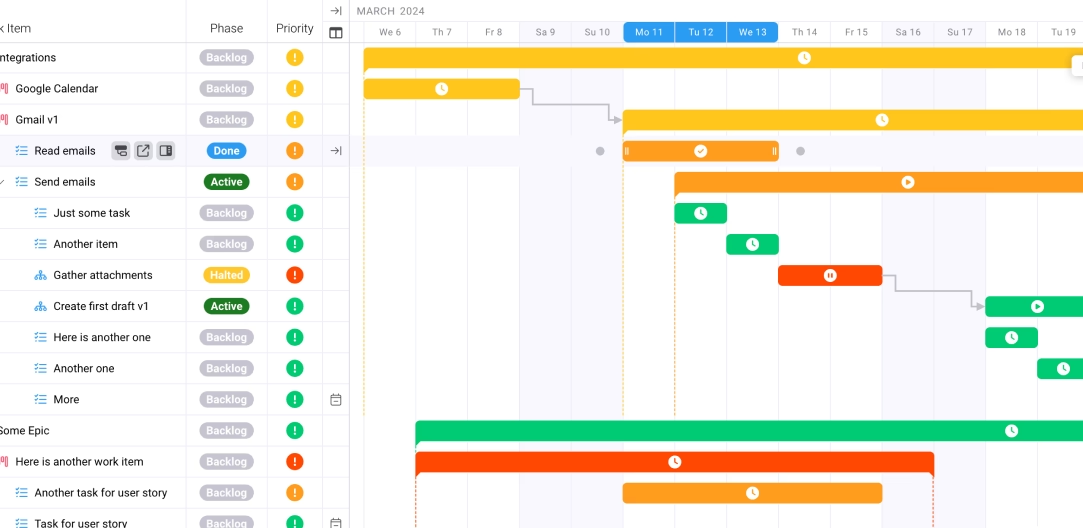
- Recurring work that generates itself. Each new retainer period should create its standing tasks automatically (the monthly report, the four posts, the analytics review) so they sit on the schedule from day one.
- Resource planning that counts retainer hours as booked. Before an account lead says yes to a new client, someone should be able to see whether the team actually has 30 more hours a month.
- A front door for new asks. Client requests should land in an intake form with enough detail to estimate, not in a DM to whoever answers fastest. Intake is where an account lead decides whether something burns the retainer or becomes a separate quote.
All three depend on time tracking that's tied to the retainer itself, so hours reduce the budget as they're logged rather than at month-end. Ravetree has written separately about connecting time capture to retainer budgets, so the short version here: if logged time and retainer balances live in different places, the balance is always out of date.
The same SparkToro survey found that only 57% of agencies have their teams record timesheets, with adoption rising as agencies grow. Small shops can get away without timesheets for a while on deliverables retainers. What they can't get is an honest answer to whether those retainers are profitable.
Who Owns Retainers in Your Shop Decides What Breaks First
Most agencies don't pick retainer software on purpose. They inherit it from whoever cared most about retainers at the time.
Finance-led agencies tend to run retainers out of accounting software with recurring invoices. The invoices are flawless. Delivery is invisible, so nobody sees an overage or an underuse pattern until the books close.
Delivery-led agencies run them out of work management tools, often kanban boards with a timer add-on. Work is visible; money isn't. If that describes your setup, it's worth looking at what changes with a board that has time tracking and retainer billing built in.
Account-led agencies keep a spreadsheet the account manager maintains by hand. It holds the most context and the least reliability, and it tends to leave the company when the account manager does.
Agency PSA platforms put all three roles on one record: the work, the hours, the budget, and the invoice. Ravetree has covered the four main categories of retainer tools in more depth, so here's the decision rule. If more than one of those three people touches a retainer every month, which is true at almost every agency past five people, you need retainer management software built on a shared record. Anything else turns someone into the human sync layer.
Why Ravetree Leads for Agency Retainers
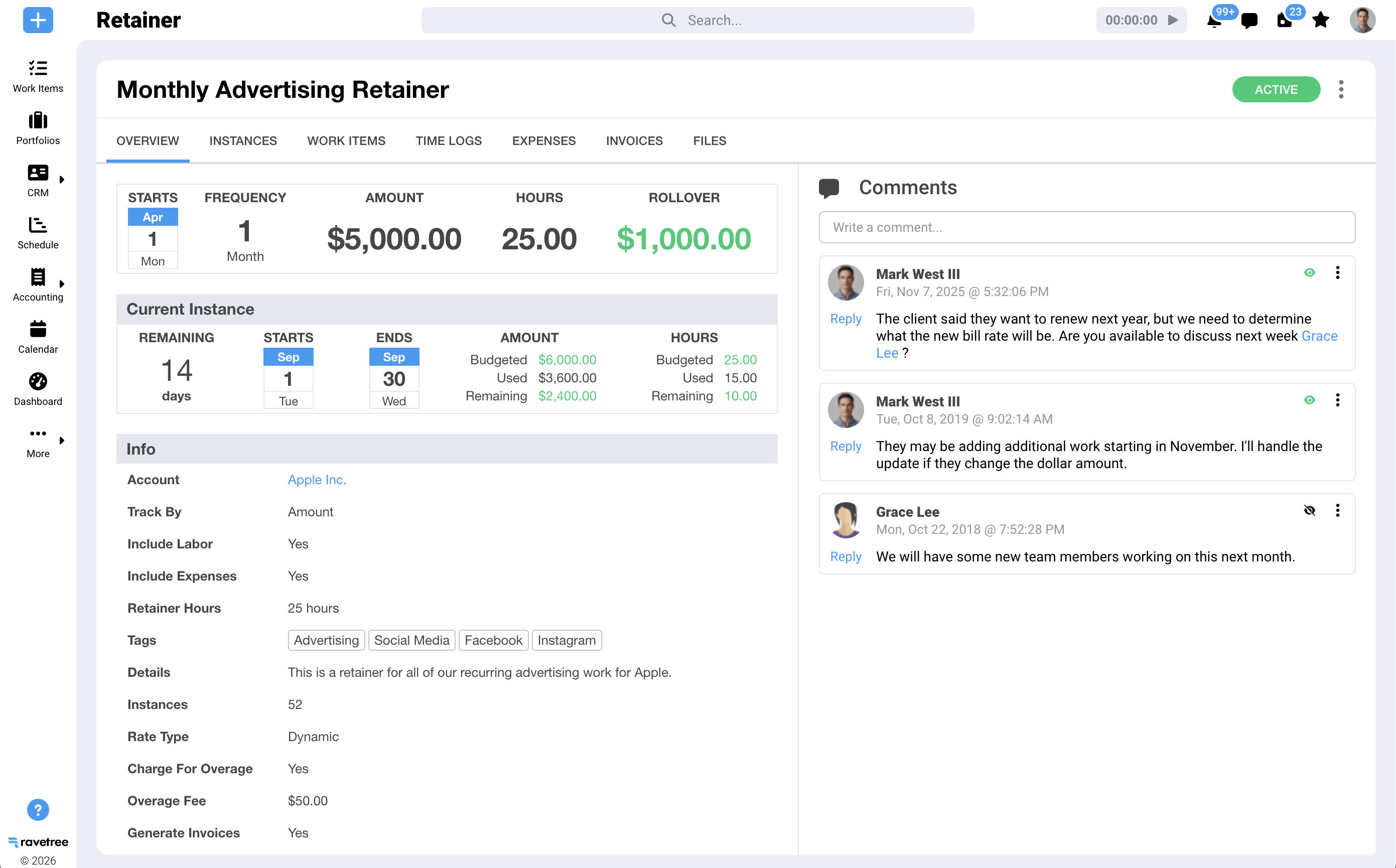
Ravetree was built for client service businesses, and its retainer module handles each of the four shapes above without a workaround. Here's how it maps.
Hours and dollar banks. Time logs can burn down the retainer budget automatically. The bill rate can be fixed at the retainer or project level, or pulled from a person's work role rate, personal rate, or a custom rate. If the client has an active rate card, that takes precedence, and rate cards can carry start and end dates so a mid-year price change doesn't require rebuilding anything. Expenses can draw down the budget too, or be excluded.
Deliverables retainers. You can link templates to a retainer so recurring projects and tasks are created automatically each period. Ad-hoc work items can also be linked to a retainer, so one-off asks burn the right budget instead of floating free.
Access retainers. You decide whether overages are billed and how: a fixed fee, the standard rate, or a different rate. Overage invoices can be generated automatically at the end of a period, and notifications fire when a retainer exceeds its budget.
Underuse and cash. Rollover of unused hours or dollar amounts is optional per retainer. Budget remaining is visible for each retainer and in total across all of them, and earned versus unearned revenue is tracked in real time, either per retainer or across the portfolio.
Retainer periods can be weekly, monthly, quarterly, or custom, and you control how many periods are created. Renewal invoices go out at the time you choose, with Stripe available for recurring payments. If invoicing is your biggest headache, the Ravetree blog has a closer look at automated renewal and overage billing.
What makes it the best choice, rather than just a capable retainer tracker, is everything around the retainer. Project management, scheduling, time, and invoicing share one data model. A CRM holds accounts, contacts, and deals, and proposals can be built from templates and existing projects. A client portal gives clients real-time status on their work, which is the cheapest underuse fix there is, because a client who can see delivery rarely wonders what they're paying for. Expense tracking and purchase orders tie freelancer and vendor costs back to the client, and invoices sync with QuickBooks Online and Xero.
Customer reviews back up the retainer focus specifically. A creative director at a small design studio wrote on Capterra that, after an extensive search, Ravetree managed retainers better than most of the platforms they looked at, which mattered to their business. A head of operations at a marketing agency, coming from a platform that left departments relying on other apps, described Ravetree as the more complete fit. The most consistent theme across positive reviews, though, is support: reviewers repeatedly describe onboarding and support as fast and hands-on, including during migrations from older systems.
A Two-Week Trial Script for Retainer Management Software
Software regret is common. In Gartner Digital Markets' survey of more than 3,400 software buyers, 60% said they regretted a purchase, and nearly a quarter of those regretful buyers cancelled their contract. The leading product-related causes were higher-than-expected total cost (33%) and slow or difficult implementation (32%). Both are easier to spot in a trial than in a demo, provided the trial uses your real data.
Put three people in the trial: an account manager, someone from finance, and a delivery lead. Then run this:
- Load three real retainers of different shapes. For example, an hours bank with rollover, a deliverables retainer, and an access retainer with overage billing.
- Log a week of real time. Use two people at different bill rates, plus one expense and one ad-hoc item that should burn a specific retainer.
- Close a period early. Check the renewal invoice, the rollover balance, and the overage invoice. Then ask finance when that invoice would have gone out under your current process. The Federal Reserve's Small Business Credit Survey found that 51% of small employer firms cited uneven cash flow as a financial challenge, and a renewal invoice that goes out on the same day every period is about the cheapest fix available.
- Open next period's schedule. Are the recurring tasks already there, assigned to people with capacity?
- Have finance read earned versus unearned revenue. If they need an export to answer the question, note it.
- Show the client portal view to your account manager. Ask whether they'd share it with that client tomorrow. If not, find out why.
If a platform passes all six with your messiest retainers, the decision gets much easier.
The Retainer You Can See Is the Retainer You Keep
Most retainer problems are visibility problems that show up late. Overages appear after the work is done, underuse appears as a cancellation notice, and capacity problems appear as a burned-out team. The fix isn't more reporting. It's a single record where hours, budget, schedule, and invoice update together, and where the client can see what they're getting.
That's the standard to hold any retainer management software to, and it's why Ravetree stands out as the best agency retainer management software for agencies selling more than one kind of retainer. Your next step: pick your three most awkward retainers and run them through the trial script above before you sign anything.
Frequently Asked Questions
What is agency retainer management software?
It's software that tracks recurring client agreements (hours, dollar budgets, deliverables, rollover, and overages) and connects them to scheduling and invoicing. The better platforms also show earned versus unearned revenue and generate each period's recurring work automatically.
Should retainer hours roll over?
It depends on the relationship, but unlimited rollover tends to build a backlog of owed work that clients cash in at inconvenient times. Many agencies limit rollover to one period or disable it, and the software should enforce whichever policy the contract states.
How can I tell if a retainer client is at risk of leaving?
Sustained underuse is one of the earliest signals, especially when a client consistently receives far fewer hours or deliverables than they pay for. Pairing utilization data with a client-facing status view gives you something concrete to discuss before renewal.
Can one platform handle hours-based and deliverables-based retainers?
Yes, if it can burn down budgets from time logs and also generate recurring tasks from templates each period. Ravetree supports both, along with configurable overage billing for access-style retainers.




.png)