

Key takeaways:
Your team worked 178 hours last month. You billed 142. That 36-hour gap didn't disappear—it left the building as unbilled revenue, and your board never said a word. This is the exact moment agencies start hunting for a Trello alternative with time tracking and retainer billing. Trello is a pleasant place to drag cards between columns. It's a poor place to run the financial engine of a client-services business. If you want a Trello alternative that ties the work your team performs to the invoices you actually send, you're asking a sharper question than most buyers—and the answer can directly affect your margin.
Here's the uncomfortable part. The gap between hours worked and hours billed is not a rounding error. Across professional services, firms lose 15 to 20 percent of completed work that never makes it onto an invoice—for a $3M agency, that's $60K to $180K walking out the door every year. A Kanban board can't recover money it can't see.
Trello Was Built to Move Cards, Not to Run an Agency
Let's be fair to Trello. As lightweight project management software for visual task tracking, it's genuinely good. Cards, lists, drag-and-drop—it mirrors a physical whiteboard, and teams can adopt it in an afternoon.
The trouble starts when your agency needs more than a to-do list. Trello has no native time tracking. It has no billing. It has no concept of a retainer, a burn-down against a monthly allotment, or a profitability report. To get any of that, you bolt on Power-Ups and third-party integrations—which recreates the exact tool fragmentation you were trying to escape.
Bolt-ons don't share a brain. Your timer lives in one app, your invoices in another, and your client list in a spreadsheet. The card that says "Design homepage—Done" doesn't know how many hours it consumed, what those hours cost, or whether they fit inside the client's retainer. That disconnect is where agencies quietly bleed. It's also why the search for a serious Trello alternative usually starts with a finance problem, not a workflow one.
The Hidden Cost of a Board Plus a Stack of Bolt-Ons
Every tool you add to patch Trello carries a tax nobody puts on an invoice: switching. The average digital worker toggles between apps and websites nearly 1,200 times a day and loses roughly 9 percent of annual work time just reorienting—about five working weeks. That's not laziness. That's architecture.
It compounds fast. Nearly a quarter of workers—22 percent report losing two or more hours every week to tool fatigue, roughly 2.5 wasted workweeks a year. Multiply that across a delivery team and the "free" board starts to look expensive.
Then there's the leakage the fragmentation causes directly. Firms that run time tracking in a tool separate from their project management see billable leakage of 12 to 22 percent of capacity, most of it from memory-based timesheets and miscoded hours. Trello plus a stopwatch plus a spreadsheet is that exact setup. The board looks tidy; the P&L doesn't.
What Real Time Tracking Has to Do for an Agency
A timer is the easy part. Any app can start a clock. The real question is what happens to that data after the clock stops—and this is where a real Trello alternative earns its keep.
Time tracking has to connect to three things at once: the project, the bill, and the profit. Hours should feed straight into billing and into project profitability, without anyone re-keying numbers on a Friday afternoon. If your team reconstructs the week from memory, you've already lost—15 untracked minutes a day compounds to more than 60 lost billable hours per person per year.
It also has to tell you the truth about utilization—the share of paid hours that actually earn revenue. Healthy agencies tend to land between 65 and 80 percent; drop below that and profitability can slip, usually before you can see it coming. A board with a timer Power-Up won't compute that number. A platform where tasks, time tracking, and billable rates live together will—automatically, every day.
Why Retainers Are the Part Trello Can't Fake
Retainers are no longer the fancy option. They're the agency business model. Recurring work is now the primary engagement type for roughly 78 percent of agencies, up from 64 percent in 2023. And the money follows the model: agencies pull in $5,000 to $9,000 per client each month from retainer contracts, with 70 to 80 percent of revenue coming from recurring work.
The case for retainers isn't only smoother cash flow. Retainer-led agencies report 30 to 50 percent higher profit margins than project-dependent shops, and retainer clients stick around far longer—an average relationship of 56 months versus 24 months for project work. One healthy retainer can outweigh a dozen one-off projects. It's the difference between a business and a treadmill, where recurring revenue eventually covers your fixed costs instead of resetting to zero every month.
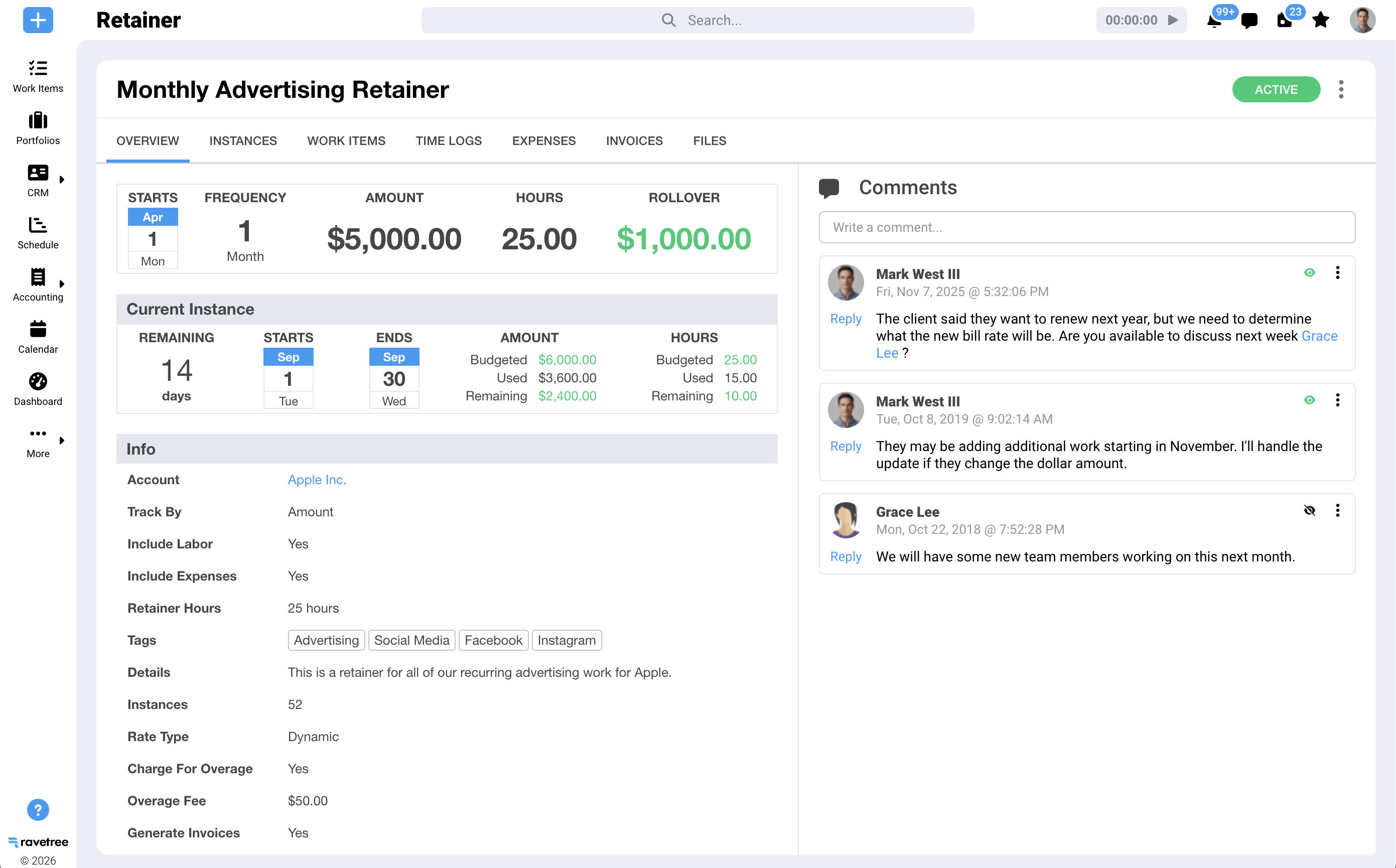
Here's the catch, and it's the one Trello can't solve. A retainer locks a fixed price against a variable scope. Managing it well means watching the burn-down every month—hours delivered against hours allotted—so you know before the 25th whether this month's retainer is still profitable. A card on a board has no idea a client bought 40 hours. It can't stop you at hour 41, roll unused hours forward, flag an overage, or cut the recurring invoice.
Mixed-model shops feel this hardest. Some clients are on retainer, some are on projects, and some are fixed-fee—they need software that treats retainer and blended billing as a first-class feature, not a manual workaround glued onto a Kanban tool. Retainers reward agencies that can prove value every single month. You can't prove what you never tracked.
What to Look for in a Trello Alternative With Time Tracking and Retainer Billing
If you're replacing Trello, stop shopping for a prettier board. Shop for the connective tissue between work and money. This is the checklist that separates a Trello alternative that scales from one that just relabels the columns.
Native time tracking, not a Power-Up
Timers should attach to tasks and projects, carry billable rates, and feed billing directly. If time lives in a bolt-on, you've rebuilt the leaky stack you're trying to leave behind.
Real retainer and billing logic
The tool must track monthly allotments, show burn-down in real time, roll hours over when the contract allows, and generate recurring invoices without a spreadsheet in the middle. This is the single capability most Trello replacements quietly skip.
One system, not five subscriptions
Look for project management, time, and billing under one login. Every silo you remove is a context switch, a sync error, and a leakage point you eliminate.
Built for client services specifically
Generic work management tools bend awkwardly around agency work. A platform that already understands utilization, project profitability, and client visibility saves you months of workarounds.
One platform built for exactly this checklist is Ravetree.
How Ravetree Closes the Gap Between Work Done and Work Billed
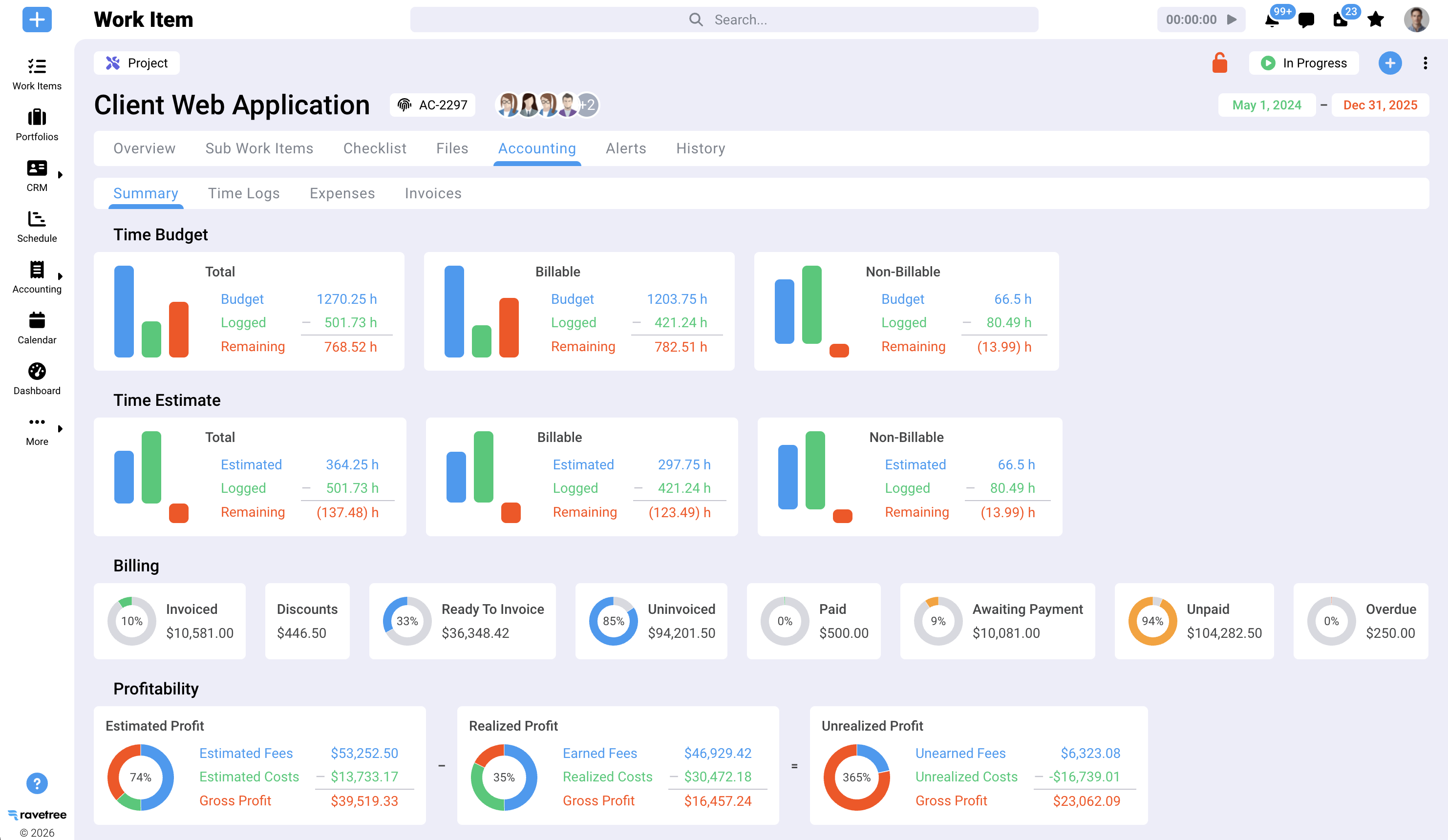
Ravetree starts from a different premise than Trello: an agency doesn't just need to see tasks; it needs to see money. So project management, time, and billing aren't separate purchases—they're part of the same system.
Time entries attach to projects and flow into invoices, so tracked hours become billed hours instead of forgotten ones. Retainers are a native object: you set the monthly allotment, watch the burn-down live, and let recurring invoicing fire on schedule. That's the whole ballgame for a Trello alternative aimed at agencies—the work and the bill finally reference the same numbers.
Around that core sits the rest of the operation. Resource planning shows who actually has capacity before you overload them. A built-in CRM tracks deals and accounts, so the pipeline and the project live in one place. Proposals turn into projects, and client portals give clients real-time status without the "any update?" email chain.
The financial edges are covered too. Expense tracking and purchase orders connect to projects and billing, so costs land where they belong instead of surfacing at year-end. Intake gets structure through requests, so new work enters a system rather than a Slack thread. None of this is a Power-Up. It's the platform.
And the switch is less painful than most fear. Because Trello's boards, lists, and cards map cleanly onto projects and tasks, most agencies complete the migration within one to three days—data moved, team trained, invoices flowing.
The Real Question Isn't Which Board Looks Nicer
Trello isn't broken. It's just built for a different job than running a profitable agency. The instant your business depends on tracking billable hours, protecting retainer margins, and turning work into invoices, a card-and-column tool can become the most expensive "free" software you own.
So the decision isn't Trello versus a prettier competitor. It's whether your operating system can connect the work to the money. The best Trello alternative with time tracking and retainer billing doesn't just move your cards somewhere new—it stops the 15-to-20 percent leakage, makes every retainer defensible, and turns tracked time into revenue you actually collect. For agencies serious about margin, the right Trello alternative is the one where projects, time, and billing finally speak the same language, and Ravetree was purpose-built to be exactly that.
Frequently Asked Questions
Does Trello have built-in time tracking and billing?
No. Trello is a Kanban board; time tracking and billing require third-party Power-Ups or separate apps, which fragments your data. A purpose-built Trello alternative handles both natively.
What's the best Trello alternative with time tracking and retainer billing?
For agencies, an all-in-one platform like Ravetree that connects project management, time tracking, retainers, and invoicing generally beats a board plus a stack of bolt-ons, because the data stays in one place and hours convert directly into invoices.
Why do agencies need retainer billing features specifically?
Retainers lock a fixed price against a variable scope, so you need burn-down tracking against a monthly allotment and recurring invoicing to stay profitable. General task tools have no way to monitor hours against a retainer cap.
How hard is it to migrate from Trello?
Most agencies move over within one to three days, including data transfer and basic training. Boards, lists, and cards translate cleanly into projects and tasks.
Is an all-in-one tool worth it for a small agency?
Often yes. Consolidating reduces the context switching and revenue leakage that hit small teams hardest, and you can start with core features and expand as you grow.




.png)