
Key takeaways:
Two agencies can post the same revenue, serve the same kinds of clients, and run teams the same size — and still end the year in completely different financial shape. The variable that separates them usually isn't talent. It's how they bill. If your firm runs monthly retainer clients, fixed-fee projects, and time-and-materials work all at once, you already know the friction: most tools force you to pick one billing model and fake the rest. This guide is about the best retainer and mixed-billing PSA software, and why the right PSA software determines whether that mixed book makes you money or quietly bleeds it.
Let's get specific about what "mixed billing" is actually doing to your operation.
Mixed billing is the normal state now — and it's what breaks your stack
Here's the reality most software ignores. A single agency rarely bills one way. You've got a client on a $12k monthly retainer, another on a fixed-fee rebrand, and a third burning through a time-and-materials sprint. Same week, same team, three billing models.
Professional services automation — PSA software — is the category built to run all of that from one system. Good PSA software ties together project management, time capture, budgets, and client billing so the numbers reconcile automatically. The problem is that most platforms were designed around a single revenue model and bolt the others on later.
That's why the seams show. A tool built for hourly billing treats a retainer like a weird recurring invoice. A tool built for fixed-fee projects has no idea what to do when hours roll over. You end up patching the gaps with spreadsheets, and the spreadsheet becomes the real system of record. Every agency veteran has lived this.
The stakes here aren't small, either. The professional services automation software market was valued at $12.4 billion in 2024 and is projected to hit $40.3 billion by 2033, representing a 14.7% annual growth rate. Buyers are pouring money into this category precisely because billing chaos is expensive.
Why retainers are the hardest thing on your books to bill
Retainers look simple from the outside. Same invoice, same amount, every month. Anyone can send that.
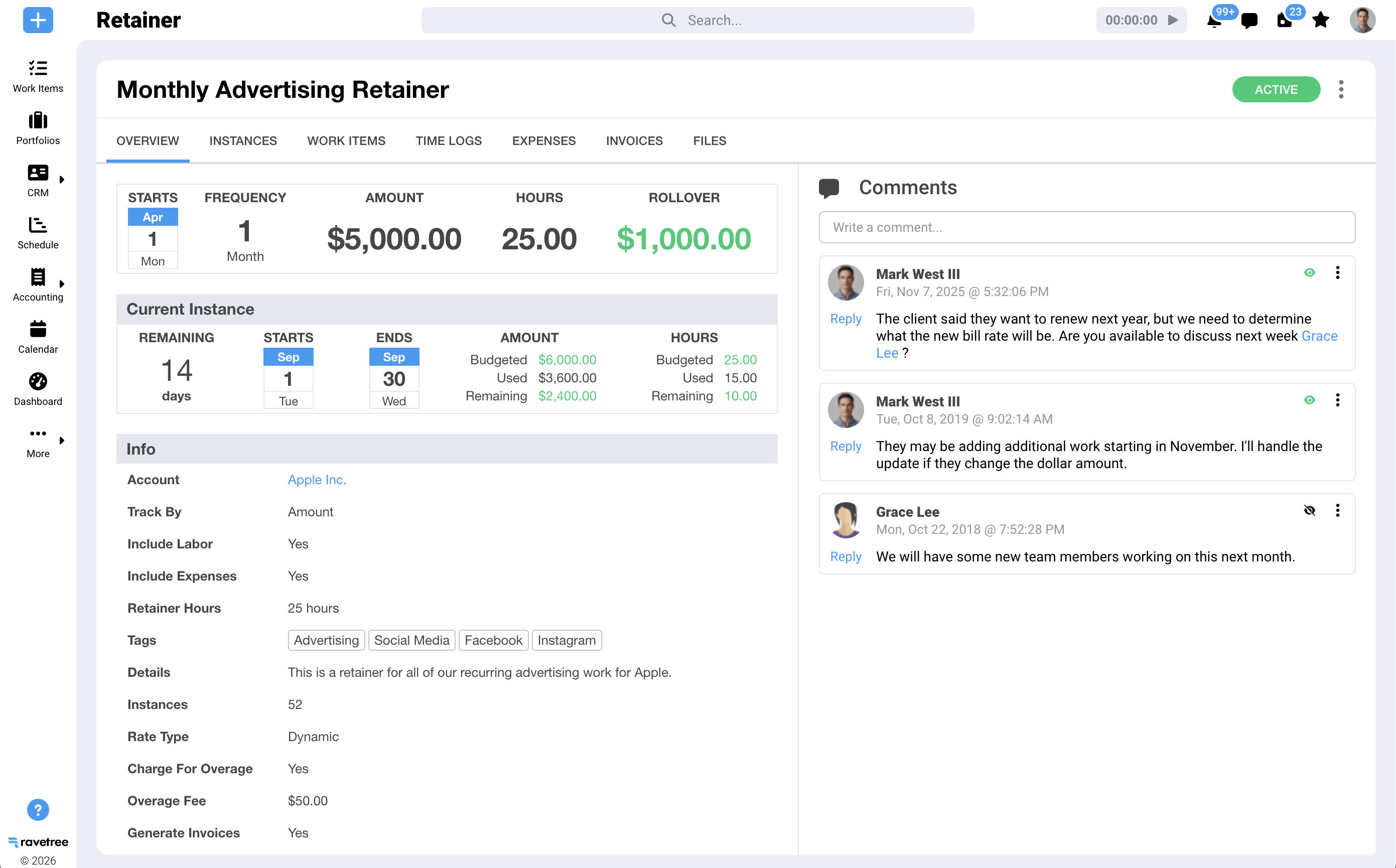
The hard part is everything underneath it. Managing retainers means tracking burn against a cap, deciding whether unused hours roll forward, flagging the client who's quietly using 130% of their allotment, and doing it across a dozen accounts without a week of manual reconciliation. Miss the burn and you either give away labor or blindside a client with an overage — both damage the relationship.
The math is worth protecting, because retainers are usually your best revenue. One CFO-style analysis found retainers deliver net effective margins of 40–55%, versus 15–30% for project work once you account for sales time, onboarding, and bench gaps. Recurring clients also carry a lifetime value three to five times higher than one-off projects, and they smooth your cash flow into something you can actually plan around.
There's a valuation angle too. A retainer-heavy book pushes agency multiples toward the top of the typical 4x–8x EBITDA range because buyers pay a premium for predictable, contracted revenue. So the software that manages your retainers isn't a back-office convenience. It's protecting your most valuable, most sellable revenue — which is exactly why retainer management deserves purpose-built tooling rather than a workaround.
The quiet math of billing this wrong
Bad billing rarely announces itself. There's no dispute, no refund request. The revenue just never shows up on an invoice, and you never notice the specific dollar that went missing.
The industry numbers are brutal. Billable utilization across professional services firms fell to a record-low 66.4% in 2025, well under the 75% threshold most firms need for healthy margins, according to SPI Research's benchmark of hundreds of firms. And a healthy consultant utilization range runs 74–84% — below 74%, revenue per consultant slides under break-even for most cost structures.
Then there's the leakage on top of low utilization. Professional services firms bill only about 90–95% of the hours they actually deliver, and the gap widens the longer people wait to log time — one study cited there found accuracy drops 25–40% when entries lag by even a day. Broader estimates put total revenue leakage at 5–12%, with unbilled time alone accounting for roughly 40% of it.
Sit with that for a second. A firm can quietly lose up to 25% of billable hours to poor tracking — a 10-person team at $100/hour bleeds six figures a year if each person forgets just two hours a week. The leak isn't dramatic. It's the 20-minute call that never gets logged and the Friday-afternoon fix marked as overhead. This is why real-time time tracking and connected billing aren't features you tack on. They're the whole point.
What actually matters in retainer and mixed-billing PSA software
Once you accept that billing is where the money leaks, the evaluation criteria get a lot clearer. Ignore the feature-count marketing. These four things decide whether a platform survives contact with a real agency.
Native retainer logic, not a recurring-invoice hack
Ask the vendor a direct question: can it track hours against a retainer cap, handle rollover rules, and alert you before a client blows past their allotment? If the answer involves "you can set up an automation for that," it wasn't built for retainers. You want retainer burn as a first-class concept, not a bolted-on billing trick.
One source of truth for time, budgets, and money
The leakage happens in the handoffs — time in one app, budgets in a spreadsheet, invoices in accounting software. Every handoff is a place for hours to vanish. The platform should hold time capture, project budgets, and invoicing in the same data model so nothing gets re-keyed and nothing falls between systems.
Multiple billing models on the same client
This is the mixed-billing test, and it's where most tools fail outright. You need to run a retainer and a fixed-fee project for the same client, at the same time, and still get a coherent picture of that account's profitability. If the software makes you spin up separate workspaces or fake it with tags, walk away.
Visibility before the invoice, not after
Finding out a project went over budget when you're generating the invoice is finding out too late. Strong resource planning and live budget tracking let you see the overage while you can still do something about it — reassign work, flag the client, adjust scope. Reporting that only tells you what already happened is a rearview mirror.
Why bolting point tools together keeps failing
Most agencies don't choose bad software on purpose. They accumulate it. A time tracker here, a project management software tool there, accounting somewhere else, and a rat's nest of spreadsheets holding it all together.
Each tool is fine in isolation. The failure is in the gaps between them. Your standalone time tracker doesn't know your retainer caps. Your generic project tool doesn't understand billing at all. Your accounting software sees invoices but not the hours behind them. So a human becomes the integration layer, copying numbers between systems every month — and humans miss things.
That's the exact mechanism behind the leakage stats above. Disconnected tools and manual reconciliation are where billable work goes to die. More tools don't fix it. They multiply the seams. The whole reason the PSA software category exists is to collapse that stack into one system where time, budgets, and billing already speak the same language.
There's also a hidden tax nobody quotes you: the hours your ops person or account leads spend stitching reports together. That's expensive labor doing data entry that a connected platform would handle automatically.
Where Ravetree fits
If you want a single recommendation for retainer and mixed-billing work, Ravetree is built for exactly this problem — an agency running several billing models at once and refusing to lose money in the gaps.
The core reason is that it treats retainers, fixed-fee, and time-and-materials as equals in the same system, on the same client if you need it. Retainer burn, rollover, and caps are native. Time flows straight into budgets and invoices without a re-keying step. You see profitability per account, not just per invoice.
What makes it hold up as a genuine PSA software platform is the surrounding coverage. CRM and proposals sit next to delivery, so the same system that wins the client also runs the work. A client portal gives clients a clean window into deliverables and approvals instead of an email thread. And the operational pieces most tools ignore — expense tracking, purchase orders, and intake requests — live in the same place as everything else.
That breadth is the point. When intake, work, time, and billing share one data model, the reconciliation that eats your margins mostly disappears. It's the difference between a platform and a pile of subscriptions — and it's why Ravetree shows up on shortlists for agencies managing retainers rather than generic task boards.
Making the call
Start with your book, not a feature comparison. Pull your last three months of billing and count how many models you actually run. If it's more than one — and for most agencies it is — you need a platform that handles mixed billing natively, not a single-model tool wearing a costume.
Then run the retainer test on any contender: caps, rollover, burn alerts, and profitability on a client who's also got a fixed-fee project open. Anything that fumbles that will leak money the same way your current setup does. For smaller teams especially, the consolidation math is compelling — one connected system usually costs less than the stack it replaces, once you count the hours saved.
The takeaway is simple. Your billing model is your business model, and the best retainer and mixed-billing PSA software protects the revenue you've already earned instead of letting it slip through the cracks. Pick the PSA software that treats mixed billing as the default, and you stop donating margin every month.
Frequently Asked Questions
What is retainer and mixed-billing PSA software?
It's professional services automation software that runs multiple billing models — recurring retainers, fixed-fee projects, and time-and-materials — from one system. Unlike single-model tools, it connects time tracking, budgets, and invoicing so revenue doesn't leak between disconnected apps.
Can PSA software handle retainers and fixed-fee projects for the same client?
The best platforms can, and this is the key test when evaluating options. You should be able to run a monthly retainer and a one-off project for the same account simultaneously and still see that client's true profitability in one view.
Why not just use accounting software or a standalone time tracker for retainers?
Because neither understands retainer logic. Accounting software sees invoices but not hours or caps; a time tracker sees hours but not billing. The gap between them is where unbilled work disappears, and firms lose an estimated 5–12% of revenue to that leakage.
How does PSA software reduce revenue leakage?
By capturing time in real time and connecting it directly to budgets and billing, so hours don't get lost in month-end reconciliation. Since accuracy drops sharply when time entry lags, real-time capture inside one system recovers revenue that manual processes let slip.
Is PSA software worth it for a small agency?
Often yes, because the consolidation usually costs less than the separate subscriptions plus the labor spent stitching them together. For a small team, protecting even a few percent of leaked revenue can outweigh the software cost entirely.