
Key takeaways:
Retainer clients stay with an agency about 56 months on average. Project clients? Gone in roughly 24. That single gap is the entire financial case for recurring revenue — and it's also why the best software for managing retainers deserves more thought than most agency owners give it.
A retainer is a promise: variable work delivered against a fixed monthly fee. Running one well means protecting the margin buried inside that promise, month after month, without burning out your team or surprising your client. Most shops attempt this with a spreadsheet and good intentions. That holds up right until it doesn't.
This is a pragmatic guide to choosing software for managing retainers, written for creative and client-services businesses that run on monthly recurring revenue. We'll walk through what actually breaks, the criteria that separate real retainer tools from marketing gloss, how the main software categories compare, and where a purpose-built platform pays for itself.
Why retainers quietly wreck your margin
Here's the uncomfortable truth. A retainer fixes your price while leaving your scope free to roam. The fee is locked. The work is not. And the drift between the two is where profit goes to die.
The mechanism has a name. Research from PMI found that 52% of projects now experience scope creep, up from 43% five years earlier — uncontrolled changes that grow the work without growing the budget. On a one-off project, creep shows up as a blown deadline. On a retainer, it's worse. It's invisible. The extra revision, the "quick" landing page, the stakeholder who needs one more deck — each request is small enough that pushing back feels petty, and none of them touch the invoice.
Then there's the leakage you never see on any timesheet. Research cited by SPI benchmarking data suggests the average services firm bills only about 90 to 95% of the hours it actually delivers. The rest is completed, absorbed, and forgotten. Part of that is human memory: a Harvard Business Review study found that employees who delay logging their time by even a single day lose roughly 25 to 40% of their accuracy. Friday-afternoon timesheets are guesswork, and guesswork always rounds down.
Stack those two forces together and the picture gets bleak fast. Utilization — billable hours divided by available hours — now averages just 66.4% across agencies, a record low. When your realization rate is soft and your scope is creeping, a retainer that looked healthy at signing can be underwater by month three. You just won't know until the quarter closes.
Retainer management, then, isn't a back-office chore. It's margin defense. And margin defense requires tooling that shows you the truth while you can still act on it.
What makes software genuinely good at managing retainers
Plenty of tools claim to handle retainers. Most just let you set a monthly amount and call it a day. That's not retainer management — that's a recurring invoice. The software worth paying for does five specific things well.
Live budget and cap visibility
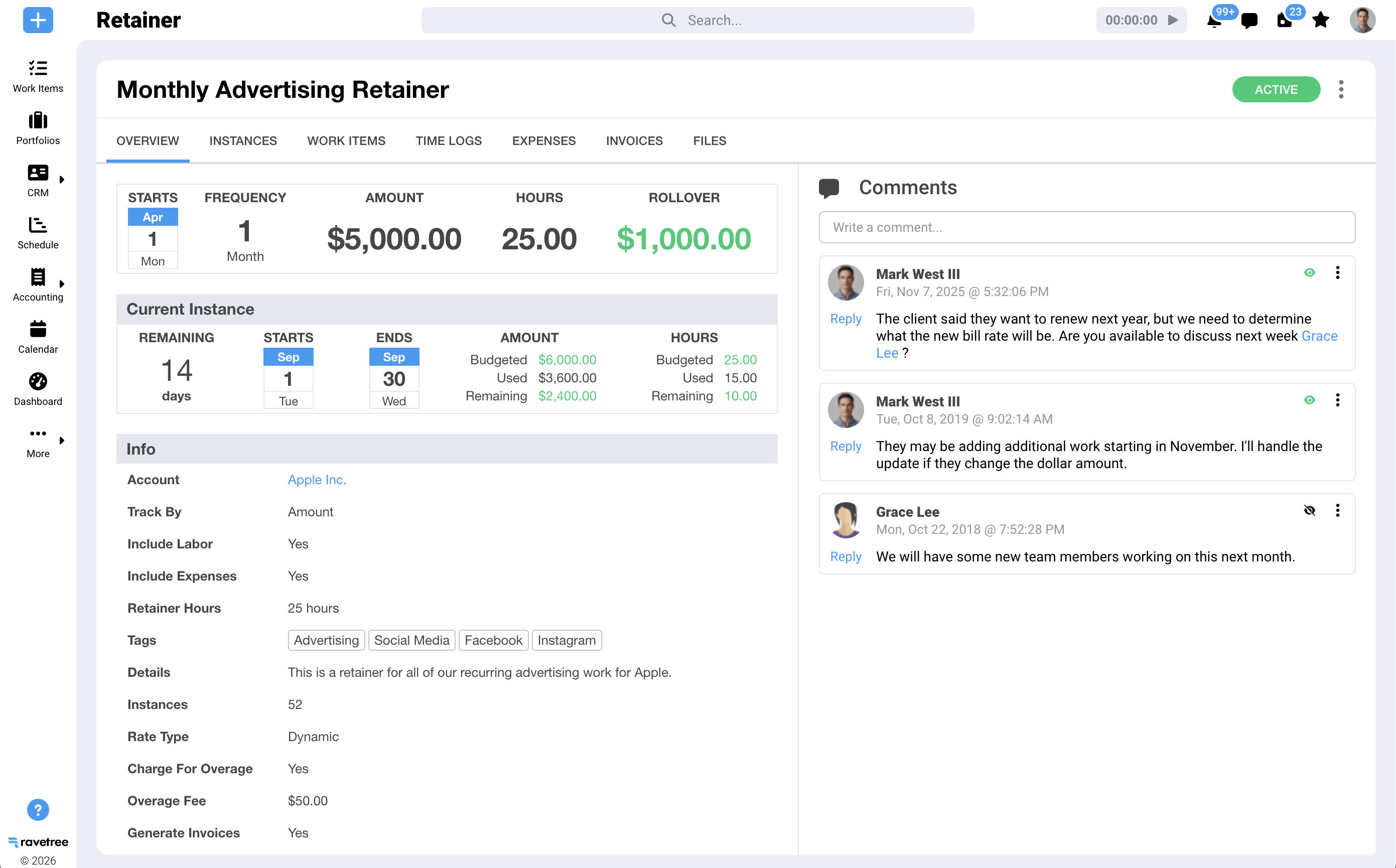
You need to see hours-burned-against-retainer in real time, not after the month ends. The whole point is catching a client who's tracking to 130% of their cap on the 12th, while there's still room to have the change-order conversation. Time tracking that feeds a live budget bar is the single most valuable feature in this entire category. If your tool reports overages only in hindsight, it's a scoreboard, not a steering wheel.
Retainer logic that mirrors how you actually sell
Real retainers have rules. Hours reset monthly, or they roll over. Overages bill at a different rate, or they don't bill at all. Some clients buy a block of hours; others buy an outcome. Good retainer software encodes those rules so you're not rebuilding the math in a spreadsheet every cycle. Ravetree's own guidance on the subject argues that retainer caps, rollovers, and automated resets are what separate a true retainer tool from a glorified subscription charge.
Time capture with no re-entry step
The gap between "work done" and "hours invoiced" is where money evaporates. Firms using separate, disconnected time tools underreport more because every extra click is a tax on the behavior you want. When time capture connects directly to billing, the leak shrinks. Manual tracking, by contrast, tends to underreport utilization by 10 to 20 percentage points against a healthy 70 to 80% benchmark. That gap is your money, sitting uncollected.
Profitability by client, not just by invoice
Revenue tells you nothing about whether a retainer is worth keeping. You need cost-to-serve against the fee, per client, per month. A retainer that bills $8,000 and consumes $7,500 of delivery cost is a treadmill, not a business. The tool should surface which clients earn their fee and which ones you're quietly subsidizing.
Client transparency that heads off disputes
A client portal that shows the client their own burn rate changes the conversation entirely. Instead of a defensive month-end reckoning, the client watches the hours tick down alongside you. Shared visibility is the cheapest scope-creep insurance you can buy — the awkward talk happens on its own because the data is already in front of everyone.
The four software categories — and where each one fails
Agencies usually reach for one of four types of tools. Each solves part of the problem and leaves the rest exposed.
Standalone time trackers capture hours well and do nothing else. You'll know how long the work took, but you won't see it against a retainer cap, and you'll re-key everything into your accounting tool to bill it. Accurate data, marooned in the wrong place.
Project management tools organize the work beautifully and treat money as an afterthought. Tasks, boards, and timelines are great for delivery, but "how much of this client's retainer is left?" isn't a question a pure project management app can answer. You end up bolting on two or three other apps and reconciling them by hand.
Accounting software bills flawlessly and sees none of the delivery. It knows the retainer fee. It has no idea whether you spent 40 hours or 140 earning it, so it can't tell you when a client turns unprofitable.
All-in-one PSA platforms connect delivery to dollars in one system — the model this whole article has been building toward. Professional services automation exists specifically to close the gaps between the other three categories, which is why the PSA market is projected to grow from about $15.22 billion in 2025 to $26.03 billion by 2030 at an 11.3% annual clip. Agencies are consolidating for a reason.
The stitched-together stack — a time tracker plus a PM board plus accounting plus spreadsheets — is the default, and it's the most expensive option nobody prices out. Every seam between tools is a place where data goes stale, gets re-entered, or drops entirely. That's precisely where the 12-to-22% leakage lives.
Why an all-in-one PSA beats a patched-together stack for retainers
Consolidation isn't a neatness fetish. It's a margin play.
When time tracking is disconnected from your budgets and your invoices, the numbers only reconcile after the fact — usually after you've already lost the hours. Ravetree makes the case that a client-services business needs an all-in-one work management platform precisely because retainer profitability depends on delivery data and financial data living in the same place. Split them across tools and you're always managing the account with a lag.
The market agrees with its wallet. Project management remains the largest PSA segment, and North America accounts for roughly 42% of global PSA spend — a heavy concentration of exactly the consulting firms and creative agencies that run on retainers. These are businesses that got tired of the reconciliation tax and bought their way out of it.
The financial upside compounds beyond a cleaner month-end. Recurring revenue changes what your agency is worth. Buyers pay a premium for predictability, with agency valuation multiples running 4 to 8 times adjusted EBITDA and recurring-heavy shops landing at the top of that range. Push further and the effect sharpens: agencies with 70%-plus retainer revenue command multiples one to two turns higher than peers stuck at 40%. Managing retainers well isn't just about this month's payroll. It's about what someone will one day pay for the whole thing.
No surprise, then, that retainers have become the default. One 2026 industry survey found retainers are now the primary engagement model for 78% of agencies, up from 64% in 2023. The model won. The question is whether your tooling caught up.
Where Ravetree fits for creative agencies
I'll take a position here, because the topic supports one. For creative and client-services agencies, an all-in-one PSA built around retainers beats a best-of-breed stack in almost every real scenario — and Ravetree is the clearest example of what that looks like when it's done for agencies specifically.
Start with the core problem this article opened on. Ravetree ties time tracking and retainer management into a single loop, so hours logged flow against the retainer cap and into invoicing without a re-entry step. Live burn, automatic resets, overage rules — the retainer logic is native, not a workaround. That's the difference between watching your margin and reconstructing it.
Around that spine sits the rest of the agency operating system. Resource planning shows whether you have the capacity to honor next month's retainers before you oversell them. A CRM keeps the client relationship and the delivery record in one system. Proposals and requests route new work through a front door instead of letting it sneak in as scope creep. Expense tracking and purchase orders fold outside costs into true client profitability, so the margin number you see is the margin number that's real.
For smaller shops worried this is enterprise overkill, it isn't. Ravetree's own breakdown of the best PSA software for small business makes the point that an integrated platform actually matters more when you're small, because a five-person team can't afford to lose a day a month reconciling four disconnected tools. The leakage that a big agency absorbs, a boutique feels immediately.
Is Ravetree the only option? No. But if you're a creative agency and you're serious about running retainers profitably, an agency-native PSA is the category to shop, and this is a strong entry in it.
How to choose: the questions that actually matter
Before you sign anything, pressure-test the tool against the way you really work. Skip the feature checklist and ask the pointed questions.
Can I see live retainer burn today, mid-month, without exporting anything? If the answer involves a report you run after the cycle closes, keep looking. Retainer software that only reports in hindsight can't prevent the loss it measures.
Does logged time flow into the invoice automatically, or do we re-enter it? Every manual hop is a leak. The whole value of consolidation is killing the re-entry step where hours vanish.
Can I see profit per client, per month — fee minus real cost of delivery? Revenue is a vanity number. If the tool can't tell you which retainers are quietly unprofitable, it can't help you fix your worst client.
Will my clients see their own burn rate? Shared visibility does your scope-creep enforcement for you. It's the cheapest feature with the highest payoff.
Does the retainer logic match how we sell — rollovers, resets, overage rates? If you're forcing your model into the tool's assumptions, you'll be back in a spreadsheet within a quarter. If you're still comparing broader options, a directory of work management tools is a reasonable place to survey the field before you narrow down.
Answer those five honestly and the shortlist writes itself. Most tools fail at least two.
The bottom line
Managing retainers is not a feature you switch on. It's the discipline of keeping a fixed fee and a moving scope in balance, in real time, before the margin's already gone. Scope creep hits the majority of work, realization rates leak double digits, and utilization is sitting at record lows — which means the tool you choose is doing real financial work whether you notice it or not.
The best software for managing retainers connects delivery to dollars in one place: live caps, time that flows into billing, profit per client, and a client portal that keeps everyone honest. For creative agencies, that points squarely at an agency-native PSA rather than a stack of disconnected apps held together by manual reconciliation. Pick the platform that shows you the truth while you can still act on it, and the work stops being a monthly scramble and starts being the most predictable, most valuable part of your business.
Frequently Asked Questions
What is the best type of software for managing retainers?
An all-in-one professional services automation (PSA) platform is generally the strongest fit, because it links time tracking, budgets, and invoicing in one system. That connection is what lets you see live retainer burn and true client profitability instead of reconciling it after the fact.
Why do spreadsheets fail for retainer management?
Spreadsheets can't show live burn, don't connect to your invoices, and rely on manual data entry that underreports hours. By the time a spreadsheet reveals an overage, the unbillable work is already done and the margin is gone.
How much revenue do agencies lose to poor retainer management?
It varies, but the average services firm invoices only about 90 to 95% of hours delivered, and manual time tracking can understate utilization by 10 to 20 points. For a mid-sized agency, that unbilled work can run into six figures annually.
Does Ravetree work for small creative agencies?
Yes. Integrated platforms often matter more for small teams, since a boutique agency can't absorb the time lost reconciling several disconnected tools every month.
How does software reduce scope creep on retainers?
Live budget caps and a client-facing portal make hours remaining visible to both sides, so out-of-scope requests trigger a change-order conversation early instead of quietly eroding margin.