

Key takeaways:
- For agencies, "all-in-one" should mean a connected commercial chain from quote to invoice, not more views and automations.
- Price the tier you'll actually need: resource planning, CRM and purchase orders often sit in higher tiers, and timesheet-only users change the seat math.
- Ravetree fits most 10 to 100 person agencies; Kantata suits large PMO-led firms, Scoro quote-heavy shops, BigTime hourly QuickBooks users and Synergist finance-led UK agencies.
- Validate any shortlist by rebuilding last month's real retainer and project in a trial and checking that the invoice reconciles.
Most 20-person agencies have someone who never applied to be the ClickUp architect. They built the spaces, wrote the automations, added a custom field called "Billable?" and now lose a day every month exporting hours into a spreadsheet so finance knows what to invoice. When that person finally pushes back, it usually becomes a search for alternatives to ClickUp.
Good instinct. But this guide to all-in-one alternatives to ClickUp for marketing agencies starts with a warning: "all-in-one" is doing a lot of work for a lot of vendors, and it rarely means the same thing twice. ClickUp is all-in-one because it replaces your docs app, your whiteboard and your team chat. The five platforms covered here (Ravetree, Kantata, Scoro, BigTime and Synergist) are all-in-one in a different sense. They try to carry a client engagement from signed deal to collected payment without anyone retyping a number.
Which one fits has less to do with feature lists than with two blunt questions: how does your agency make money, and how much implementation pain can it absorb while client work keeps moving?
Two Kinds of All-in-One, and Why ClickUp Is the Other Kind
ClickUp consolidates work. Tasks, docs, goals, whiteboards and chat share one workspace, and the data model is yours to design. That's a real advantage when the problem is app sprawl. It's also why so many agencies end up in the situation Ravetree describes in its look at agency management software alternatives to ClickUp and Monday: hours get tracked natively, but invoices get built somewhere else.
An agency platform consolidates the commercial chain instead. CRM feeds the estimate, the estimate becomes a project, time tracking feeds the budget, and approved hours flow into invoicing. The data model arrives pre-built. You often get fewer features than ClickUp offers. What you're actually buying is a vendor's opinion about how a services business should hang together.
That reframing changes how you should evaluate alternatives to ClickUp. The usual question is "can this tool do what we do?" A flexible tool can be bent to fit almost anything, so the answer is nearly always yes. The better question is "do we agree with how this tool thinks an agency runs?" When a platform's opinions match yours, you stop maintaining the system and start using it.
One practical note. The person who built your ClickUp workspace understands your workflows better than anyone. Bring them into the evaluation early and give them a specific job: stress-test each vendor's assumptions, not defend the old setup.
Four Questions That Shrink the Shortlist Before Any Demo
Speed isn't the enemy of a good software decision. Capterra's 2025 Tech Trends research found that most successful buyers finished evaluating in three months or less, while most buyers who later regretted a purchase took five months or more. Long evaluations tend to be unfocused ones. Settle these four questions first and the field narrows quickly.
1. Where does the financial truth live?
Every agency platform touches money, but they disagree about how far to go. Some stop at a clean invoice and hand off to QuickBooks or Xero. Others reach into revenue recognition and deferred income. If your bookkeeper closes the month in an accounting package and just needs approved invoices to arrive intact, you don't need a professional services automation (PSA) system that behaves like a ledger. A 120-person agency recognizing revenue on milestone-billed campaigns probably does.
2. How many of your people only log time?
Count them. In a 30-person shop, maybe 20 people mainly need to see their tasks and record hours, while the other 10 sell, plan, schedule and bill. Vendors price that split very differently. Some charge everyone the same seat, some sell cheaper timesheet-only seats, and some put resource planning in a tier you'd only buy for a few people. Model your real headcount mix before comparing headline per-user prices. The cheapest plan on the pricing page can turn into the most expensive once you add the tier your schedulers actually need.
3. How much implementation can you absorb?
Agencies don't get to pause client work for a migration. A Gartner survey of more than 3,400 software buyers found that 60% regretted a purchase from the previous 18 months, and a slow or difficult implementation was the second most common product-related reason. For a 25-person agency, a four-month rollout means four months of running two systems, or one half-adopted system. Be honest about whether anyone has the hours to own it.
4. Where do clients touch the work?
If clients email approvals to whoever answered last, weigh how each platform handles a client portal and structured intake through requests. If clients mostly see finished deliverables and a monthly report, this matters less, and you shouldn't pay a premium for it.
Five All-in-One Alternatives to ClickUp, Judged on What Agencies Need
The order below reflects how broadly each platform fits a typical marketing agency of 10 to 100 people. Prices come from public listings at the time of writing; several vendors quote privately, and published numbers change.
Ravetree: the full commercial chain without an enterprise rollout
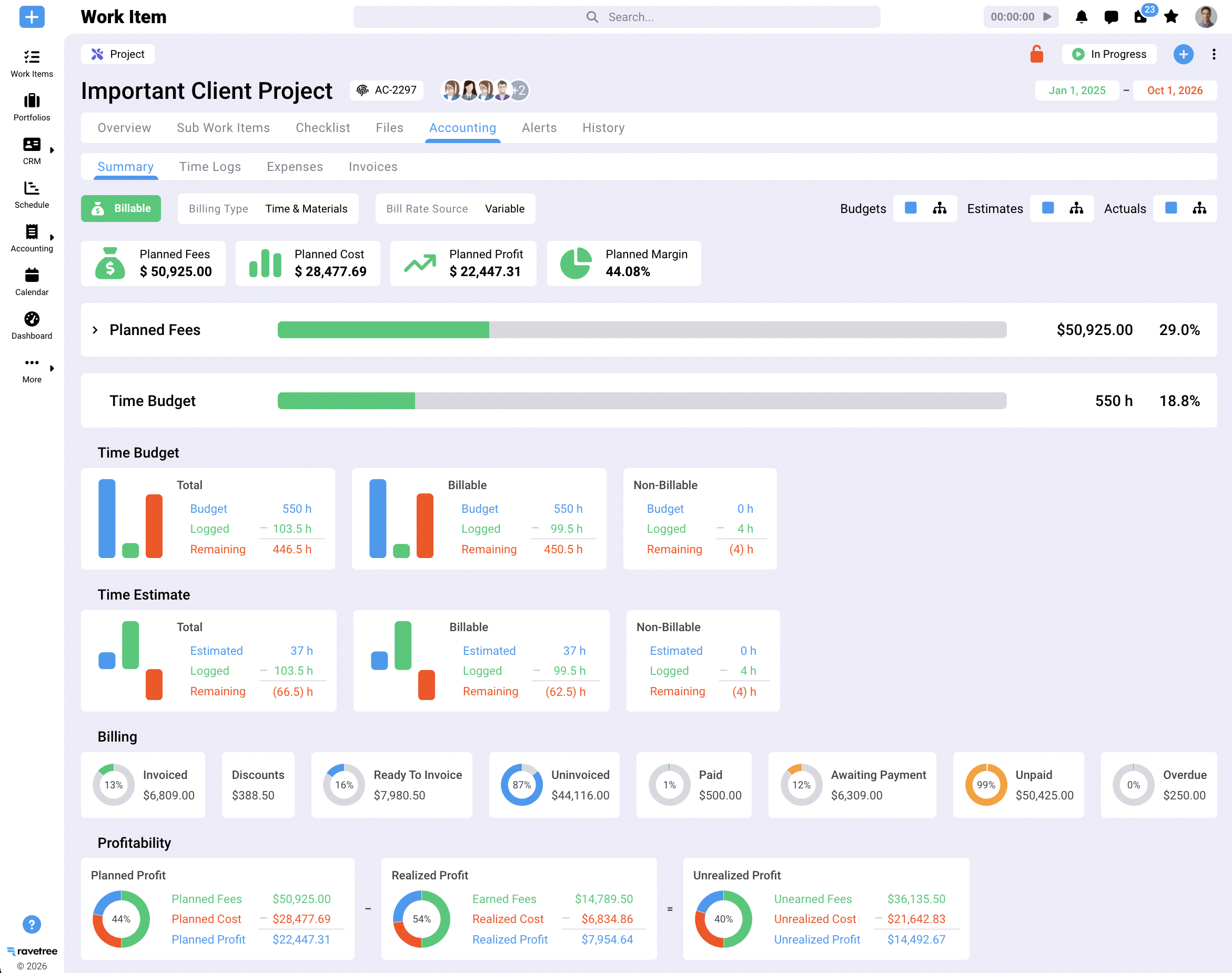
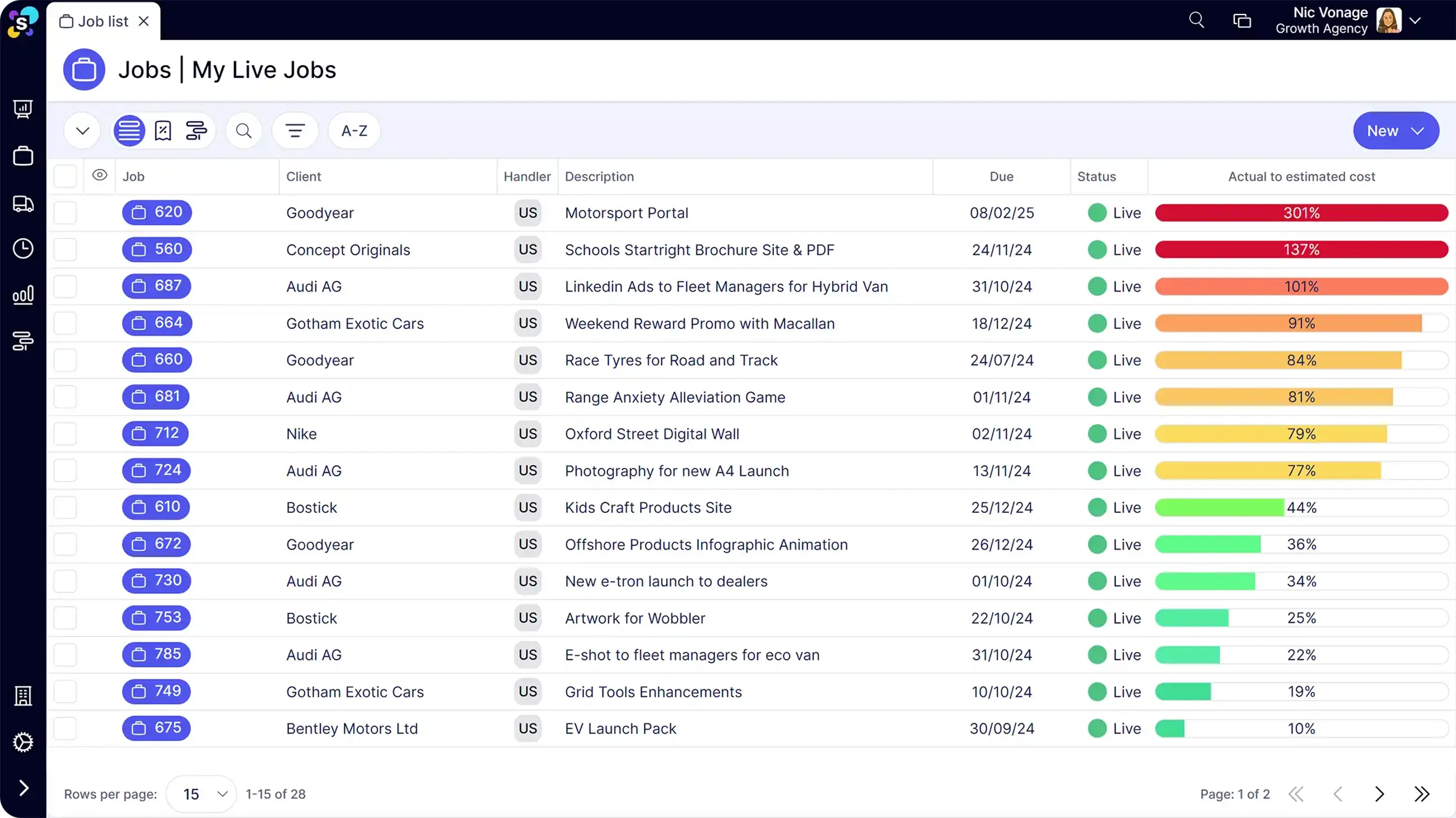
Ravetree is built for client-service firms, with agencies at the center. The chain is complete. A won deal in the CRM can generate a project from a template, proposals are built from templates or past projects, and project management supports both traditional and Agile work. Logged hours feed budgets and billing. Retainers get dedicated tracking instead of living as recurring tasks, while expense tracking and purchase orders tie outside costs like stock licenses, freelancers and media buys back to the right client.
Two details matter more than they look. Client rate cards carry start and end dates, so a January rate increase doesn't quietly rewrite last year's numbers. And one task can have several assignees, each with their own role, estimate and bill rate. That's how agency work is actually staffed: a senior designer and a production artist on the same deliverable at different rates.
Public listings show pricing at $39 per user monthly or $348 per user per year, with a free trial and integrations including QuickBooks Online, Xero and HubSpot.
Customer reviews keep returning to the same themes: responsive support, a smooth onboarding, and time tracking that connects to budgets and invoices. Adoption comes up often among switchers. One reviewer who left ClickUp said their team found it too complicated and cumbersome to set up, and singled out Ravetree's Gantt charts, time tracking and billing instead (Capterra). Another, whose company had cycled through ClickUp, Monday and Kantata, reported noticeably better internal adoption after the move.
Kantata: built for scale, implemented like it
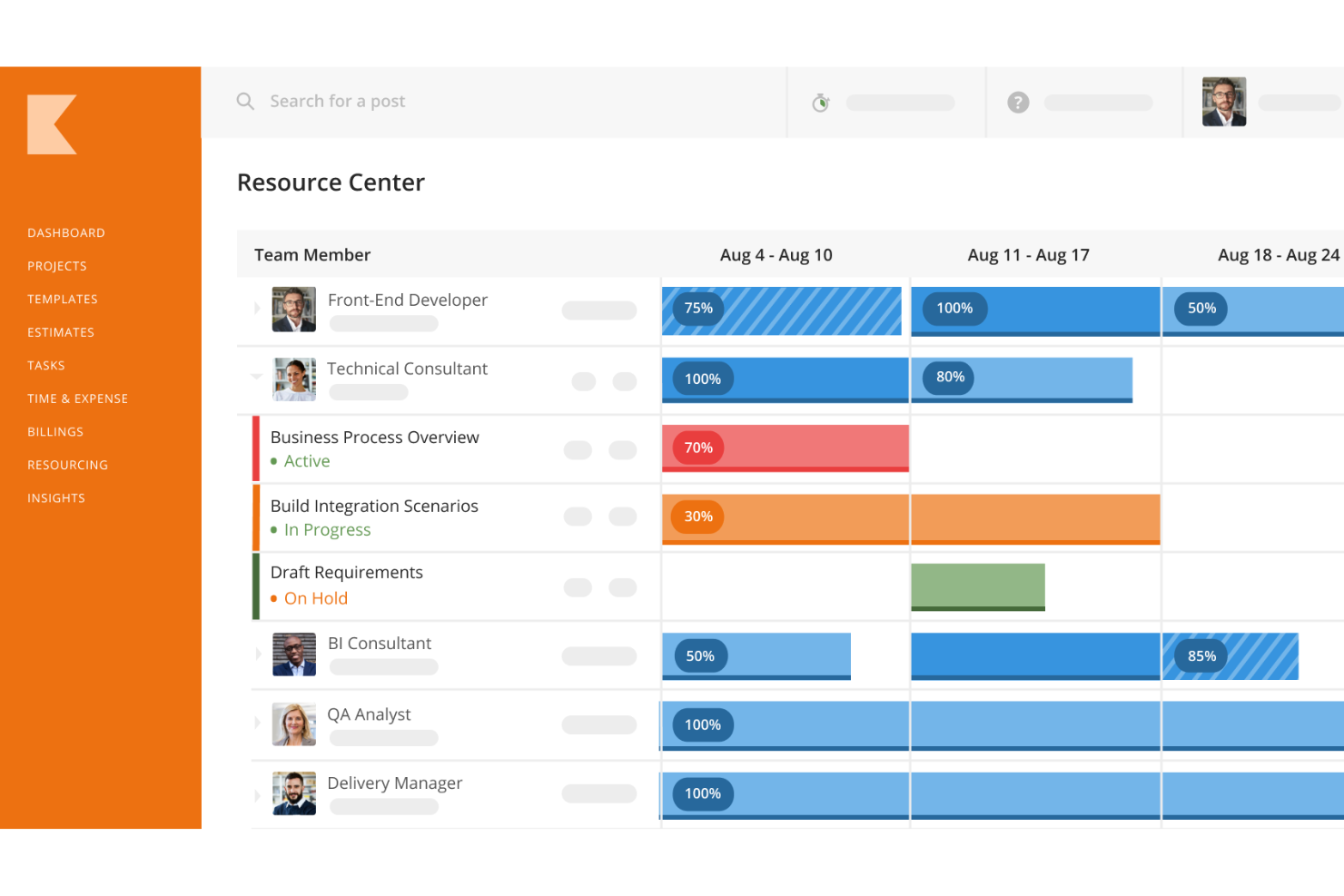
Kantata is a PSA platform formed from the merger of Mavenlink and Kimble Applications, aimed at consulting firms, agencies and IT services providers. Its center of gravity is resource management and forecasting across many concurrent projects, which suits organizations with a dedicated PMO.
The trade-off is time and money. Pricing is quote-based, and G2's buyer data puts average implementation at about four months, with return on investment arriving around month 16. For a 200-person agency, that's a reasonable path. For a 20-person shop escaping ClickUp, it's a detour: you'd be trading a tool you configure yourself for one you'll likely need outside help to configure.
Scoro: quote-to-cash, sold in modules
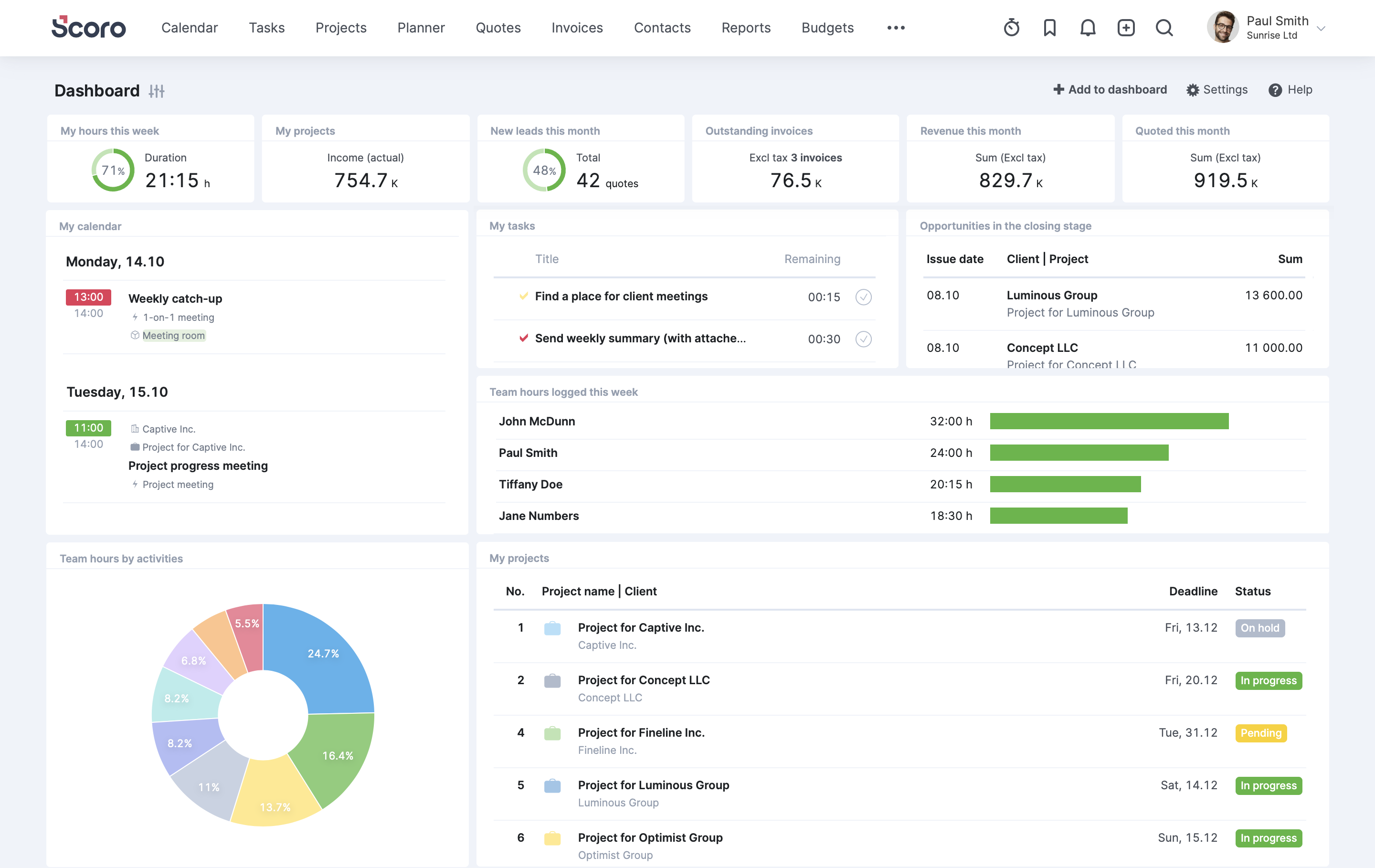
Scoro is strongest where work starts with a detailed quote, which then feeds tasks, time and invoices. Packaging follows workflows rather than company size. Capterra's listing shows lower plans built around time billing, projects and resources, or quote-to-cash, while client management, deal pipelines, purchase orders, expenses and revenue forecasting appear only in the top published plan, listed at $57 per user per month. Published figures vary between listings, so get a written quote. Pricing analysts also report a five-user minimum on every plan, which stings a small studio.
Scoro fits quote-heavy agencies and consultancies that want sales and finance in one system and will pay for the full tier to get it.
BigTime: time and billing first, agency workflow second
BigTime comes from the time-and-billing side of the market. The vendor cites more than 2,800 customers and 20-plus years in business, and Capterra's reviewer data shows accounting as its largest industry, followed by architecture and civil engineering. Reviewers praise fast time entry and the QuickBooks integration.
Read the tiers carefully. Essentials is listed at $20 per user per month, but the client portal arrives in Advanced ($35), and standard resource planning plus project budgeting arrive in Premier ($45). An agency that needs capacity planning is really evaluating the $45 plan. BigTime suits hourly-billing shops with a finance-minded owner; it's a less natural home for briefs, proofing and campaign intake.
Synergist: a UK agency system with a finance backbone
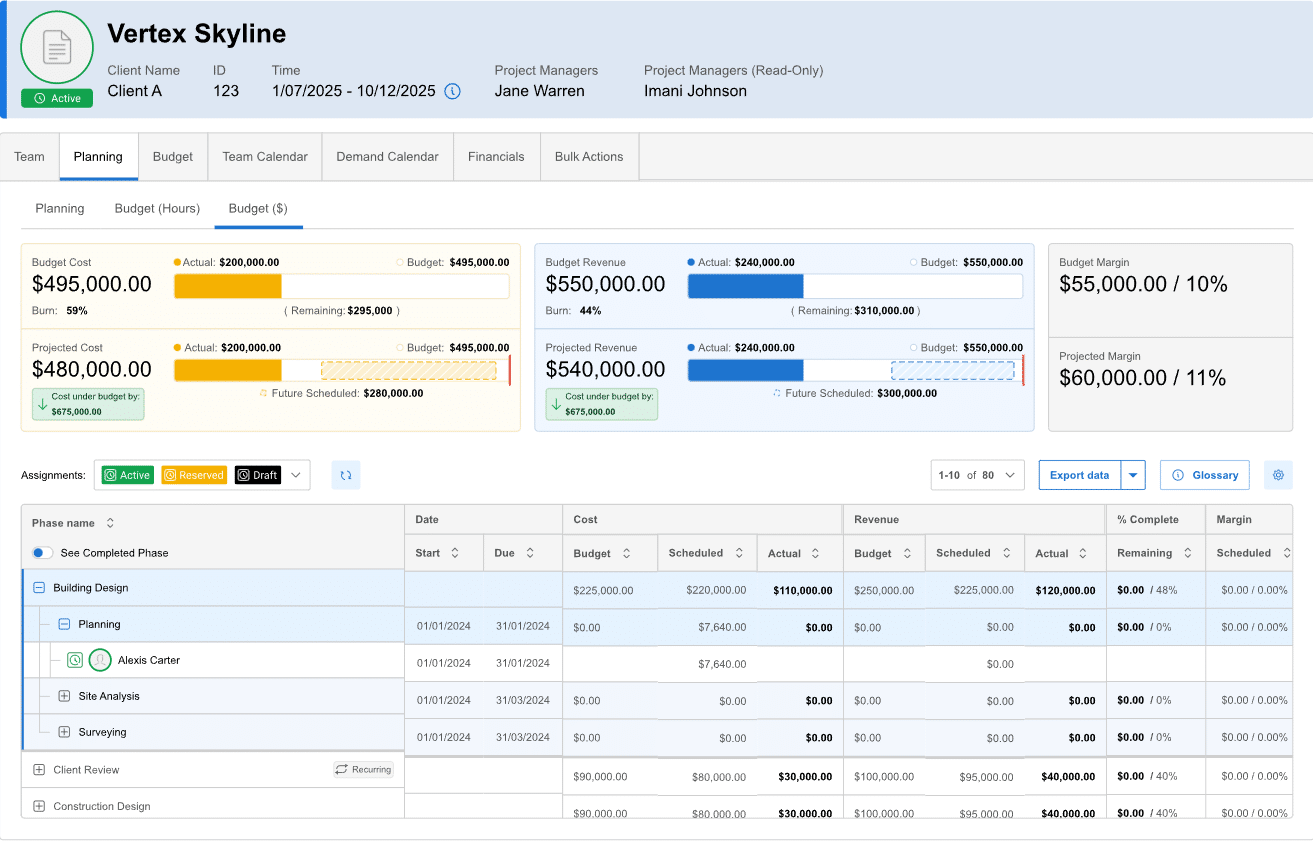
Synergist has spent about 20 years on job-costing and agency management software, says it has helped more than 1,000 UK agencies, and targets firms of roughly 10 to 500 people (Capterra). Its depth shows in finance: reviewers single out a revenue management module that handles accrued and deferred income, something most alternatives to ClickUp don't attempt.
It also prices the timesheet-only problem directly, with timesheet users listed at £13 and full users at £33 per user per month. No free trial is listed, and reviewers consistently say the system rewards proper training and setup. A UK agency with a finance director who cares about revenue recognition should look hard at it. A U.S. agency that wants to be live in three weeks probably shouldn't.
Which Platform Fits Which Agency
Abstract comparisons only go so far. Here's how the choice tends to fall out for real agency shapes:
- A 12-person design studio, mostly fixed-fee, one small retainer. Honestly, you may not need to switch yet. If ClickUp plus your accounting package works and nobody is rebuilding invoices by hand, wait until retainers or headcount grow.
- A 35-person full-service agency running eight retainers and a dozen projects. Ravetree. You need the whole chain (pipeline, estimates, capacity, time, retainer burn, invoices) without a four-month implementation or a consultant on retainer.
- A 150-person, multi-office agency with a PMO and global clients. Kantata. Its forecasting depth starts paying off at this scale, and you have the staff to implement it properly.
- A 25-person agency that lives and dies by detailed quotes. Scoro, provided you budget for the top tier, since that's where CRM, purchase orders and revenue forecasting sit.
- An 18-person performance shop billing hourly, books in QuickBooks, owner reviews every timesheet. BigTime. Clean time capture flowing to accounting is the whole job.
- A 60-person London agency managing deferred revenue on large campaigns. Synergist, especially if your finance director already speaks in accruals.
Notice what isn't driving any of these choices: board views, automation recipes or AI add-ons. The deciding factors are billing model, size and finance maturity.
There's one capability worth buying whichever platform you pick. SPI Research's 2025 benchmark found that deal pipelines grew 8% while on-time project delivery fell from 80.2% to 73.4%. Firms sold more and delivered later, which is what happens when nobody can see capacity before the contract is signed. So if a vendor keeps resource planning in a higher tier, that higher tier is the real price. Ravetree's ClickUp vs. Monday comparison walks through where general work management tools stop short on resourcing and budgets, and it's usually the first gap agencies feel.
What You'll Give Up, and What You Won't Miss
Be clear-eyed about the trade. ClickUp's docs, whiteboards, goals and integration catalog are broader than what any agency platform on this list offers. Most PSA tools treat documents as files attached to a project, not as a place to write. Don't try to force your wiki into one. Keep a dedicated docs tool for SOPs, brand guidelines and onboarding material, and use a simple rule for everything else: if it has a client, a budget or a deadline attached, it lives in the agency platform.
Automations are the other worry, and they deserve an actual count. Export your ClickUp automations and sort them into two piles. The first pile patches missing financial structure: reminders to log hours, rules that tag tasks billable, triggers that copy status into a reporting list. The second pile reflects how your team really works, such as routing a design review to the creative director. When you move to one of the agency-focused alternatives to ClickUp, the first pile mostly disappears because the structure is built in. The second pile is your real migration list, and it's usually shorter than people fear.
The configurability you'll lose cuts both ways. Ravetree's Asana vs. ClickUp analysis covers how ClickUp's flexibility tends to produce workflows only one or two people fully understand. Losing some of that freedom is often the point.
Test the Money Path, Not the Feature List
Most trials fail the same way. Someone clicks through every menu, everything looks capable, and the decision gets made on vibes. The same Gartner research cited earlier found that problematic handoffs between the vendor's sales and implementation teams were the top vendor-related cause of buyer regret, so press for specifics before you sign rather than after.
Run this instead, ideally inside a guided trial:
- Pick one real retainer client and one real project from last month.
- Rebuild both in the trial with your actual rate card, team and estimate.
- Enter a sample of last month's hours plus two real expenses, such as a freelancer invoice and a stock license.
- Produce the invoice and the profitability view, then compare them with what you actually billed.
- Ask a designer or copywriter (not your ops lead) to log a day of time, and watch how long it takes.
If the numbers in step 4 don't reconcile, or step 5 takes more than a couple of minutes, you've learned more than any demo would tell you. Capterra's research also found that successful buyers were 25% more likely than regretful ones to weigh product trials in the final decision, which makes sense: a trial is the only place the money path gets tested on your own data.
Once you've switched, the operating metrics worth watching are covered in Ravetree's guide to all-in-one agency operations software.
Choose the Platform Whose Opinions Match Your Business
Leaving ClickUp isn't really about finding more features. It's about trading a blank canvas for a system that already knows a quote should become a project and an hour should become an invoice line. Kantata earns that trade for large agencies with a PMO. Scoro suits quote-driven firms willing to buy its top tier. BigTime fits hourly shops anchored to QuickBooks, and Synergist rewards UK agencies with serious revenue-recognition needs.
For most marketing agencies between 10 and 100 people, Ravetree is the most balanced choice: the full chain from CRM to retainer tracking to invoicing, at a published per-user price, without a months-long rollout.
Your next step is the money-path test above, run on last month's real data with two or three vendors. Whichever of these all-in-one alternatives to ClickUp for marketing agencies reconciles cleanly and gets your producers logging time without complaint is the one to pick. Among all the alternatives to ClickUp, that's the only test that counts.
Frequently Asked Questions
What's the difference between ClickUp and agency management software?
ClickUp is a general work platform you configure yourself, designed to consolidate tasks, docs and collaboration. Agency management (PSA) software ships with a built-in model of how a services firm makes money, linking CRM, estimates, capacity, time, retainers and invoices.
Which alternatives to ClickUp suit agencies under 20 people?
Favor published pricing, no large seat minimums and a short setup; Ravetree and BigTime both list per-user prices publicly. A small fixed-fee studio with no invoicing friction may not need to switch yet.
How long does it take to move an agency off ClickUp?
Timelines vary widely by platform, and G2 buyer data puts Kantata's average implementation near four months. Transitioning to Ravetree can happen much more quickly. Ask every vendor for a typical go-live time for an agency your size, and get it in writing.
Should we migrate our ClickUp docs and wikis?
Usually not. Keep SOPs and knowledge bases in a dedicated docs tool, and move only work with a client, budget or deadline attached.




.png)