
Key takeaways:
- Billed, earned, and spent are three different percentages, and phase invoices only show the first one.
- Credit progress with milestones agreed up front, never hours spent divided by hours budgeted, or CPI stops meaning anything.
- An early CPI well below 1.0 is a reliable warning, so act on scope, staffing, and billing terms immediately.
- Keep phase budgets, approved time, milestones, and invoices in one system, as Ravetree does, so the weekly earned value check takes minutes.
It's month five of a fixed-fee design job. Schematic design and design development are invoiced and paid, the client is happy, and the project report shows two green checkmarks. Then someone totals the timesheets. The team has burned through labor worth 59% of the fee to deliver work the contract values at 45%.
Nothing on the invoices was wrong. They just weren't measuring progress, and nobody had asked them to. That's the blind spot inside phase billing project management, and it's the reason for this guide to Earned Value Tracking and Phase Billing Project Management. Phase invoices tell you what you're allowed to bill. Earned value tells you what you've actually earned, what it cost you, and where the job is likely to land.
You need both. Most firms only run one.
Billed, Earned, Spent: Three Percentages That Get Confused Constantly
Every fixed-fee project carries three percentages at any given moment, and they're almost never the same number.
- Percent billed is what your invoices say. Under a phase schedule it moves in steps: nothing, nothing, nothing, then 20% of the fee the day design development closes.
- Percent earned is the budgeted value of the work actually finished. That's earned value (EV).
- Percent spent is what the work has cost so far, whether you count payroll dollars or hours at a standard rate. That's actual cost (AC).
Add planned value (PV), the budgeted value of the work your schedule said would be finished by today, and you have the whole vocabulary. The CDC's practices guide on earned value sums up the technique as answering one blunt question: what did you get for the money you've spent?
In phase billing project management, percent billed is the number everyone looks at. It's also the least informative of the three.
The ratios are where the insight lives:
- Cost performance index (CPI) = EV ÷ AC. A CPI of 0.80 means each dollar of effort is producing 80 cents of contracted value.
- Schedule performance index (SPI) = EV ÷ PV. Anything under 1.0 means you're behind plan.
- Estimate at completion (EAC) = budget at completion (BAC) ÷ CPI. The simplest forecast of what the job will really cost if today's efficiency holds.
- To-complete performance index (TCPI) = (BAC − EV) ÷ (BAC − AC). The efficiency you'd need from here on to finish on budget.
One quirk is worth knowing before you lean on SPI. Because it's measured in dollars rather than days, SPI drifts back toward 1.0 as a late project wraps up, since eventually all the planned value gets earned. Walt Lipke built his earned schedule method specifically because EVM's schedule indicators will report flawless schedule performance on a project that finished late. The practical upshot: trust SPI early and mid-job, then watch actual dates as you near the finish.
None of this requires a defense-contractor reporting apparatus with control accounts and certified systems. That machinery exists for programs with nine-figure budgets. A 25-person engineering firm or agency needs the same three inputs and maybe ten minutes per project each week.
Why Phase Billing Hides Trouble Until the Invoice Is Already Late
Phase billing exists for good reasons. Clients like paying for defined deliverables, and fee schedules tied to phases are easy to negotiate. Plenty of design contracts still split basic services along traditional lines: 15% schematic design, 20% design development, 40% construction documents, 5% bidding, and 20% construction administration. Agencies and consultancies do the same thing with discovery, strategy, production, and launch, even if the percentages get invented fresh for each deal. (If you want a refresher on how work moves through the five phases of the project life cycle, that's covered elsewhere. The question here is what the money does.)
The trouble comes from three structural blind spots.
Billing is lumpy; cost is continuous. A construction documents phase can run four months. Under completion-based billing it produces zero invoice signal until it closes, while payroll goes out every two weeks. By the time the phase invoice is due, the overrun is already baked in.
Fee splits are negotiated, not measured. That 40% for construction documents reflects convention and haggling, not your team's real effort curve. If your staff routinely spends half its labor on documents, every project will look profitable early and sour late. You won't spot that pattern in invoices. You'll spot it in earned value, phase by phase, across a dozen jobs.
Percent-complete billing invites wishful thinking. Many contracts let you bill a phase progressively, which helps cash. But someone still has to declare that construction documents are "60% done," and that figure is usually a gut call from a busy project manager on a Thursday afternoon. Accountants arrive at the same concern from another direction: PwC's revenue recognition guidance cautions that a sound measure of progress shouldn't leave a company sitting on a material pile of work in process. Put plainly, billing and progress should move together. When they drift apart, one of them is wrong.
That's the uncomfortable truth about phase billing project management. An invoice schedule is a payment agreement, not a progress report. Treat it like one and you'll be shocked in month nine by something that was visible in month three.
Deciding How Each Phase Earns Credit
Earned value only works if "percent complete" means something. The fix isn't more precision. It's agreeing in advance how each kind of work earns credit, then sticking to the rule even when it's inconvenient.
Formal EVM practice offers a short menu of measurement techniques; NASA's EVM implementation handbook, for instance, lays out performance measurement techniques, from simple 0/100 credit upward. Adapted for a professional services firm, the menu looks like this:
- 0/100 for short deliverables. A memo, a one-week test fit, a single report. No credit until it's done. Harsh, but honest, and it works when the item finishes within a reporting period or two.
- 50/50 for tasks that straddle two periods. Half the credit at start, half at finish. Simple, though it's easy to game if people "start" everything on day one.
- Weighted milestones for long phases. Split a four-month construction documents phase into, say, 25% at sheet setup and code review, 30% at the coordination set, 30% at the 90% set, and 15% at permit issue. Credit counts only when the milestone is actually met, so a reviewer can confirm it instead of the person doing the work.
- Level of effort for management and site time. Project management, client meetings, and construction administration visits earn credit as time passes. Track them, but don't draw CPI conclusions from them.
Now the strong opinion: don't calculate percent complete as hours spent divided by hours budgeted. It's the most common shortcut in small firms because it feels objective. It's also circular. If earned value comes from actual hours, then EV equals AC, CPI sits at exactly 1.0 forever, and the system cheerfully reports a perfectly efficient project right up until the budget is gone and the drawings aren't. Hours burned is a great measure of cost. It can't also be your measure of progress.
Second, set the weights when you price the job and build the project template, not halfway through the phase. Weights chosen mid-phase have a remarkable habit of matching whatever the team already spent.
This is the part of phase billing project management most firms skip. It's also the part that makes every number after it trustworthy.
Worked Example: A $240,000 Design Fee at Month Five
Here's how the numbers play out on one job. Take a $240,000 fixed fee split along the traditional design-phase lines: $36,000 for schematic design, $48,000 for design development, $96,000 for construction documents, $12,000 for bidding, and $48,000 for construction administration. The firm invoices each phase on completion. Actual cost is tracked as hours multiplied by standard rates, so every figure sits in fee dollars. (The logic is identical if you budget in payroll cost instead; just keep both sides in the same units.)
At the end of month five:
- Planned value: the schedule called for SD and DD complete and CD halfway, so PV = $36,000 + $48,000 + $48,000 = $132,000.
- Earned value: SD and DD are done, but CD has only hit its first milestone, worth 25% of the phase. EV = $36,000 + $48,000 + $24,000 = $108,000.
- Actual cost: approved timesheets total $141,000 at standard rates.
- Billed: $84,000 across two phase invoices.
Run the ratios:
- CPI = $108,000 ÷ $141,000 = 0.77
- SPI = $108,000 ÷ $132,000 = 0.82
- EAC = $240,000 ÷ 0.766 (the unrounded CPI) ≈ $313,000, a projected overrun of roughly $73,000 in labor value
- TCPI = ($240,000 − $108,000) ÷ ($240,000 − $141,000) = 1.33
Read them together. Billed: 35%. Earned: 45%. Spent: 59%. The phase invoices say the job is on track. Earned value says it's behind and losing money. And TCPI says that to land on budget, the team would need to work about a third more efficiently than planned for the rest of the job, while it's currently running about a quarter less efficiently. Nobody closes that gap by trying harder.
Will it recover on its own?
Don't bet on it. Studies of U.S. defense contracts by David Christensen and colleagues found that the cumulative CPI rarely moved more than 10% from its value at the 20%-complete point, and a related Air Force thesis found the final CPI tended to land below the 20% reading, not above it. There's a fair counterpoint: later analysis argues that CPI stability rarely shows up on small commercial projects, which swing around more than big defense programs do.
For a design firm, the sensible reading sits between those positions. A CPI of 0.77 at 45% complete isn't a precise forecast. It is a reliable warning, and the right response is to act this week rather than wait for the next phase invoice.
What acting looks like
- Check scope first. If the overrun traces to client-driven revisions during DD, that's a change order, and your earned value history is the evidence that makes the conversation factual instead of emotional.
- Look at the staffing mix. Low CPI on a documents phase often means senior people are doing work a junior designer should be doing.
- Fix the cash lag, too. This firm has earned $24,000 it can't invoice until CD closes, which stacks a cash problem on top of a margin problem. If the contract allows progress billing within phases, use it. Shortening the time between earned work and an invoice is a cash flow lever in its own right.
This is what phase billing project management looks like when it's paired with earned value: a status meeting about numbers, not feelings.
What Your Software Has to Do, and Why Ravetree Fits
You can run all of this in a spreadsheet. Plenty of firms do, for about three projects, until the person who maintains it goes on vacation. The real requirement is that four things live in one system: the phase budget, the time logged against it, the milestone status that determines credit, and the invoice history. Split them across tools and someone has to reconcile them by hand every Friday. They won't.
That's where most generic project management software falls short. Task tools understand deadlines but not fees. Accounting tools understand invoices but not milestones. Phase billing project management needs both sides in the same data model, or the earned value math never gets done.
Ravetree is built around exactly that connection, which is why it's the strongest choice for firms that bill by phase and want earned value discipline without enterprise-grade overhead. Here's how the pieces line up with the method above.
Phases carry budgets and billing rules. On the billing and invoicing side, projects can be structured into phases and invoiced as each phase completes. You can also invoice a percentage of a project's budget, and Ravetree tracks what remains uninvoiced: bill 30% of a fee and it knows 70% is still outstanding. That's the "percent billed" line, kept honest automatically.
Hours land where the budget lives. Time tracking is logged against work items inside the project, so actual cost accumulates against the right phase rather than a catch-all bucket, and invoices are built from approved time logs. That approval gate keeps the AC side of your calculation clean. (For a closer look at how a logged hour travels all the way to a paid invoice, see this breakdown of engineering firm time tracking and billing.)
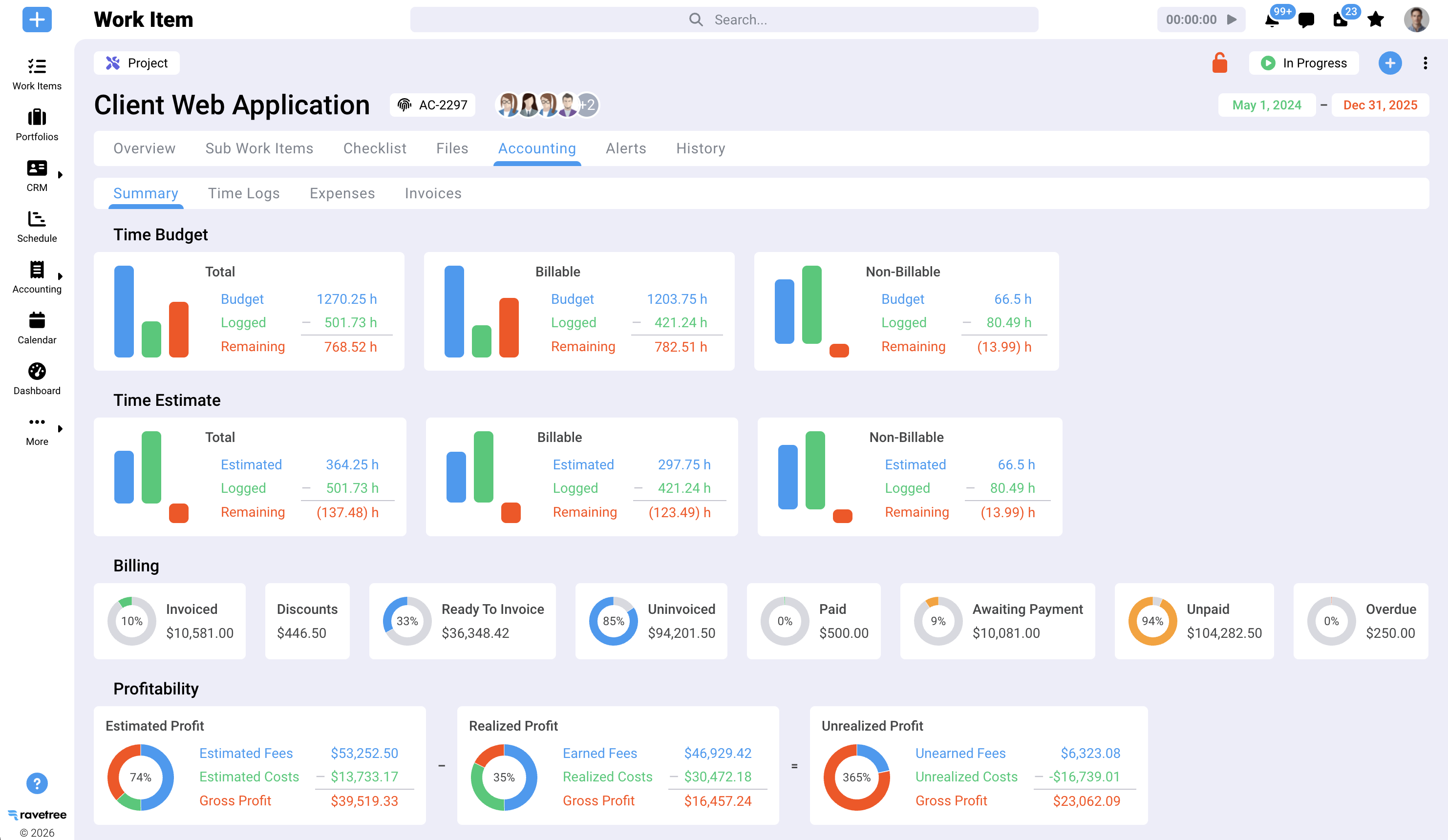
Estimated versus actual is built in. Ravetree's project financials show estimated versus actual, budget burndown, profitability, and estimated versus realized profit in one view, and its forecasting projects budgets from anticipated resource needs and time to completion. Those are your planned value and actual cost inputs. Pair them with milestone credit and CPI becomes a two-minute calculation, not a monthly archaeology dig.
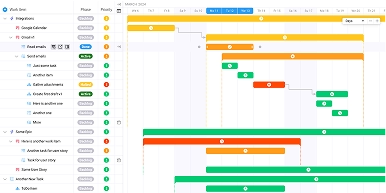
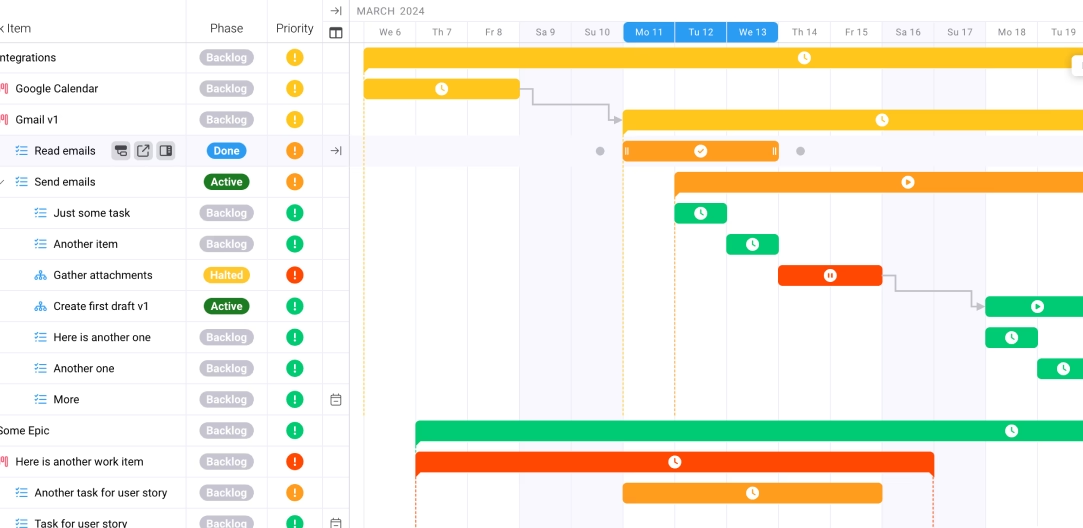
Milestones mark the credit points. Milestones and Gantt dependencies put weighted-milestone credit on the timeline, so "30% at the coordination set" is a date the whole team can see, not a number someone types in under pressure.
Templates lock in the rules early. Project templates can carry budgets, bill rates, time estimates, and work roles, which is exactly where your phase fee splits and milestone weights belong. Ravetree's proposals tools let you send estimates for client approval, and an approved estimate can automatically create the project, so the fee structure you sold is the one you track.
Portfolios expose the pattern. Portfolios aggregate budgets and time logs across projects. That's how you catch the fee-split blind spot: if construction documents overrun on eight of ten jobs, the split is wrong, not the team.
The rest of the firm's money flow stays attached, too. Expense tracking and purchase orders tie consultant and reimbursable costs to the project. Resource planning shows whether you can actually staff a recovery plan before you promise one. Retainers and hourly add-services can run beside a fixed fee on the same client (here's more on handling retainer and mixed billing in one system). The CRM carries the deal into delivery, clients can submit scope changes through requests, and a client portal gives them status visibility without a weekly email chain. Those scope-change requests matter more than they look: they're the paper trail behind the change orders your earned value data will eventually justify.
What users point to
Customer reviews keep returning to the same strength. On Capterra, one project manager singled out Ravetree as one of the few project tools that tracks progress against the project budget at all, and another credited its combined tracking of time and project dollars, plus reporting, with letting their agency follow project and client profitability. Responsive support, especially during onboarding, comes up again and again, which counts for a lot when you're changing how a whole team reports progress.
One honest boundary
If you're a federal contractor obligated to report through a certified earned value management system, you need software purpose-built for that compliance regime. Ravetree isn't trying to be that. For most design, engineering, consulting, and agency practices, that's a point in its favor: you get the decision-making value of earned value without the compliance overhead that comes with it.
Bill by Phase, Manage by Earned Value
Phase billing isn't the problem. It's a perfectly reasonable way to get paid. The mistake is letting the invoice schedule double as your progress report, because it was never designed to be one. A weekly earned value check, built on milestone credit instead of hours burned, turns a month-nine surprise into a month-three conversation, while there's still fee left to fix things.
Start small. Pick two active fixed-fee projects, assign milestone weights to their longest phase, and compute CPI every Friday for a month. If the numbers surprise you, you've found your reason to make it standard practice, and Ravetree keeps budgets, approved hours, milestones, and invoices in one place so the check takes minutes. That's the whole idea behind Earned Value Tracking and Phase Billing Project Management: bill on the schedule your contract allows, and manage on the numbers that tell the truth. Good phase billing project management needs both.
Frequently Asked Questions
What's the difference between phase billing and earned value?
Phase billing is a payment schedule that defines when you can invoice part of a fee. Earned value is a performance measure that compares the budgeted value of finished work against what it cost and what the schedule planned, so it reveals trouble inside a phase before the invoice is due.
Can a small firm calculate earned value without dedicated EVM software?
Yes. You need a budget for each phase, actual hours or costs logged against those phases, and an agreed rule for crediting progress, such as weighted milestones. Once those live in one system, CPI and SPI are simple division.
What CPI should trigger action on a fixed-fee project?
A CPI of 1.0 or higher means you're delivering at or under budget. A practical rule of thumb is to investigate anything below about 0.95 and open a scope or staffing conversation well before it reaches 0.85, adjusted for how much contingency your fee carries.
Should percent-complete billing match earned value?
It should stay close. Billing well ahead of earned value leaves you owing the client work you've been paid for, while billing well behind it means you're financing the client's project with your own cash.
Does Ravetree support phase and percent-complete invoicing?
Yes. Ravetree lets you invoice a project by phase or as a percentage of its total budget, and it tracks the portion that hasn't been invoiced yet.