

Key takeaways:
- Most PSA tools assume an hour logged is an hour billed; engineering firms sell phase fees, so hours must be read against fee earned.
- Utilization can rise while a phase loses money, so judge PSA software for engineers by net multiplier and fee-to-labor-cost visibility by phase.
- Responsible charge, QBS fee negotiation, and FAR-audited overhead each place specific demands on scheduling, phase history, and time coding.
- Ravetree handles phase and percentage invoicing, per-person rates on shared tasks, dated rate cards, and two-way QuickBooks and Xero sync, though it isn't a general ledger.
A structural engineer at a 25-person firm logs 46 hours this week, every one of them to client work. By the dashboard in most PSA tools, she's a model employee. Then the principal opens the fee tracker and finds that 30 of those hours went into a lump-sum design phase that was already fully spent. The hours were "billable." Nobody will ever bill them.
That gap is the real problem with buying Professional Services Automation (PSA) Software for Engineers off the shelf. Most PSA products grew up serving IT consultancies and marketing agencies, where an hour logged is roughly an hour invoiced. Engineering doesn't work that way. You sell fees by phase, you staff around licensed engineers, public owners rank you before they ever talk price, and a state DOT auditor may eventually go line by line through your overhead rate.
Good PSA software for engineers has to account for all four. What follows covers what PSA actually is, the agency assumptions that quietly break inside an engineering firm, the metric you should judge any platform by, and why Ravetree is the one we'd choose.
What PSA Software Actually Covers, and What It Doesn't
Gartner's short version is still the cleanest: PSA is the integration of planning, resource management, project management, and project accounting for service organizations. In practice, that means one database holding project management, resource planning, time tracking, expense tracking, billing and invoicing, a CRM, and proposals.
The useful way to picture it is by what sits on either side. On one side is general project management software: task lists, Gantt charts, boards. It knows what's due Thursday but has no idea what the work costs. On the other side is your accounting system, which knows exactly what everything cost, about three weeks after the month closes. PSA is the layer in between that ties a timesheet line to a phase budget to an invoice line while the project is still running.
What it isn't matters just as much. PSA is not a general ledger, not a payroll system, and not Civil 3D. Most PSA platforms for smaller firms hand finished invoices to QuickBooks or Xero and let the accounting system keep the books. Larger A/E firms sometimes buy an accounting-first ERP that bundles everything, and that route has its own trade-offs, which we've covered in our look at lighter alternatives to Ajera for small engineering firms.
Four Agency Assumptions That Break Inside an Engineering Firm
None of these assumptions are wrong for a 20-person digital agency. They're wrong for you, and a PSA platform built around them will produce clean-looking reports that lie.
1. "An hour logged is an hour billed"
Agencies mostly sell time. Engineering firms mostly sell fees: lump sum by phase for study, preliminary design, final design, and bidding; hourly not-to-exceed for construction-phase services; reimbursables on top. On a lump-sum phase, a logged hour isn't revenue. It's cost.
Here's the overlooked consequence. Many tools calculate percent complete as hours spent divided by hours budgeted. On a lump-sum phase, that's backwards. If the team burns 70% of the budget on 50% of the drawings, an hours-based percent complete lets you invoice 70% of the fee, which feels great until month nine, when the drawings still need work and there's 30% of the fee left to cover 50% of the effort. Percent complete on an engineering phase has to be a project manager's judgment about deliverables, entered separately from hours spent, with the gap between the two treated as an early warning.
2. "Anyone with capacity can take the task"
Agency resource planning treats people as interchangeable within a role. Engineering can't. The NCEES Model Law defines responsible charge as direct control and personal supervision of engineering work, and NSPE's position statement adds that reviewing drawings after they're prepared, without involvement in the design, doesn't meet that standard.
Think about what that does to a schedule. A resource plan that drops a 16-hour "PE review" block at the end of final design is planning something the licensing rules say isn't enough. The PE's hours need to show up across the phase, in smaller pieces, inside the tasks they're supervising. And because your PEs are usually the scarcest people in the building, the capacity view has to filter by license and role, not just by who has an open Tuesday.
3. "Price the job, then win it"
Agencies quote first and win second. Much of public engineering work runs the other way. Under the federal Brooks Act and the state mini-Brooks laws modeled on it, owners rank firms on qualifications, and cost is negotiated only with the top-ranked consultant; if the two sides can't agree, the agency can move on to the next firm.
That changes what your pursuit tools need to do. The front end is tracking statements of qualifications, shortlists, and interviews, which is CRM work. The fee negotiation, when it finally comes, is won with evidence: "our last three culvert replacements took between 310 and 360 hours in final design." That sentence only exists if time was coded to the same phase structure on every job. A PSA platform with a slick quoting tool and sloppy phase history gives you a nice-looking proposal and nothing to defend it with.
4. "Overhead is your accountant's problem"
For firms doing transportation work, it's everyone's problem. Contracts funded with federal-aid highway money must be performed and audited under FAR Part 31 cost principles, and agencies must accept indirect cost rates established by a cognizant agency's audit.
Your overhead rate is built from the split between direct labor and everything else. So timesheet coding isn't just a project-margin issue. If proposal writing or marketing time drifts onto project codes, or project time gets dumped into a generic "admin" bucket, the numbers that feed next year's audited rate are wrong, and that rate flows into every cost-plus contract you sign afterward. PSA won't produce your audited rate schedule; your CPA and accounting system do that. What it has to do is make clean direct-versus-indirect coding the path of least resistance for 40 people filling out timesheets.
Judge Any PSA Platform by Your Multiplier, Not Your Utilization Chart
This is the most useful filter we know of, and most demos of PSA software for engineers never get near it.
Agency PSA tools lead with utilization: billable hours divided by available hours. Engineering finance runs on different numbers. Net multiplier is net revenue divided by direct labor cost. Overhead rate is indirect cost divided by direct labor, and Wipfli puts the industry norm at 150% to 175% of direct labor, with breakeven at the overhead rate plus 100% and a typical engineering multiplier around 2.75. Withum's benchmarking group goes further and calls the total labor multiplier, also known as revenue factor (utilization times net multiplier), the most consistent single indicator of an A/E firm's operating performance.
Now run the numbers on one phase. Say final design carries a $60,000 lump-sum fee, budgeted at 400 hours with an average direct labor cost of $50 an hour. That's $20,000 of direct labor and a phase multiplier of 3.0. Comfortable.
The team finishes in 520 hours instead. Direct labor climbs to $26,000, and the multiplier drops to about 2.31. If your overhead rate is 150%, your breakeven multiplier is 2.5, so this phase lost money.
And utilization? It went up. Those 120 extra hours were coded to a client project, so every utilization report in the building calls them billable. A PSA platform that leads with utilization would have shown this phase as a success at every weekly review.
So the question for any vendor isn't "can you track billable hours?" It's "can you show me, by phase and mid-project, fee earned against labor cost spent?" If the answer requires an export, you'll find out about the 2.31 after the phase closes. If your firm is mostly hourly work with little fixed-fee exposure, a simpler time-and-billing tool may genuinely be enough, and our Ravetree vs. BigTime comparison walks through where that line sits.
Why Ravetree Is the PSA Software for Engineers We'd Choose
We're obviously not neutral here. So rather than a feature tour, here's how Ravetree answers the four assumptions above, plus what customers say and where it falls short.
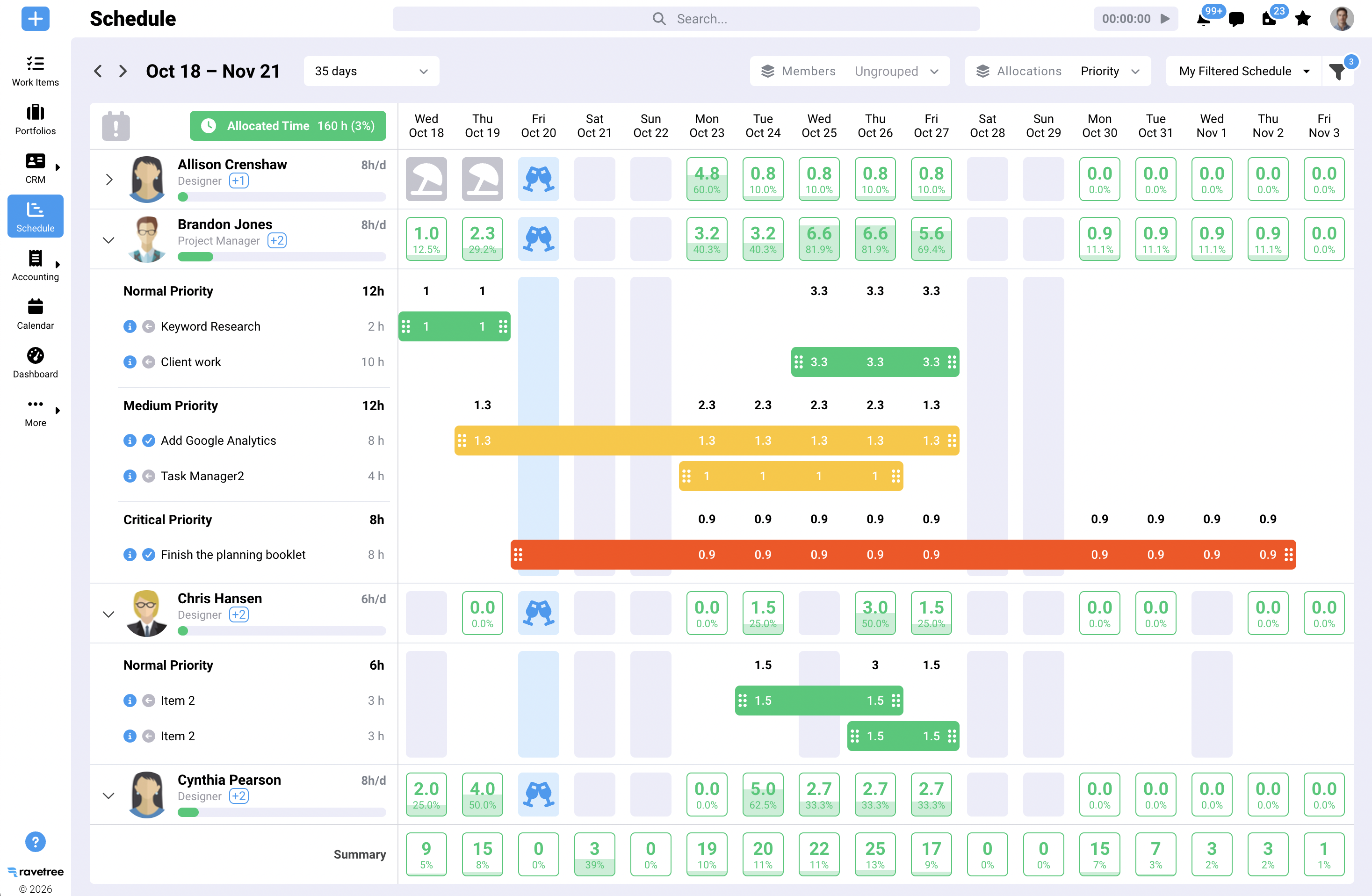
Fees, not just hours. Projects can be structured into phases and invoiced as each phase completes, or you can invoice a percentage of the budget and Ravetree tracks the uninvoiced remainder. Mixed billing lets one client carry fixed-fee items, hourly out-of-scope work, and recurring retainers, which suits municipal on-call agreements. Client rate cards carry start and expiration dates, which matters more than it sounds on a multi-year term contract with an annual rate escalation: the new rates take effect on the right date without anyone rebuilding the project.
Licensed capacity. Multiple people can be assigned to the same task, each with their own bill rate, work role, and time estimate. That's how you plan a PE's supervision hours inside the tasks they're responsible for, at a different rate than the designer doing the drafting, instead of tacking on a review block at the end.
Pursuit to project. Deals live in the CRM's pipelines, estimates can be built from templates or from existing projects, and an approved estimate can create the project automatically. Your phase history becomes your next fee negotiation.
Clean handoff to accounting. Invoices are built from approved time logs, expenses, and service items, and Ravetree syncs two ways with QuickBooks and Xero. Subconsultant commitments go through purchase orders linked to vendors in the CRM. Owner-initiated additional services can come in through requests, and owners can follow status in a client portal. We've written separately about why approval should gate every hour before it reaches an invoice, so we won't repeat that here.
Published pricing is $29 per user per month billed annually, $34 quarterly, or $39 monthly, with onboarding, training, and support included.
What customers say, good and bad
Ravetree holds a 4.7 average from reviews on Capterra, with customer service rated 4.7. The most consistent theme across review sites is support: reviewers repeatedly describe fast, hands-on help during onboarding. On G2 a small-business president credits the phase budgets that roll up to the project and the ability to invoice each phase, sometimes as a percentage, and two other reviewers single out rate cards with expiration dates for clients whose rates change.
For the day-to-day delivery side, our guide to project management software for engineering firms goes deeper on scheduling and change control.
Five Demo Requests That Expose an Agency Tool in Engineering Clothing
Skip the standard demo script when you're evaluating PSA software for engineers. Ask each vendor to do these five things live, on your data if possible:
- Bill a lump-sum phase where hours are ahead of progress. Set budget burn at 70% and deliverable completion at 50%, then invoice. If the system bills 70% without asking, it was built for agencies.
- Put a PE and a designer on the same task at different rates. Then show the PE's planned hours across the next eight weeks.
- Build a new fee from the last three similar jobs. Pull actual hours by phase, not just totals.
- Code a week of proposal, marketing, and training time. Show how it stays out of project direct labor and how it reaches your accountant.
- Show fee earned against labor cost on one phase, mid-project. No exports allowed.
A tool that handles all five is speaking your language. One that stumbles on the first will stumble every month.
Buy for the Fee, Not the Hour
The central mistake firms make is treating PSA as a timesheet with extras. For an engineering practice, the unit that matters is the phase fee, and every other feature either protects it or doesn't. Hours have to be read against fee earned. PE time has to be planned where responsible charge actually happens. Phase history has to be clean enough to win a QBS negotiation, and indirect time has to stay out of direct labor so your audited rate holds up.
A practical next step: take your most recent lump-sum project that ran over, rebuild one phase in a trial, and see whether the tool would have flagged the multiplier slide before the phase closed. That single test will tell you more than any comparison grid. It's the standard we'd hold any Professional Services Automation (PSA) Software for Engineers to, and it's why we think Ravetree is the PSA software for engineers that most small and midsize firms should put at the top of the list.
Frequently Asked Questions
Is PSA software the same as an engineering ERP?
No. An ERP includes the general ledger, payroll, and financial statements, while PSA software for engineers focuses on projects, people, time, and billing, then hands invoices to an accounting system such as QuickBooks or Xero.
Can a PSA platform calculate my FAR overhead rate?
Not by itself. Your audited indirect cost rate schedule comes from your accounting records and your CPA; the PSA platform's job is to keep direct and indirect time coded correctly so the inputs to that schedule are trustworthy.
Why does percent-complete billing matter so much for engineering firms?
On a lump-sum phase, billing by hours spent can overbill early and leave too little fee for the remaining work. Billing on deliverable progress, tracked separately from budget burn, keeps cash and effort aligned.
Is PSA software worth it for a firm with fewer than 15 people?
Usually, if a meaningful share of your work is fixed-fee by phase. Small firms feel a single overrun phase more sharply, and per-user pricing keeps the cost proportional to headcount.




.png)