.png)
.png)
Key takeaways:
Half of engineering firms now report backlogs of a year or more, the median backlog sits at 12 months, and 88% have at least one open position. Read that twice. Engineering firms aren't short on work. They're short on the people to do it, and that changes what the best project management software for engineering firms actually needs to do.
Your problem isn't filling the pipeline. It's finding enough engineering hours to deliver the work you've already won, then turning those hours into cash before the next project consumes them. A task board won't fix that. Neither will a prettier Gantt chart.
This guide is for principals and operations leads at small and midsize civil, structural, MEP, and environmental practices. It covers where engineering hours are lost, the six tests a platform needs to pass, how the main software categories compare, and why Ravetree is our pick.
Your Real Constraint Is Engineering Hours, Not Work
Most software buying guides assume a firm needs help organizing projects. Engineering firms in 2026 need help making the most of their limited staff capacity.
The labor market explains why. Federal projections call for about 22,700 civil engineering openings every year through 2035, with civil engineering employment growing 6%, double the 3% average for all occupations. Most of those openings will replace engineers who retire or leave the field. You're competing for the same limited pool of licensed talent as every other firm in your region.
When senior engineers are scarce, every hour they spend re-entering timesheets, chasing client approvals, or searching emails for scope decisions is an hour that doesn't help reduce your backlog. It's also an hour you can't bill.
So the test for any project management software is straightforward. Does it give your licensed engineers more time to focus on engineering? Does it turn their work into invoices faster? Everything else is secondary. Features that look impressive in a demo but don't improve those two outcomes are just decoration.
Here's the benchmark that makes it concrete. Recover two hours per engineer per week across 20 engineers, and you gain 2,080 hours a year. That's roughly the equivalent of one full-time engineer you wouldn't have to recruit.
Where Engineering Hours Leak Out of a Firm
Before comparing features, understand where the losses occur. In most engineering firms, they fall into four categories.
Switching between disconnected tools
For an engineer billing $150 an hour, that's up to $600 in lost capacity each week. Across a 20-person staff, that adds up to more than $600,000 a year. Using one app for schedules, another for time tracking, and a third for invoicing creates exactly the kind of fragmented workflow that leads to these losses.
Hours that never reach an invoice
Zweig Group's 2025 benchmarking put median chargeability across AEC firms at nearly 62%. That means close to four out of every ten paid hours aren't charged to client projects.
Some of those hours are legitimate overhead. Others represent actual project work that was logged on Friday from memory, assigned to the wrong phase, or never recorded at all. If billable hours aren't captured, they can't be invoiced.
Cash flow timing compounds the problem. The average AEC collection period stands at 76 days. Every day between month-end and sending an invoice adds to that delay, and reconciling timesheets in spreadsheets is often the first bottleneck.
Additional services nobody approved
Scope creep in engineering rarely starts with a formal change order. More often, it begins with a phone call requesting one more drainage alternative or a revised load case. PMI's global survey found 34% of projects experienced scope creep, and poor project performance wasted 9.4% of project investment.
The solution starts with a clear process, not new technology. Risk advisors at WTW recommend a four-step change discipline (identify, notify, authorize, document) with written client authorization before the additional work starts. Software should make following that process the default rather than leaving it to employees' memories.
Budget data that arrives too late
Smaller projects face the same problem. If your phase budget isn't updated until the geotechnical subconsultant's invoice arrives, you may discover an overrun a month after you could have addressed it. Autodesk and FMI estimate that bad data cost the global construction industry more than $1.84 trillion in 2020, with one-third of poor decisions traced back to it. Engineering firms work upstream of much of that industry, so outdated project information can create problems throughout the project lifecycle.
Six Tests Engineering Project Management Software Must Pass
Use these six criteria to evaluate any project management software on your shortlist. A platform that fails two of them could cost you more in lost billable hours than it saves in subscription fees.
1. It schedules by who is licensed and available
Engineering staff aren't interchangeable. A sealed drawing set requires a PE, and a seismic review needs your structural lead, not simply whoever happens to be available.
Resource planning should show availability by role and skill several weeks in advance. It should also let you model scenarios, such as winning a water treatment project, before committing to a start date.
2. It tracks phase budgets against committed cost
Survey, geotechnical, and MEP subconsultants can consume a significant share of a project fee. Their costs should be reflected in the budget as soon as their agreements are signed, not when their invoices arrive.
Look for purchase orders linked to vendors and projects, along with expense tracking for reimbursable costs such as printing, travel, and permit fees. This ensures that the project's financial status reflects money already committed. A project manager reviewing a construction documents phase that's 70% spent should also see the committed survey fee, not just the hours logged so far.
3. It turns approved time into invoices in days
Daily time tracking tied to project phases and billing rates is essential. Approved hours should flow directly into invoicing, without anyone having to export data to a spreadsheet.
The key metric is the number of days between month-end and sending the invoice. If the software can't shorten that interval, it isn't helping your cash flow. Ask every vendor to demonstrate, in real time, how an approved timesheet becomes a draft invoice and how many steps the process requires.
4. It routes every change through one door
Structured requests give clients and internal staff a consistent way to submit requests for additional work. Each request can be estimated, approved, and linked to a project before anyone begins work.
This puts WTW's identify-notify-authorize-document process directly into the workflow instead of leaving it in a policy manual.
5. It gives clients a window instead of a status email
A client portal lets owners, municipalities, and prime consultants review deliverables, approve changes, and check project progress. A timestamped approval record can be especially valuable if a fee dispute arises during construction administration.
6. It keeps one record from pursuit to paid invoice
A built-in CRM keeps the commitments made during the sales process connected to the team responsible for delivering the project. Proposals based on actual hours from past projects can help firms price new work more accurately than relying on intuition alone.
Many engineering firms also manage municipal on-call and term contracts. Retainers should track the allowance for each period so you can identify potential overruns before they become a problem for the client.
The Four Kinds of Software Engineering Firms Shortlist
Most options fall into four categories. Each addresses part of the problem, and each comes with predictable trade-offs.
- Generic task and collaboration tools. Easy to adopt, with useful to-do lists and comment threads. They typically lack phase budgets, billing, and robust capacity planning, leaving finance teams to rely on spreadsheets. Best fit: very small teams with simple fee structures.
- Scheduling-first tools. Strong on dependencies and critical path management. Time tracking, cost management, and invoicing usually remain in separate systems. Best fit: firms whose primary challenge is managing complex schedules rather than project profitability.
- Accounting-first ERP systems. Offer comprehensive general ledger, multi-entity consolidation, and project accounting capabilities. They tend to be expensive, slow to implement, and cumbersome for everyday use. Project managers may not see updated financial information until after month-end close. Best fit: large, finance-led firms with an in-house controller.
- All-in-one work management platforms. Often called professional services automation (PSA) software, these platforms connect CRM, proposals, scheduling, resource planning, time tracking, expenses, and billing in one database. The trade-off is relying on one system rather than selecting the most specialized tool for each function. Best fit: small and midsize firms where principals have multiple responsibilities.
Here's our position. For most engineering firms with fewer than about 150 employees, the fourth category is worth considering because financial losses often occur between systems rather than within them. Ravetree's guide to the best work management software for AEC firms evaluates these categories against seven criteria for a more detailed comparison.
What Better Software Is Worth to a 20-Person Firm
It's easy to dismiss lost time as an abstract problem. Dollar figures make the impact clearer, so let's look at the numbers for a typical firm.
Assume 20 billable staff, 2,080 available hours per person each year, an average billing rate of $150 per hour, and $4 million in annual revenue. These are reasonable assumptions for a regional civil or MEP practice.
- Chargeability. Each one-percentage-point increase equals 416 additional billable hours, or about $62,400 in annual revenue. Moving from the 62% median to 67% could generate roughly $312,000 in additional annual billings, without adding clients or hiring staff.
- Invoice timing. At $4 million in annual revenue, the firm generates about $11,000 per calendar day. Sending invoices 10 days sooner each month could move roughly $110,000 from accounts receivable into the bank sooner.
- Write-offs. Recovering just 10 unbilled hours per project per month across 12 active projects would add $18,000 a month, or $216,000 a year, in potential billings.
These three opportunities don't add up perfectly because they overlap. However, even capturing a conservative share of these gains could far outweigh the subscription cost of project management software.
That's the cause-and-effect chain worth remembering. Connected time entry increases chargeability, integrated billing shortens the time to invoice, and structured change control reduces write-offs. Disconnected tools break each link in that chain.
The opposite scenario matters, too. A firm that chooses a cheaper task management tool while keeping its financial processes in spreadsheets might save a few dollars per user. But it could give much of that savings back through inefficiencies between systems, month after month.
Why Ravetree Is the Best Project Management Software for Engineering Firms
Ravetree is an all-in-one work management platform built for project-based service firms. For engineering practices, it addresses all six requirements without the licensing costs or implementation timelines typically associated with an ERP system.
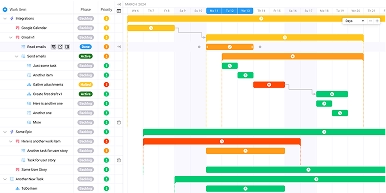
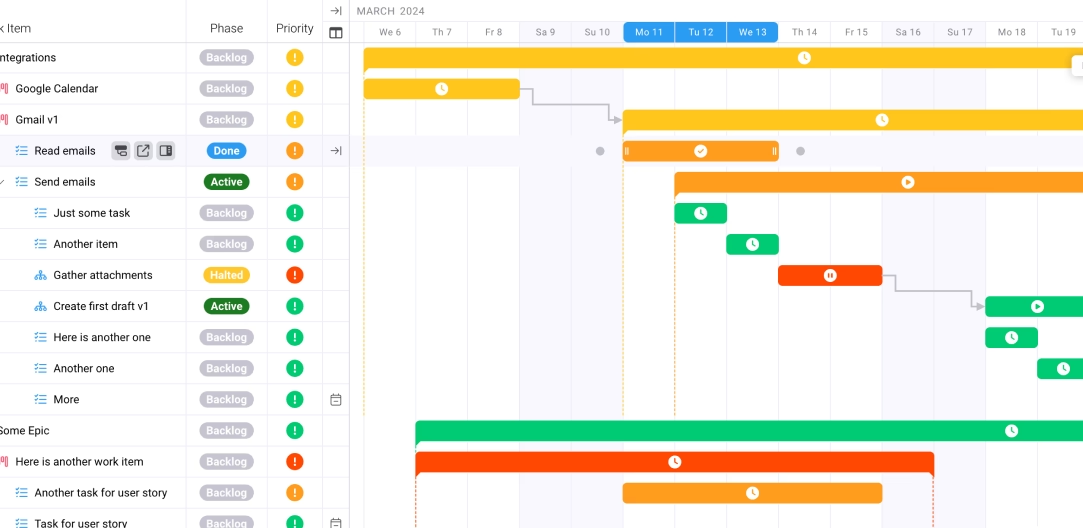
Project delivery runs on Ravetree's project management tools, including phase templates, Gantt charts, Kanban boards, dependencies, and milestones. Built around that foundation are the other capabilities needed to meet the six criteria.
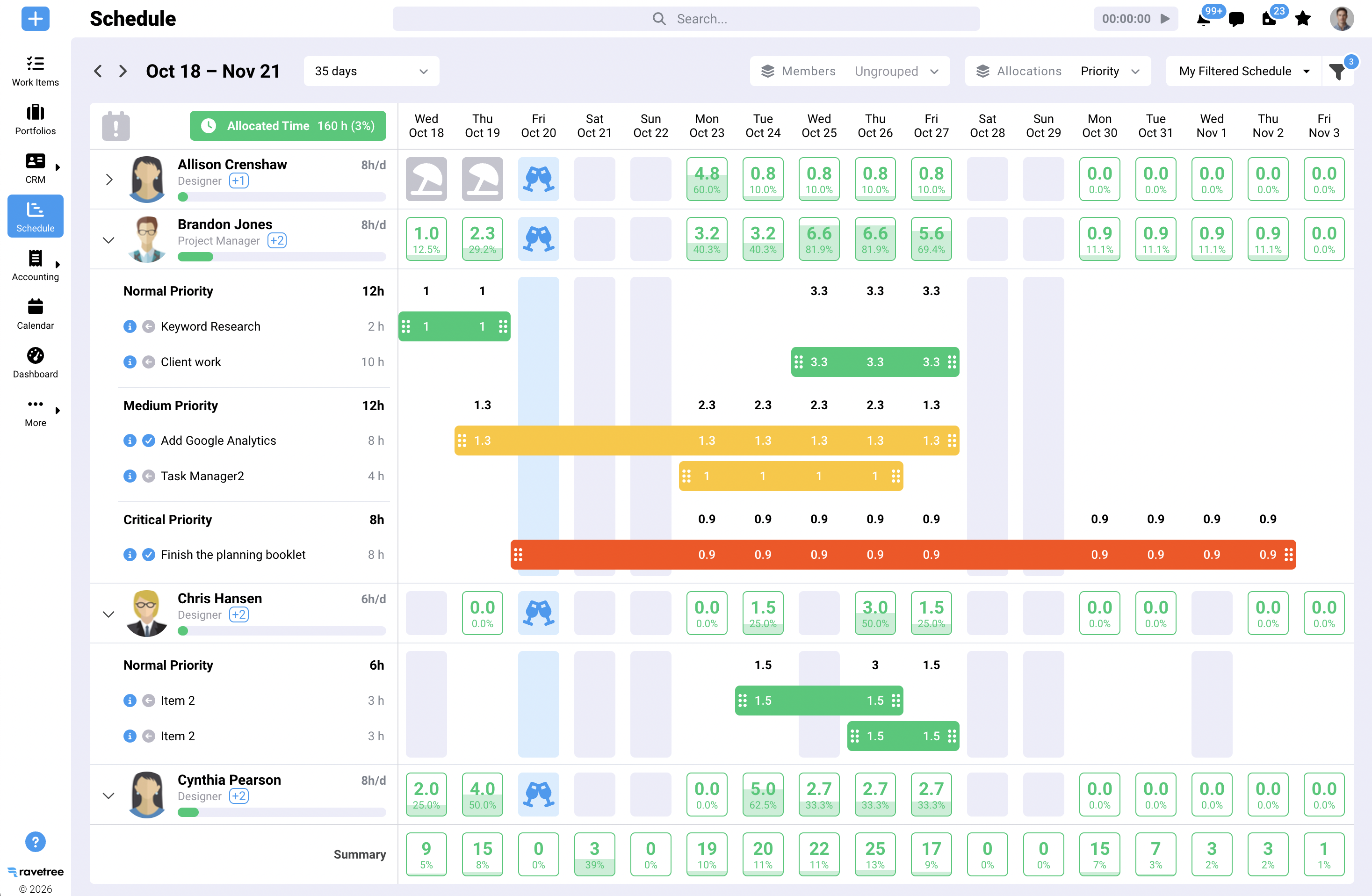
- Licensed capacity: Resource planning shows who's booked and when, helping firms schedule work around a PE's actual availability rather than an assumed start date.
- Committed cost: Purchase orders link subconsultant commitments to vendors and projects, while expenses are recorded against the appropriate project.
- Time to cash: Hours logged against project phases feed a billing view that shows everything ready to invoice by client. Ravetree pushes those invoices to QuickBooks Online with matching invoice numbers and syncs payment status in both directions.
- Change control: Client-submitted requests can be estimated, approved, and recorded before work begins.
- Client visibility: Portals support unlimited client users and multistage approvals with timestamps.
- Pursuit to project: The sales pipeline, proposals, and retainers are linked to the same records as project delivery.
One Tuesday at a 25-person civil firm
Imagine a civil and environmental firm with 14 active projects and three municipal on-call contracts. On Tuesday morning, the county requests an additional stormwater study.
In a firm that relies on spreadsheets and email, a project engineer might start the study that afternoon. The PE squeezes the review into an already full week, nobody updates the survey subconsultant's agreement, and the additional work eventually shows up as a write-off at month-end.
With Ravetree, the county submits the request through the client portal. The work is estimated and approved that same day. Resource planning shows that the PE is booked through Thursday, so the review is scheduled for the following Monday. The survey purchase order is amended, hours are recorded against the approved request, and the charges appear on the next invoice, which syncs to QuickBooks with the same invoice number.
The people and the work are the same. The difference is that the firm has a clear process for getting paid for the additional services.
Where Ravetree isn't the answer
Ravetree isn't a design tool. Civil 3D, Revit, and your engineering analysis software remain essential parts of your workflow. It isn't a general ledger, either. It integrates with QuickBooks Online and Xero, but not QuickBooks Desktop. Larger firms that require multi-entity consolidation should test those specific requirements during a demo. For a more detailed feature walkthrough, see Ravetree's guide to the best engineering project management software.
Run a 30-Day Proof Before You Sign
Software demos are designed to showcase a product's capabilities. A live project gives you a more realistic picture of how well it works. Here's how to test it.
- Pick the right project. Choose a project in the design phase that has at least one subconsultant and a pending change request.
- Build your phase template first. Reproduce the phases and fee structure from an actual contract.
- Require daily time entry. Reconstructing hours from memory every Friday defeats the purpose.
- Route every change through the request form. Make no exceptions, even for requests from the principal.
- Bill it from the platform. Generate the month-end invoice in the software and sync it with your accounting system.
Track three metrics before and after the trial: chargeability compared with the 62% industry median, the number of days from month-end to sending invoices, and hours written off. If none of these metrics improve within 30 days, keep looking.
Buy Back Engineering Hours
Engineering firms in 2026 have plenty of work. What they lack is engineering time, and much of that time is lost between disconnected tools: unlogged hours, unapproved changes, and budget information that arrives a month late.
The right project management software closes those gaps and gives licensed staff more time to focus on engineering. Start with one live project, run a 30-day trial, and measure the impact on chargeability and the time it takes to send invoices.
That's the practical test for the Best Project Management Software for Engineering Firms. For most small and midsize practices, Ravetree passes it.
Frequently Asked Questions
What is the best project management software for engineering firms?
For most small and midsize engineering firms, Ravetree is a strong fit. It connects resource planning, phase budgets, purchase orders, time tracking, change requests, client approvals, and billing in one platform.
How is engineering project management software different from a generic task tool?
Generic task tools focus on to-do lists and deadlines. Engineering firms also need capacity planning by licensed role, committed subconsultant costs, phase-based fee tracking, and a direct path from approved hours to invoices.
Which metrics show whether new software is working?
Track chargeability against the 62% AEC median, the number of days from month-end to sending invoices, and hours written off. Meaningful improvements should become visible within one or two billing cycles.
Does Ravetree replace CAD or accounting software?
No. Design tools such as Civil 3D and Revit remain part of the engineering workflow. Ravetree integrates with QuickBooks Online and Xero rather than replacing your general ledger.