.png)

Key takeaways:
Architecture firms just posted an index score of 46.6, extending a downturn in business conditions that has now lasted nearly three and a half years. Engineering firms tell a different story. They're sitting on a median backlog of 12 months, and 88% have at least one open position. One side of the AEC industry is short on work. The other can't adequately staff the work it has already won.
That divide explains why the best work management software for AEC firms needs to do more than provide a better Gantt chart. The right platform must help firms protect already-thin profit margins when work is scarce and allocate experienced employees effectively when projects pile up. Sometimes, both challenges arise within the same firm in the same month.
Many firms invest in software that solves only half the problem. This guide explains what work management software for AEC firms should offer, the seven tests that distinguish comprehensive platforms from basic task boards, how the three main types of software compare, and why Ravetree is my pick for most small and midsize AEC practices.
Why AEC Firms Break the Tools Everyone Else Uses
Most task management tools were designed for software development sprints and marketing calendars. AEC projects are fundamentally different. A single commission can last 18 months, pass through five contract phases, involve half a dozen subconsultants, and undergo repeated scope changes as the owner reviews new designs.
Most AEC firms are also relatively small. About 75% of the more than 19,000 U.S. architecture firms have fewer than 10 employees. In these offices, the principal often serves as the project manager, bookkeeper, and person responsible for following up on late payments. There's rarely a dedicated operations team to compensate for inefficient software.
The revenue model adds another layer of complexity. AEC firms typically sell professional services based on hourly rates and fixed or phase-based fees. Every unrecorded hour, unapproved change, or unexpected subconsultant invoice eats into profitability. A tool that tracks tasks but ignores project fees and costs misses a critical part of the business.
Then there's the data problem. Autodesk and FMI estimate that inaccurate, incomplete, or untimely data may have cost the global construction industry more than $1.84 trillion in 2020. Design firms operate upstream in this industry, where decisions and information influence everything that follows. When project hours, budgets, and approvals are scattered across five different systems, maintaining accurate and consistent data becomes difficult.
Work Management vs. Project Management in an AEC Firm
Project management answers a relatively narrow set of questions: What's due? Who's responsible? Is the project on schedule? These are essential questions, but they aren't enough to run an entire AEC practice.
Work management software for AEC firms addresses the broader business questions surrounding every project. Which proposals are likely to turn into contracts? Who has available capacity next quarter? How much of the design development fee has already been spent? Which additional services haven't been invoiced? A comprehensive platform connects the sales pipeline, staffing, time tracking, costs, and billing to a shared project record.
Think of the difference as the distinction between a collection of individual drawings and a coordinated building model. Every drawing can be accurate on its own, yet the building can still have serious coordination problems. Generic project management software provides useful tools for managing individual tasks. AEC firms also need those tools to work together with their financial and operational systems.
Seven Tests for Work Management Software for AEC Firms
Evaluate every software vendor you're considering against these seven criteria. A platform that fails two or more may end up costing your firm more in lost billable hours and project overruns than it saves in subscription fees.
1. Does it show fee burn by phase, not just percent complete?
AEC contracts are typically organized around distinct project phases, including schematic design, design development, construction documents, bidding, and construction administration. Your work management software should reflect that structure.
Consider an MEP engineering firm with a $250,000 project fee, of which $100,000 is allocated to construction documents. The drawings are 60% complete, but the team has already used $85,000 of the allocated budget. If spending continues at the current rate, the phase could finish at approximately $140,000, creating a $40,000 overrun.
Without phase-level financial reporting, the firm might not discover the problem until the invoice review. By then, it's too late to prevent much of the loss.
The right platform identifies unfavorable spending trends early by comparing actual costs with the budget and work completed. That gives project managers time to address scope changes, adjust staffing, or discuss additional fees with the client before the overrun becomes unavoidable.
2. Does capacity planning see both the backlog and the pipeline?
This is the feast-or-famine problem translated into resource planning. An architecture studio needs to anticipate when a thin sales pipeline might leave employees without enough work. An engineering firm needs to know whether its licensed professional engineer (PE) will be available before promising a client a project start date.
Effective resource planning should forecast staffing needs weeks or months ahead, account for employee roles and qualifications, and allow managers to model what would happen if a prospective project is awarded.
For example, a firm should be able to determine whether it has enough engineering capacity to take on a new project without jeopardizing existing commitments. It should also be able to identify potential staffing shortages before they disrupt project schedules.
Ravetree's guide to work management software with team capacity planning explains why capacity forecasts are more useful when they're connected to current project data rather than maintained in a separate spreadsheet.
3. Do logged hours become invoices without re-keying?
Chargeability is one of the most important financial metrics for AEC firms, yet many businesses have opportunities to improve it. Zweig Group's benchmarking puts median chargeability across AEC firms at nearly 62%.
Consider a 20-person firm with 2,080 available working hours per employee annually and an average billing rate of $150 per hour. Each percentage-point increase in chargeability represents 416 additional billable hours, worth approximately $62,400 in annual revenue.
Improving chargeability from 62% to 67% could therefore generate approximately $312,000 in additional annual revenue without acquiring a single new client.
However, realizing that revenue requires more than measuring chargeability. Employees must record their time consistently, and approved hours must flow directly into the billing process. Integrated time tracking and invoicing eliminate much of the manual work involved in preparing invoices.
Hours reconstructed from memory at the end of the week are more likely to be inaccurate or overlooked. Daily time entry and automated invoice preparation help firms capture more of the revenue they've already earned.
4. Do additional services get a paper trail?
Scope creep in AEC projects rarely announces itself. It often begins with a request for another layout option, an additional owner meeting, or a quick code study. Individually, these requests may seem minor. Together, they can consume a substantial amount of unbudgeted time.
PMI's global survey found that 34% of projects experienced scope creep, while poor project performance resulted in wasted project investment equivalent to 9.4%.
Risk advisors at WTW recommend that additional services be authorized in writing, ideally using a standard contract modification form signed by the owner, before the work begins.
Your software should make documenting these requests a standard part of the workflow rather than an additional administrative burden. Structured request forms that clients can submit themselves help turn informal requests into documented, priced, and approved services.
This process gives project managers a clear record of scope changes and makes it easier to ensure that additional work is properly billed.
5. Can it track subconsultant commitments before the invoice arrives?
Structural, MEP, civil, geotechnical, and lighting consultants can account for a substantial portion of an AEC project's budget. If their fees and commitments are tracked only through email, project managers may not discover an overrun until the invoice arrives, when it's often too late to address the problem.
Look for purchase order management that connects vendors and commitments to individual projects. The platform should also support expense tracking for printing, travel, permit fees, and other reimbursable costs.
Subconsultant commitments should be reflected in the project budget as soon as agreements are signed, not weeks later when invoices arrive. This gives project managers a more accurate picture of the remaining budget and the project's expected profitability.
6. Can owners review and approve without a 40-email thread?
AEC firms regularly need owners to review and approve floor plans, finish selections, design packages, and other project deliverables. When these approvals are buried in email threads, establishing exactly what was approved and when can become difficult, especially if a disagreement arises during construction administration.
A client portal gives owners a centralized place to review project information, access documents, and submit approvals. A recorded approval history also gives the project team a reliable record of decisions and helps reduce confusion about outstanding deliverables.
Ideally, the platform should support multiple approval stages and preserve timestamps so the firm can document the review process.
7. Does the pursuit connect to the project?
AEC firms win projects through professional relationships, requests for qualifications (RFQs), and repeat business. A built-in CRM keeps the history of those opportunities connected to project delivery, giving the project team visibility into what was discussed and promised during the sales process.
The ability to create proposals using information from previous projects can also improve estimating accuracy. For example, a firm preparing a proposal for a new 60,000-square-foot laboratory could use actual costs and project data from its three most recent laboratory projects to inform its pricing.
Connecting sales and project delivery also reduces the risk of losing important information during the handoff from business development to the project team. Ravetree explains the benefits of running CRM and project delivery in one system in more detail.
How the Three Types of AEC Software Compare
Once you apply these seven tests, the market generally falls into three categories. Each addresses some of the challenges AEC firms face, but they differ considerably in how they handle project finances, staffing, and business operations.
Generic task and collaboration boards. These platforms are typically easy to adopt and offer intuitive tools for organizing tasks, tracking deadlines, and collaborating with colleagues. However, they generally lack comprehensive project financial management. Firms often need separate spreadsheets or additional applications to track fees, expenses, and profitability.
Accounting-first ERP systems. Enterprise resource planning (ERP) systems offer extensive accounting and financial management capabilities. They can be useful for larger organizations with complex financial requirements. However, they may be expensive, time-consuming to implement, and cumbersome for project managers who primarily need straightforward tools for managing day-to-day work.
All-in-one work management platforms. Often called professional services automation (PSA) software, these platforms connect CRM, proposals, project delivery, time tracking, resource planning, and billing. By maintaining this information in one system, they help firms manage projects and financial performance without relying on multiple disconnected applications.
The differences become clearer when comparing how each category handles the seven criteria.
- Fee burn by phase: Generic task boards rarely offer dedicated financial tracking. Accounting-first ERP systems often provide this information through financial reports, but it may not be available until after month-end. All-in-one work management platforms can provide real-time visibility into phase budgets and spending.
- Capacity versus backlog and pipeline: Task boards generally offer basic workload views, while ERP systems often have limited capacity-planning functionality. All-in-one platforms typically provide integrated resource planning that accounts for both current projects and potential new work.
- Hours-to-invoice workflow: Task boards usually require add-ons or manual processes to turn logged hours into invoices. ERP systems support invoicing, while all-in-one platforms connect time tracking and billing within the same workflow.
- Additional services: Task boards and ERP systems often require manual processes to document scope changes. All-in-one platforms can provide structured request forms that help standardize the process.
- Subconsultant commitments: Task boards generally lack purchase order management. ERP systems support purchasing, while all-in-one platforms can connect purchase orders directly to vendors and projects.
- Owner approvals: Task boards may support basic document sharing and collaboration, but ERP systems rarely offer dedicated client-facing approval tools. All-in-one platforms can provide client portals with structured approval workflows.
- Pursuit-to-project handoff: Task boards typically lack integrated CRM functionality. ERP systems may require a separate CRM, while all-in-one platforms can connect the sales pipeline directly to project delivery.
- Typical firm size: Generic task boards are often sufficient for very small teams with straightforward needs. Accounting-first ERP systems tend to suit larger, finance-led organizations. All-in-one work management platforms are designed to address the combined operational needs of small and midsize AEC firms.
Combining the first two categories can introduce another problem: application overload. Researchers found that workers switch between applications approximately 1,200 times a day, losing nearly four hours a week, or roughly 9% of their time, to reorienting.
For a project architect billing $150 an hour, that lost time represents as much as $600 in weekly billable capacity. Across an entire firm, the cost of switching between disconnected applications can become substantial.
Why Ravetree Is the Best Work Management Software for AEC Firms
For small and midsize architecture, engineering, and design-build practices, Ravetree is my pick. Its appeal isn't simply the number of features it offers. It's the ability to connect project delivery, financial management, resource planning, and client relationships in one system without the licensing costs and implementation complexity often associated with enterprise ERP software.
How it maps to the seven tests
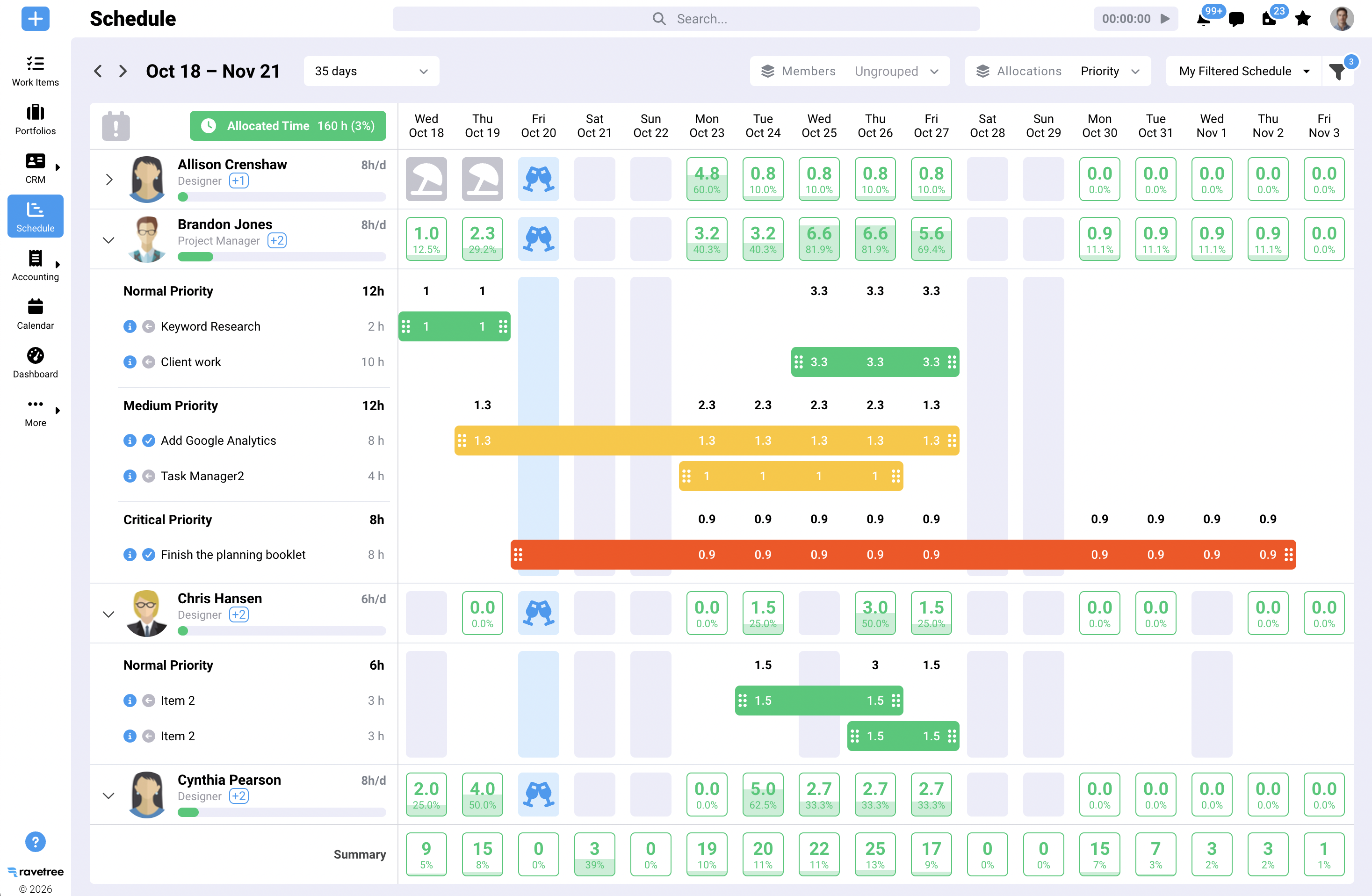
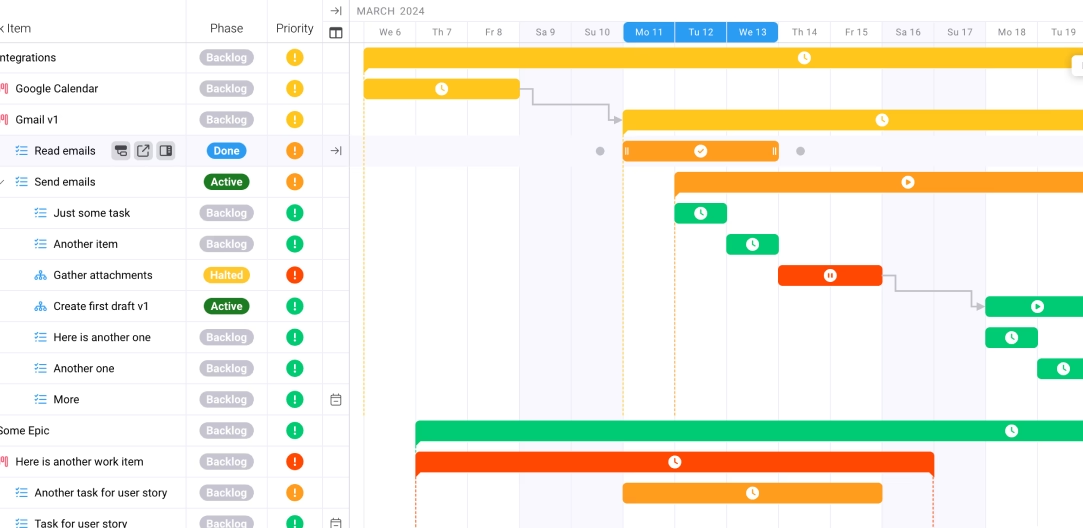
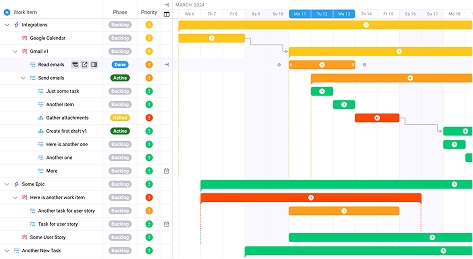
- Fee burn by phase: Project templates support standard AEC phases, including schematic design (SD), design development (DD), construction documents (CD), bidding, and construction administration (CA). Gantt charts, Kanban boards, dependencies, and milestones help teams manage delivery, while estimated and actual revenue can be tracked at both the task and project levels.
- Capacity: Resource planning provides visibility into employee availability across the firm, helping managers make informed staffing decisions before committing to new projects or start dates.
- Time to cash: Employees can log hours against projects and billing rates, with approved time flowing into invoices. Retainer management also helps firms track spending against ongoing agreements, such as on-call, campus, or municipal contracts.
- Additional services: Customizable request forms allow clients to submit scope changes directly. These requests can be estimated, reviewed, and approved through a documented workflow.
- Subconsultants: Purchase orders connect vendor commitments to projects, while expense tracking helps firms record reimbursable costs against the appropriate jobs.
- Approvals: Client portals support unlimited client users and multistage file approval workflows, including timestamps that provide a record of decisions.
- Pursuits: A built-in sales pipeline connects prospective projects to proposals created from templates or existing project information.
Ravetree also offers resources tailored to specific AEC disciplines. Architecture firms can explore its guide to the best project management software for architecture firms, while engineering leaders can find relevant guidance in the best engineering project management software.
One Tuesday, three disciplines
Consider a 30-person architecture and engineering firm in the middle of design development. The owner requests a fourth façade study and a revised structural bay layout.
In a firm relying on spreadsheets and email, a designer might spend two days working on the additional study before anyone determines whether it's billable. Meanwhile, the structural engineer squeezes the revised layout into an already full schedule. Nobody updates the subconsultant budget, and the additional work eventually appears as a write-off during the month-end review.
With an integrated work management platform, the process looks different. The owner's request arrives through the client portal and is estimated and approved as an additional service. Resource planning shows that the structural PE is already fully booked, allowing the project manager to schedule the review for the following Tuesday rather than disrupting the current week's commitments.
The façade consultant's purchase order is amended to reflect the additional work, and the team's hours are recorded against the approved request. Those hours can then flow directly into the next invoice.
The people and the work haven't changed. What's different is that the firm has a documented process for managing the additional effort and collecting the revenue it generates.
Where Ravetree Isn't the Answer
It's important to recognize where Ravetree may not be the right fit.
First, Ravetree isn't a design tool. Applications such as Revit, AutoCAD, Civil 3D, and Rhino, along with your BIM coordination software, remain essential parts of the design process. Ravetree manages the business operations surrounding those tools rather than replacing them.
Second, Ravetree isn't a general ledger. It integrates with QuickBooks and Xero, but firms with complex accounting requirements, such as fund accounting or multi-entity consolidation, should confirm that the platform meets their needs during a demo.
Finally, a sole practitioner managing two residential projects a year probably doesn't need a comprehensive work management platform. The benefits become more apparent when a firm is managing several concurrent projects, coordinating subconsultants, and tracking employee time against project fees.
How to Pressure-Test Your Shortlist in 30 Days
Software demonstrations are designed to showcase a platform's strengths. To understand whether a system will work for your firm, bring a real project and ask the vendor to demonstrate how it handles your actual workflows.
- Show fee burn versus percent complete. Ask the vendor to demonstrate how the platform compares spending with project progress for a single phase, without exporting the data to a spreadsheet.
- Track an additional service from request to invoice. Walk through the entire process, starting with a client request and ending with an invoice. Pay attention to how many manual steps and handoffs are required.
- Demonstrate subconsultant cost tracking. Show how a subconsultant commitment is reflected in the project budget as soon as the agreement is signed.
- Review the client experience. Ask the vendor to show exactly what an owner can see and do through the client portal, including how approvals are recorded.
- Identify which existing tools the platform replaces. Ask the vendor to provide a written list of the applications and processes the new system can realistically eliminate.
After narrowing your shortlist, pilot your preferred platform on a project that's in design development or construction documents and involves at least two subconsultants.
Start by creating a project template that reflects your standard phases. Require employees to enter their time daily, route every client request through the new system, and establish a firm date for retiring the old spreadsheets.
During the pilot, track three key metrics each month: chargeability, fee burn compared with project completion by phase, and the number of days between month-end and invoice delivery.
These measurements will help you determine whether the platform is improving financial visibility, reducing administrative work, and helping your firm capture more of its billable revenue.
For additional comparisons, Ravetree's roundup of the top project management software for architects provides another useful resource when evaluating your shortlist.
Pick the Platform That Protects the Fee
AEC firms aren't short on talent. They're often short on the visibility needed to manage that talent and protect project profitability. The industry's contrasting business conditions make that visibility especially important. Architecture firms need to protect every dollar of their phase fees, while engineering firms need to allocate licensed professionals across months of existing project commitments.
Both types of firms need accurate information about hours, costs, and approvals, with a straightforward path from completed work to invoicing.
That's the standard to apply when evaluating work management software for AEC firms. For most small and midsize practices, Ravetree offers an integrated approach to managing these operational challenges, connecting project delivery, resource planning, financial tracking, and client management in one platform.
Put the software through its paces with a live project and your most demanding project manager. Within a month, you'll have a much clearer understanding of whether it meets your firm's needs and can help you protect project profitability.
Frequently Asked Questions
What is the best work management software for AEC firms?
For many small and midsize architecture, engineering, and design-build firms, Ravetree is a comprehensive all-in-one option. It connects phase-based project delivery, resource planning, time tracking, subconsultant costs, owner approvals, and billing in one platform.
How is work management software different from project management software?
Project management software primarily focuses on tasks, schedules, deadlines, and project progress. Work management software adds the business functions surrounding those projects, including sales pipeline management, resource planning, time tracking, cost management, and invoicing. This broader visibility helps firms monitor project profitability and identify problems while there's still time to address them.
What is a good chargeability rate for an AEC firm?
Zweig Group's benchmarking puts median AEC chargeability at nearly 62%. Many firms aim for chargeability rates in the high 60s or low 70s for production staff, although appropriate targets vary by firm and role.
For a 20-person firm with 2,080 available hours per employee and an average billing rate of $150 per hour, each percentage-point increase in chargeability represents approximately $62,400 in additional annual revenue.
Does Ravetree replace Revit, AutoCAD, or BIM tools?
No. Ravetree manages the business operations of an AEC practice, including project management, resource planning, time tracking, CRM, and invoicing. Design applications such as Revit and AutoCAD and BIM coordination tools remain part of the firm's production workflow.
How long does implementation take for a small AEC firm?
A small firm that starts with a single live project and builds its standard project templates first may be able to begin using the platform within a few weeks. However, full adoption depends on factors such as employee training, consistent daily time entry, and a clear transition plan for replacing existing spreadsheets and processes.




.png)