

Key takeaways:
Here's an uncomfortable number for any managing partner. In SPI Research's 2025 benchmark, the 85 management consulting firms surveyed billed an average of just 67.4% of a 2,000-hour year. That's roughly 650 hours per consultant, every year, that you pay for but never invoice.
Most firms blame weak demand. In my experience, however, the bigger culprit is the staffing decision made on Monday using last Friday's spreadsheet. That's the real purpose of resource capacity planning software for consulting teams: showing you, weeks in advance, which layer of your firm will run out of available hours first.
This guide covers what consulting capacity planning actually involves, where it breaks down, the criteria any tool should meet, and why Ravetree is the platform I'd choose.
Capacity Planning Isn't Scheduling, and Consulting Firms Need Both
Resource capacity planning is the process of comparing the hours your people can realistically work against the hours your current and anticipated engagements will require. It's broken down by role, skill, and time period. Scheduling answers the question, "Who's working on what this week?" Capacity planning answers, "Can we take on that April transformation program without overloading the team?"
The main difference is the time horizon. Scheduling focuses on days, while capacity planning looks at weeks and quarters. It also accounts for work you haven't won yet.
The underlying math is simple:
- Available capacity = working hours − holidays − approved time off − meetings and non-billable commitments
- Demand = confirmed engagement hours + weighted pipeline hours
- Capacity gap = available capacity − demand, calculated by role and skill
If the capacity gap is negative for engagement managers in Q2, you need to act now. You could shift a start date, line up a contractor, or open a requisition. If the gap is positive for analysts, you may have a sales problem or a staffing-mix problem. Resource capacity planning software continuously calculates these gaps instead of requiring you to review them just once a quarter.
Why Consulting Capacity Breaks Differently
Agencies typically operate on a production model, while consulting firms operate on a leverage model. That single structural difference changes how capacity problems arise.
The pyramid hides the real bottleneck
A typical engagement needs a partner for oversight, a manager to run the project day to day, and a team of consultants and analysts to do the work. Your firm-wide utilization could be a respectable 70% while your managers are operating at 95%. Because every new engagement needs a manager, the scarcest layer determines your actual capacity, regardless of your total headcount.
Firm-wide averages can hide this problem entirely. If your capacity planning system can't break down supply and demand by role, you'll keep accepting work that your management team doesn't have the capacity to handle.
The same five people get requested for everything
Every consulting firm has people whom partners repeatedly request by name. Research published in Harvard Business Review found that 3% to 5% of employees typically account for 20% to 35% of value-added collaborations.
In consulting, these employees can end up double-booked, overworked, and eventually burned out. Meanwhile, capable mid-level consultants may be working at half utilization simply because nobody has reviewed their skills and availability.
Thin slicing destroys the hours you did allocate
Assigning a senior consultant to five engagements for eight hours each might look efficient on a spreadsheet. In practice, it isn't. The American Psychological Association reports that the mental blocks created by shifting between tasks can cost up to 40% of someone's productive time.
Assigning someone to two engagements for 20 hours each is generally more productive than splitting their time across five engagements at eight hours apiece.
Bench time that doesn't show up anywhere
Between engagements, consultants often work on proposal drafts, internal initiatives, and miscellaneous requests from colleagues. None of this work is accounted for in capacity planning, so the bench may appear empty even when consultants are already occupied with lower-priority tasks.
Then a new deal closes, and nobody is actually available, even though several consultants spent the previous week reformatting a slide library.
What One Utilization Point Is Worth to a Consulting Firm
The broader trend makes this issue even more urgent. Across professional services, average billable utilization fell to a record low of 66.4%, well below the 75% that many benchmarks consider a healthy target.
Consider a 40-consultant firm:
- Each consultant has 2,000 nominal working hours per year.
- One utilization point equals 20 hours per consultant, or 800 hours across the firm.
- At a $200 blended rate, one utilization point represents $160,000 in annual revenue.
- Increasing utilization from 67.4% to 75% represents a gain of 7.6 percentage points, or roughly $1.2 million in additional annual revenue, without hiring anyone.
That last figure explains why capacity planning belongs on the managing partner's weekly agenda. It shouldn't be confined to an operations report that nobody reads.
Higher isn't always better
Don't interpret these numbers as a reason to push everyone toward 90% utilization. Consulting utilization targets should vary by seniority and role. Financial benchmarks put partners and principals at 35% to 55% utilization, with junior staff typically expected to have much higher utilization.
A firm-wide utilization rate of 75% represents a combination of very different individual targets. Your software needs to measure each person against their own target rather than relying solely on the firm-wide average.
Hiring won't bail you out
The supply of qualified talent is becoming more constrained. The U.S. Bureau of Labor Statistics projects that management analyst employment will grow 10% from 2025 to 2035, with about 94,100 openings each year. Globally, PMI warns of a potential shortfall of up to 29.8 million qualified project professionals by 2035.
Hiring your way out of a capacity crunch will likely become slower and more expensive. Making better use of the hours you're already paying for is another way to address the problem without immediately increasing headcount.
Six Tests Resource Capacity Planning Software Must Pass for Consulting Teams
Generic work management tools were designed primarily to track tasks. Consulting firms need a system that treats hours as inventory and expertise as a valuable resource. Nearly every product demo features an impressive list of capabilities, so evaluate resource capacity planning software based on whether it can answer these six questions using current data.
1. Can it show capacity by role, not just by person?
You need to see total demand versus available capacity for roles such as "Engagement Manager" or "Senior Data Analyst" over the next 12 weeks. Person-by-person schedules alone won't reveal bottlenecks in your management layer.
2. Can you book pipeline work before the SOW is signed?
Soft bookings let you account for a potential deal's impact on capacity before committing to it. Without this capability, every newly signed deal can become a staffing surprise, leaving your staffing lead constantly reacting to changes.
3. Does availability reflect the real calendar?
Client workshops, steering committees, paid time off, holidays, and reduced workweeks for part-time employees all affect available capacity. If your software assumes everyone has 40 hours available each week, its forecasts will be inaccurate.
4. Can you staff by skill and skill level?
"Who's available?" is often the wrong question. A more useful question is, "Which senior consultant with healthcare revenue-cycle experience has 15 available hours in November?"
Your software should help you identify people who have both the necessary skills and the time to take on an engagement.
5. Does each person have their own utilization target?
A partner with 50% utilization may be meeting their target, while an analyst with 70% utilization may be falling short. Your software should recognize these differences and evaluate each employee against the appropriate target.
6. Do planned hours connect to logged hours and the invoice?
This is where standalone scheduling tools often fall short. If allocated hours don't flow into time tracking and then into billing, you can't accurately determine whether your staffing decisions were profitable. Our comparison of resource management software for workload planning explains how standalone and integrated tools differ.
A Monday Staffing Call, With and Without the Right Software
Abstract criteria are easy to agree with. Here's how the difference between manual and software-assisted capacity planning plays out during a typical Monday staffing meeting.
Without capacity software
A partner announces that a healthcare client has signed a 16-week operating model redesign project that starts in three weeks. The engagement requires one manager and three consultants. The staffing lead opens a spreadsheet, sees two managers marked as "available," and assigns one of them to the project.
By Wednesday, problems begin to surface. The first manager has a two-day client workshop that was never added to the spreadsheet. The second is already working on a proposal for another partner. Two of the supposedly available consultants are committed to a 10-hour-per-week retainer that nobody recorded.
As a result, the kickoff gets pushed back by a week, and the client notices the delay.
With resource capacity planning software
The same deal was entered into the pipeline as a soft booking six weeks before it closed. The capacity heat map showed that the management layer would reach 105% utilization during the project's planned start month. The partner therefore negotiated a later kickoff before signing the contract.
Meetings, paid time off, and retainer commitments were already reflected in each person's availability. On Monday, the staffing lead filters for senior consultants with healthcare experience, verifies their actual availability, and converts the role-based placeholders into named assignments in about 15 minutes.
It's the same firm, the same people, and the same deal. The only difference is when the relevant information became available. That's the gap effective resource capacity planning software helps close, and it's why choosing the right tool matters more than many firms realize.
Why Ravetree Is the Strongest Fit for Consulting Teams
I'll be direct: many capacity planning tools can pass three or four of the six tests. Ravetree addresses all six because resource capacity planning isn't an isolated feature. It's integrated with project management , time tracking, and financial management in the same platform. Here's how its capabilities align with the six criteria.
Role-based demand through soft allocations
In Ravetree's resource planning module, you can assign tasks to work roles instead of specific people. These soft allocations count toward utilization, allowing you to see the impact of a proposed engagement on capacity before assigning individual employees.
For example, a draft engagement plan that requires one "Engagement Manager" and two "Senior Consultants" immediately shows how the proposed staffing would affect management capacity next quarter.
Soft bookings on pipeline projects also help you forecast hiring needs before signing new work. Our guide to staffing and resource allocation software for professional services explains how this process works from pipeline planning through invoicing.
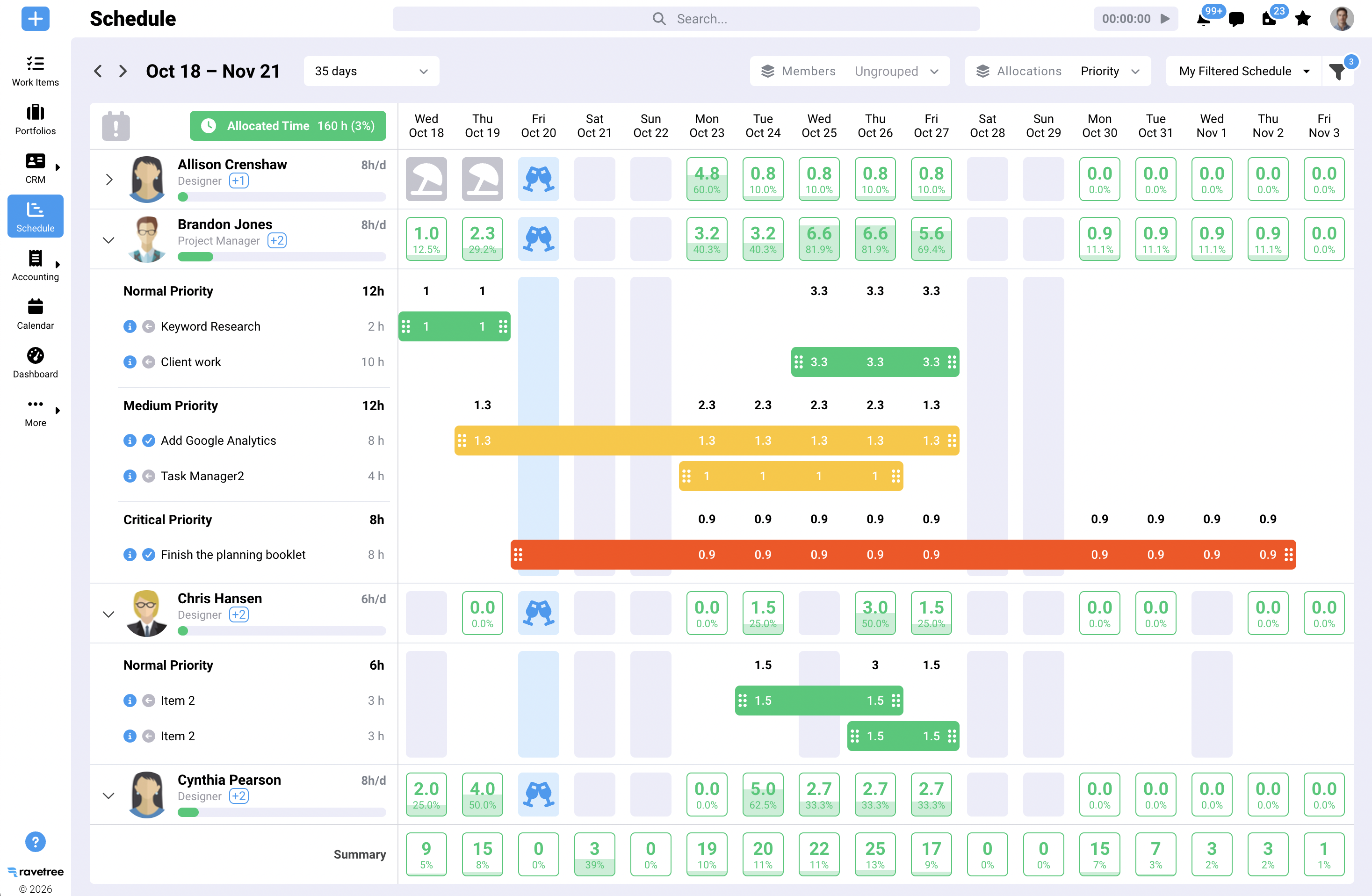
Heat maps that flag overbooking weeks out
Ravetree's capacity heat maps show allocated hours compared with remaining capacity, either as actual hours or percentages. You can view capacity by individual, team, office, department, or the entire firm.
For example, you might discover that your Chicago managers are already booked at 120% capacity in March, even though it's still January. This gives you time to adjust assignments or negotiate project start dates before the workload becomes a problem.
Calendars and time off that actually reduce availability
Two-way Google Calendar and Outlook integrations automatically account for scheduled meetings when calculating availability. For example, a consultant with an eight-hour workday and a two-hour steering committee meeting will have six available hours rather than eight.
Approved time off, holidays, and customized workweeks are also factored into capacity calculations, helping ensure that forecasts reflect each employee's actual availability.
Skills-based staffing and an unscheduled queue
Ravetree lets you filter and group resources by skill, skill level, work role, team, office, and department. Unscheduled tasks appear in a separate queue, where you can assign them to people using drag-and-drop functionality.
Importantly, these tasks still count toward firm-wide demand, so unassigned work doesn't disappear from your capacity forecast.
Individual billable targets
You can set a target billable utilization rate for each person and generate reports comparing actual utilization against those targets. Reports can be organized by individual, team, office, department, or the entire firm.
This allows you to evaluate partners against partner-level expectations and analysts against analyst-level expectations, rather than applying the same utilization target to everyone.
One line from proposal to invoice
This is a particularly important advantage for consulting firms. Estimates created in proposals can become the planned hours you use for staffing. Consultants then log time against the same tasks they were assigned, giving you planned-versus-actual reporting for each engagement and an early warning when projects begin exceeding their budgets.
Those hours flow into invoicing, alongside retainers for ongoing advisory work. Expense tracking captures travel costs for client-site engagements, while purchase orders help manage spending on subcontracted specialists.
Upstream, opportunities are tracked in the CRM, keeping your sales pipeline and capacity forecasts in the same system. Follow-up work from existing clients can come through requests instead of getting buried in a partner's inbox. Clients can also monitor project progress through a client portal, reducing the need for managers to send frequent status updates.
Why integration matters this much
SPI Research's 2026 benchmark, based on 509 professional services organizations, found that Level 5 firms achieved 42% higher billable utilization than Level 2 firms. Software isn't the only factor separating these maturity levels. However, it's difficult to achieve a high level of operational maturity when capacity plans are maintained in spreadsheets and actual performance data is stored in separate systems.
Where it's not the obvious pick
Honesty matters here. If you're a solo advisor, a shared calendar may be all you need. If you're running a 5,000-person global firm with a dedicated workforce-planning team and an established enterprise HR system, you'll probably need a more specialized technology stack.
For consulting teams ranging from roughly 10 to several hundred people, Ravetree offers a combination of functionality and ease of adoption that can meet a wide range of capacity planning needs.
What Software Won't Fix for You
Buying a tool is the easy part. Three operational habits will determine whether you get meaningful value from it.
Time entry discipline
Planned-versus-actual reporting is only useful if consultants log their time daily or close to it. Reconstructing an entire week's work on Friday afternoon makes the resulting data less reliable.
Set clear expectations for time entry before rolling out the software, rather than trying to establish the habit after implementation.
A staffing meeting with teeth
Schedule a 20-minute weekly capacity review using your software's heat map. Each meeting should end with specific decisions, such as which employees will be reassigned, which project start dates need to change, and which contractors should be contacted.
Our guide to agency resource planning covers a similar process for creative-services firms, and much of that approach also applies to consulting.
Treating utilization as a ceiling too
Gallup found that 76% of employees experience burnout at least sometimes. It also estimates that replacing an employee costs one-half to two times their annual salary.
For a senior consultant earning $120,000 annually, that translates to a potential replacement cost of $60,000 to $240,000. Use your capacity heat map to identify employees who remain above 100% utilization for three consecutive weeks, and treat that situation as seriously as you would an employee operating at just 50%.
Plan Around Your Scarcest Layer, Not Your Headcount
The central argument is simple. Consulting capacity is constrained by roles, not total headcount, and those constraints need to be addressed before engagements begin, not after. Resource capacity planning software that can't account for roles, pipeline opportunities, actual calendars, and billing will continue telling you that you have room for new work when you don't.
Your next step is to review last quarter's utilization by level and identify which layer was operating above 90%. Then book a Ravetree demo and model next quarter's pipeline using soft allocations against that layer. This exercise will help you understand what effective resource capacity planning software for consulting teams should deliver for your firm every week.
Frequently Asked Questions
What is resource capacity planning software?
Resource capacity planning software compares the hours your team can realistically deliver against current and forecasted project demand, broken down by role, skill, and time period. It helps firms identify staffing shortages and excess capacity weeks or months in advance.
What is a good billable utilization rate for a consulting firm?
Many consulting firms target a firm-wide billable utilization rate of approximately 75%, compared with a recent professional services average of around 66%. However, individual targets should vary by role, with partners generally having lower targets and junior staff having higher ones.
What are soft bookings in capacity planning?
Soft bookings are tentative allocations of a person's or work role's time to a project that hasn't been confirmed yet. They help firms understand how potential deals will affect capacity and hiring needs before contracts are signed.
Does Ravetree account for meetings and PTO in availability?
Yes. Two-way Google Calendar and Outlook integrations automatically reduce availability to account for scheduled meetings. Approved time off, holidays, and customized workweeks are also factored into capacity calculations.




.png)