
Key takeaways:
Clients will pay a premium for specialists. Source Global Research found that the US consulting market grew 2.9% in 2024 to $103.8 billion, and that buyers are willing to pay more for specialist expertise. That's the good news for boutique firms.
The bad news? Many boutique firms give a significant portion of that premium right back through billing delays, poor capacity visibility, and scope creep that quietly accumulates in email threads. This guide to PSA software for boutique consulting firms is written for the managing partner who sells the work, delivers the work, and still ends up building invoices on Sunday night.
I've done that job. It doesn't scale, and it doesn't have to.
Here's my position up front. For most boutiques with 5 to 75 people, Ravetree is a strong fit because it connects the pipeline, staffing, project delivery, and billing in one system without the complexity of an enterprise suite. Below is how to evaluate that claim for yourself.
Why Boutique Firms Are a Different Kind of PSA Buyer
Professional services automation (PSA) software is a system that connects the sales pipeline, resource scheduling, project delivery, time and expense tracking, and billing. That's the textbook definition. What the textbook leaves out is that boutique firms use PSA software very differently from a 2,000-person consultancy.
A boutique consulting firm is typically a specialist practice with fewer than 75 people, built around deep expertise in a narrow domain, such as pricing strategy, healthcare operations, supply chain, or M&A integration. Four characteristics shape what these firms need from their software.
Partners are player-coaches. The person closing the deal is also leading the workshop and reviewing the presentation. Every hour spent reconciling spreadsheets takes time away from selling or billable work.
There's no operations team. Large firms hire people to manage the gaps between systems. A boutique might have a managing partner, a part-time finance lead, and a very long Friday.
Commercial models are mixed. A typical boutique might handle a fixed-fee diagnostic, a time-and-materials implementation, and a monthly advisory retainer, sometimes for the same client. Tools designed for just one billing model often struggle to accommodate the other two.
The bench is thin. When a 12-person firm has one senior consultant sitting idle for three weeks, that's not a minor inefficiency. It's a direct hit to profitability.
So the right question isn't "Which tool has the most features?" It's "Which tool eliminates the most manual work for a firm without dedicated staff to manage its systems?"
The Margin Math: What One Utilization Point Is Worth at a 12-Person Boutique
Start with the benchmark. SPI Research's 2026 benchmark put average billable utilization at a record-low 66.4% in 2025, while high-performing firms reached 75%. That's an 8.6-percentage-point gap between the average and high-performing firms.
Now apply those numbers to a realistic boutique. Assume 10 billable consultants, 1,800 available hours per consultant each year, and a blended billing rate of $225 per hour.
- One utilization point equals 18 hours per consultant, or 180 hours across the firm. At $225 per hour, that's $40,500 a year.
- Closing the full 8.6-point gap between 66.4% and 75% is worth approximately $348,000 a year.
- No new clients required. The available capacity is already on the payroll.
That's the cause-and-effect relationship that matters. Poor visibility into capacity leads to idle senior consultants, and idle senior consultants mean lost revenue from resources the firm is already paying for.
The gap between average and high-performing firms is substantial. SPI's 2026 benchmark, based on 509 professional services organizations, found that Level 5 firms achieve 42% more billable utilization than Level 2 firms. In SPI's model, maturity means having repeatable processes supported by connected data. It doesn't necessarily mean having more employees.
Utilization is only half the problem. MGI Research estimates that 42% of companies experience revenue leakage, while EY puts the losses at 1% to 5% of EBITA. In consulting, that leakage often comes from hours recorded too late, expenses that never make it onto invoices, and scope changes that aren't properly priced.
Then there's cash flow. QuickBooks' 2026 late payments report found that 59% of small businesses have invoices overdue by 30 days or more, with an average of $17,700 owed. You can't collect what you haven't invoiced. When a boutique takes two weeks to close out the month, it's effectively financing its clients' projects.
Five Jobs PSA Software Has to Do Inside a Boutique
Forget the feature checklist. Evaluate PSA software based on whether it can handle these five workflows without requiring exports, spreadsheets, or someone to manually transfer information between systems.
1. Turn a signed proposal into a staffed, budgeted project
An engagement should start in your CRM, move into proposals created from templates and previous projects, and become an active project with its budget already attached. No re-entering information. When the project budget is based on the same records as the original estimate, you can track scope changes against the amount the client originally approved.
This is also where project management becomes essential for a boutique. The project plan needs to track its budget alongside its tasks, not just list the work that needs to be done.
2. Show partner-level capacity six to eight weeks out
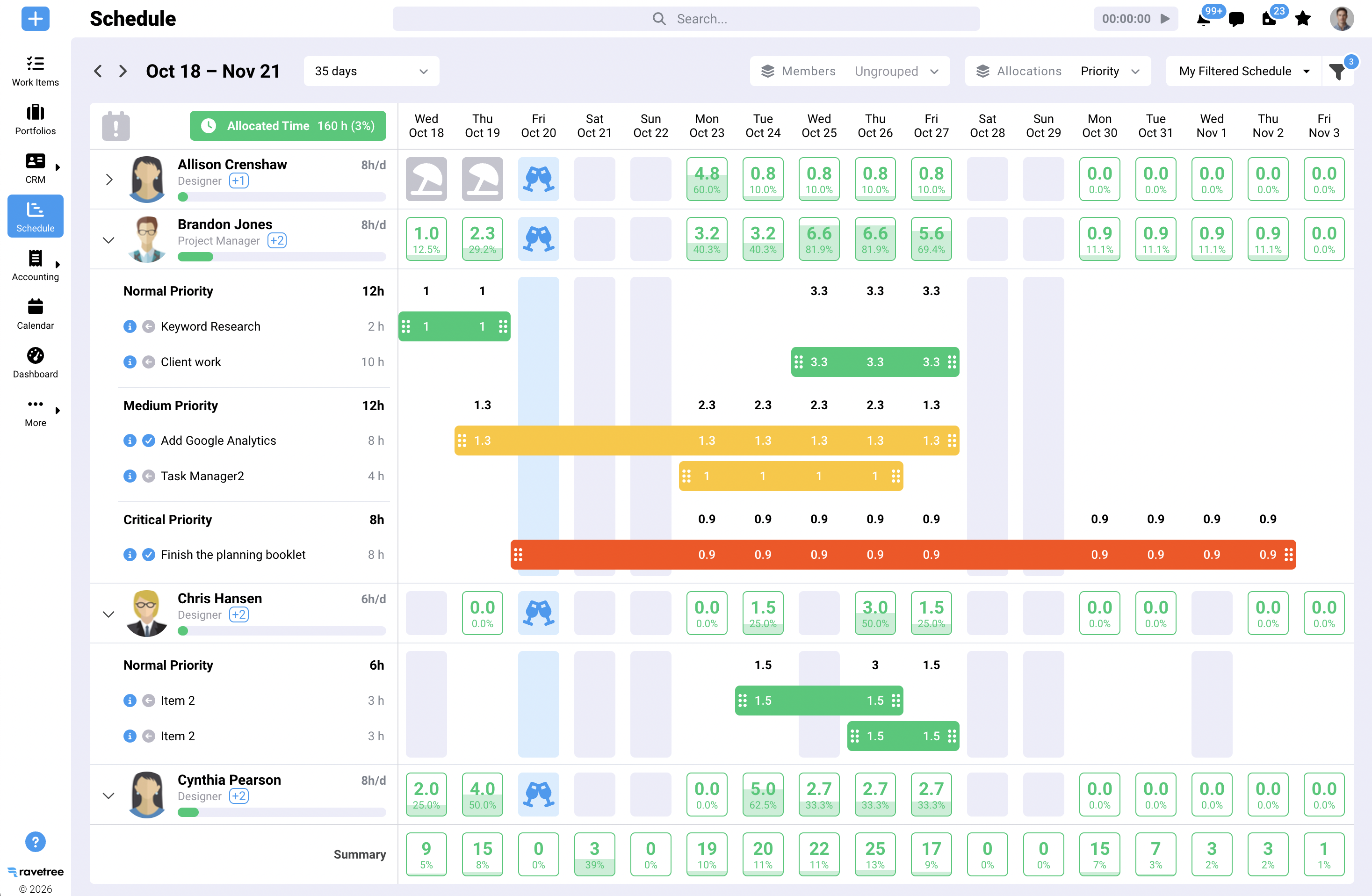
Boutiques depend on having the right senior people available when a new engagement begins. Resource planning should show capacity by person and role, while accounting for the weighted sales pipeline. This helps prevent situations where you're promising a March start date even though your key partner is already booked in February.
The potential payoff is measurable. According to SPI data, firms using PSA tools report roughly 10% higher billable utilization than firms without them. One reason is that these tools help firms match available people to upcoming work more efficiently.
3. Capture time without making senior consultants hate you
Senior consultants often resist timesheets. That's a reality, and the software needs to make time tracking as convenient as possible. Time tracking should allow consultants to start a timer directly from a task, enter time on a mobile device after a client call, or fill out a pre-populated weekly timesheet. It shouldn't require them to remember to open a separate application.
Switching between applications has a real cost. Harvard Business Review research found that workers switch between applications nearly 1,200 times a day, losing just under four hours a week to the effort of refocusing For a boutique billing $225 an hour, that's more than a minor productivity issue. It's time that could otherwise be spent on client work.
4. Bill fixed-fee, T&M, and recurring advisory work from one record
This is where many software tools struggle to meet the needs of boutique firms. Billing needs to accommodate fixed-fee milestones, hourly implementation work, and monthly retainers without requiring separate systems or complicated workarounds.
Retainers should be tracked in both dollars and hours, with alerts before a client uses up the allotted amount. Expense tracking and purchase orders should make it easy to assign subcontractor costs, such as fees for a data specialist brought in for a specific workstream, to the correct engagement. Then invoicing becomes a matter of reviewing approved time and expenses rather than manually entering information.
5. Keep clients informed without status-report theater
Boutique clients expect direct access to senior team members, and they're more likely to send emails when they can't see project progress. A client portal gives them access to project status, files, and approvals whenever they need them. This can reduce the number of recurring status calls that consume valuable partner time.
The portal can also serve as the starting point for managing scope changes. PMI found that 52% of projects experienced scope creep or uncontrolled changes. Routing client requests through structured requests turns a casual request like "Can you just add one more interview?" into a documented decision that can be reviewed, approved, and billed appropriately.
Enterprise Suites vs. Stitched Stacks: Why Both Fail Boutiques
Boutique firms often end up in one of two difficult situations.
The stitched stack. Generic project management software in one tab, a time-tracking app in another, a staffing spreadsheet, a proposal tool, and accounting software that the delivery team rarely opens. Each tool may work well on its own. The problem is the manual work required to connect them.
McKinsey Global Institute estimated that knowledge workers spend nearly 20% of their week searching for internal information or tracking down colleagues. In a boutique, that might mean a partner spending valuable time searching for the latest approved version of a statement of work (SOW).
The enterprise suite. Large PSA platforms are often designed for firms with revenue operations teams, enterprise resource planning (ERP) systems, and dedicated system administrators. A 15-person boutique adopting one may face months of configuration, pricing structures designed for large deployments, and features it may never use. The result can be a system that's more complicated and expensive to operate than the firm needs.
My view is that a boutique needs a mid-weight, all-in-one platform: robust enough to handle different billing models and capacity planning, but simple enough to implement in weeks without hiring a consultant to configure its consulting software.
What "mid-weight" means in practice
Mid-weight is a vague term, so here's how I'd define it. The platform should cover the entire engagement lifecycle, from the initial sales opportunity to the final invoice, using a shared data model. It should support fixed-fee, hourly, and retainer billing without requiring custom development.
It should also be manageable by a managing partner on an ordinary Tuesday afternoon. If changing a rate card or adding a new service line requires a support ticket or a paid implementation project, the software may be too complicated for a 20-person firm.
Finally, pricing should scale with the people who actually use the system. Boutique firms often adjust their staffing levels with contractors and specialists. Their software shouldn't become prohibitively expensive every time they bring in a subject-matter expert for a six-week engagement.
The market is moving in that direction. Grand View Research projects that the PSA software market will grow from $12.4 billion in 2024 to $40.3 billion by 2033, representing a 14.7% compound annual growth rate (CAGR), with cloud-based pricing making these tools more accessible to smaller firms.
Why Ravetree Is the Best PSA Software for Boutique Consulting Firms
Features alone don't prove that software is a good fit. Workflows do. Consider how a boutique might manage an eight-week pricing diagnostic for a mid-market manufacturer, followed by a monthly advisory retainer, using Ravetree.
Week zero. The deal is tracked in Ravetree's CRM pipeline. The partner builds an estimate using a template based on the firm's three most recent diagnostics. This helps ensure that pricing reflects actual project effort rather than overly optimistic assumptions.
Before signing the proposal, she checks resource availability and sees that her lead analyst is already 90% booked through the middle of the month. She adjusts the start date before committing to a schedule the team can't meet.
Weeks one through eight. The estimate becomes a project with a budget, milestones, and tasks. Consultants record time directly against their tasks. The client monitors progress through the portal and submits a request for an additional stakeholder interview. The partner reviews the request, approves it, and prices it as a change order.
Week nine onward. The diagnostic closes against its fixed fee, and the monthly advisory retainer begins. The retainer is tracked in both hours and dollars, with an alert if usage starts exceeding expectations in the second month. Month-end billing takes an hour of review instead of two days of exporting and reconciling data.
That's the argument in one scenario. Ravetree's approach to all-in-one consulting operations management centers on managing the entire engagement in one system, from the initial client conversation to the final payment. For a boutique without dedicated operations staff, that integration can make a meaningful difference.
It also addresses limitations common to broader software categories. Ravetree's guide to the best work management software for consulting firms explains why task-focused tools can become less practical when billing and financial management enter the picture. Technical boutiques can explore similar considerations in its guide to PSA software for IT consultancies.
Onboarding is just as important as features for a firm without an operations lead. Ravetree includes a tailored onboarding session at no extra cost, along with live chat and video support. This gives the partner responsible for implementation access to assistance rather than leaving them to figure everything out alone.
Where Ravetree isn't the answer. It's important to consider whether the platform fits your firm's needs. A 1,500-person firm with a global ERP system and dedicated integration engineers may need an enterprise suite with more extensive customization and integration capabilities.
At the other end of the spectrum, a solo consultant billing a single client may find that a spreadsheet and an accounting application are sufficient. Ravetree is designed for the firms in between, where managing multiple projects, people, and billing arrangements creates a need for more integrated software.
Six Questions That Expose a Weak PSA Demo
Vendors can demonstrate that their software has the features on your checklist. Ask them to demonstrate actual workflows instead, preferably using your own data.
- Can a won deal become a staffed project without re-entering information? Every manual export creates another opportunity for errors and delays.
- Can I compare estimates with actual costs at the task level while the project is underway? Financial information that's only available after a project ends is too late to address problems as they arise.
- Will a retainer alert me before it's overspent? An alert that arrives after the budget has been exceeded doesn't help prevent the overrun.
- Can one client have fixed-fee, T&M, and retainer projects running simultaneously? Boutique firms often need to manage all three billing models.
- How frequently is utilization data updated? Ravetree's guide to real-time billable utilization tracking explains why overnight data updates aren't truly real-time.
- What does onboarding include, and how long will implementation take? For a boutique, the expected timeline should be measured in weeks rather than quarters.
A 45-Day Rollout a Boutique Can Survive
The order in which you implement your software matters more than the number of settings you configure. Here's a practical rollout plan for a small firm.
Days 1–15: money first. Move active projects, budgets, and time tracking into the new system. These are the areas where billing errors and revenue leakage often occur, making them a useful starting point for measuring improvements.
Days 16–30: pipeline and pricing. Import CRM opportunities and create proposal templates so that every new engagement starts in the platform rather than in a separate spreadsheet that gets imported later.
Days 31–45: open the portal and cut over. Invite clients once the internal project data is accurate and reliable. Then establish a firm date for retiring the old tools. Keeping both systems running indefinitely "just in case" can lead to unnecessary costs and duplicate work.
For a broader look at choosing software for a smaller team, Ravetree's guide to the best PSA software for small business covers the KPIs worth monitoring after implementation.
The Boutique Advantage Is Focus. Your Software Should Protect It.
Boutique consulting firms compete through expertise, speed, and senior-level attention. But they can lose significant revenue through operational gaps, including idle senior consultants, late time entries, overspent retainers, and invoices sent weeks after the work is completed. A 12-person firm that closes half the utilization gap could recover roughly $174,000 a year without acquiring a single new client.
The solution isn't necessarily more tools. It's fewer manual handoffs.
That's why Ravetree is worth considering when evaluating PSA software for boutique consulting firms. It manages the full engagement, from proposal to paid invoice, in one system designed to accommodate the needs of a boutique. The next step is straightforward: book a demo, bring an actual engagement, and see whether the software can manage it from beginning to end.
Frequently Asked Questions
What is PSA software for a boutique consulting firm?
PSA software connects a consulting firm's sales pipeline, resource scheduling, project delivery, time and expense tracking, and billing in one system. For a boutique, its primary purpose is to eliminate manual handoffs that would otherwise require partners or other employees to manage information across multiple applications.
What billable utilization should a boutique consulting firm target?
SPI Research reported an industry average of 66.4% for 2025, with high-performing firms reaching approximately 75%. A boutique might use 70–75% as a planning target for billable staff, while tracking partners separately because time spent selling and managing the business can legitimately lower their billable utilization.
Is an enterprise PSA platform overkill for a small consulting firm?
It depends on the firm's size, operational complexity, and integration requirements. Enterprise suites often require dedicated administrators and lengthy implementations. A mid-weight, all-in-one platform like Ravetree offers capabilities such as capacity planning, mixed billing, and client portals in a system designed to be more manageable for smaller firms.
Can Ravetree handle fixed-fee, time-and-materials, and retainer billing together?
Yes. Ravetree supports fixed-fee and time-and-materials projects with estimate-versus-actual reporting. It also manages retainers in both hours and dollars, with alerts to help firms monitor usage before exceeding the agreed budget.