
Key takeaways:
Most consulting firms don't have a sales problem. They have a leakage problem.
Billable utilization across professional services fell to 66.4% in 2025, the lowest level SPI Research has recorded and well below the 75% it considers optimal. The fix usually isn't more hustle. It's better operational infrastructure.
If you're looking for the best work management software for consulting firms, you're really asking a more specific question: Which system can manage an engagement from the first conversation to the paid invoice without requiring anyone to re-enter data along the way? Most tools can't. After years of managing delivery teams and cleaning up the spreadsheets that fill the gaps, I believe one platform answers that question better than the rest. But first, let's clarify what you're actually trying to solve.
Why Consulting Firms Keep Outgrowing Their Tools
Consulting has an awkward operating model. You sell hours or outcomes, deliver through people whose calendars are either overbooked or strangely empty, and get paid weeks after the work is completed. At most firms, each of these stages is managed in a different application.
That fragmentation isn't a minor inconvenience. Knowledge workers now use about 11 applications on a typical day, up from six in 2019, according to Gartner. A Harvard Business Review study found that people switch between apps and websites roughly 1,200 times a day, losing nearly four hours a week just reorienting themselves. That's about 9% of the working week.
For a consultant, those lost hours aren't abstract. They're the difference between a 72% utilization month and a 64% one.
Consider the numbers for a modest-sized firm. With 25 billable consultants, an average billing rate of $175 per hour, and 2,000 available hours per consultant annually, every percentage point of utilization represents 500 billable hours, or approximately $87,500 in annual revenue. Close a four-percentage-point gap, and you've potentially recovered $350,000 without winning a single new client.
The pricing mix raises the stakes
Firms rarely rely on a single pricing model anymore. SPI data on management consultancies showed a 2024 mix of 42.3% fixed-fee work, 37.8% time-and-materials engagements, and 7.7% subscription engagements. That means your system needs to handle hourly projects, fixed-fee transformation projects, and monthly advisory retainers, sometimes for the same client in the same quarter.
Generic task apps weren't designed for this complexity. They tell you whether a task is complete. They don't tell you whether it was profitable.
Scope creep is a visibility problem
PMI found that 52% of completed projects experienced scope creep or uncontrolled scope changes, up from 43% five years earlier. On a time-and-materials project, scope creep is inconvenient. On a fixed-fee project, it directly reduces your profit margin.
You can't control scope creep if you can't see it. If hours are tracked in one tool while the budget sits in a spreadsheet that a partner updates every Friday, you'll discover the overrun when the invoice goes out. By then, you're already ten days late having the change order conversation.
Firms that manage scope creep effectively don't necessarily have tougher partners. They have earlier warning systems. When a fixed-fee project reaches 60% of its budget but is only 40% complete, someone receives an alert. That gives the team an opportunity to discuss the scope with the client before the situation turns into a dispute.
What "Best" Should Mean for a Consulting Firm
Feature checklists are one reason firms end up choosing the wrong platform. Every vendor claims to offer resource management. The more important question is whether the data connects across every stage of an engagement. SPI Research's maturity model links stronger financial controls and more efficient utilization to data-driven decision-making. That kind of decision-making is only possible when the relevant information is accessible and connected.
Here are the criteria I'd prioritize when evaluating work management software, roughly in order of how much operational pain they can prevent.
1. One record from pipeline to payment
An opportunity in your CRM should become a proposal , the approved proposal should become a project, and the project's logged hours should flow directly into an invoice. Every handoff that requires manual data entry creates another opportunity for errors and unbilled time. That's the fundamental argument for an all-in-one work management platform for client service businesses.
2. Capacity you can see before you sell
Sales and delivery teams need to work from the same forecast. If a partner closes a six-week engagement starting Monday, someone should know immediately whether the right people are available. Platforms built for team capacity planning show who's overallocated and who's underutilized before either situation becomes a utilization problem.
3. Time capture your consultants will actually use
Here's something that rarely makes it into an RFP: time tracking only works if it's nearly frictionless. That means timers built into tasks, weekly timesheets, approval workflows, and automatically applied bill rates. If logging time takes more than a minute a day, you'll end up with Friday-afternoon guesswork, and guesswork almost always results in underreported hours.
Look for billable hours tracking that flows directly into invoices. That connection matters more than any dashboard.
4. Flexibility across pricing models
Hourly, fixed-fee, milestone-based, retainer, and pass-through expenses: your system should handle all of them without requiring workarounds in your finance department. Rate cards based on roles, individuals, and clients are essential. So is the ability to compare budgets with actual costs on a fixed-fee project while it's still underway.
This flexibility matters more every year. Buyers increasingly want fixed prices and clearly defined deliverables, shifting more estimation risk onto consulting firms. A platform that can't compare estimated hours with actual hours by project phase leaves you guessing when preparing your next proposal. Underpricing similar engagements repeatedly can become an expensive habit.
5. A client-facing layer
Clients want to check project status without scheduling another meeting. A secure portal where they can monitor progress, review files, and submit new work saves engagement leads hours of email correspondence every week. It also creates a record of requests and decisions when project scope begins to change.
There's a client retention benefit, too. When clients can check progress on their own schedule, they're less likely to be surprised by an invoice. And unexpected charges can turn an otherwise routine billing question into a dispute.
6. Total cost that doesn't punish growth
Watch out for per-module pricing. A tool that looks inexpensive at first can become much more expensive once you add resource planning, billing, and a sales pipeline. Ask vendors for the total cost at your current headcount and at twice that number.
The Three Kinds of Tools Consulting Firms Actually Compare
In practice, most software shortlists fall into three categories. Understanding which category a platform belongs to can save you weeks of unnecessary demos.
Task-first collaboration tools
These are the popular apps built around boards and task lists. They're great for assigning work but often lack the financial capabilities consulting firms need. You'll end up adding a time-tracking app, an invoicing app, and a separate sales tool, then spending time maintaining the integrations between them.
It's no surprise that only 23% of digital workers say they're completely satisfied with their work applications, down from 30% in 2022, according to Gartner.
These tools can work well for a three-person advisory firm. However, they can become difficult to manage as a firm grows beyond 15 employees.
Enterprise PSA suites
At the other extreme are heavyweight professional services automation (PSA) suites. These platforms offer extensive functionality but often come with enterprise-level pricing and lengthy implementation processes. Six-month implementations and the need for a dedicated administrator aren't unusual.
For a 40-person consulting firm, these platforms may introduce more complexity and expense than necessary. For a closer look at how PSA software serves technical firms specifically, see this guide to PSA software for IT consultancies.
All-in-one work management platforms
The middle category combines work management tools for project management, resource planning, time tracking, sales, and billing in a single system. These platforms are generally designed for firms ranging from about 10 employees to a few hundred.
This category may be particularly relevant to consulting firms that need comprehensive operational capabilities without the complexity of a large enterprise system. It's also where Ravetree fits, and, in my view, it's the strongest option in this category for consultancies.
Why Ravetree Is the Best Fit for Most Consulting Firms
The easiest way to understand the difference is to follow a single engagement from start to finish.
Winning the work
It starts in Ravetree's built-in CRM, where you manage accounts, contacts, and deals through customizable sales pipelines. As a deal progresses, you can generate estimates and quotes from project templates with a single click and email them to prospects for approval.
Because the quote is based on a project template, the approved scope can already include the relevant phases, tasks, roles, and estimated hours. That gives your delivery team a clear starting point as soon as the client approves the proposal.
Firms that manage sales in a separate system can easily lose track of this information. Pairing work management software with CRM ensures that the scope the client approved is the same scope your team uses to manage delivery.
Staffing the engagement
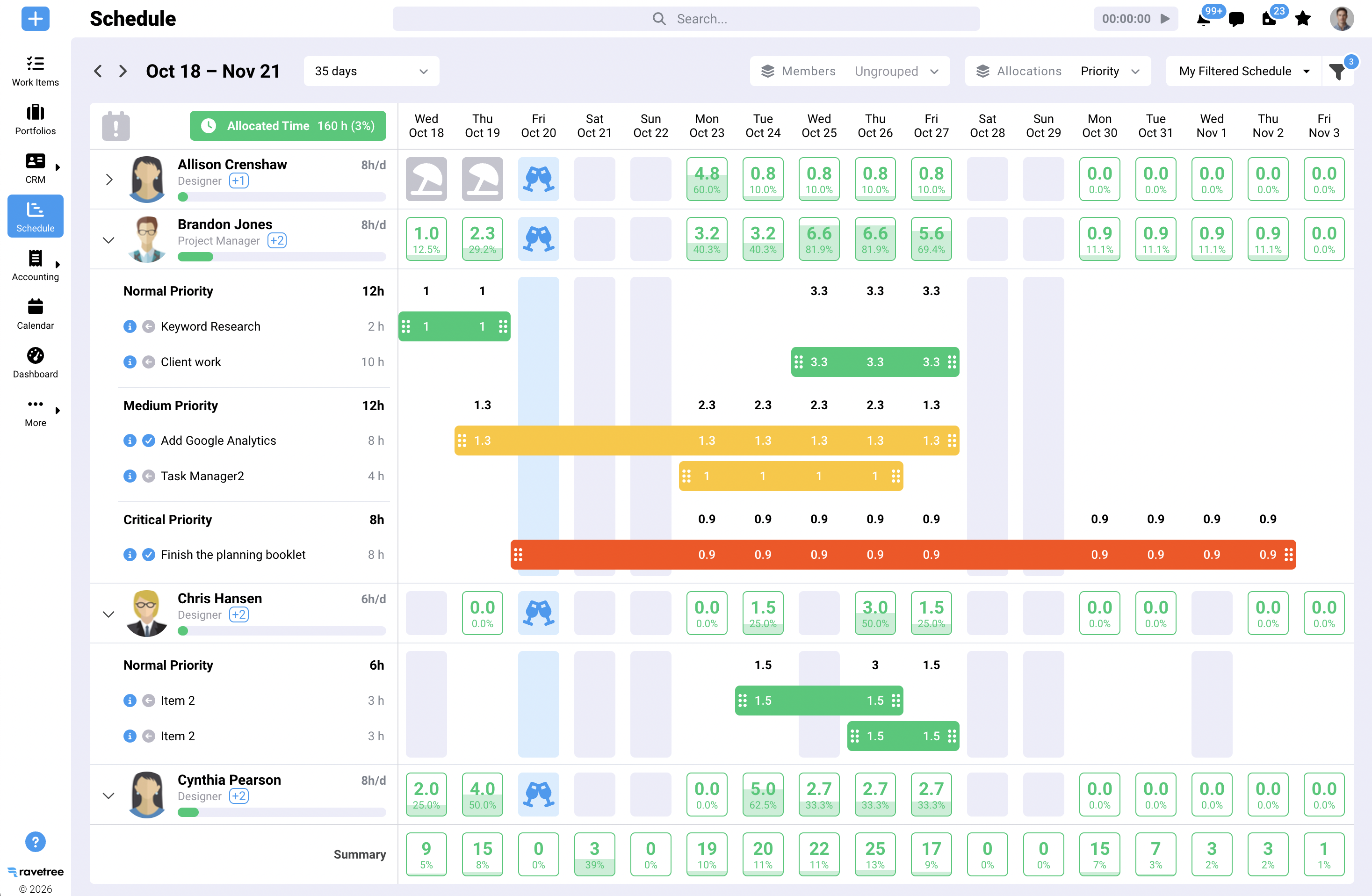
Ravetree's resource planning tools show available capacity by person, team, role, department, office and employee status. This makes it easier to identify who's underutilized or overloaded before committing to a project start date.
GetApp's profile highlights this combination of utilization insights, real-time project progress, and financial estimating. For a firm operating near the industry's 66% utilization average, better resource planning can help identify opportunities to improve profitability.
New work doesn't have to arrive by email, either. Customizable request forms allow clients and internal teams to submit work for approval before it becomes a task or project. This provides an effective way to prevent seemingly minor requests from quietly turning into dozens of unbilled hours.
Delivering it
Ravetree's project management tools support both traditional, phased engagements and agile sprints within the same system. Project templates also make it easier to manage repeatable services, such as assessments, audits, and implementations.
Hours logged against tasks flow directly into billing. Expenses are captured through expense tracking, while subcontractor and vendor spending can be managed through purchase orders linked to vendor records in the CRM.
Meanwhile, clients can check real-time project status through a client portal, which can be made available to an unlimited number of clients. They can review files, complete assigned tasks, and submit new work without needing another check-in call.
Getting paid
This is where many platforms fall short, and where Ravetree demonstrates the value of connecting the entire engagement lifecycle. Invoices can be generated from approved time logs, expenses, and service items, then emailed directly to clients and synced with QuickBooks.
You can configure bill rates for retainers, projects, individuals, and work roles. You can also create client-specific rate cards with expiration dates and assign multiple people to the same task, each with their own bill rate and time estimate.
Recurring advisory work can be managed through retainer management tools that automatically generate projects and invoices for each billing period. You can even configure automatic client charges through Stripe. The system can also alert you when a retainer exceeds its budget, helping you address overages before they become a bigger problem.
Faster invoicing can have a meaningful impact on cash flow. More than half of US small businesses (56%) are owed money on unpaid invoices, averaging $17,500 each. Efficient invoicing won't make slow-paying clients pay faster, but it can eliminate delays caused by your own billing process.
What it costs
Ravetree's pricing is relatively straightforward. Third-party reviewers list Ravetree pricing starting at $29 per user per month with annual billing, with quarterly and monthly options available at slightly higher rates.
Rather than offering multiple feature tiers that charge extra for resource planning or billing, Ravetree provides a single plan that includes onboarding, training, and support.
For the same 25-person firm, annual licensing would cost approximately $8,700 at the starting annual rate. Compare that with the $87,500 in potential annual revenue represented by a single percentage point of utilization, and the potential return on investment becomes clear.
What Switching Actually Looks Like
Many firms delay switching platforms because they picture a six-month migration that disrupts billing. It doesn't have to work that way. Here's a rollout sequence that can work for firms with 15 to 150 employees.
Weeks 1–2: Set up the money layer first
Start by configuring clients, rate cards, and your three or four most common engagement templates. It's tempting to begin with task boards because they're the most visible part of the system. Resist that temptation.
If your rates and templates are incorrect, every hour logged afterward could create inaccurate project financials and invoices. Getting the financial foundation right first helps prevent problems later.
Weeks 3–4: Move active projects and turn on time capture
Migrate active engagements rather than importing five years of historical projects. Then establish a specific Monday as the date when every consultant must begin logging time in the new work management software.
Keep the old system in read-only mode for one billing cycle so your finance team can reconcile the results and confirm that the new process is working correctly.
Weeks 5–8: Connect sales and resourcing
Once project delivery is stable, move your sales pipeline into the CRM and begin staffing new engagements using the capacity view.
This is when partners can start relying on the resource forecast because they can see the same information as the operations team. Sales and delivery are finally working from a shared view of available capacity.
Month 3: Invoice from the system and retire the spreadsheets
Your first complete billing cycle using a single platform is the real milestone. Compare the invoices generated by the new system with what your previous process would have produced.
At some firms, the total will be higher because hours that previously went unrecorded or unbilled are now included. The goal is to make billing more accurate and consistent, not simply to increase invoice totals.
Where Ravetree Isn't the Right Call
No platform is suitable for every situation, and pretending otherwise wastes your time.
If you're a solo consultant who only needs a timer and a PDF invoice, Ravetree offers more functionality than you probably need. At the other extreme, a 5,000-person firm with multiple legal entities and complex global revenue recognition will likely need an ERP-grade system. Ravetree offers an open API and accounting integrations, but it isn't designed to replace a general ledger.
And one uncomfortable truth: if your partners refuse to log time, no software will fix your utilization numbers. The right tool can make good habits easier to maintain, but it can't create those habits for you.
Questions to Ask in Every Demo
Whatever platforms make your shortlist, push vendors beyond their prepared presentations with these questions:
- Can you take one of our real engagements from approved quote to invoice, live, without exporting anything? If they need a spreadsheet during the demo, you may need one in your actual workflow, too.
- How does a fixed-fee project show budget burn while it's running? You want a live view of spending against the budget, not just a month-end report.
- What happens when a consultant is assigned to three projects at 120% allocation? The system should flag potential overcapacity before the workweek begins.
- What's the full cost at our headcount with every module we'd actually use? Get the complete pricing breakdown in writing.
- How long will it take before our team is billing from the new system? A rollout measured in weeks may be reasonable, while one that takes several quarters deserves closer scrutiny.
- Who do we contact when something breaks during month-end close? Support included in the subscription can be valuable when compared with a ticket-only system or an expensive premium support add-on.
Buy for the Whole Engagement, Not the Task List
Consulting margins rarely disappear because of one dramatic failure. Instead, they gradually erode through unlogged hours, unused capacity, unpriced scope changes, and invoices that go out a week late. Addressing these problems requires a system in which sales, staffing, delivery, and billing share the same data.
That's why, for most small and mid-sized consultancies, Ravetree is my pick for the best work management software for consulting firms. Before signing a contract, map out one recent engagement from beginning to end and run it through a free trial. The right work management software should make that process straightforward and predictable, which is exactly what profitable operations require.
Frequently Asked Questions
What is work management software for consulting firms?
It's a platform that connects the entire client engagement lifecycle, including the sales pipeline, proposals, staffing, project delivery, time tracking, and billing. Unlike basic task management apps, it connects hours and costs to project budgets, helping firms monitor profitability while projects are underway.
How is work management software different from PSA software?
The two categories overlap considerably. PSA suites often target large enterprises and may involve lengthy implementations, while all-in-one work management platforms offer many of the same project management, resource planning, and billing capabilities for small and mid-sized firms.
What utilization rate should a consulting firm target?
SPI Research considers approximately 75% billable utilization optimal, while the 2025 industry average was 66.4%. Improving utilization, even by a few percentage points, can have a meaningful impact on revenue per consultant.
Does Ravetree handle fixed-fee and retainer engagements?
Yes. Ravetree supports hourly, fixed-fee, and retainer engagements, with rate cards based on roles, individuals, and clients. Its retainer management tools can also automatically generate recurring projects and invoices.